

Platinum and palladium, the two metals that do more than anything else to fill South Africa's export invoices, are down roughly 15% each so far in 2026 and about a third from the peaks they set in the last week of January. Over the same eight months USD/ZAR fell from 16.514 to 15.9672 on the European Central Bank's reference fixings, meaning the rand strengthened while its flagship export collapsed. In the 768 trading sessions before 4 September 2026 the rand had been stronger than this on thirteen of them. Both statements are true and only one of them fits the story everyone tells about this currency. Either the rand is not the platinum-group-metals proxy it is universally described as, or something else has been paying for eight months of appreciation while the metals bled. That is the question this forecast has to answer before it can put a number on anything.
The measurement resolves it, and the answer is arithmetic rather than narrative. Across the 249 sessions from 4 September 2025 to 4 September 2026, the daily log-return correlation between USD/ZAR and an equal-weight basket of the abrdn Physical Platinum Shares ETF and its palladium sibling was -0.313. Strip out the generic emerging-market dollar factor by regressing USD/ZAR on USD/MXN (fitted beta 1.201) and correlating the residual with the metals, and a rand-specific signal survives at -0.181 with a t-statistic of -2.89. So the PGM channel is real. It is also tiny: the fitted slope says a 10% move in the metals basket has historically shifted USD/ZAR by about 0.73% the other way. Run the collapse through it. A 33% drawdown in the basket since 23 January is worth roughly 2.4% of upward pressure on USD/ZAR. The pair instead fell 3.3%. Something structural was worth around 6% of rand, and identifying it is the whole trade.
Key facts
- USD/ZAR spot 15.9672, ECB reference rate for 4 September 2026 — Frankfurter API, retrieved 5 September 2026. The 2026 range runs 15.6738 (29 January) to 17.1906 (27 March).
- South Africa has gone 476 consecutive days without load-shedding since 16 May 2025, with an energy availability factor of 67.79%, the highest since 2020, and diesel spend down R4.84bn or 81.64% year on year — Eskom media statement, 4 September 2026.
- The current account ran a surplus of 2.4% of GDP in Q1 2026 (R190.7bn, seasonally adjusted annualised), the largest since Q3 2021, up from 0.6% in Q4 2025 — SARB, released 11 June 2026.
- Repo rate 7.00%, raised 25bp on 28 May 2026 and held on 23 July on a 4–2 vote with two members wanting more; the target is now 3% with a one percentage point band — SARB MPC statement, July 2026.
- Headline CPI was 4.3% in July, down from 5.0% in June, with core at 4.2% — Stats SA P0141, released 19 August 2026. Inflation has been above the 4% ceiling since April.
- The Supreme Court held on 20 February 2026 that IEEPA does not authorise the President to impose tariffs, voiding the 30% reciprocal tariff that dominated South African trade coverage through 2025 — Learning Resources, Inc. v. Trump, No. 24–1287.
- US non-farm payrolls rose 162,000 in August against a 53,000 consensus, with June and July revised up a combined 55,000 — Bureau of Labor Statistics, 4 September 2026. Three FOMC members had already dissented in favour of a hike on 29 July.
The metals beta is real and it is small
South Africa's export basket is metals and the transmission mechanism is not controversial. Dollar-priced ore against a rand cost base widens mining margins, lifts export receipts and improves the external balance. Everybody agrees on the sign. Almost nobody separates that channel from the much larger one underneath it, which is global appetite for emerging-market risk generally, and the separation is where the money is. If the rand is only a high-beta version of the emerging-market dollar cycle then watching platinum is wasted screen space. If a metals-specific component survives the controls, then a PGM shock carries information no dollar index will give you.
It survives. Over the year to 4 September the metals basket correlated -0.313 with USD/ZAR, against -0.256 with USD/MXN and -0.173 with USD/BRL. The rand is the most metals-sensitive of the three, exactly as its export composition predicts. Sampled monthly rather than daily the relationship tightens to -0.635 across thirteen observations, which is what a slow trade-flow channel looks like rather than a fast speculative one. Narrow the daily window to 2026 alone and the correlation strengthens to -0.39 over 168 sessions, so the link did not break this year even as the levels diverged.
Two caveats belong in plain sight. The metal prices here are exchange-traded fund proxies quoted in US hours, so the series shape is reliable and the levels are not spot quotes. And thirteen monthly observations is a small sample; the daily residual test, with 249 observations behind it, is the number to lean on. Our platinum scenario work and the palladium spike on the Montana walkout cover the supply side of the same trade from the metal's end.
The re-rating nobody put a number on
Four things changed about South Africa in roughly eighteen months, and each of them removed a discount that had been sitting in the currency for years.
Power came back first. The country has run 476 straight days without load-shedding since 16 May 2025, with the energy availability factor at 67.79% and diesel burn down more than 80%. Eskom itself reported a R30.3bn profit for the year to March 2026, its second consecutive profitable year after eight years of losses. Group CFO Calib Cassim tied the two together directly in the results statement of 31 August 2026: "We received our first credit-rating upgrade in over a decade, which will enhance Eskom's access to lower borrowing costs... which also contributed to South Africa's own sovereign upgrade."
He was not exaggerating the sovereign part. S&P lifted South Africa from BB− to BB on 14 November 2025, the country's first upgrade from any major agency in sixteen years, and holds a positive outlook. Moody's moved its Ba2 outlook to positive on 22 May 2026, its first positive stance on the sovereign since 2007. Fitch upgraded to BB on 5 June 2026, its first upgrade of South Africa in about twenty-one years. Three agencies, three constructive moves, inside seven months.
The fiscal arithmetic turned with them. The 2026 Budget, tabled by Finance Minister Enoch Godongwana on 25 February, projects gross national government debt peaking at 78.9% of GDP this fiscal year before easing to 76.5%, alongside a third consecutive primary surplus and the Budget Review's own claim that debt will stabilise for the first time in seventeen years. Debt-service costs still absorb 21.3% of revenue, which is why nobody in Pretoria is celebrating.
Then the external accounts flipped. A current-account surplus of 2.4% of GDP in the first quarter, the widest since the third quarter of 2021, is not a rounding error for a currency historically hostage to its financing needs. Foreign ownership of domestic government bonds sits near 25%, down from a 41.4% peak in 2017, which cuts both ways. That combination paid for the rand's 2026 gain while platinum fell by a third.
Washington stopped being the problem, mostly
The 30% US reciprocal tariff on South African goods was the dominant risk in every 2025 forecast of this pair. It no longer exists. In Learning Resources, Inc. v. Trump, decided 20 February 2026, the Supreme Court held plainly that IEEPA "does not authorize the President to impose tariffs," vacating the statutory basis for the whole reciprocal schedule. A successor regime under different authority followed at a materially lower headline rate, with Section 232 duties on vehicles, steel and aluminium untouched.
The second Washington risk closed a few days ago. AGOA had lapsed on 30 September 2025 and was running on an extension that USTR's 30 June 2026 notice described as expiring on 31 December 2026, with South Africa listed as one of 33 designated beneficiary countries. The Continuing Appropriations and Extensions Act, 2027, signed on 3 September 2026, carries AGOA preferences through 2028. Pretoria had asked for fifteen years and got two, and South Africa's beneficiary status for 2027 remains a separate annual presidential determination rather than something the statute settles. It is a reprieve with a short fuse, not a resolution.
A central bank defending a target it moved
The Reserve Bank spent 2025 arguing for a lower inflation objective and won it. On 12 November 2025 the Minister of Finance and the Governor jointly announced a target of 3% with a one percentage point tolerance band, replacing the 3–6% range that had stood for twenty-five years. Then an oil and Middle East shock pushed CPI from 3.0% in February to 5.0% in June, and the Bank found itself defending a tighter number in the worst possible conditions. It raised the repo rate 25bp on 28 May, the first hike since 2023, and held at 7.00% on 23 July on a 4–2 vote with the minority wanting another.
Governor Lesetja Kganyago was blunt about the sequence at the Bank's 106th annual general meeting on 31 July 2026: "That is why we raised rates to 7% in May – to ensure that inflation gets back to target." On the currency itself, the July MPC statement recorded that "the exchange rate has been resilient, with the rand close to where it started the year against the dollar, and stronger against the euro." July CPI came in at 4.3%, still above the 4% ceiling but heading the right way, and the Bank's projection model shows the policy rate broadly stable through the rest of the year.
All of which leaves the carry trade in an awkward spot. South Africa's ten-year yields 8.695% against 4.79% on the US ten-year, a spread near 390 basis points that is thin by the standards of the past decade. It is thin because the American leg stopped falling. Three FOMC members dissented in favour of a hike on 29 July; August payrolls then printed 162,000 against a 53,000 consensus with 55,000 of upward revisions behind them. The Federal Reserve meets on 16 September and the SARB a week later on 23 September. Those two dates, in that order, are the whole fourth quarter for this pair.
Where the levels sit
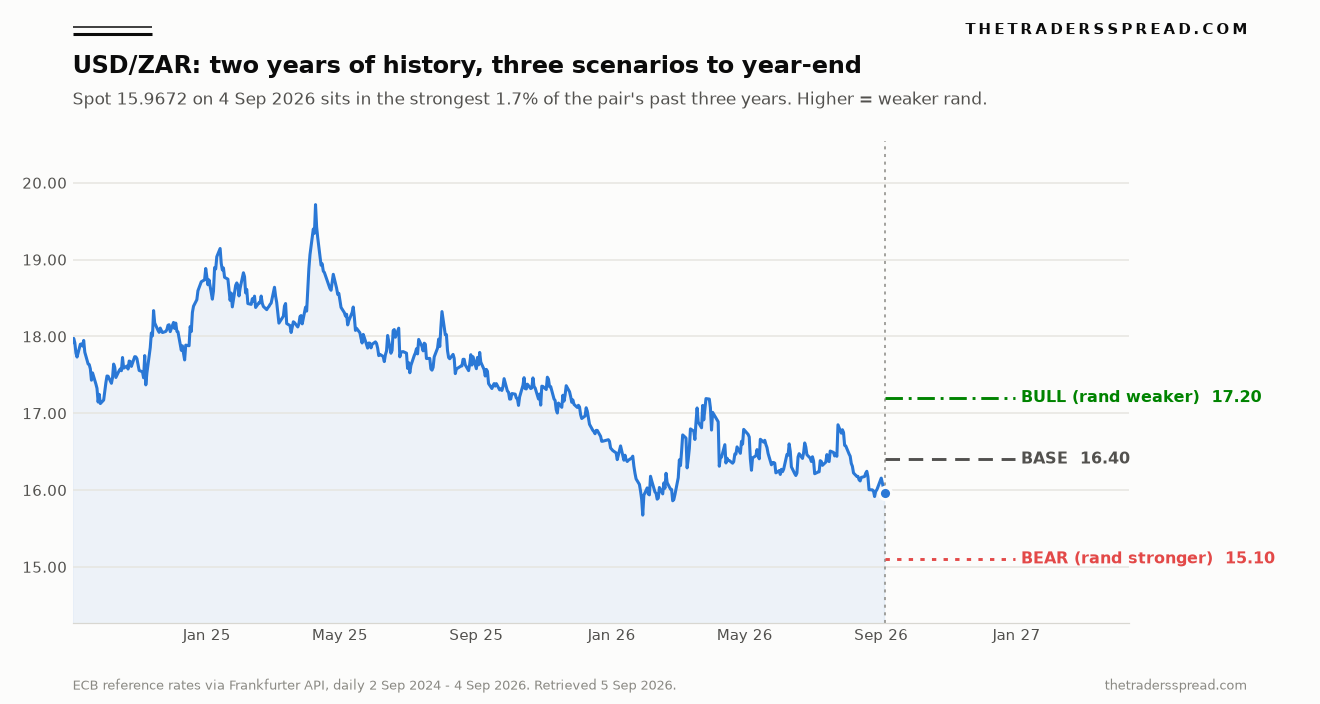
Trailing 250-day realised volatility is 11.1% annualised, and the 60-day figure only 9.0%. With 118 days to 31 December 2026, that implies a one standard deviation range of roughly 14.99 to 17.00. Anything outside it needs a named catalyst rather than a trend line.
| Scenario | USD/ZAR | Move from spot | What it requires |
|---|---|---|---|
| Bull (rand weaker) | 17.20 | +7.7% | A Fed hike or hawkish hold on 16 September, metals staying broken, and a 4 November election result that reopens the coalition question |
| Base | 16.40 | +2.7% | The re-rating is priced, carry erodes gradually, SARB holds at 7.00% and CPI returns to the band |
| Bear (rand stronger) | 15.10 | -5.4% | A PGM recovery, a further rating action, and a SARB hike on 23 September that widens the real-rate gap |
The case against this call
Mean reversion is a description, not an argument. USD/ZAR sitting in the bottom 2% of its three-year distribution says only where it has been, and currencies trend for years.
The stronger objection is that a re-rating is precisely the thing that should not mean-revert. If load-shedding is genuinely over, if debt genuinely stabilises, and if two agencies genuinely upgrade from positive outlooks, then 16 is the new range rather than an overshoot of the old one. Northam Platinum chief executive Paul Dunne argued in the company's results published 28 August 2026 that "there is a persistent and growing market deficit for the metals we produce, metals that are critical and essential to the modern world," which if right restores the export leg too. The World Platinum Investment Council's Q1 2026 report, published 18 May, forecast a 297 koz platinum deficit for the year, a fourth consecutive shortfall, with above-ground stocks down to just under three months of cover.
A self-limiting mechanism also works against further rand strength. Impala Platinum's FY2026 results, released 3 September 2026, show dollar revenue per 6E ounce up 63% while rand revenue per ounce rose only 51%. Sibanye-Stillwater averaged R16.41 to the dollar in the first half against R17.88 a year earlier. A stronger rand is quietly taxing the sector that funds the fiscus, and that pressure eventually shows up in policy.
The call
Base case: 16.40 by 31 December 2026, probability 45%. The re-rating is done and largely in the price. Load-shedding cannot end twice, the tariff cannot be struck down twice, and the upgrades are behind us rather than ahead. What remains is a currency that has banked its good news, trading against a Federal Reserve that has stopped easing. Drift back toward the year's average of about 16.39 is what a quiet calendar produces.
Bull case for the pair, meaning a weaker rand: 17.20, probability 32%. This needs the Federal Reserve to deliver or clearly signal a hike on 16 September, which after three dissents on 29 July and an August payroll print three times consensus is a live scenario rather than a tail. Add continued weakness in platinum and palladium, worth about 0.7% of USD/ZAR for every 10% of metal on the measured beta, and the 4 November municipal elections, the first local vote held under the Government of National Unity, landing fifteen days before the 19 November MPC meeting. At 1.2 standard deviations on trailing volatility, 17.20 is an ordinary quarter, not a crisis.
RelatedUSD/THB Forecast: 34.80 Bull Case vs 32.40 Bear Case
Bear case for the pair, meaning a stronger rand: 15.10, probability 23%. Platinum and palladium recover toward the WPIC deficit narrative, another agency acts on a positive outlook, and the SARB hikes on 23 September while the Fed holds. That takes the pair through the January low of 15.6738 into territory unseen since 2022. Three things have to break the same way, which is why it gets under a quarter of the distribution.
What would change my mind. A monthly close below 15.60 on the ECB fixing invalidates the structure and moves me to neutral. So does a SARB hike on 23 September paired with a Fed hold on 16 September, because that is the differential moving decisively the wrong way. In the other direction, a further 15% drawdown in the metals basket that fails to lift USD/ZAR at all would tell me the residual correlation has gone to zero, the metals framework in this piece no longer applies, and the pair has become a pure Federal Reserve expression. Two data releases could also date this quickly: Q2 GDP lands on 8 September and the Q2 current account on 10 September, and a surplus that narrows sharply would weaken the strongest pillar under the rand.
Frequently asked questions
Does a rising USD/ZAR mean a stronger or weaker rand?
Weaker. The dollar is the base currency, so USD/ZAR at 17.20 means one dollar buys 17.20 rand against 15.9672 today, which is rand depreciation. The bull case in this article is therefore a bearish call on the rand, and the bear case is a bullish one. The same convention governs our USD/MXN and USD/JPY forecasts.
If platinum has fallen a third, why has the rand not followed?
Because the measured link is much weaker than the label suggests. On daily data over the year to 4 September 2026, a 10% move in an equal-weight platinum and palladium ETF basket coincided with roughly 0.73% in USD/ZAR the other way, so a 33% drawdown accounts for about 2.4% of upward pressure. Structural repair worth several times that absorbed it.
What is the South African Reserve Bank targeting now?
Three percent, with a tolerance band of one percentage point either side, agreed between the Governor and the Minister of Finance and announced on 12 November 2025 in place of the old 3–6% range. Headline inflation was 4.3% in July 2026 and has been above the 4% ceiling since April. The repo rate has been 7.00% since 28 May 2026, and the next MPC decision is 23 September 2026.
Is South African load-shedding really over?
On the operational data, yes for now. Eskom's statement of 4 September 2026 records 476 consecutive days without load-shedding since 16 May 2025, an energy availability factor of 67.79% and diesel expenditure down 81.64% year on year. Any analysis still framing the rand around a live power crisis is working from pre-2025 conditions.
What happened to the 30% US tariff on South African goods?
The Supreme Court struck down its legal basis on 20 February 2026, holding in Learning Resources, Inc. v. Trump that IEEPA does not authorise the President to impose tariffs. A lower successor tariff replaced it under different authority. AGOA preferences were extended through 2028 by legislation signed on 3 September 2026, though South Africa's 2027 eligibility remains an annual presidential determination.
How much should I trust the volatility band behind these targets?
It is backward-looking. Realised volatility was 11.1% annualised over the past 250 sessions and 9.0% over the past 60, so the 14.99 to 17.00 range assumes conditions resembling the recent past. This pair has realised well above 20% in past stress episodes, including the oil shock we covered in our crude analysis. It is a central expectation, not a boundary.
Disclaimer
This article is analysis and information only. It is not investment advice, a recommendation, or an offer to transact in any instrument. Foreign exchange and contracts for difference are leveraged products and carry a high risk of rapid loss. The price levels, probabilities and scenarios described here are the author's assessment on the date of publication and may prove wrong. Past price behaviour and measured correlations do not predict future results. Capital is at risk. Readers should conduct their own research and consider their own circumstances before making any financial decision.