

AUD/CHF stood at 0.58418 on the European Central Bank reference for 14 October 2026, 37 pips under the 18 September high of 0.58788 and 12.5% above the 0.51916 reference of 14 October 2025. On the morning of 15 October the Australian Bureau of Statistics reported that employment fell by 39,000 in September. Those two facts do not sit comfortably together. A labour market that loses jobs is usually a reason for a currency to cheapen. A cross that has climbed for a year, while the Reserve Bank of Australia's cash rate sits at 4.60% and the Swiss National Bank's policy rate sits at 0%, is a currency the interest-rate gap is still paying holders to keep. One of those descriptions has to give way before 31 December. The bull case in this note is 0.6120. The bear case is 0.5480.
The rise into that 0.58418 print was not a Swiss franc story, which is what a hot US inflation number usually suggests. On 14 October the US Bureau of Labor Statistics said the consumer price index rose 0.6% in September and 3.7% over the year, with gasoline up 9.1% on the month. A haven bid for the franc would have pushed AUD/CHF down. The ECB dollar rates show the opposite. USD/CHF moved from 0.83232 on 13 October to 0.83341 on 14 October, so the franc was marginally weaker against the dollar, not firmer. Australian dollars per US dollar fell from 1.4331 to 1.4266. Divide those two published rates and the cross rebuilds at 0.58419, against a direct AUD/CHF reference of 0.58418. The gap is 0.00001. The cross rose because the Australian dollar rose.
Key facts
- AUD/CHF ECB reference 0.58418 on 14 October 2026, up 12.5% from 0.51916 a year earlier; high 0.58788 on 18 September, low 0.51428 on 20 October 2025 — ECB rates via Frankfurter, retrieved 15 October 2026
- RBA cash rate target 4.60% after a 25 basis point rise decided on 29 September, effective the next day, the fourth increase of 2026 from a 3.60% starting point — RBA media conference, 29 September 2026, and the RBA cash rate table
- SNB policy rate left at 0% on 24 September; Swiss inflation 0.8% in August, from 0.6% in May; forecast 0.7% for 2026 and 0.8% for 2027 and 2028 if the rate stays at 0% — Martin Schlegel, SNB remarks, 24 September 2026
- Seasonally adjusted unemployment 4.7%, employment down 39,000, participation 66.8%, employment-to-population 63.6%; trend unemployment unchanged at 4.6% — ABS, 15 October 2026
- US CPI-U up 0.6% on the month and 3.7% on the year; core up 0.3% and 2.6%; gasoline up 9.1% on the month; energy up 20.4% on the year — BLS, 14 October 2026
- On 2 October the franc did firm: USD/CHF fell from 0.83528 to 0.82664 and AUD/CHF fell from 0.58056 to 0.57363 — ECB via Frankfurter, retrieved 15 October 2026
- Extending the past year's 12.5% pace across the 78 days to 31 December lands near 0.5998, between the 0.5920 base and the 0.6120 bull case — arithmetic on that ECB series, not a model
Who set the 460 basis point gap
460 basis points separate the two policy rates. That is 4.60 minus zero, not a market inference.
Michele Bullock, Governor of the Reserve Bank of Australia, opened her 29 September media conference with the decision: the Board had raised the cash rate target by 25 basis points to 4.60 per cent, because higher rates were needed to get inflation back to target. She put inflation at about 3.5 per cent, a percentage point above the target, and said underlying inflation had sat near that pace for about six months. She would not turn a further rise into a timetable.
The cash rate table matches her count. The target was 3.60% at the December 2025 meeting. Meetings minuted on 3 February, 17 March and 5 May took it to 3.85%, 4.10% and 4.35%. June and August, minuted on 16 June and 11 August, left 4.35% unchanged. A change takes effect the following day, so 4.60% applies from 30 September.
Asked which channel does the work, she said: "According to our research, in fact, the most important channel is the exchange rate channel." A cross against a central bank that is not raising is where that channel shows up.
On 24 September in Berne, Martin Schlegel, Chairman of the Governing Board of the Swiss National Bank, told the news conference the policy rate was unchanged at 0%. The conditional forecast is 0.7% inflation for 2026 and 0.8% for 2027 and 2028, if that rate holds for the whole horizon. Inflation had risen from 0.6% in May to 0.8% in August, mainly on oil products, and 0.8% was still inside the 0% to 2% band the SNB calls price stability. The discount on sight deposits above a threshold stayed at 0.25 percentage points.
He did not describe a haven currency. Since the June assessment the franc had depreciated by around 3% on a trade-weighted basis, "in line with the widening of interest rate differentials" against Switzerland. The SNB is willing to be active in foreign exchange "as necessary to ensure appropriate monetary conditions."
Petra Tschudin, Member of the Governing Board, gave the Swiss growth figures in the same remarks: between 1.5% and 2% for 2026, after a second quarter she said overstated the underlying pace because of chemicals and pharmaceuticals. Capacity utilisation was below average, especially in manufacturing, and unemployment had risen somewhat through to early summer. Antoine Martin, Vice Chairman, said key rates had been raised in the euro area and in the United States. The same Swiss rate, against the euro rather than the Australian dollar, is the subject of the EUR/CHF forecast. Martin's sentence is used here only as evidence that, on 24 September, the SNB already saw itself as the bank that had not followed the others up.
Two October days, two different francs
If the franc were the driver, AUD/CHF would fall when the franc firms. The last two weeks did that once, and the CPI morning was not that once.
On 2 October the franc firmed. USD/CHF dropped from 0.83528 to 0.82664, a 1.0% move, which is a stronger franc. AUD/CHF dropped from 0.58056 to 0.57363, down 1.2%, or 69 pips, on one reference. Australian dollars per US dollar rose from 1.4388 to 1.4411, so the Australian dollar was softer against the US dollar as well. Both legs pointed the same way. That session is the template for the bear case. It needed a franc bid, and the cross followed it down.
On 14 October that template failed. The CPI numbers are already in the opening: 0.6% on the month, 3.7% on the year, gasoline up 9.1%, core up 0.3% and 2.6%, energy up 20.4% on the year, index 336.940. USD/CHF rose 0.13%. AUD/CHF rose 0.58%. The franc did not firm.
The dollar-franc leg, the rate in the division, is set out in the USD/CHF forecast.
Inverted from the ECB quote, the Australian dollar went from about 0.6978 to about 0.7010 per US dollar. That leg is in the AUD/USD forecast. The news on this cross was there, not in a Swiss rally. An ECB reference is a daily fixing, not the hour after the 8:30am Washington release. On the rate that was published, Bullock's exchange-rate channel fits the day better than a haven story does.
From 0.51428 to a high the cross has not cleared
The twelve-month low is 0.51428, on 20 October 2025. From there to 14 October 2026 is a rise of 13.6%. The anniversary comparison, 14 October to 14 October, is 12.5%. The cross ended 2025 at 0.52978 and was 0.53096 on 2 January 2026.
February and early March built a shelf just under 0.5500: 0.54815 on 12 February, 0.54804 on 27 February, 0.54815 on 6 March, 0.54710 on 9 March. The bear case at 0.5480 is that shelf, 9 pips above the spring low. After 9 March the cross left it. The reference was through 0.557 on 11 March.
On 18 June, the start of the window Schlegel used, the reference was 0.56338. On 24 September, the day he said the franc's trade-weighted value was down about 3% since June, AUD/CHF was 0.58163. That is a 3.2% rise in this one pair. A trade-weighted index is not AUD/CHF, and 3.2 is not 3. The parallel is still awkward for a haven story. Against the Australian dollar, over the dates the SNB chairman used, the franc cheapened by roughly the amount he reported for the basket.
The high is 0.58788 on 18 September. The cross has not printed above it since. It was 0.58163 on 24 September, 0.58056 on 1 October, and 0.57363 on 2 October. The recovery to 0.58418 retraced most of that dip and stopped 37 pips, 0.6%, under the September extreme.
The September high did not hold.
That is the constraint on 0.6120. It sits 241 pips above a high the cross has already failed, and 278 pips above the latest reference. The base at 0.5920 is only 41 pips above that same high. The pace arithmetic is in the key facts: a straight run of the past year lands near 0.5998, above the base and below the bull case.
Three paths, and the pace that gets you there
The chart is the ECB reference from 14 October 2025 to 14 October 2026, extended to 31 December only so the three levels have a length. The dot is 0.58418. The lines to the right are not a path the price has walked.
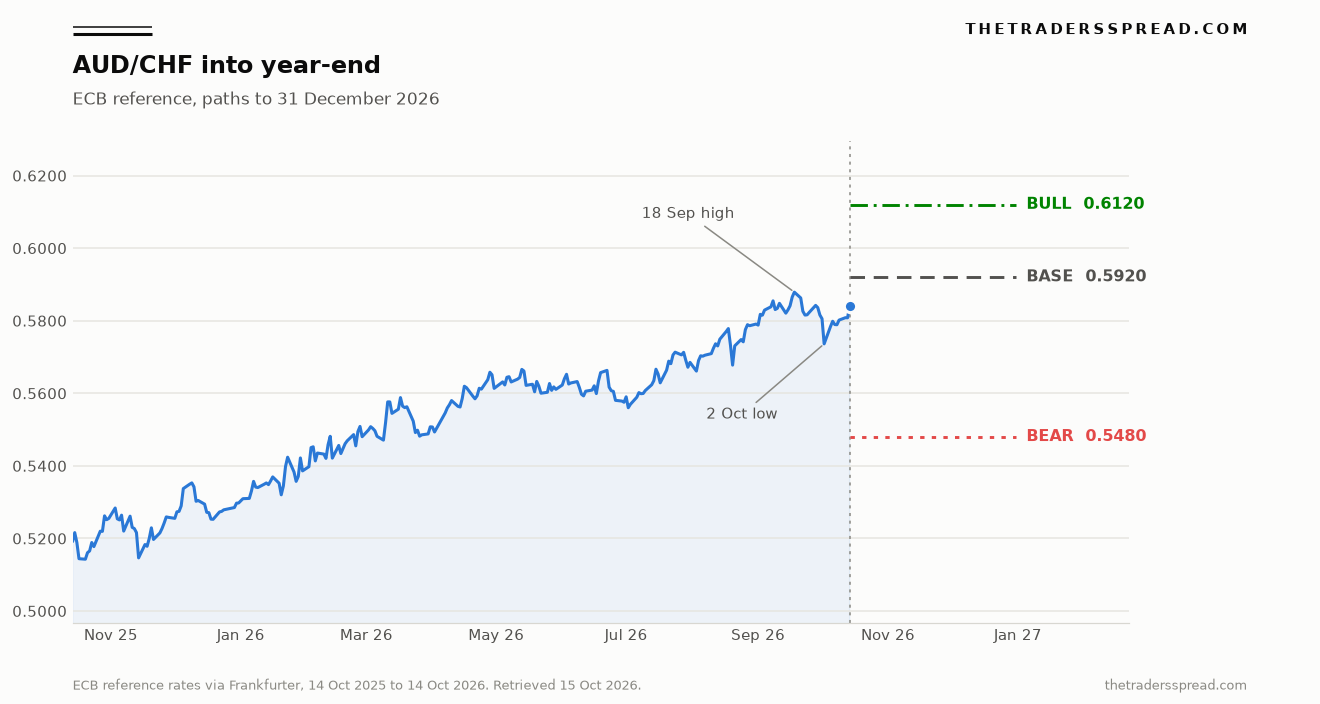
| Path | Level | Versus 0.58418 | What has to be true |
|---|---|---|---|
| Base | 0.5920 | +1.3%, about 78 pips | The 460 basis point gap stays open, and trend unemployment does not lift off 4.6% |
| Bull | 0.6120 | +4.8%, about 278 pips | The cross clears 0.58788 and the year's pace speeds up |
| Bear | 0.5480 | −6.2%, about 362 pips | Another employment drop, and a franc bid like 2 October that is not reversed |
| ECB reference | 13 Oct 2026 | 14 Oct 2026 | Change |
|---|---|---|---|
| AUD/CHF | 0.58080 | 0.58418 | +0.58% |
| USD/CHF | 0.83232 | 0.83341 | +0.13% |
| AUD per USD | 1.4331 | 1.4266 | −0.45% |
The change column is the whole of 14 October. The franc's dollar rate barely rose. The Australian dollar strengthened. The direct print matches the division of the other two to 0.00001.
The base line sits just above the September high. Parking it on 0.58418 would be a forecast of "unchanged" dressed as a number. 0.5920 is still a new high if it is held. The bear line is on the March shelf, below the 2 October low of 0.57363, so one repeat of that session would not get there. Nothing in either table is an instruction. The panel target is the base, 0.5920. The panel invalidation is the bear case, 0.5480.
The 39,000 the trend did not confirm
Sean Crick, head of labour statistics at the Australian Bureau of Statistics, put September in the 15 October release without decoration. "This month there were 39,000 less employed people and 9,000 more unemployed people," he said. The employment-to-population ratio fell 0.3 percentage points to 63.6 per cent, and participation fell 0.2 percentage points to 66.8 per cent. A higher proportion of people remained unemployed than in recent years. Underemployment rose 0.1 percentage points to 6.3 per cent.
The same release then refuses the simple version. Hours worked rose 0.1 per cent. Full-time hours rose 0.4 per cent and part-time hours fell 1.5 per cent. Over the year, employment and hours are up 1.2 per cent and 1.3 per cent. In trend terms, which the ABS calls the better measure of underlying behaviour, unemployment was unchanged at 4.6 per cent, employment grew 0.1 per cent, hours were steady, and trend underutilisation rose only marginally, to 11.0 per cent.
There is a methodological reason to hesitate. The ABS has changed how it collects supplementary surveys, removing an effect that used to show up in February and August. It says a small residual influence on the September seasonally adjusted estimates is possible, and that only time will show it. The Bureau's advice is to prefer the trend.
RelatedNZD/CHF Forecast: 0.4790 Bull Case vs 0.4560 Bear Case
Bullock, sixteen days earlier, still called the labour market "a little bit tight," and she declined to treat 3.5 per cent inflation with 4.6 per cent unemployment as anything like stagflation. She also said a higher jobless rate need not mean jobs have been destroyed, because participation can rise faster than hiring. September did not fit that version. Participation fell, and employment fell. The trend rate did not.
The October survey reference period ran from 27 September to 10 October, so it already covers the week after the cash-rate rise. This note does not invent a publication hour for the next release. The bear case needs that reading to look like the seasonally adjusted September figures, not like the trend. Until it does, the cross is 0.6% off its high of the year, with one soft month the preferred measure did not confirm.
Base, bull and bear into 31 December
The central path is 0.5920 on 31 December, 1.3% above 0.58418 and 41 pips above the September high. It needs the gap near 460 basis points, Switzerland still at 0%, Australia not cutting, and trend unemployment still at 4.6%. It does not need a fifth RBA rise. Bullock said four might be enough, and that she did not know. A drift back toward 0.5800 would miss 0.5920 without touching the bear case.
0.6120 means clearing 0.58788 and then about another 240 pips in 78 days. Run the past year's pace forward and you land near 0.5998. Apply the roughly 3% franc move Schlegel described to 0.58418 and you land near 0.602. Both are below 0.6120. The bull case is the top of the range, not the middle of it.
0.5480 is the March shelf, 6.2% under the reference. A repeat of 2 October stops at 0.57363. Reaching the shelf needs that franc bid to stick, and either another employment fall with trend unemployment lifting off 4.6%, or an SNB rate above the 0% its forecast assumes through 2028. Neither was in the 14 October reference.
The weights are a judgement, not a market price: about 50% on the base, 25% on 0.6120 and 25% on 0.5480. Conviction is 3 out of 5. The gap is too explicit, in both central banks' own words, to ignore. The level is too close to a failed high to treat the bull case as the path. What would change the weights is concrete. Trend unemployment above 4.6%, with another employment drop, lifts the bear side and pulls the central path toward 0.57363. A further RBA rise lifts the bull side, because it widens a gap Berne's forecast does not match. An SNB rate above zero, or a 2 October-style drop that is not retraced, does the opposite. Until one of those prints arrives, 0.5920 is the level that respects the climb without assuming it accelerates.
Questions that decide the year-end print
Is 0.58418 a live dealing price for AUD/CHF?
No. It is the ECB reference rate for one Australian dollar in Swiss francs on 14 October 2026, retrieved from Frankfurter on 15 October. The file had no 15 October reference at the time of writing. A broker's tradable price will differ by the spread and by whatever has happened since that fixing. The bull, base and bear levels in this note are measured from 0.58418, not from a later quote.
Why is the bull case above the September high?
Because 0.58788 on 18 September is the highest ECB reference in the year to 14 October, and the cross has not traded through it since. Any case above the current 0.58418 print that is more than a few pips of noise has to be a new high. 0.6120 is 241 pips above that high. It is the upside tail, not the base. The base, at 0.5920, is only 41 pips above the same high.
Did Australia's labour market break in September?
The seasonally adjusted figures were soft: employment down 39,000, unemployment 4.7%, participation down to 66.8%, the employment-to-population ratio down to 63.6%. The trend unemployment rate was unchanged at 4.6%, and the ABS warned that the new supplementary-survey method may still be touching the September seasonally adjusted estimates. Hours worked rose 0.1%. The headline is real. The Bureau has told users it is not the best measure of the underlying market.
Why did AUD/CHF rise on a hot US CPI print?
Because the franc did not firm against the dollar in the ECB references. USD/CHF rose from 0.83232 to 0.83341, a slightly weaker franc, while the Australian dollar strengthened. Dividing the two dollar rates rebuilds AUD/CHF at 0.58419, in line with the direct print of 0.58418. The day the franc did firm in this window was 2 October, and AUD/CHF fell 69 pips that day.
What would make 0.5480 or 0.6120 the relevant level?
0.5480 becomes the relevant level if a franc bid of the 2 October type sticks and Australian employment falls again with the trend jobless rate lifting off 4.6%. 0.6120 becomes the relevant level if the cross clears 0.58788 and the climb speeds up past the past year's pace, most plausibly because the RBA raises the cash rate again while the SNB stays at 0%. Neither was established by the 14 October reference.
This article is analysis of published rates and official releases. It is not a recommendation to trade AUD/CHF or any other instrument, and the scenario levels are not instructions. Foreign exchange moves, and you can lose capital. The figures were retrieved on 15 October 2026 and will be overtaken by later ECB references, labour prints and policy decisions.