

At seven in the morning Mountain Time on Thursday 3 September, about 420 members of United Steelworkers Local 11-0001 walked off the job at the Stillwater East mine outside Nye, Montana, and at the Columbus Metallurgical Complex forty miles away. Between them those two sites are the only primary palladium mine in the United States and the only plant in the country that smelts and refines platinum-group metal. Sibanye-Stillwater had told the market it was coming: a strike notice arrived on 1 September and the company disclosed it by SENS from Johannesburg the following day, naming Stillwater East and Columbus and confirming that the East Boulder mine, which sits under a separate agreement, would keep running. Palladium closed that Thursday at $1,441.00 an ounce, up 4.92%, the best performer in the precious complex. By Friday morning in London the same metal was quoted at $1,445.00.
Here is the part worth sitting with. The market wrap that priced the session credited palladium's gain to "a persistent supply deficit and growing industrial demand tied to catalytic converters," and did not mention Montana, Sibanye or a strike anywhere. Nor does the macro story that carried the rest of the complex explain the size of it: on the same day gold rose 1.96% and platinum 3.43%, so palladium ran at roughly two and a half times gold's beta on a shared impulse. The mechanical reason that beta exists is sitting in a public file nobody joined to the news. As of the last published Commitments of Traders report, speculative money held 9,989 short palladium contracts on NYMEX against 4,503 longs, a gross short of 998,900 ounces, in a contract carrying 18,178 lots of open interest in total. A mine stopping is one thing. A mine stopping into a book that size is another.
The week in numbers
- Palladium closed at $1,441.00 an ounce on 3 September 2026, up 4.92%, ahead of platinum at +3.43% and gold at +1.96% — Texas Precious Metals daily market update, 3 September 2026.
- Roughly 420 United Steelworkers members struck Stillwater East and the Columbus Metallurgical Complex from 07:00 MT on 3 September — Sibanye-Stillwater SENS announcement, 2 September 2026, and Montana Free Press, 3 September 2026.
- Stillwater East produced 76,334 2Eoz in the first half of 2026, about 55% of the group's US PGM output of 137,930 2Eoz — Sibanye-Stillwater SENS announcement, 2 September 2026.
- Managed money held 9,989 gross short NYMEX palladium contracts, 998,900 ounces, against 4,503 longs and 18,178 lots of open interest — CFTC Commitments of Traders, futures and options combined, 25 August 2026.
- The USITC found on 15 June 2026 that no US industry was materially injured by Russian palladium imports, ending the trade case with no duty orders — Federal Register 91 FR 36878, 18 June 2026.
- abrdn Physical Palladium Shares (PALL) closed at $25.79 on 3 September, up 4.92%, on 1,733,134 shares against a 90-day median of 776,220 — stockanalysis.com, pulled 4 September 2026.
- Two independent live price feeds disagreed on palladium by 1.53% at the same instant on 4 September while agreeing on gold to within 0.009% — api.gold-api.com and Swissquote public quotes, 08:26 UTC, 4 September 2026.
The struck ounces
Scale first, because the numbers are small and that is exactly what makes them interesting. Sibanye-Stillwater's US operations produced 137,930 two-element ounces in the first half of 2026. Stillwater East accounted for 76,334 of those, roughly 55%, or about 446 ounces a day. East Boulder, which is not on strike, made the other 61,595. Set against Nornickel's guided 2.415 to 2.465 million ounces of palladium for 2026, the struck mine is a rounding error on global supply.
Columbus is not.
The metallurgical complex smelts and refines everything the US operations produce, and it is the only facility of its kind in the country. Halting it does not merely pause new ounces. It interrupts the path from concentrate to deliverable metal for whatever is already in the pipeline, and it removes the domestic processing route for spent autocatalysts at the same time. That is a supply-chain node rather than a supply number, and nodes are what markets misprice.
The dispute itself has nothing to do with palladium. Montana Free Press reported the sticking points as health-plan deductibles and out-of-pocket costs, changes to short-term disability cover, and the structure of incentive pay. Andrew Cameron, an underground miner on the union negotiating committee, put the union case plainly: "We aren't asking for anything more than what we've had. We're fighting for the same benefits we've had for years." He also described the work, which is worth quoting because it explains why incentive pay is the flashpoint: "I go some place no human has been before, drill holes and then blast the ground. It's very hazardous, and a lot of our job is extremely physically demanding."
Management's position is that the operation does not currently pay for itself. Heather McDowell, a Sibanye-Stillwater spokesperson, told the same paper that "current metal prices mean that the business is, at best, operating at break-even levels. On some days, we are operating at a loss." Richard Stewart, the group's chief executive, went further in the SENS announcement, writing that reducing unit operating costs at the US operations "remains an imperative to securing the long-term future of these operations." The uncomfortable arithmetic underneath the whole thing is that the strike lifted the price of the product by 4.92% in one session, which makes a wage negotiation considerably harder to settle rather than easier.
What the tape did, and what it could not agree on
Palladium has no free, verifiable per-session spot history in the way a currency pair does, so the honest way to chart it is through a physically backed fund that holds nothing else. PALL is that fund. It launched on 6 January 2010, trades on NYSE Arca, tracks the London PM fix less a 0.60% expense ratio, and holds $702.99m of metal, 99.92% of it physical palladium bullion. Its share price is around $25.79 and is emphatically not the palladium price, which is around $1,441 an ounce. The percentage moves are the useful part.
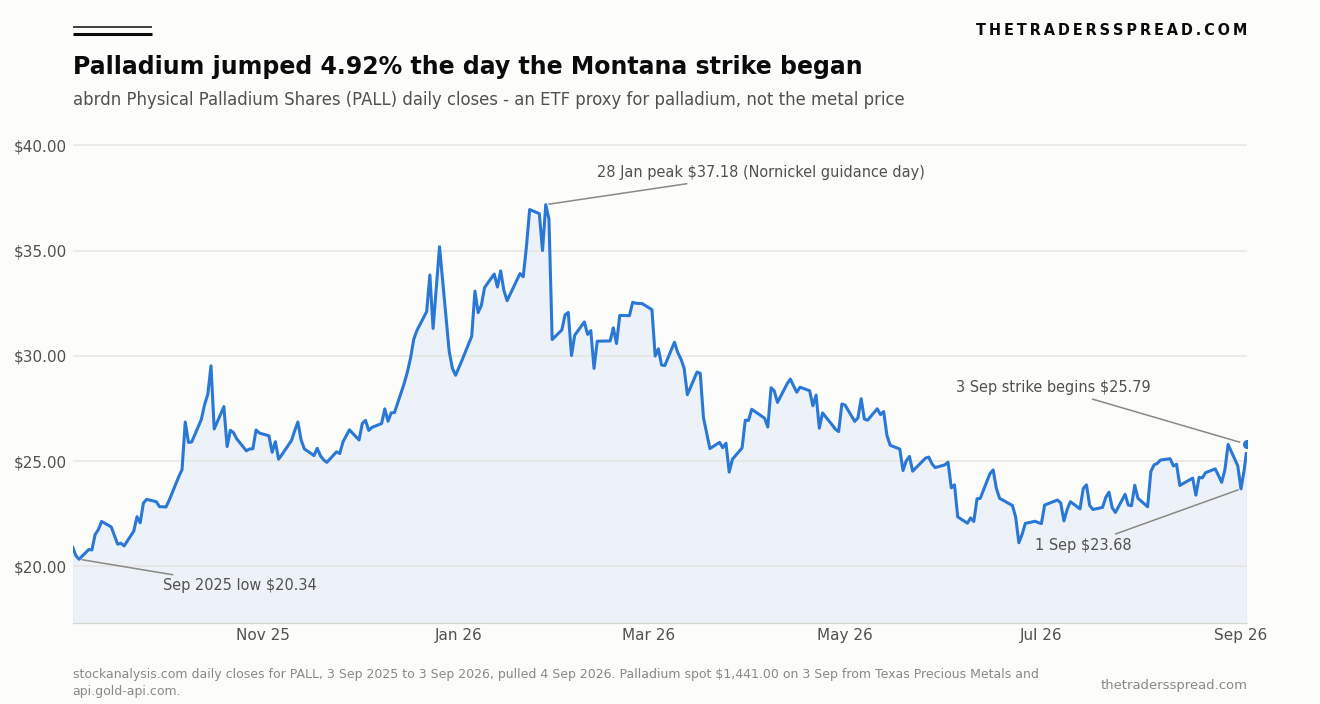
Chart: PALL daily closes via stockanalysis.com, an ETF proxy for palladium and not the metal price. Spot from api.gold-api.com.
The sequence ran like this. Friday 28 August closed at $25.79, up 4.92%, on the heaviest volume of the period. Monday gave back 3.92%, Tuesday another 4.44% to $23.68, the weakest close since 18 August. Wednesday recovered 3.80% as the strike notice was disclosed. Thursday added 4.92% to $25.79 on 1,733,134 shares, 2.2 times the 90-day median, as the walkout began.
Two identical closes and two identical percentage changes four sessions apart look enough like a corrupted feed that I checked the underlying rows before charting them. The intraday ranges differ, the volumes differ by a factor of 1.6, and every close-to-close change across the full 253-session year reconciles to its reported percentage, with no duplicate dates and no repeated price-and-volume rows. The coincidence is real. Between those identical prints the fund travelled 17.1 percentage points of gross daily movement and finished exactly where it started, which means anyone measuring this week from the previous Friday sees nothing happening at all.
Then there is the question of what palladium actually costs, which turns out to be harder to answer than it should be. At 08:26 UTC on 4 September I pulled four metals simultaneously from two independent live feeds.
| Metal | gold-api spot | Swissquote mid | Cross-feed gap | Swissquote bid-offer |
|---|---|---|---|---|
| Gold | $4,481.50 | $4,481.11 | 0.009% | 1.1 bp |
| Silver | $67.21 | $67.11 | 0.147% | 6.2 bp |
| Platinum | $1,822.00 | $1,819.26 | 0.151% | 14.5 bp |
| Palladium | $1,439.00 | $1,417.38 | 1.525% | 19.1 bp |
Gold's two feeds agreed to nine thousandths of a percent. Palladium's disagreed by 170 times as much, $21.62 an ounce, and the dealer spread on it was seventeen times gold's. The obvious explanation is that one feed had gone stale, so I re-pulled both twenty-two minutes later: gold-api had moved to $1,445.00 and Swissquote to a $1,421.06 mid, both live, both now 1.68% apart. This is not a broken quote. It is what a metal looks like when its global benchmark is fixed twice a day by six accredited firms and the rest of the time it trades over the counter between a handful of desks quoting what they are willing to warehouse. Compare the 16% run in silver to $69.57 in late August, which happened in a market whose feeds still agreed to fifteen hundredths of a percent. Palladium's price is a range, and the range widens exactly when the move is biggest.
The petition that failed in June
On 30 July 2025 two petitioners jointly asked Washington to impose anti-dumping and countervailing duties on unwrought palladium from Russia. The Federal Register names them: Stillwater Mining Company, and the United Steel, Paper and Forestry, Rubber, Manufacturing, Energy, Industrial and Services Workers International Union.
The mine and the union, on the same side of the filing.
Commerce did its part. It set a preliminary Russia-wide dumping margin of 132.83% on 10 February 2026 on a trade worth $877.7m in 2024, down from $1.35bn in 2022, and the case went to a hearing on 27 April. Then, on 15 June 2026, the International Trade Commission determined "that an industry in the United States is not materially injured or threatened with material injury by reason of imports of unwrought palladium from Russia." No duty orders followed. The determination was signed by Lisa Barton, secretary to the Commission, and published on 18 June at 91 FR 36878.
Eleven weeks later the two petitioners stood on opposite sides of a picket line, arguing about deductibles at an operation the company says runs at break-even, and the price they had jointly gone to Washington to defend rose 4.92% on the day production stopped. Anyone modelling palladium through trade policy this year has been watching the wrong lever. The metal is not tight because of a tariff that never arrived. It is tight because the marginal Western ounce is uneconomic at $1,441, which is exactly what a break-even operation stopping tells you.
Supply everywhere else is fine, which is the problem
Nornickel, which mines roughly two-fifths of the world's palladium, guided 2026 output down to 2.415 to 2.465 million ounces at the end of January, a fall of up to 11%. Evgeny Fyodorov, its first vice-president and chief operating officer, has since reconfirmed that the company "confirms its 2026 metals production forecast at the level previously announced." He attributed the reduction, when it was first disclosed, to a "change in the metal composition of processed raw materials," which is the industry's phrase for ore grades falling rather than for anything breaking. Chief executive Vladimir Potanin blamed part of the shortfall on replacing Western equipment with Chinese and Belarusian machinery that was "initially less advanced and productive."
That guidance landed on 28 January 2026. PALL's twelve-month closing high, $37.18, was set the same day. The fund sits 30.6% below it now and 13.4% lower year to date, despite being 23.2% up on twelve months ago. Palladium has spent this year rewarding supply pessimism on the morning it is announced and punishing it for the two quarters that follow.
Platinum, quoted at $1,822.00 on the same feed at the same second, leaves the platinum-to-palladium ratio at 1.27, with palladium at 79% of its sibling's price. The two substitute chemically in gasoline autocatalysts, and this site set out platinum's own bull and bear cases on 2 September, but they are not analytically interchangeable. Platinum carries a diesel legacy, a hydrogen option and a jewellery bid. Palladium's demand sits almost entirely in gasoline catalysts, and every formulation change of the past five years replaced it with cheaper platinum rather than the reverse. Three days of ratio compression does not undo that.
What this changes
The first consequence is a duration question rather than a price one. A 420-person strike at an operation producing 446 ounces a day removes very little metal in a week and a meaningful amount in a quarter, and the difference between those outcomes is a health-plan negotiation rather than a commodity forecast. Watch the bargaining calendar, not the ore body. Watch also whether Columbus restarts before Stillwater East does, since the refinery matters more to deliverable supply than the mine does.
RelatedRubber TSR 20 Rises 8.3% in a Month to 264.8 Cents
The second concerns that short book. Speculative money went into September holding 998,900 ounces of gross short exposure in a contract with 18,178 lots of total open interest, and it had barely shifted through August: net short 5,429 contracts on 4 August, 5,486 on 25 August. The Commitments of Traders report covering the week of the strike had not published when this was written. Whether those shorts were still in place on 1 September is the single most informative number due in the next few days, and it is free.
The third is that nobody in the market commentary connected the walkout to the price. That is not a criticism of anyone, since a Johannesburg SENS filing about a Montana labour dispute does not appear on most precious-metals desks' morning list. It does mean the strike was not priced as a strike. It was priced as macro beta, on a day when the whole complex rose, which leaves the position exposed in both directions: a quick settlement removes something the market never explicitly paid for, and a long dispute forces it to pay for that thing later and all at once.
Three things worth watching, then, rather than three price levels. The next Commitments of Traders print, for whether the short book covered. Any statement from Sibanye-Stillwater or United Steelworkers Local 11-0001 about a return to the table. And the cross-feed spread itself: if 1.5% narrows back toward platinum's 0.15% over the coming fortnight, the market has settled on what this is worth. If it stays wide, it has not.
Palladium questions readers are asking
What happened to palladium on 3 September 2026?
Palladium closed at $1,441.00 an ounce, up 4.92%, the best performer in the precious complex, ahead of platinum at +3.43% and gold at +1.96%. That same morning, about 420 United Steelworkers members struck Sibanye-Stillwater's Stillwater East mine and Columbus Metallurgical Complex in Montana, the only primary palladium mine and the only PGM refinery in the United States.
Was the strike the reason the price moved?
No market commentator said so. The wrap covering the session credited a persistent supply deficit and catalytic-converter demand, with no mention of Montana. The timing is exact and the magnitude is roughly two and a half times gold's move on the same macro impulse, but the causal link is an inference from sequence and positioning rather than a sourced attribution. Treat it as the most plausible explanation available, not a confirmed one.
How much palladium does the struck mine produce?
Stillwater East produced 76,334 two-element ounces in the first half of 2026, about 446 ounces a day and roughly 55% of Sibanye-Stillwater's US PGM output of 137,930 2Eoz. East Boulder, which produced the remaining 61,595 2Eoz, sits under a separate agreement and is still running. The Columbus refinery matters more than the raw tonnage, since it is the only PGM smelting and refining plant in the country.
Did the US ever put tariffs on Russian palladium?
No. Commerce set a preliminary Russia-wide dumping margin of 132.83% in February 2026, but the International Trade Commission determined on 15 June 2026 that no US industry was materially injured or threatened by the imports, and the case ended with no duty orders. The petitioners had been Stillwater Mining Company and the United Steelworkers, the same two parties now in dispute in Montana.
Why do palladium prices differ between websites?
Because the metal is quoted over the counter by a small number of desks rather than on a deep continuous order book, and its global benchmark is set only twice a day by six accredited firms. At 08:26 UTC on 4 September, two live feeds differed by 1.53% on palladium and by 0.009% on gold. Re-pulling both twenty-two minutes later showed each had moved and the gap had widened to 1.68%, so neither was stale. Comparing a spot market quote with a futures settlement or a fund's net asset value widens the discrepancy further.
Is palladium in an uptrend?
The fund proxy sits 30.6% below its 28 January close of $37.18 and 13.4% lower year to date, while trading 23.2% above where it was a year ago, and it gave back 1.28% in Friday pre-market. Those facts are all accurate and point in different directions, which describes a market without a settled narrative rather than a contradiction. For contrast, gold has had a very different year.
This article is analysis and information about the palladium market. It is not financial advice, an offer, or a recommendation to transact in any instrument. Prices quoted were pulled live on 4 September 2026 and will have moved since. Commodity markets, and palladium in particular, are volatile, thinly quoted and prone to wide dispersion between sources, and capital is at risk. Anyone acting on market information should take advice appropriate to their own circumstances.