

EUR/AUD is the cross I pulled up first this morning. The file on the desk is the ECB reference series from 8 October 2025 through 7 October 2026, 255 sessions via frankfurter.dev, and the last print in it is 1.6079. That print is the low of the window and the low of 2026. This EUR/AUD forecast is built from that fix.
Both central banks are tightening because of the same Middle East energy shock, and the cross has still printed a one-year low. That is the awkward part. From the window high of 1.7995 on 17 October 2025, the Australian dollar's US dollar rate is up 7.09% and the euro's is down 4.31%, while EUR/AUD itself is down 10.65%. I divided the 7 October dollar rates, 1.1177 by 0.69513, and got 1.6079 back. The fix is not a mystery print. The Australian leg has done more of the work than the euro leg has.
- ECB reference rate 1.6079 on 7 October 2026, down 8.16% from 1.7508 on 2 January 2026. Source: ECB via frankfurter.dev, pulled 8 October 2026.
- High of the same window: 1.7995 on 17 October 2025, so the latest fix sits 10.65% lower. Source: ECB via frankfurter.dev, pulled 8 October 2026.
- RBA cash rate target 4.60%, effective 30 September 2026, after a unanimous 25 basis point rise on 29 September. Next decision 3 November 2026 at 2.30 pm Sydney time. Source: Reserve Bank of Australia, checked 8 October 2026.
- ECB deposit facility 2.50%, main refinancing rate 2.65%, marginal lending rate 2.90%, effective 16 September 2026 after a 25 basis point rise on 10 September. Source: ECB decision, 10 September 2026.
- Gap between those policy rates: 2.10 percentage points, or 210 basis points (4.60% minus 2.50%). Arithmetic from the two official rates, 8 October 2026.
- Euro area inflation 3.2% in August 2026, up from 2.9% in July, with energy inflation at 14.3% after 10.3%. Source: Christine Lagarde, ECB, 28 September 2026.
- Yahoo Finance mid for EURAUD=X: 1.6104 at 06:57 UTC on 8 October 2026, 25 pips above the ECB fix. Scenarios use the ECB print. Source: Yahoo Finance, pulled 8 October 2026.
What a year of reference rates actually shows
The line does not fall in one slope, which is why a year-end number near today's fix is a different claim from a return to 1.75. The window opens at 1.7689 on 8 October 2025, spikes to 1.7995 on 17 October, and is still 1.7508 on 2 January 2026. That January print is the high of calendar 2026 in the file. Everything since is a lower high.
February did the first real damage. The low that month is 1.6592 on 26 February. March was the violent patch inside an otherwise grinding downtrend: 1.619 on 12 March, back at 1.674 on 30 March, then 1.6771 on 2 April. That April print is the spring high, and the last time the file was anywhere near January.
From there the range compressed. May's low was 1.6158 on the 13th. June's rally stalled at 1.6544 on the 30th. The summer high in the file is 1.6546 on 2 July. August ended at 1.6191, back on the March low rather than through it. September produced the first print under 1.61 in this window, 1.6095 on the 18th, and the bounce died at 1.6297 on the 30th.
October did not bounce. It broke.
The 5 October reference was 1.6097, and 7 October printed 1.6079. That is 2.82% under the 2 July high and 1.34% under the 30 September bounce. The March low at 1.619, which had propped the cross up for half a year, is behind the price. Treating 1.61 as a floor means arguing that a level the ECB file has just left should suddenly hold. I am not making that argument.
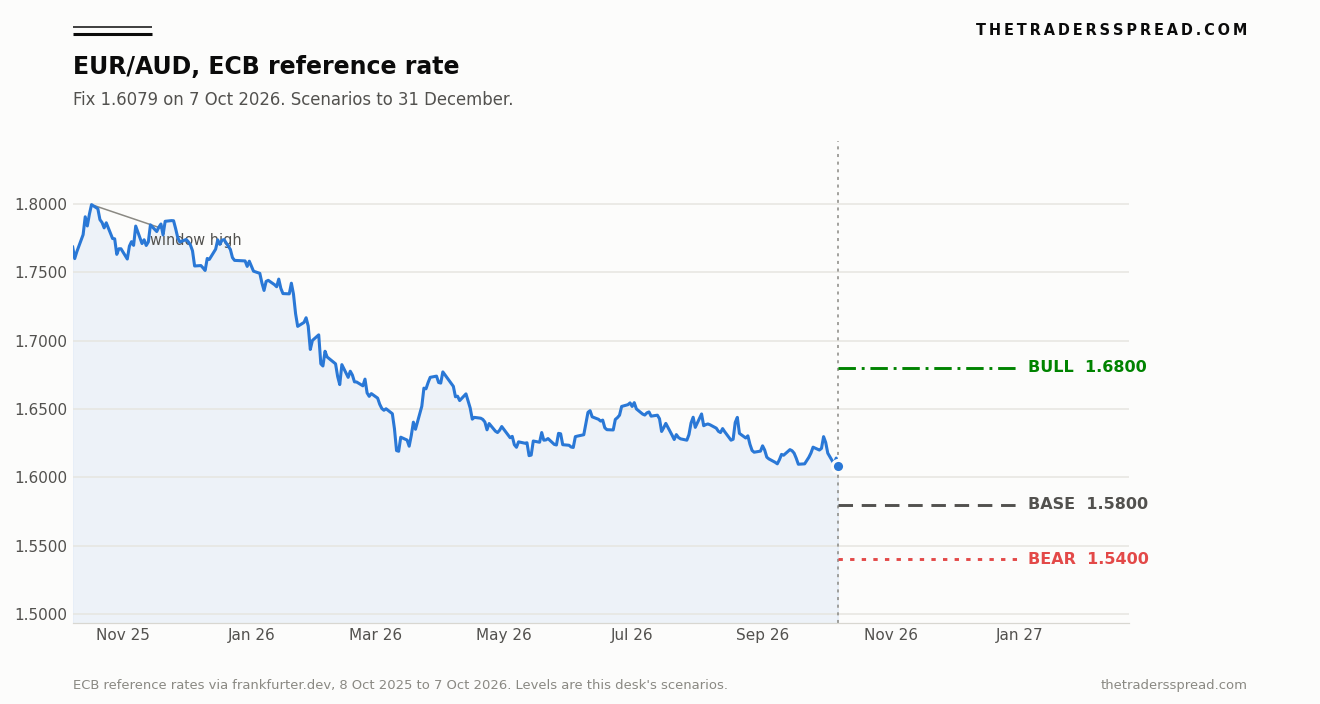
The chart is that ECB file. The dot at the right edge is 1.6079. The three lines past the dotted marker are this desk's scenarios for 31 December 2026, not an ECB projection. Bull is 1.6800, above both the fix and this morning's 1.6104 market mid. Base is 1.5800. Bear is 1.5400.
| Scenario | Level | Versus 1.6079 | What has to be true |
|---|---|---|---|
| Bull | 1.6800 | +4.48% | The RBA holds on 3 November and the ECB hikes on 29 October or 17 December, or the Australian dollar gives back a chunk of its rise since October 2025. |
| Base | 1.5800 | -1.74% | The 210 basis point gap stays put, and the cross drifts through the new low without a fresh shock. |
| Bear | 1.5400 | -4.22% | The RBA hikes again, and the ECB stays measured because the energy shock is not showing up in wages. |
A lower EUR/AUD means one euro converts into fewer Australian dollars. The fall from 1.7508 to 1.6079 is an 8.16% decline in what the euro buys in Australia. Anchoring on January overstates how much downside is left. Anchoring only on the last three weeks misses that the summer rally already failed.
The Australian dollar did more of the lifting
EUR/AUD is not an independent price. On any day the ECB publishes all three, the cross equals the euro's US dollar rate divided by the Australian dollar's. I checked three dates.
On 17 October 2025 the dollar rates were 1.1681 and 0.64912. Divide them and you get 1.7995, the window high. On 2 January 2026 they were 1.1721 and 0.66947, and the division is 1.7508. On 7 October 2026 they were 1.1177 and 0.69513, and the division is 1.6079. Three dates, three exact matches.
Inside 2026 the split is closer than that year-long picture. From 2 January to 7 October the euro's dollar rate fell 4.64% and the Australian dollar's rose 3.83%. Both legs pushed the cross down. "It is all the Aussie" fits the window back to October 2025 better than it fits this calendar year.
The 7 October Australian dollar rate of 0.69513 sits on the 0.6950 bear case in the earlier AUD/USD forecast. That is a consequence for this cross, not a new view on that pair. The leg that did the heavy lifting into the window high's reversal has already reached a downside case an earlier note put on it.
The euro leg is through an earlier map as well. At 1.1177 it sits below the 1.1250 bear case in the EUR/USD forecast. This note stops there. If the euro stabilizes against the dollar and the Australian dollar does not give ground, the cross can keep falling. If the Australian dollar reverses, the cross can rise while the ECB still sounds stern.
The Yahoo mid is not the anchor. At 06:57 UTC on 8 October, EURAUD=X was 1.6104, with the euro at 1.1198 and the Australian dollar at 0.6953. Divide those dollar quotes and you get about 1.6105, so the feed agrees with itself, and it sits 25 pips above the ECB fix. Bull at 1.68 clears both prints. Bear at 1.54 and base at 1.58 sit under both. The chart uses the ECB series because the history and the fix are the same source.
One energy shock, two reaction functions
The Reserve Bank raised the cash rate target by 25 basis points to 4.60% on 29 September. The decision was unanimous. Effective date 30 September. Next update 3 November, 2.30 pm Sydney time. The statement says inflation is still too high, that some upside risks flagged in August are materializing, and that the Board will lift the cash rate further if needed. It also says housing prices have fallen in most capital cities and new housing loans have declined noticeably.
Michele Bullock, at the Sydney media conference that afternoon, put domestic capacity pressures first and the Middle East impulse on top of them. She described underlying inflation as about 3.5% for six months and unemployment as 4.6%. Those are her figures as she stated them on 29 September, not an ABS table I pulled. The Board had considered a hold. She would not name a future cash rate, and she said four increases are now in the system, with much of the effect still to come through.
Higher interest rates are needed to ensure inflation returns to target.
Michele Bullock, Governor of the Reserve Bank of Australia, Sydney, 29 September 2026. RBA transcript.
The line that matters for this cross is about the pipes, not the inflation adjective. Bullock said the most important channel, on the Bank's research, is the exchange rate. A higher cash rate puts upward pressure on the Australian dollar and makes imports cheaper. If that mechanism is operating, RBA tightening leans toward a lower EUR/AUD even when nothing else changes in Europe.
She also took a question on bonds. Yields were rising quickly but in an orderly way, she said, as markets priced higher inflation and more long-term funding, including from AI firms. The mechanism sits in the US 10-year yield note. I am not importing that note's yield as an Australian fact for today.
The September step was also 25 basis points, to a 2.50% deposit rate, and the Council is not pre-committing to a path. Staff projections in that release put headline inflation at 3.0% in 2026, 2.5% in 2027 and 2.1% in 2028, and growth at 0.9%, 1.4% and 1.5%. Growth for 2026 was revised up. Inflation risks stayed tilted higher. Growth risks stayed lower.
Christine Lagarde, in Brussels on 28 September, separated the energy price from the wage response. Compensation per employee was 3.3% in the second quarter, down from 3.6% in the first. Unemployment stood at 6.4% in July. Longer-term rates had risen since the September meeting, she said, enough to slow growth by more than the projections assumed. Europe can tighten at the long end without another step in the deposit rate.
When facing energy shocks, the ECB has a very clear strategy: we do not react to energy prices, we react if we see risks of higher energy prices becoming embedded in inflation.
Christine Lagarde, President of the ECB, European Parliament, Brussels, 28 September 2026. ECB speech.
The gap is 210 basis points, and the shock both banks cite is the same. Australia has hiked four times in 2026 and says it will go again if inflation stays stuck. The channel Bullock named is the exchange rate. Lagarde says the energy shock is not in wages yet. Housing is the caveat: a November pause would not deliver 1.68, but it would remove the cleanest argument for another leg down.
The EUR/AUD forecast into 31 December
Three dates sit between this fix and year-end, and only the ones on a page I checked this morning count. The ECB calendar has a monetary-policy meeting concluding on 29 October, with the press conference that day, and another on 17 December. The RBA cash-rate page lists the next update as 3 November. I am not inventing a December Reserve Bank date the page does not show. Europe has two scheduled decisions before 31 December. Australia has at least the November one.
RelatedEUR/CAD Forecast: 1.64 Bull Case vs 1.56 Bear Case
Frankfurt speaks first. A hawkish 29 October press conference hits the cross before Sydney has spoken. A bland one leaves 3 November as the larger swing, because Lagarde's test is already public and another Australian hike is not. An ECB increase followed by an RBA hold is the route toward 1.68. An RBA increase with the deposit rate left at 2.50% is the route toward 1.54. Neither surprise, with the October break left unrepaired, is 1.58.
Base, bull and bear
The base case is 1.58 by 31 December 2026, 1.74% under the 7 October fix. The cross is already down 8.16% from 2 January, so four Reserve Bank increases are partly in the price. Lags cut both ways. Tightening still working through can pressure EUR/AUD lower, and it can also let the Board decide in November that it has done enough. The central path is the dull one: the 210 basis point gap stays put, October's break is not repaired, and the reference rate drifts to 1.58 rather than back into the summer range. That is the level on the view. Conviction is three out of five. The direction is clearer than the distance.
The bull case is 1.68, 4.48% above the fix, back through 1.6546 on 2 July and toward 1.6771 on 2 April. It needs the gap to narrow, or the Australian dollar to give back part of the 7.09% it has gained against the US dollar since 17 October 2025. An RBA hold on 3 November plus an ECB increase on 29 October or 17 December is the clean version. The euro does not have to rally on its own.
The bear case is 1.54, 4.22% under the fix. The gap has to widen in expectations, not merely sit still: another cash-rate rise on 3 November, which the Board left open, and an ECB that sticks to the test Lagarde set on 28 September. Energy inflation was 14.3% in August, and she does not yet see it in wages. The September bounce failed at 1.6297. The March low at 1.619 is already behind the price.
What changes the view is a reference rate above 1.6550, through the 2 July high. That is the invalidation. I would also drop the bearish bias if December's projections showed the energy shock feeding wages. A push through 1.6297 would only mean October is being tested, not that the downtrend from 1.6546 is over. The reference point for all three paths is the 1.6079 ECB fix, not the 1.6104 Yahoo mid.
Questions around the EUR/AUD forecast
What is the EUR/AUD forecast for the end of 2026?
The base case is 1.58 on the ECB reference rate by 31 December 2026, 1.74% under the 7 October fix of 1.6079. The bull case is 1.68 and the bear case is 1.54. That base path assumes the 210 basis point gap between a 4.60% RBA cash rate and a 2.50% ECB deposit rate stays roughly where it is. A reference rate back above 1.6550 would retire it. These are scenarios, not a path the market has to follow.
Why has EUR/AUD fallen in 2026?
From 1.7508 on 2 January to 1.6079 on 7 October the cross fell 8.16%. The euro's US dollar rate fell 4.64% over that stretch and the Australian dollar's rose 3.83%, so both legs contributed. The Reserve Bank is at 4.60% after four increases this year. The ECB deposit rate is 2.50%. From the 17 October 2025 high the split is less even, with the Australian dollar up 7.09% against the US dollar and the cross down 10.65%.
What is the euro to Australian dollar rate right now?
The ECB reference rate for 7 October 2026 is 1.6079 Australian dollars per euro, pulled from frankfurter.dev on 8 October. Yahoo Finance showed 1.6104 for EURAUD=X at 06:57 UTC that morning, 25 pips higher. That gap is a previous-session reference rate versus the next session's market, not two sources fighting over one print. On either figure, one euro converts into about 1.61 Australian dollars.
Which central bank matters more for EUR/AUD from here?
The gap matters more than either bank alone. The RBA meets on 3 November and has said it will lift the cash rate again if inflation requires it. The ECB meets on 29 October and on 17 December, and it has refused to pre-commit. An Australian hike with no European match leans toward 1.54. A pause in Sydney plus an increase in Frankfurt is the cleanest route toward 1.68.
What level would break this view?
A reference rate back above 1.6550, just through 1.6546, the 2 July high in this file. A move through 1.6297, the 30 September high, would say October is being tested, not that the bearish bias is finished. If December's projections show the energy shock in euro area wages, the bull case deserves more weight than it has here.
How do you calculate EUR/AUD from the dollar rates?
Divide the euro's US dollar rate by the Australian dollar's. On the ECB figures for 7 October 2026, 1.1177 divided by 0.69513 equals 1.6079, the published cross. The same check holds on 2 January 2026 (1.1721 divided by 0.66947 equals 1.7508) and on 17 October 2025 (1.1681 divided by 0.64912 equals 1.7995). If a quoted cross does not match that division on the same day's dollar rates, one of the three numbers is stale.
This is analysis, not a recommendation. Foreign exchange can move sharply, and capital is at risk. The levels above are scenarios built from ECB reference rates and from public statements by the Reserve Bank of Australia and the European Central Bank. They are not an instruction to take a position in EUR/AUD or in any other market.