

The standard explanation for why the Mexican peso must eventually crack is that Banco de México has cut its policy rate by 475 basis points, and a carry trade cannot survive the destruction of its own carry. USD/MXN closed at 16.9481 on 28 August 2026, its lowest level since May 2024, which is a difficult number to reconcile with that story. Anyone building a dollar to peso forecast from the nominal rate path alone has been wrong for eleven consecutive months, and the reason is arithmetic rather than sentiment: the nominal differential narrowed, but the real differential never did.
Here is the part that does not appear in the commentary. Mexico's policy rate is 6.50% against headline inflation of 3.10%, a real policy rate of roughly +3.40%. The federal funds range is 3.50%–3.75% against headline PCE of 3.7%, a real policy rate of approximately −0.08%. The gap between the two is about 3.5 percentage points, and it is close to the widest of the cycle — not because Banxico stayed tight, but because Mexican inflation fell faster than Banxico cut while US inflation went the other way. The peso has not been carried by its nominal yield. It has been carried by the fact that Mexico is the one running a genuinely restrictive policy and the United States is not. That framing also explains the second thing nobody is saying out loud: every published year-end consensus sits above spot. The Banxico survey of private-sector economists puts end-2026 at 17.88 and the Citi México survey puts it at 17.68. Our bull case is the market's base case.
Key facts
- USD/MXN spot 16.9481, European Central Bank reference rate for 28 August 2026, retrieved 29 August 2026 — frankfurter.dev.
- The 21 August close of 16.898 was the lowest since 29 May 2024, a span of roughly 27 months — calculated from the ECB daily reference series.
- Banxico's target rate is 6.50%, held unanimously on 25 June and 6 August 2026, with guidance that "it will be appropriate to maintain the reference rate at its current level" — monetary policy statement, 6 August 2026.
- The easing cycle is formally over. Banxico announced the conclusion of the cutting cycle begun in March 2024 at its May 2026 meeting, after taking the rate from 11.25% to 6.50% — Quarterly Report, April–June 2026, published 26 August 2026.
- The federal funds target range is 3.50%–3.75%, with interest on reserve balances at 3.65%, effective 30 July 2026 — FOMC implementation note, 29 July 2026.
- Mexican headline inflation fell to 3.10% in the first fortnight of July 2026 from 3.55% a month earlier; core inflation was 3.93% in the first fortnight of August — Banxico statement, 6 August 2026, and Quarterly Report, 26 August 2026.
- Realised volatility has compressed to 6.10% annualised over the past three months, against 7.43% over the past year — calculated from 255 ECB daily fixings.
Why 475 basis points of cuts did not break the peso
Banxico began cutting in March 2024 from 11.25%. It reached 6.50% in May 2026 and, in the same decision, declared the cycle finished. The Governing Board has since held twice, in June and August, both times unanimously, and both times repeating that the current level is the appropriate one.
The nominal carry against the dollar is now roughly 287.5 basis points, measured against the midpoint of the federal funds range. That is a fraction of the 700-plus basis points available at the peak, and on a naive reading it should have drained the trade. It did not, because the thing that compensates a foreign holder of peso assets is the real return, and Mexican inflation collapsed alongside the policy rate. Headline inflation ran at 3.10% in the first fortnight of July. A 6.50% nominal rate against that is a real policy rate of about 3.40%, which is close to where the real rate sat when the nominal rate was in double digits.
The United States travelled in the opposite direction. The funds range has not moved all year, while the Federal Reserve's preferred inflation gauge accelerated. The result is a real US policy rate hovering around zero. An investor comparing the two is no longer comparing 11.25% with 5.50%; they are comparing a central bank that is meaningfully restrictive with one that, on its own Chairman's account, is not.
Banxico's own Quarterly Report describes the resulting price action in unusually calm language, noting that the currency showed "orderly behaviour, characterised by a stabilisation in its quotes with a tendency towards appreciation", and recording an intraday range for the quarter of 18.00 pesos per dollar on 1 April down to 16.90 on 20 August. That 16.90 figure, taken from Mexican market closes, corroborates the 16.898 ECB fixing on 21 August almost exactly, from a different venue and a different methodology. Two independent sources agreeing on a 27-month extreme is a stronger signal than either on its own. The pattern is not unique to Mexico, and readers tracking the same real-rate mechanism in developed markets will recognise it from our AUD/USD forecast.
The Fed is now the variable, not Banxico
For most of the past two years the interesting question for this pair was what Mexico would do. That has inverted. Banxico has pre-committed to a level and repeated the commitment twice. The Federal Reserve has done the opposite.
At the Jackson Hole symposium on 28 August 2026, Chairman Kevin Warsh set out a case that reads as a tightening bias in everything but name. "I would be hard pressed to describe broad financial conditions as restrictive," he said, adding that "the labor markets are consistent with full employment" while "on the price-stability side of our mandate, the numbers are more concerning." He put the twelve-month change in the PCE price index at 3.7% and the six-month change at 4.1%, then set an explicit bar: "We must be confident that underlying inflation is moving to our objective, clearly and at sufficient speed. Otherwise, we have work to do." The remarks are published in full by the Board of Governors.
A six-month inflation rate running above the twelve-month rate is an acceleration, and a Chairman who describes conditions as non-restrictive while inflation accelerates is describing a policy rate he thinks is too low. That is the single largest risk to peso strength between now and December, and it does not require Mexico to do anything wrong. We examined how the September contract has repriced around exactly these remarks in our analysis of the Fed's September decision.
The calendar matters here because the two central banks are sequenced awkwardly. The Federal Open Market Committee meets on 15–16 September, then 27–28 October and 8–9 December, per the Board's published calendar. Banxico announces on Thursday 24 September, then 5 November and 17 December, per its own published calendar of monetary policy statements. The Fed moves first every single time. Mexico spends eight days each quarter absorbing a US decision it cannot pre-empt, with a Governing Board under Governor Victoria Rodríguez Ceja that has already said it does not intend to respond.
What the price and the positioning actually say
The chart below sets the past year of daily fixings against the three scenarios discussed in the final section. The convention is worth restating because it trips up readers who searched for the dollar in peso terms: a higher USD/MXN means a weaker peso, so the green bull line is the dollar-strong, peso-weak case.
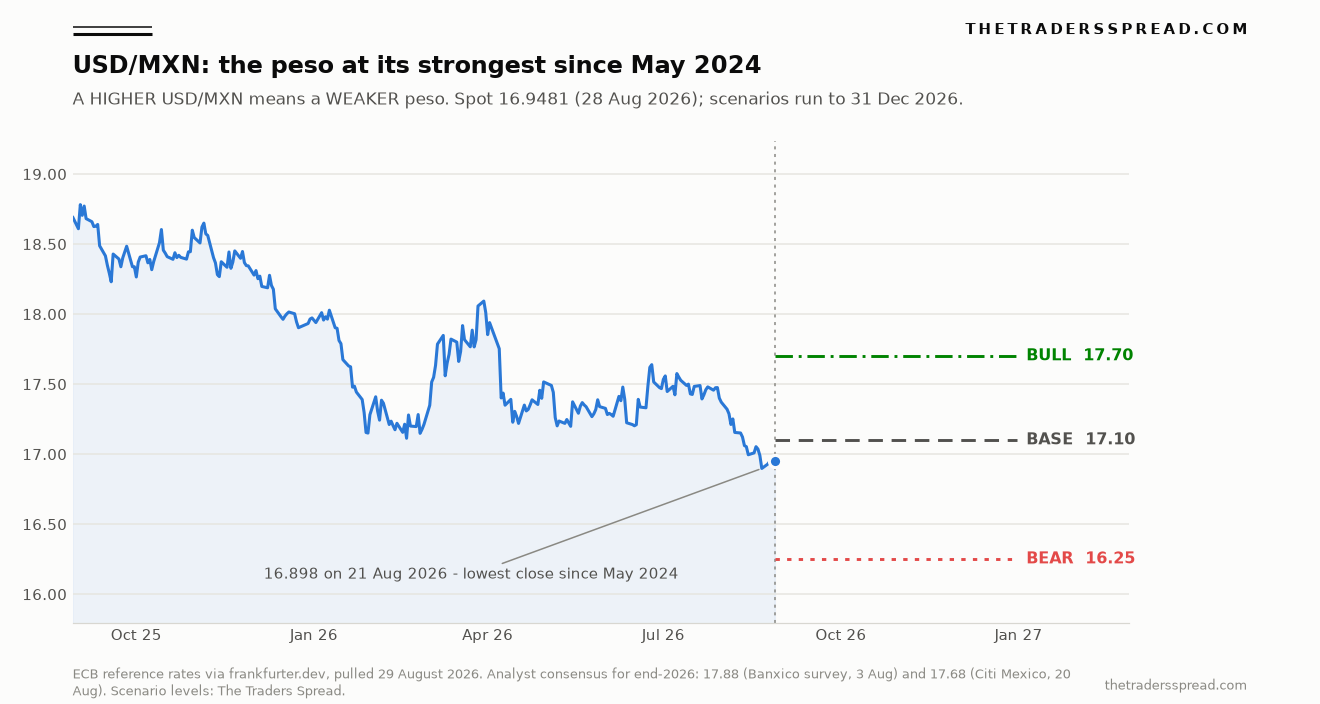
Two features stand out. The first is the slope: USD/MXN has fallen 9.3% over twelve months, from 18.6945 on 29 August 2025, and 19.2% from the cycle high of 20.969 on 9 April 2025. The second is the texture. Realised volatility over the last three months is 6.10% annualised against 7.43% over the full year, and Banxico separately reports that volatility declined in both the fixed-income and foreign exchange markets during the quarter.
Falling volatility alongside a one-way trend is the signature of a carry position that is working and therefore accumulating. It is also what makes the position fragile, because the same compression that flatters risk-adjusted returns encourages larger notional exposure against the same risk budget. The unwind of a crowded carry trade is not symmetric with its accumulation.
| Measure | Mexico | United States |
|---|---|---|
| Policy rate | 6.50% | 3.50%–3.75% |
| Headline inflation | 3.10% (1st fortnight July) | 3.7% (PCE, 12-month) |
| Approximate real policy rate | +3.40% | −0.08% |
| Stated bias | Hold at current level | No commitment; hawkish rhetoric |
| Next decision | 24 September 2026 | 15–16 September 2026 |
Sources: Banxico monetary policy statement, 6 August 2026; Banxico Quarterly Report, 26 August 2026; FOMC implementation note, 29 July 2026; Warsh remarks, 28 August 2026.
Consensus is the other half of the picture. Banxico's own survey of private-sector economists, conducted in July and published on 3 August 2026, has a median end-2026 forecast of 17.88 and an end-2027 median of 18.45. The Citi México survey of 20 August puts the same figures at 17.68 and 18.24. Both were revised lower during the quarter, from 18.10 and 18.60 respectively at the end of March. So forecasters have been chasing the peso stronger all year and still sit 4.3% to 5.5% above spot. That is a consensus that has been repeatedly wrong in the same direction, which is a reason to discount it, but not a reason to invert it. Similar dynamics across Latin American risk assets are visible in our coverage of the Brazilian presidential race.
Trade policy and remittances: the two structural constraints
The peso's rally has a political ceiling that is easy to miss because it operates through flows rather than prices.
Banxico's Quarterly Report contains a finding that cuts against the usual framing of remittances as an unambiguous peso positive. Average remittance income measured in dollars fell in the second quarter, after three consecutive quarters of gains. Measured in real pesos, remittances "continued to decline, derived from the appreciation of the exchange rate". A stronger peso mechanically reduces the domestic purchasing power of every dollar sent home. The flow that is supposed to support the currency is being devalued in real terms by the currency's own strength, which is a self-limiting mechanism and a live political pressure point.
The second constraint is trade policy. Banxico records that "the activation of the annual review mechanism of the T-MEC by the United States prolonged the uncertainty over the regional trade relationship", and notes that while current terms remain in force and Mexican exports keep their preferential treatment, the absence of a definitive resolution "persists as an adverse factor for investment decisions". This is a genuine asymmetry. A favourable resolution largely confirms what markets already assume; an unfavourable one is a repricing event. Mexico has been hedging, and in May 2026 completed the modernisation of its free trade agreement with the European Union, in force since 2000, through a Modernised Global Agreement and an Interim Trade Agreement.
The growth backdrop has improved enough to matter. Banxico raised its 2026 GDP forecast to 1.5% from 1.1%, with a range of 1.0% to 2.0%, on stronger second-quarter activity, and expects 2.0% in 2027. Mexican GDP grew 0.5% in 2025. Quarterly seasonally adjusted increases of 2.44%, 1.64% and 1.36% in primary, secondary and tertiary activity marked a genuine reactivation after a first-quarter contraction. Banxico still expects headline inflation to converge to its 3% target only in the fourth quarter of 2027, which is the clearest argument that it will not be cutting again soon.
The dollar to peso forecast: bull, base and bear cases
All three levels below are derived from live spot of 16.9481 and from one-year realised volatility of 7.43%, which implies a one-standard-deviation move of roughly 4.4% over a four-month horizon to 31 December 2026.
| Scenario | Level | vs spot | Peso | What it requires |
|---|---|---|---|---|
| Bull (USD/MXN higher) | 17.70 | +4.44% above | Weaker | The Fed hikes or signals a hike; the differential compresses from both ends |
| Base | 17.10 | +0.90% above | Broadly flat | Both banks hold; spot converges on the carry-implied forward |
| Bear (USD/MXN lower) | 16.25 | −4.12% below | Stronger | US inflation cools, the Fed's hawkish turn fades, carry continues |
The base case of 17.10 is not a guess. It is approximately the outright four-month forward implied by the 287.5 basis point nominal differential: 16.9481 multiplied by one plus 2.875% of a third of a year gives 17.11. A trader earning the carry and seeing spot finish at 17.10 has broken roughly even. This is the honest neutral outcome and it sits marginally above spot precisely because the peso pays more.
The bull case of 17.70 is one standard deviation higher, and it is also, almost exactly, the Citi México consensus of 17.68 and just below the Banxico survey median of 17.88. To reach it, nothing exotic needs to happen. The forecasting community simply needs to be right for the first time this year. The mechanism would be a Fed that acts on Warsh's stated standard, compressing a differential that Banxico has already committed not to defend.
RelatedGBP/AUD Forecast: 1.9600 Bull Case vs 1.8400 Bear Case
The bear case of 16.25 is one standard deviation lower and would take USD/MXN to levels last seen in the first half of 2024. It requires the US inflation acceleration to reverse, the hawkish repricing to unwind, and the real-rate gap to persist at 3.5 points while volatility stays near 6%.
On balance we lean towards the upper half of that range, which makes this a contrarian position on a twelve-month trend rather than an endorsement of it. The asymmetry has changed even though the carry has not. A position that has worked for eleven months, at a 27-month price extreme, with compressed volatility and a hawkish shift at the reserve currency's central bank, carries a different risk profile than the same position did in January.
What would change our mind. A sustained break below 16.80 on a closing basis would invalidate the framing, since it would mean the market is pricing the real-rate gap as durable rather than cyclical. A September FOMC that holds with dovish language would remove the principal catalyst for the bull case and shift weight towards 16.25. In the other direction, any Banxico language on 24 September that softens the "maintain the reference rate at its current level" formula would be a material change, because the entire structure rests on that sentence. A comparable set-up in a funding currency is covered in our USD/JPY forecast, and the full desk coverage sits on our markets hub.
Frequently asked questions
What is the dollar to peso forecast for the end of 2026?
Our base case is 17.10, which is the carry-implied forward rather than a directional view, with a bull case of 17.70 and a bear case of 16.25. Published consensus is higher: the Banxico survey median is 17.88 and the Citi México survey is 17.68. All of these imply a weaker peso than the 16.9481 spot on 28 August 2026.
Does a rising USD/MXN mean the peso is getting stronger or weaker?
Weaker. The pair quotes the number of Mexican pesos required to buy one US dollar, so a higher number means each dollar buys more pesos and the peso has lost value. When USD/MXN fell from 20.969 in April 2025 to 16.9481 in August 2026, the peso strengthened by about 19%.
Why is the Mexican peso so strong in 2026?
Principally the real interest rate gap. Mexico's 6.50% policy rate against 3.10% inflation produces a real rate near 3.40%, while the US funds range of 3.50%–3.75% against 3.7% PCE inflation produces a real rate near zero. Banxico has also formally ended its easing cycle, removing the expectation of further cuts that had weighed on the currency.
When does Banco de México next set rates?
Thursday 24 September 2026, with announcements published at 13:00 Mexico City time, followed by 5 November and 17 December. The Federal Reserve meets on 15–16 September, 27–28 October and 8–9 December, so the Fed decision precedes the Banxico decision in each of the three remaining rounds of 2026.
What is the biggest risk to the peso between now and year-end?
A hawkish Federal Reserve. Chairman Kevin Warsh told the Jackson Hole symposium on 28 August 2026 that he would "be hard pressed to describe broad financial conditions as restrictive", with headline PCE at 3.7% over twelve months and 4.1% over six. A US hike compresses the differential without Banxico doing anything, and Banxico has said it does not intend to respond.
How volatile is USD/MXN right now?
Unusually quiet. Annualised realised volatility over the past three months is 6.10%, against 7.43% over the past twelve, calculated from ECB daily reference rates. Banxico's Quarterly Report confirms that volatility declined across both fixed-income and foreign exchange markets during the second quarter.
Featured image: Banco de México headquarters, Mexico City. Photo by Juan Carlos Fonseca Mata, CC BY-SA 4.0, via Wikimedia Commons.

Disclaimer
This article is analysis and information only. It is not financial advice, an offer, or a recommendation to transact in any instrument. Levels, scenarios and probabilities are estimates derived from public data and may be wrong. Foreign exchange and CFD trading carries a high risk of loss and is not suitable for every investor. Capital at risk. Always do your own research.