

Having tracked NZD/CHF on this desk, reference by reference, through the Reserve Bank of New Zealand's September decision, I no longer read a higher cash rate as an automatic bid for this cross. On Wednesday 2 September the Monetary Policy Committee lifted the Official Cash Rate by 25 basis points to 2.75 percent. The ECB reference for NZD/CHF that day was 0.47433, down from 0.47748 on Tuesday 1 September. The latest print in the Frankfurter feed, dated Friday 9 October 2026, is 0.46656. Monday 12 October was not in the set when this was pulled. The high for the year is still 0.4792, the Monday 17 August reference. The low is still 0.45601, from Tuesday 7 April. The last seven weeks have handed back part of the summer rally while Wellington was tightening.
The rate gap moved the wrong way for a softer cross, which is why the tape is the part that matters. The Swiss National Bank left its policy rate at 0 percent on 24 September. Martin Schlegel, chairman of the Governing Board, said the franc had depreciated by around 3 percent on a trade-weighted basis since June, in line with wider rate differentials against Switzerland. A higher New Zealand cash rate and a softer franc are the textbook supports for NZD/CHF. From 17 August to 9 October they were not enough. The cross fell 2.6 percent. NZD/USD fell 5.1 percent and USD/CHF rose 2.6 percent. The kiwi did the selling. The franc's decline against the dollar cushioned the cross. A safe-haven reading of this window is a reading of the wrong leg.
Key facts
- NZD/CHF ECB reference 0.46656 on 9 October 2026, against 0.4792 on 17 August and 0.45755 on 2 January — Frankfurter feed of ECB reference rates, retrieved 12 October 2026
- The cross fell on the hike day: 0.47433 on 2 September, from 0.47748 on 1 September, while NZD/USD fell from 0.58910 to 0.58275 — Frankfurter, ECB reference rates, 1 and 2 September 2026
- The OCR is 2.75 percent after a 25 basis point rise on 2 September. June-quarter inflation was 4.1 percent, and 2.9 percent excluding vehicle fuels — Reserve Bank of New Zealand, Monetary Policy Statement published 7 September 2026
- The SNB policy rate was left at 0 percent. The conditional inflation forecast, if that rate holds, is 0.7 percent in 2026 and 0.8 percent in both 2027 and 2028 — Martin Schlegel, Swiss National Bank news conference, 24 September 2026
- Swiss consumer prices were unchanged in September and up 1.0 percent on the year, index 101.5 with December 2025 as 100 — Swiss Federal Statistical Office, 1 October 2026
- If petrol and diesel prices had not changed, New Zealand's CPI would have risen 2.9 percent in the year to the June 2026 quarter, not 4.1 percent — Stats NZ, 21 July 2026
The leg that actually moved
NZD/CHF is a product, not a single opinion. In the ECB reference set it equals NZD/USD multiplied by USD/CHF. On 9 October that was 0.56139 times 0.83107, which lands on 0.46656. On 17 August it was 0.59169 times 0.80989, which lands on 0.4792. Anyone who wants a cause for the cross has to say which factor moved.
17 August was a Monday and 9 October a Friday. Between them the kiwi lost 5.1 percent against the US dollar. The dollar gained 2.6 percent against the franc, which is the franc cheapening. Put the two together and the cross is down 2.6 percent. That is the opposite of a franc bid. USD/CHF rose. The cushion is why the cross did not fall with the kiwi.
From 2 January the cross is up 2.0 percent, 0.45755 to 0.46656, even though NZD/USD is down 2.7 percent, 0.57691 to 0.56139. USD/CHF rose 4.8 percent, 0.79311 to 0.83107. Franc weakness against the dollar has more than offset the kiwi's dollar loss. The 17 August high was the day both lined up the other way: the kiwi firm at 0.59169, the franc not yet at the October level. Since then only the kiwi has reversed.
The NZD/USD forecast is where the dollar leg of the kiwi is written up on its own. It matters here because that leg, not the Swiss one, accounts for the decline since August. The USD/CHF forecast is the other factor in the product. I am not borrowing either page's scenario levels. A view on NZD/CHF that cannot survive a look at both references is a view about a blended price.
The hike day was the same split in one session. NZD/CHF fell 0.7 percent, from 0.47748 to 0.47433, while NZD/USD fell 1.1 percent and USD/CHF rose 0.4 percent. The cash rate went up and the cross finished lower. Friday 2 October then printed 0.4639, the spring-to-date low, and 9 October's 0.46656 is only about 0.6 percent above it. From 0.47459 on 11 September the cross is down 1.7 percent, again with the kiwi's dollar rate doing more of the falling than the franc did of the rising.
Wellington hiked, Zurich did not
Fuel, not a broad re-acceleration, is why New Zealand's headline is outside the band. Stats NZ said on 21 July that the CPI rose 4.1 percent in the year to the June 2026 quarter, after 3.1 percent to March. The band is 1 to 3 percent. Nicola Growden, prices and deflators spokesperson at Stats NZ, said higher petrol prices accounted for almost a quarter of that 4.1 percent. Petrol was up 27.5 percent on the year. Diesel was up 71 percent. Had petrol and diesel not changed, the CPI would have risen 2.9 percent. The June quarter itself was 1.5 percent, and Growden said those two fuels were almost two-thirds of it. The September quarter, scheduled for 22 October, is the test of whether the split survives.
The Committee judges that gradually removing monetary stimulus is appropriate to return inflation to the 2 percent target mid-point while supporting growth and employment.
That sentence is from the policy assessment signed by Anna Breman, Governor, in the September Monetary Policy Statement. The same text says lifting the OCR to 2.75 percent was meant to return inflation to the midpoint without unnecessary instability in output, employment, interest rates, and the exchange rate. Excluding vehicle fuels, June inflation was 2.9 percent. The Committee looks for a return to the 1 to 3 percent band by mid-2027, and it is not trying to sponsor a stronger kiwi on the way.
The room was not of one mind. Hayley Gourley, Karen Silk, Prasanna Gai and Anna Breman saw upside inflation risks if energy stays high and firms lift domestic prices by more than import costs. Paul Conway, the Bank's chief economist, and Carl Hansen saw inflation risks as balanced and activity risks skewed down, through weak house prices and cautious households. Everyone agreed the activity risks were serious, that the OCR may need to rise further, and that the path is not pre-set. Export income is the firm part of the economy in that statement. Household spending, Auckland and Wellington especially, is the soft part. On 2 September, NZD/CHF fell.
Zurich did not follow Wellington up. At the 24 September news conference in Berne, Schlegel said the policy rate stayed at 0 percent, with sight deposits paid at that rate up to a threshold and a 0.25 percentage point discount above it. The Bank remains willing to act in foreign exchange if monetary conditions require it. Inflation had gone from 0.6 percent in May to 0.8 percent in August. The conditional forecast, on an unchanged 0 percent rate, is 0.7 percent for 2026 and 0.8 percent for 2027 and for 2028, inside the 0 to 2 percent range the SNB calls price stability.
The franc, he said, was about 3 percent weaker on a trade-weighted basis than at the June assessment, alongside wider rate gaps versus Switzerland. Antoine Martin, vice chairman, noted that the euro area and the United States had raised key rates, with energy still holding inflation up in many countries. Petra Tschudin, a Board member, put 2026 growth between 1.5 and 2 percent, and 2027 around 1.5 percent. A week later the Federal Statistical Office put September inflation at 1.0 percent, index unchanged on the month at 101.5 (December 2025 = 100). That 1.0 percent rate is above the 0.8 percent Schlegel cited, still inside the band, and it does not, on the Bank's forecast, force a hike.
One range, and the levels on it
The chart is the ECB reference for NZD/CHF from 2 January to 9 October 2026, drawn out to 31 December only so the scenario lines have length. The dot is the 9 October print. Nothing after that date is a price.
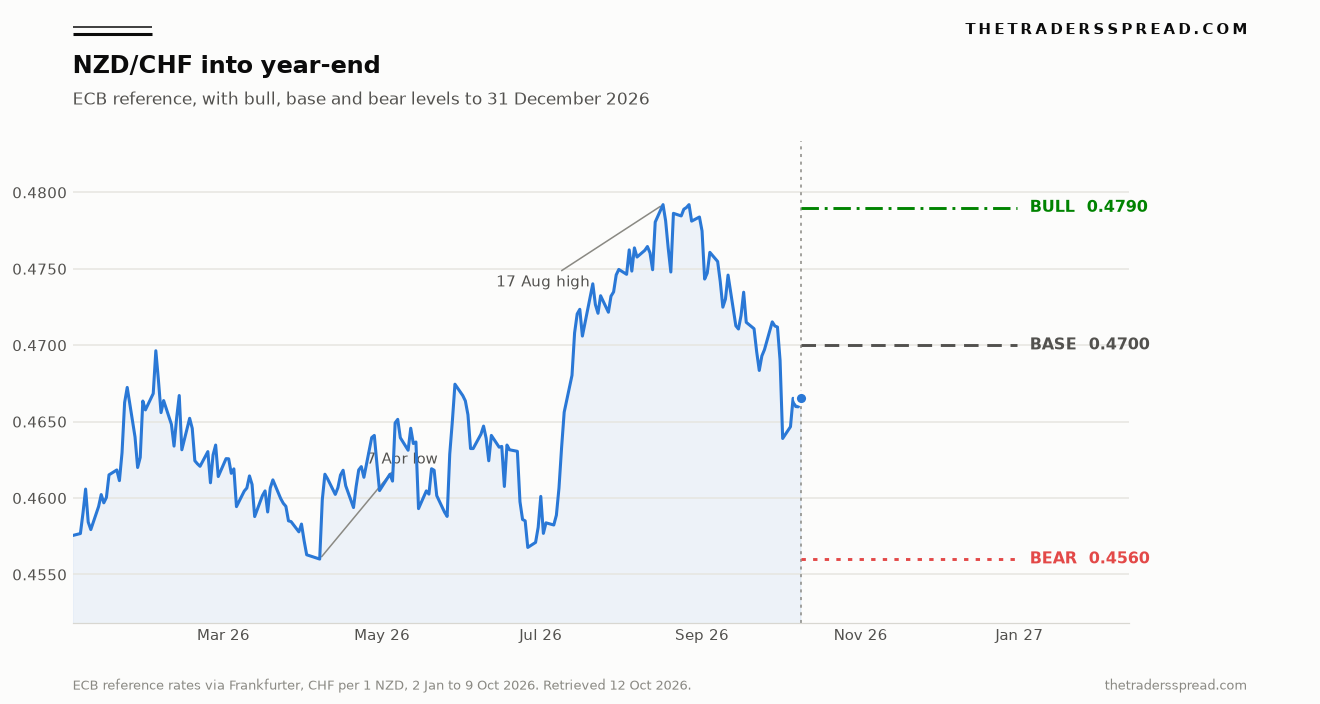
Three levels, and the spot they are measured from.
| Scenario | Level | Distance from 0.46656 | What it lines up with |
|---|---|---|---|
| Bull | 0.4790 | +2.7 percent | Two pips under the 17 August high of 0.4792 |
| Base | 0.4700 | +0.7 percent | The late-September cluster, 0.46835 on 23 September to 0.47153 on 28 September |
| Bear | 0.4560 | −2.3 percent | The 7 April low of 0.45601 |
0.4790 is two pips under a high already printed, so the bull case is a retest, not a new regime. It needs the kiwi's dollar slide to stop and the franc to stay cheap against the dollar. 0.4700 is the smaller repair, back into the late-September band, and it only needs 0.4639 to have been a pause. 0.4560 restates the April low. No 2026 reference has printed below 0.45601. A finish there would wipe out the year's 2.0 percent gain. The rate gap, taken on its own, does not point there.
| Window | NZD/CHF | NZD/USD | USD/CHF |
|---|---|---|---|
| 2 January to 9 October | 0.45755 to 0.46656, +2.0 percent | 0.57691 to 0.56139, −2.7 percent | 0.79311 to 0.83107, +4.8 percent |
| 7 April, the 2026 low | 0.45601 | 0.57024 | 0.79969 |
| 17 August to 9 October | 0.4792 to 0.46656, −2.6 percent | 0.59169 to 0.56139, −5.1 percent | 0.80989 to 0.83107, +2.6 percent |
| 1 to 2 September | 0.47748 to 0.47433, −0.7 percent | 0.58910 to 0.58275, −1.1 percent | 0.81053 to 0.81396, +0.4 percent |
| 11 September to 9 October | 0.47459 to 0.46656, −1.7 percent | 0.58210 to 0.56139, −3.6 percent | 0.81530 to 0.83107, +1.9 percent |
One comparison uses cash-rate arithmetic, and it is not a market forward. The OCR is 2.75 percent and the SNB rate is 0 percent. Over the 53 days from 17 August to 9 October that gap accrues about 0.4 percent, before spreads. The spot decline was 2.6 percent. On this crude measure, the gap did not pay for the move. The OCR reached 2.75 percent only on 2 September, so the accrued gap is smaller than 0.4 percent, not larger.
Who is on the other side
The other side of this reading is not foolish. It says the kiwi's dollar slide is the live impulse, that a higher OCR already failed once as same-day support, and that franc cheapening can stop.
Nothing in the September statement says the NZD/USD drop is finished. Financial conditions had already tightened into that meeting, including a small exchange-rate appreciation on expected OCR rises, and the decision day still closed with this cross lower. The OCR page sets the next review for 2:00pm on 28 October, and a full statement for 9 December. The 22 October CPI sits in front of both. A fuel-heavy print supports gradualism. A rise in the ex-fuel rate gives Conway and Hansen's activity worries and the inflation worries of Gourley, Silk, Gai and Breman something each. The exchange rate can be pulled both ways.
Schlegel left the door open to foreign-exchange operations, and he said the medium-term forecast is a bit higher than in June partly because the franc weakened. With Swiss CPI at 1.0 percent, the Board can decide the cheapening has gone far enough without that becoming a hike. The USD/CHF rise that has cushioned NZD/CHF need not last. The same franc question is in the EUR/CHF forecast. I am not taking its levels. Whether the franc keeps cheapening is only half of NZD/CHF. The other half is the kiwi against the dollar.
The year still has the opposite sign from the last seven weeks. The cross is 2.0 percent above 2 January and 2.3 percent above the April low, after giving back 2.6 percent from August. The bear case is a return to that low. The bull case is a retest of a high already printed. The heavier weight, after a hike the cross sold, is still a repair toward 0.4700.
Base, bull and bear into 31 December
The bias is bullish, conviction 3 out of 5. The level on that bias is 0.4790. The heaviest weight sits on a base of 0.4700 by 31 December 2026, not on the upside case. These are desk weights, not a model and not a market price: about 30 percent nearer 0.4790, about 45 percent nearer 0.4700, about 25 percent nearer 0.4560. The bias is bullish because the base and the bull case both sit above the 9 October reference of 0.46656. The bear case sits below it.
RelatedCAD/JPY Forecast: 115.30 Bull Case vs 107.50 Bear Case
The base path climbs back into the late-September band and stops short of August. It fits a September-quarter CPI that still looks like fuel, a 28 October review that does not restart the kiwi's dollar slide, and a franc soft enough that USD/CHF keeps most of this year's rise. It needs 0.4639, the 2 October reference, to hold. It does not need a full recovery in NZD/USD.
The bull path retests 0.4790, two pips under the 17 August high of 0.4792. That asks the kiwi to take back a real piece of a 5.1 percent dollar loss while the SNB's foreign-exchange line stays a line. I can hold the bullish bias without that retest. The 0.4790 figure is the upside the bias points at. The centre is 0.4700.
The bear path is 0.4560, against the 7 April low of 0.45601. It is what follows if the kiwi's dollar slide keeps the lead and the franc cushion thins: a review read as a growth tax, an ex-fuel CPI that rises, or an SNB that leans against franc weakness. Any one of those is enough. I would retire the bullish reading at 0.4560, not before. References through 0.4639 would make the repair early, and the conviction would fall first. If, before the December statement, NZD/USD has already reversed far enough that the product of the two factors is near 0.4790, the bull case becomes the centre. Until that print exists, 0.46656 on 9 October is the reference for all three.
Questions the cross actually raises
What is the NZD/CHF forecast into the end of 2026?
The bull case is 0.4790 and the bear case is 0.4560, set against the ECB reference of 0.46656 on 9 October 2026. The heavier weight sits near 0.4700 by 31 December. Those are scenario levels for Swiss francs per New Zealand dollar. They are not a suggestion to transact, and they are not a traded quote. The feed had no 12 October reference when the levels were set.
Why did NZD/CHF fall when the RBNZ raised the cash rate?
On 2 September the OCR rose by 25 basis points to 2.75 percent, and the NZD/CHF reference fell from 0.47748 to 0.47433. The same day NZD/USD fell from 0.58910 to 0.58275, while USD/CHF rose from 0.81053 to 0.81396. The cross dropped because the kiwi's dollar rate dropped by more than the franc cheapened. A higher cash rate was not, on that ECB print, a same-day bid for the pair.
How does a Swiss policy rate of 0 percent sit under the cross?
The SNB held the policy rate at 0 percent on 24 September. Its conditional forecast, if the rate stays there, is 0.7 percent inflation in 2026 and 0.8 percent in 2027 and 2028, inside the 0 to 2 percent band it calls price stability. The gap versus the New Zealand cash rate is 2.75 percentage points. Since 17 August that gap has not offset the 2.6 percent spot decline in NZD/CHF.
Which releases come before year-end?
Stats NZ is due to publish the September-quarter CPI on 22 October 2026. The Reserve Bank's next OCR review is at 2:00pm on 28 October, and a Monetary Policy Statement follows on 9 December. Swiss September inflation is already out: the index was unchanged on the month and up 1.0 percent on the year, in the Federal Statistical Office release of 1 October. The SNB's September forecast did not include that 1.0 percent print.
When does the bullish reading fail?
A reference at 0.4560 would retire it. That is the bear case, lined up with the 7 April low of 0.45601. Nearer than that, the 2 October reference of 0.4639 is the low of the recent slide. ECB prints through 0.4639 would say the kiwi's dollar slide is still in charge, and that a repair toward 0.4700 or 0.4790 is early. The conviction would come down before the bear case moved.
Is NZD/CHF just NZD/USD under another name?
No. From 17 August to 9 October, NZD/USD fell 5.1 percent and NZD/CHF fell 2.6 percent, because USD/CHF rose 2.6 percent. The franc cheapened against the dollar and absorbed part of the kiwi's fall. The two pairs can fall together and still disagree on the size. For the year to 9 October they disagree on the sign as well: the cross is up 2.0 percent and the kiwi's dollar rate is down 2.7 percent.
Disclaimer
This is analysis, not advice, and it is not a recommendation to take a position in NZD/CHF or in any other instrument. Scenario levels are judgements about ECB reference rates. They can be wrong, and the rate can move through them. References are not live tradable quotes. Capital is at risk.