

What is the platinum market actually pricing at $1,764 an ounce? Not the deficit. A market that believed in a fourth consecutive annual shortfall would not have taken the metal 37% below its January record and left it there for seven months. The price is pricing something narrower and more specific: the possibility that the shortfall which has drained platinum's above-ground stocks since 2023 is no longer being caused by industry at all. Platinum spot was $1,764.00/oz when we pulled it from gold-api.com at 16:16 GMT on 2 September 2026. That is 11% below the $2,000 level the World Platinum Investment Council described as price support when it published its last quarterly on 18 May. The market has quietly voted against that floor, and the reason is visible in the Council's own table.
Strip investment demand out of the 2026 forecast entirely and the arithmetic changes sides. Total supply of 7,377 koz against automotive, jewellery and industrial demand of 7,155 koz leaves a 222 koz surplus. Run the same subtraction on prior years and a trend appears: the ex-investment platinum market ran a 409 koz deficit in 2023, a 319 koz deficit in 2024, a 54 koz deficit in 2025, and is forecast to flip into surplus this year. Every one of those figures comes from Table 1 of the WPIC Platinum Quarterly Q1 2026, prepared by Metals Focus. The headline 297 koz deficit is real. It is also, for the first time in this cycle, entirely a product of what investors do rather than what factories consume.
Key facts
- Platinum spot $1,764.00/oz, 37% below the 23 January 2026 record and 19% lower year-to-date — gold-api.com XPT, 2 September 2026; series shape from PPLT closes.
- Forecast 2026 market deficit 297 koz, down from a record 1,191 koz in 2025 — WPIC/Metals Focus, Platinum Quarterly Q1 2026, 18 May 2026.
- Above-ground stocks fall to 1,747 koz by end-2026, under three months of demand cover, from 4,268 koz at end-2023 — a 59% drawdown in three years (same source).
- Mine supply 5,551 koz, flat year-on-year, after platinum prices roughly doubled during 2025. All of 2026's 2% supply growth is recycling (same source).
- Investment demand collapses 54% to 519 koz, as 2025's ETF and exchange-warehouse inflows reverse by 100 koz each (same source).
- Q1 2026 recorded a 268 koz surplus, the first quarterly surplus since Q3 2024, on 255 koz of ETF outflows and a 119 koz CME warehouse drawdown (same source).
- Chinese retail bar and coin demand grew from about 31 koz in 2019 to just over 400 koz in 2025 — WPIC, Shanghai Platinum Week 2026 release, 16 July 2026.
The deficit is real. Its composition is not what it was.
For three years the platinum bull case rested on a simple sentence: the market consumes more platinum than it produces. That sentence is still true in aggregate, and the cumulative effect has been severe. Above-ground stocks stood at 4,268 koz at the end of 2023 and are forecast to end 2026 at 1,747 koz, which the Council translates as just under three months of global demand cover.
The composition has changed underneath the headline. In 2023 and 2024 the shortfall was driven by end-use: autocatalysts alone absorbed 3,204 koz and 3,108 koz respectively, jewellery was recovering, and industrial demand was running above 2,490 koz. Investment flows were a rounding error against that. By 2026, automotive demand is forecast at 2,959 koz, jewellery at 1,958 koz after a 12% fall, and industrial at 2,238 koz. Add those and you get 7,155 koz against 7,377 koz of supply.
That is the number the price is trading on.
None of this makes the Council wrong. Trevor Raymond, Chief Executive Officer at the World Platinum Investment Council, put the structural case plainly at Shanghai Platinum Week in July: "On current fundamentals, the value proposition for platinum remains compelling. The platinum market is forecast to record its fourth consecutive deficit in 2026, leading to further depletion of above ground stocks, with just under three months' worth of cover to meet global demand now expected by the end of 2026." Stock cover of under a quarter's consumption is a genuinely tight physical position, and it does not become less tight because the marginal buyer changed identity. But an investor-driven deficit behaves differently from an industrial one. Factories buy at any price because they must. Investors buy when the chart cooperates, and in 2026 it has not.
Supply cannot answer a price signal
The single most important fact about platinum supply is that it did nothing at all when the price doubled.
WPIC forecasts refined production of 5,551 koz in 2026, unchanged from 5,557 koz in 2025 and below 2024's 5,777 koz. South Africa, which is roughly 72% of primary output, edges up 1% to 4,005 koz. Russia falls 5% to 646 koz. Zimbabwe falls 2% to 508 koz. North America falls 5% to 201 koz. Public company guidance, in the Council's phrasing, collectively indicates stable output. A metal that opened January 2025 near $944 and peaked at $2,816 a year later produced no additional refined ounces at all.
Ivanhoe's Platreef is the first greenfield platinum project commissioned in South Africa since Styldrift in 2019. Seven years, one new mine. Deep-level shafts take the better part of a decade to sink, the orebody is concentrated in two countries, and the capital decisions behind 2026 output were taken when the price was a third of today's. Patrick Morutlwa, Group Chief Operating Officer at Impala Platinum, framed the producers' position at the same event: "PGM price cycles can have long 'winters' and short 'summers', but we believe our strong balance sheet and wide suite of quality brownfield projects ensure the sustainability of our refined output to support future demand requirements." Sustaining refined output is not the same undertaking as growing it, and the guidance says so.
The only elastic part of supply is recycling, forecast up 9% to 1,826 koz, of which spent autocatalysts contribute 1,365 koz. Even that response is thinner than it looks. Recyclers told Metals Focus during Q1 that they were receiving lower-grade spent autocatalysts, which suggests scrapyards are working through material hoarded when prices made it uneconomic to process in 2023 and 2024. If the recycling chain is drawing on inventory and still only managing 9%, the three-to-five-year growth path for secondary supply is softer than the consensus assumes. That asymmetry is the spine of the bull case, and it is the same inelasticity argument we made for copper at $7.50 against $5.60, where the constraint is smelting rather than shaft-sinking.
Where the ounces actually go
Autocatalyst demand is the segment everyone expects to die, and it keeps not dying quickly. WPIC forecasts a 2% decline to 2,959 koz in 2026, against BEV production growth of 14%. The offset is regulation: Euro 7 arrives in November 2026 and requires higher PGM loadings per vehicle; US Tier 4 is expected in January 2027 with tighter limits on NOx, CO and hydrocarbons; China 7 pulls the same direction. European platinum automotive demand falls 7% to 878 koz. North America rises 2% to 464 koz on a 17% jump in light hybrids and a 16% rise in catalysed heavy-duty output. Japan drops 15% to 255 koz. China gains 1% to 542 koz on a 40% jump in fuel-cell heavy vehicles.
Hybrids are the reason the decline is 2% rather than 12%. A hybrid carries a catalyst; a battery-electric vehicle does not. Every quarter that consumers pick a hybrid over a BEV buys the platinum autocatalyst book another year, which is worth holding in mind alongside the pace of pure-BEV deployment at the front of that transition.
| Segment (koz) | 2023 | 2024 | 2025 | 2026f | 2026 change |
|---|---|---|---|---|---|
| Automotive | 3,204 | 3,108 | 3,031 | 2,959 | -2% |
| Jewellery | 1,849 | 2,008 | 2,214 | 1,958 | -12% |
| Industrial | 2,491 | 2,526 | 2,049 | 2,238 | +9% |
| Investment | 388 | 713 | 1,136 | 519 | -54% |
| Total supply | 7,135 | 7,323 | 7,240 | 7,377 | +2% |
| Balance | -799 | -1,033 | -1,191 | -297 | |
| Balance excluding investment | -409 | -319 | -54 | +222 |
Source: WPIC/Metals Focus, Platinum Quarterly Q1 2026, 18 May 2026. Ex-investment balance calculated by The Traders Spread from the same table.
Industrial demand is the segment doing the heavy lifting, up 9% to 2,238 koz, with glass alone rebounding 83% to 377 koz off a collapsed 2025 base and electrical up 20% to 119 koz. The longer-dated version of that story is China. Almost US$300 billion is earmarked for AI infrastructure under the 15th Five-Year Plan, and platinum sits inside a wide spread of those applications: crucibles for growing crystals used in optical interconnects, thin-film coatings on semiconductors and sensors, silicone production, hard disk drives, electronic-grade glass fabrics for circuit boards, and fuel cells for data-centre backup power. The plan also doubled China's fuel-cell vehicle target to 100,000 units by 2030.
Twelve months of price, and the levels that frame the next two quarters
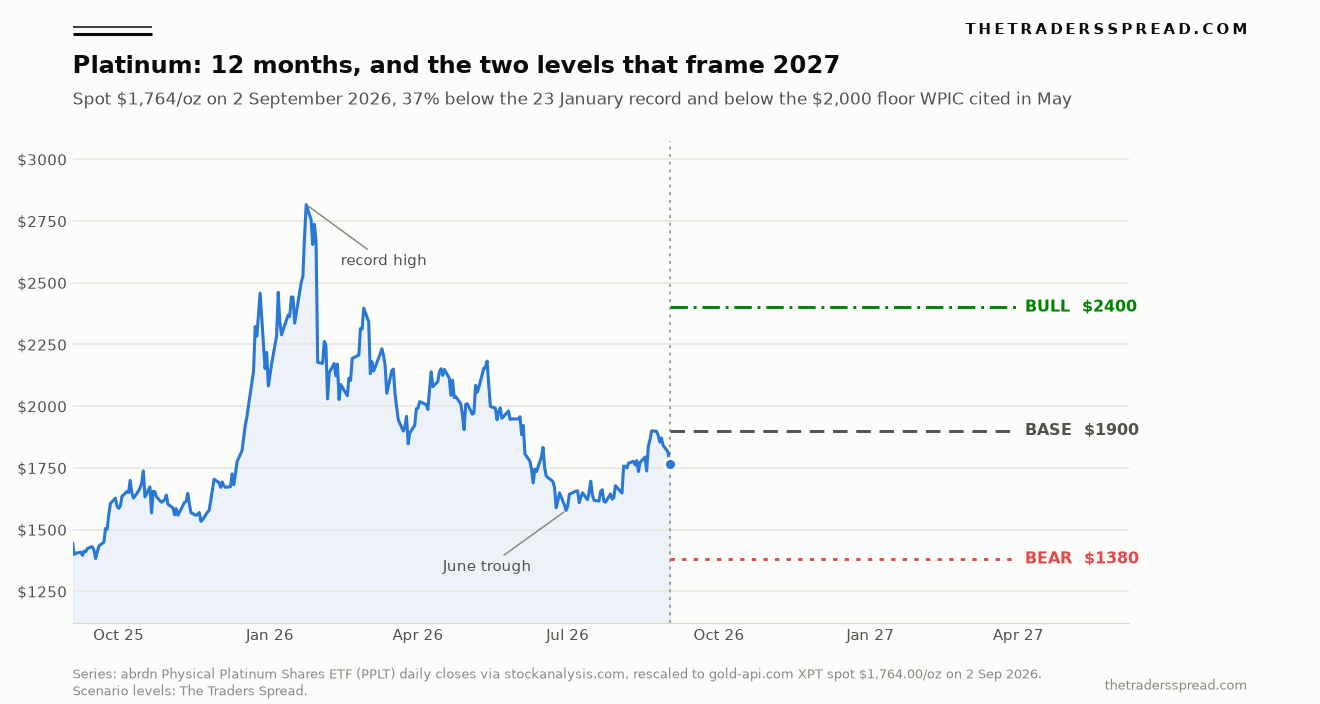
The shape of the year is unmistakable. Platinum opened 2026 around $2,172, ran to $2,816 on 23 January, and then gave back the entire rally and more. By 30 June it had traded down to roughly $1,578. The 12-month low is about $1,383, set on 17 September 2025, before the rally began. Today's $1,764 sits 28% above that low and 37% below the high, which is a wide enough band to make anchoring on either extreme a mistake. The path in this chart is built from PPLT closing prices rescaled to the live spot print, since no free daily series of LBMA platinum fixings is publicly available; it agrees with WPIC's independent description of an all-time high in January 2026 and a doubling of the price through 2025.
Two dates matter more than the rest. On 28 February 2026 the US and Israel struck Iran; Brent rose 55% over the following weeks while platinum fell 16% and gold fell 13%, as energy-driven inflation raised rate expectations and non-yielding metals lost their bid. And on 18 May, when WPIC published the quarterly that identified $2,000 as support, platinum was trading at about $1,992. It has spent most of the period since below that line.
Who is selling
Q1 2026 answered this question in detail, and the answer is not producers. Platinum ETF holdings fell 255 koz over the quarter, with South African funds leading the reduction and North American funds down 108 koz. Exchange warehouse stocks fell a further 119 koz, mostly out of CME vaults, as tariff anxiety eased following the January interim decision in the Section 232 critical-minerals investigation and the fat New York EFPs of 2025 compressed. Those two lines alone turned a market that had run six consecutive quarterly deficits into a 268 koz surplus.
Retail went the other way. Bar and coin demand rose 42% year-on-year to 105 koz in Q1, led by Japan and China, and WPIC forecasts 533 koz for the full year, a six-year high. Chinese retail large-bar demand has gone from under one tonne in 2019 to almost 13 tonnes in 2025. Beijing's Caibai, the largest gold bar and coin retailer in northern China, signed an agreement with WPIC in July to stock a platinum investment bar series for the first time.
One friction is worth watching because it is not in any headline number. Platinum lease rates remain well above historical norms, and WPIC's product partners in Europe and North America reported that elevated leasing costs made it prohibitively expensive to fabricate small bars and coins during Q1. US net retail purchases almost halved to 17 koz partly for that reason. High lease rates are a symptom of physical scarcity in the loco-London market, and they simultaneously suppress the retail demand that scarcity should be attracting. The bull case needs that knot to loosen.
New price discovery is arriving from an unfamiliar direction. The Guangzhou Futures Exchange launched platinum and palladium contracts in November 2025; its first contracts expired in June 2026 with 2,276 kg of platinum delivered, and institutional investors account for 61% of platinum open interest. For context on how a domestic Chinese venue can reshape a metal's pricing behaviour, the pattern rhymes with lithium carbonate's move onto Guangzhou pricing.
Base, bull and bear
Base case, $1,900. The physical market is tight in stock terms and loose in flow terms, and those two facts fight to a draw. Mine supply cannot grow, recycling grows slowly, and the ex-investment balance is a modest surplus. A drift back toward the $2,000 shelf over two to three quarters, without reclaiming it decisively, is what the current fundamentals support. Probability weight: roughly 45%.
Bull case, $2,400. This requires investment flows to turn, and there are three plausible triggers: an easing rate path that restores the bid for non-yielding metals, a Section 232 outcome that re-prices US platinum against loco-London, or Chinese retail and institutional demand scaling as GFEX opens further to international participants. Above-ground stocks of 1,747 koz cannot absorb a genuine investment bid; that is the whole point of three months' cover. The 9 September Platinum Quarterly is the next scheduled test. Probability weight: roughly 30%.
RelatedAntimony Price Prediction: 112,000 Yuan Bull vs 94,000 Bear
Bear case, $1,380. The ex-investment surplus of 222 koz persists, jewellery keeps contracting at 12%, ETF and warehouse outflows overshoot the 200 koz WPIC assumes, and platinum retraces to the level it held before the 2025 rally began. Nothing about that path requires a demand shock. It only requires investors to keep doing in Q3 and Q4 what they did in Q1. Probability weight: roughly 25%.
What would change our mind: a producer cutting guidance, which would remove the ex-investment surplus at a stroke; three consecutive months of ETF inflows; or lease rates normalising while the price holds, which would signal the physical squeeze is resolving through supply rather than through demand destruction. A daily close above $2,050 invalidates the bear framing. A weekly close below $1,380 invalidates the bull one. We track platinum and the rest of the metals complex on the markets hub, alongside our current work on gold's $5,050 and $3,960 cases and silver at $69.57.
Platinum FAQ
Why is platinum falling if the market is in deficit?
Because the 2026 deficit of 297 koz is smaller than 2025's 1,191 koz and is composed differently. Automotive, jewellery and industrial demand together total 7,155 koz against 7,377 koz of supply, a 222 koz surplus. The headline shortfall exists only once investment demand of 519 koz is added, and investment flows respond to price rather than driving it.
How much platinum is left in above-ground stocks?
WPIC forecasts 1,747 koz at end-2026, down from 2,044 koz at end-2025 and 4,268 koz at end-2023. That is just under three months of global demand cover. The Council has said a series of material annual surpluses would be needed to rebuild those stocks to sustainable levels, and no such surplus is currently forecast.
Does the shift to electric vehicles kill platinum demand?
More slowly than headline BEV growth implies. WPIC forecasts automotive platinum demand down only 2% in 2026 to 2,959 koz despite 14% BEV production growth, because hybrids carry catalysts and because Euro 7 in November 2026 and US Tier 4 in January 2027 both raise PGM loadings per vehicle.
Why can't miners produce more platinum at these prices?
Deep-level underground mining has multi-year lead times and the reserves sit largely in South Africa, Zimbabwe and Russia. Ivanhoe's Platreef is the first greenfield South African project commissioned since Styldrift in 2019. Refined production is forecast flat at 5,551 koz in 2026 after prices roughly doubled during 2025.
What is the next scheduled catalyst for platinum?
WPIC publishes its next Platinum Quarterly on 9 September 2026, which will carry Q2 actuals and a revised full-year balance. The key line to read is whether the investment forecast of 519 koz has been cut again, since that single number determines whether 2026 prints a deficit at all.
What do platinum lease rates tell you?
They measure the cost of borrowing physical metal in London, and they have stayed well above historical norms through 2026. Elevated rates signal genuine physical tightness, but they also raised fabrication costs enough that WPIC's partners struggled to mint small bars and coins, which held US net retail purchases to 17 koz in Q1.
Sources: WPIC Platinum Quarterly Q1 2026, prepared by Metals Focus, published 18 May 2026; WPIC Shanghai Platinum Week 2026 news release, 16 July 2026; gold-api.com XPT spot, 2 September 2026; PPLT daily closes via stockanalysis.com.
Disclaimer: This article is analysis and information only. It is not investment advice, a recommendation, or an offer to transact in any instrument. Scenario levels are our own estimates and may be wrong. Trading commodities and derivatives carries risk, and capital is at risk. Readers are responsible for their own research and may wish to seek independent professional advice.