

GBP/CAD has spent a year leaning on the same ceiling, and the lean has a count behind it. I pulled every European Central Bank reference rate for the pair from October 7, 2025 through October 6, 2026, 255 fixes in all. The low was 1.8121 on March 9. The high was 1.9032 on July 7. The latest fix, still October 6 when I re-pulled the series on October 7, is 1.8918. That print sits 0.0114 under the high and 0.0797 above the low, which is 87.5% of the distance from one to the other. Only 10 of the 255 fixes have been at or above 1.8918. Eight fell between July 3 and July 16, one printed on August 5 at 1.8934, and the tenth is October 6. From July 17 through October 5, all 57 fixes landed between 1.8615 and 1.8934. October 6 is 0.0016 under that August print. It is another visit to the top of a band, not a breakout.
The level itself checks out. On the same October 6 fix, one pound bought 1.3276 US dollars and one US dollar bought 1.425 Canadian dollars. Multiply those and the product is 1.89183, which is the direct GBP/CAD rate of 1.8918 at four decimal places. The euro route agrees: EUR/CAD at 1.6058 divided by EUR/GBP at 0.8488 also comes out at 1.8918 at four decimals. The direct quote, the dollar legs and the euro legs are the same print. What they do not support is a story in which sterling has been the strong currency. Over that year GBP/USD fell from 1.3405 to 1.3276, down 0.96%, while USD/CAD rose from 1.3955 to 1.425, up 2.11%. GBP/CAD rose 1.13%, from 1.8706 to 1.8918, because the Canadian dollar weakened against the US dollar by more than sterling did.
Key facts
- The ECB reference rate for GBP/CAD was 1.8918 on October 6, 2026, still the latest fix when the series was re-pulled on October 7, 2026. Source: European Central Bank reference rates via Frankfurter, October 7, 2026.
- Across 255 reference dates from October 7, 2025 to October 6, 2026, the low was 1.8121 on March 9 and the high was 1.9032 on July 7. The October 6 fix is 87.5% of the way from that low to that high. Source: Frankfurter series of ECB rates, October 7, 2026.
- On October 6, GBP/USD was 1.3276 and USD/CAD was 1.425. Their product, 1.89183, matches the direct GBP/CAD fix at four decimals. Source: ECB reference rates via Frankfurter, October 6, 2026.
- The Bank of Canada overnight target is 2.25%. The Bank held it on September 2, 2026. The remaining 2026 dates are October 28, with a Monetary Policy Report, and December 9. Source: Bank of Canada, September 2, 2026, and its policy-rate schedule.
- Bank Rate is 3.75%, 1.50 percentage points above the Canadian target. The committee held it on September 17, 2026 by 6-3, with three members preferring 4%. Next announcement: November 5, 2026. Source: Bank of England minutes, September 17, 2026.
- Canada's consumer price index rose 3.0% in the 12 months to August 2026. Gasoline rose 22.8%. Excluding gasoline, the index rose 2.4%. Source: Statistics Canada, September 14, 2026.
- UK CPI rose 3.1% in the 12 months to August 2026, up from 2.9% in July. Motor fuel rose 23.0%. Core CPI was 2.6%, unchanged from July. Source: Office for National Statistics, September 16, 2026.
Ten prints at the ceiling, then a band
The chart is that 255-day file. The lines run to December 31 only so the scenarios are visible. They are not orders.
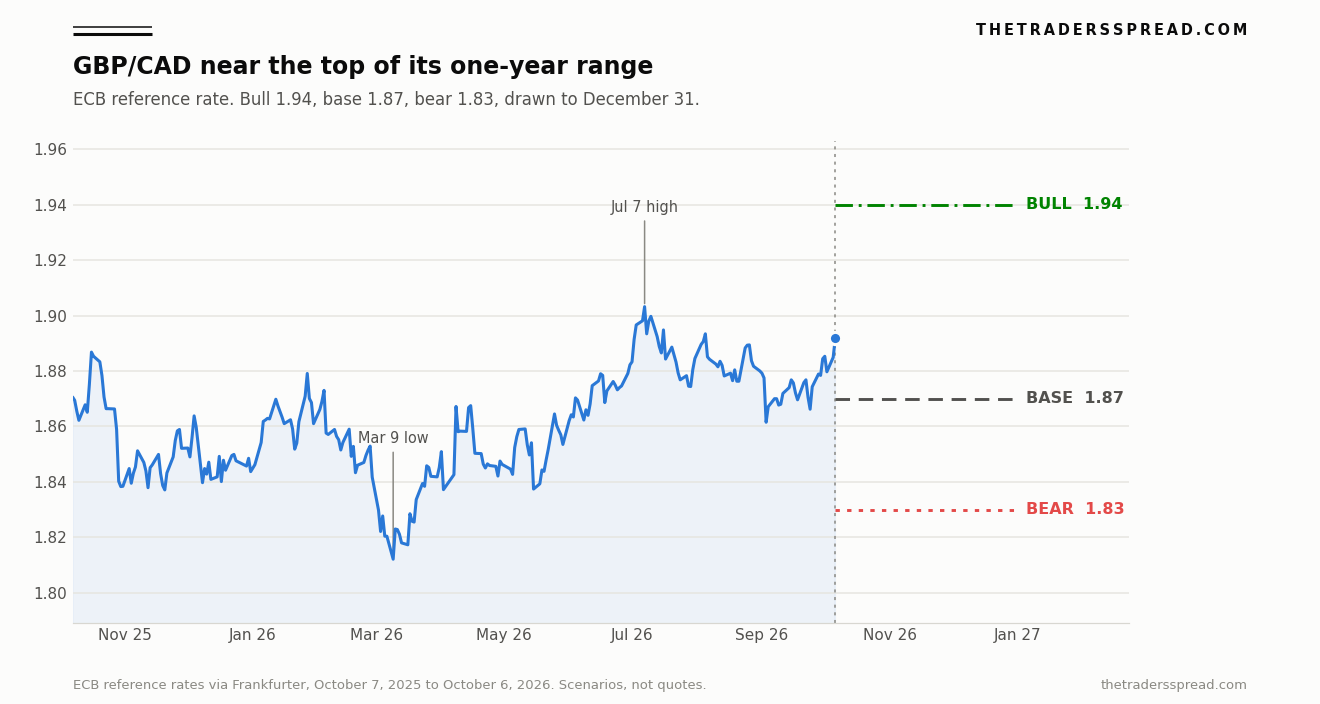
A print near a high can mean the market now lives there, or that it keeps touching a shelf. The count says the shelf. Ten fixes out of 255 is about 4% of the year, and eight of those ten were a July cluster. Since then the cross has been allowed up to 1.8934 once, on August 5, and back to 1.8918 on October 6.
| Scenario | Level | Versus the October 6 fix | Where it sits in the year |
|---|---|---|---|
| Bull | 1.94 | 2.55% above 1.8918 | 0.0368 above the July 7 high of 1.9032 |
| Base | 1.87 | 1.15% below 1.8918 | Inside the post-July band, still above the year's average of 1.8612 |
| Bear | 1.83 | 3.27% below 1.8918 | 0.0179 above the March 9 low, and below the September 3 low of 1.8615 |
The mean of the 255 fixes is 1.8612, so 1.8918 sits 0.0306 above a typical print. A drift to 1.87 would not return the cross to that average. It would step off the ceiling into the band that already held every fix from July 17 through October 5. From the March low to the July high the cross rose 5.03%. Another 2.55% to 1.94 is a move this pair has shown it can make. The last three months have not made it.
That is the range. The legs explain who did the work.
From the March 9 low, GBP/CAD went from 1.8121 to 1.8918, up 4.40%. Over those same dates GBP/USD went from 1.3354 to 1.3276, down 0.58%, and USD/CAD went from 1.357 to 1.425, up 5.01%. Almost the entire rebound is a weaker Canadian dollar.
The desk's September USD/CAD forecast put a bull case at 1.4250. The October 6 fix is 1.425, so that leg is on the number. The GBP/USD forecast from August put a bull case at 1.4050 and a bear case at 1.3050. At 1.3276, sterling against the dollar is closer to that bear case than to that bull case. The cross can look strong while sterling, in dollars, does not.
The euro check is arithmetic, not a second forecast. Dividing the euro rates reproduces the direct fix, which is why the EUR/CAD forecast is a different article.
One fuel shock, a wide gap in rates
Both central banks spent early autumn looking at fuel. They did not reach for the same tool. On September 2 the Bank of Canada left the overnight target at 2.25%, with the Bank Rate at 2.5% and the deposit rate at 2.20%. On September 17 the Bank of England left Bank Rate at 3.75%. The gap is 1.50 percentage points, in sterling's favor, and it was already there. A carry advantage that has been sitting in the price is a poor explanation for a breakout that has not happened.
Governor Andrew Bailey put the hold on the Bank's decision page that day: "Today, we've held Bank Rate at 3.75%. So far, higher global energy costs have had a limited effect on price and wage setting in the UK. But the longer this volatility persists, the bigger the impact it will have on inflation, and the more likely it is we will need to raise Bank Rate to ensure that inflation falls back to our 2% target."
The vote was not quiet. The committee voted 6-3 to keep Bank Rate at 3.75%. Megan Greene, Catherine L. Mann and Huw Pill preferred 4%, wanting a proactive increase with inflation projected to peak in early 2027. Bailey was in the majority of six. Clare Lombardelli, also in that majority, wrote in the minutes: "The case for raising Bank Rate is building the longer the conflict continues without lasting resolution."
The same meeting voted unanimously to unwind the remaining monetary-policy gilt stock, £368 billion after the banknote allocation, by September 2034. That is a schedule. It is not a new bid for sterling.
| United Kingdom | Canada | |
|---|---|---|
| Policy rate | 3.75% Bank Rate | 2.25% overnight target |
| Latest decision | Hold, September 17, 2026, vote 6-3 | Hold, September 2, 2026 |
| Next decision | November 5, 2026 | October 28, 2026, with a Monetary Policy Report |
| Decision after that | December 17, 2026 | December 9, 2026 |
| August inflation | CPI 3.1%, ONS, September 16 | CPI 3.0%, Statistics Canada, September 14 |
| Fuel in that print | Motor fuel up 23.0% on the year | Gasoline up 22.8% on the year |
UK motor fuel and Canadian gasoline are different baskets, so the rows are cousins. UK core CPI was unchanged at 2.6% while headline CPI rose from 2.9% to 3.1%. In Canada, gasoline slowed from 25.7% to 22.8%, and the index excluding gasoline sped up from 2.2% to 2.4%. Neither bank cut. Only one had members voting to hike.
What the Canadian dollar actually did
Governor Tiff Macklem's opening statement on September 2 is not a currency call. "Monetary policy cannot offset the effects of tariffs or influence global energy prices. What we can do is ensure global developments don't jeopardize price stability in Canada." He said second-quarter GDP was up 3.3% after a very weak first quarter, some of it temporary, and that unemployment had edged down to 6.4% in July. New US tariffs covered about 5% of exports to the United States. He did not expect a large direct hit to activity. He did expect delayed hiring.
The press release said the Canadian dollar had appreciated slightly on US-dollar weakness. USD/CAD was 1.4074 on July 15 and 1.3925 on September 2, down 1.06%, which is a firmer Canadian dollar. The next day went further: USD/CAD 1.3792 on September 3, and GBP/CAD 1.8615, the bottom of the post-July band. Sterling was not weak in dollars on that dip. GBP/USD printed 1.3497, above the 1.3386 recorded on July 7, the day the cross set its high. The cross fell because the Canadian dollar firmed.
Then it reversed. By October 6, USD/CAD was 1.425 and GBP/USD was 1.3276. From September 3, GBP/CAD rose 1.63%, GBP/USD fell 1.64%, and USD/CAD rose 3.32%. The cross climbed back to the ceiling because Canada gave up the September firmness while sterling softened against the dollar. A bid that depends on a soft Canadian dollar is a different bet from a bid that depends on a Bank of England hike.
Oil stays in the piece only as that channel. Macklem said the Bank had been looking through the direct hit from energy prices, and that a long spell of high refinery margins raised the risk of a spillover. Gasoline up 22.8% is the domestic print. A spillover by October 28 supports the Canadian dollar. A report that dwells on tariffs instead can weaken it, which is the missing piece for a new high in the cross.
A hike case the survey did not put in the center
The Bank's Market Participants Survey, open September 2 to 4 and published September 18, asked 92 people for the most likely Bank Rate after each meeting. The median for November 5 was 3.75%. The 75th percentile was 3.81%. The median for December 17 was also 3.75%, with a 75th percentile of 4.00%. Fieldwork was before the September decision. The center of that survey was another hold. The right tail had room for a hike. It was not the median.
Bailey told interviewers that afternoon that conditions had already tightened without a new increase. "Monetary conditions in this country have tightened quite a bit this year because we were expected to cut rates and we haven't." On his account, mortgage rates since the end of February had risen by nearly 1%. He also refused an interviewer's figure of four future increases. That figure is not used here as fact.
Asked where policy is neither loose nor tight, 91 respondents put the median at 3.25%. Bank Rate at 3.75% is already above that. The same survey's median for GBP/USD a year ahead was 1.3500, from 72 answers, against an October 6 fix of 1.3276. A modest dollar-leg recovery, on a one-year horizon, does not by itself deliver 1.94 on this cross.
Base, bull and bear into December 31
The base case is 1.87 by December 31, 1.15% under the October 6 fix and inside the band that held every rate from July 17 through October 5. It is still above the year's average of 1.8612, and it is not a return to March. The cross steps off a ceiling it has touched and not broken, while the 1.50 percentage point gap stays put. The reference point is the ECB fix, not a live dealing price. Bias is neutral: a drift that small is not a trend. Conviction is 2 out of 5, because Canada decides on October 28 and December 9, and Britain on November 5 and December 17.
RelatedEUR/TRY Price Prediction: 62.50 Bull Case vs 51.50 Bear
The bull case is 1.94, 2.55% above the fix and 0.0368 above the July 7 high. That level invalidates the base. A poke above 1.9032 would be a warning, not the scenario. Getting to 1.94 means a softer Canadian dollar after October 28, a Bank of England hike on November 5, or a majority moving toward the three members who already wanted 4%. Sterling is down 0.96% against the dollar over this file. A bull case that needs that leg to reverse is possible. It is not the last three months.
The bear case is 1.83, 3.27% under the fix, 0.0179 above the March low, and below the September 3 print of 1.8615. It is early September taken further: USD/CAD back toward the 1.38s, sterling still heavy against the dollar, and most of the rebound from March given back. A firmer Bank of Canada on fuel pass-through, plus another hold in London, fits. A fix under 1.8615 would mean 1.87 was too high. 1.83 is the next step, not the first crack.
A Canadian cut or a UK hike, with fixes then holding above the July high, retires 1.87 and leaves 1.94. A Canadian hold aimed at inflation, with USD/CAD back through 1.39, retires 1.87 the other way. Quiet holds, and a cross stuck between 1.86 and 1.90, are the base. The ceiling has been touched. It has not been broken.
Questions the fix actually raises
Is 1.8918 a live price a broker would show?
No. It is the ECB reference rate for October 6, 2026, taken from Frankfurter on October 7, when that date was still the latest. A reference rate is a daily fixing for statistics and valuation. A dealing price moves through the session and can sit away from 1.8918 by more than the gap between these scenarios. The product of 1.3276 and 1.425 only shows that the ECB's own dollar legs agree with its own cross.
Why is the base case under the fix if sterling yields more?
Because the yield gap is old and the ceiling is not. Bank Rate at 3.75% is 1.50 percentage points above the Canadian target, and that gap was already there in September. It did not stop GBP/USD falling 0.96% over this file, and it did not produce a GBP/CAD fix above 1.9032 after July 7. The base at 1.87 keeps the gap and puts the cross back in a band it has already occupied.
What would get GBP/CAD to the 1.94 bull case?
A new high, then follow-through. July 7 at 1.9032 is the first hurdle, and 1.94 sits 0.0368 beyond it. The clean versions are a softer Canadian dollar after October 28, a Bank of England increase on November 5, or both. The survey median was still a 3.75% hold for November, so a hike would change that center. Without a change in one leg, 1.94 is only a line.
What would get the cross to the 1.83 bear case?
A repeat of early September, taken further. On September 3 the cross printed 1.8615 while GBP/USD was 1.3497 and USD/CAD was 1.3792. Sterling was firm against the dollar and the cross still fell, because the Canadian dollar was firmer. Reaching 1.83 means a 3.27% drop from 1.8918 and a break of that September low. A tougher Bank of Canada on inflation, plus another hold in London, resembles that tape. It is a scenario, not a floor.
Do the October 28 and November 5 meetings both matter?
Yes, for different currencies. October 28 is the Bank of Canada, with a Monetary Policy Report, so it can reset the story moving USD/CAD. November 5 is the Bank of England, with three members already on record for 4%. December 9 in Canada and December 17 in Britain sit in the same window. Skipping either date is a guess about which leg dominates.
Is this a recommendation to trade GBP/CAD?
No. The base, bull and bear figures locate the October 6 reference rate against a year of ECB fixes and two published policy rates. They are not an order, a limit or a personal instruction. Conviction on the base is deliberately low, because the next decisions can move the cross through 1.87 either way. Capital is at risk, and past fixes do not decide the next one.
Disclaimer
This is analysis, not a recommendation. Nothing here is an instruction to trade GBP/CAD or any other instrument. The scenarios use ECB reference rates and the central-bank documents cited above. They are not promises. Exchange rates can trade through every level on the chart. Capital is at risk.