

CAD/JPY is pricing one question. Does Canada's September labor report, at 8:30 a.m. Eastern on October 9, reopen a Bank of Canada cut on October 28, or does the rate gap over Japan keep the cross supported into December 31? The CAD/JPY forecast here is a base of 112.50, from an ECB reference of 110.98 on October 8. The bull case is 115.30. The bear case is 107.50. This note was finished on the morning of October 9, before Statistics Canada published the survey.
The awkward fact is the timing. The same reference series shows 115.33 on September 1 and 111.16 on September 11, a fall of 4.17 yen, then 112.69 on September 18, the day the Bank of Japan raised its call-rate guideline to around 1.25%. The decision-day print was higher than the week before the vote. By October 8 the cross was 110.98. Most of the decline was on the tape before Tokyo moved.
Key facts
- CAD/JPY ECB reference: 110.98 yen per Canadian dollar on October 8, 2026. Dollar rates that day, 1.4262 Canadian dollars and 158.28 yen per US dollar, divide to the same figure (158.28 / 1.4262). Source: Frankfurter, retrieved 06:32 UTC on October 9, 2026.
- Range on that series, October 9, 2025 to October 8, 2026: low 107.18 on October 17, 2025, high 117.07 on April 27, 2026. Latest print is 1.46 yen (1.3%) above the year-ago 109.52 and 6.09 yen (5.2%) below the April high. Source: Frankfurter, October 9, 2026.
- Bank of Canada overnight target: 2.25%, Bank Rate 2.5%, deposit rate 2.20%, held on September 2, 2026. The target has been 2.25% since the October 29, 2025 cut. Next announcement: October 28, 2026, with a Monetary Policy Report. Source: Bank of Canada, checked October 9, 2026.
- Bank of Japan call-rate guideline: around 1.25% from September 18, 2026, a 7-2 vote, effective September 24. The June 16 guideline was around 1.0%. The gap versus Canada narrowed from 1.25 percentage points to 1.00. Source: Bank of Japan, September 18.
- Canada, August: employment down 42,000 (-0.2%) to 21,173,000, unemployment rate unchanged at 6.4%, average hourly wages $37.02, up 2.0% ($0.71) year over year. September was unpublished at writing. Source: Statistics Canada, released September 4, 2026.
- Calendar consensus before the release: employment +6,100 and unemployment 6.5%, with no actual posted. The calendar's prior employment cell is -41,700, against the official decline of 42,000. Source: Forex Factory, morning of October 9, 2026.
- Total CPI inflation: 3.0% year over year in August 2026, the same as July. CPI-trim 1.9%, CPI-median 2.0%, CPI-common 2.6%. Front-month NYMEX WTI indicated at $90.80 at 06:40 UTC on October 9, after $91.49 on October 8. Sources: Bank of Canada Valet and Yahoo Finance, October 9, 2026.
A labor market that cooled without breaking
Statistics Canada has set the September Labour Force Survey for October 9. The August release says the new figures will reflect the week of September 13 to 19. The Daily is published at 8:30 a.m. Eastern, which is 12:30 UTC. This note was closed near 07:00 UTC, so September is still a consensus, not a print. August is the last official survey.
Employment fell by 42,000 in August, or 0.2%, and the employment rate slipped 0.1 percentage point to 60.8%. The unemployment rate stayed at 6.4%. Participation edged down 0.1 point, to 65.0%, which is why unemployment did not rise with the job loss.
August also followed a stronger run. From April to July, employment rose a cumulative 181,000, or 0.9%. Over the year to August it was up 217,000, or 1.0%. The reference week was August 9 to 15. One down month does not cancel that run.
Wages are the part a central bank can use. Average hourly wages were $37.02 in August, up 2.0%, or $0.71, from a year earlier. Statistics Canada called that the slowest year-over-year wage gain since November 2017, leaving out 2021. July's gain had been 2.8%.
Prices did not slow with them. Bank of Canada Valet shows total CPI inflation at 3.0% in both July and August 2026. Wage growth of 2.0% did not keep up with that headline. In the September 2 opening statement, Governor Tiff Macklem said inflation had stayed around 3% "mainly because of persistently high gasoline prices," and that inflation excluding gasoline was 2.2% in July. On the same Valet feed, August core is split: CPI-trim 1.9%, CPI-median 2.0%, CPI-common 2.6%. Headline hot, two of three core gauges near 2%.
Manufacturing rose 22,000, mostly in Ontario, while natural resources fell 7,700 and public-sector employment fell 78,000 since May. Youth unemployment was 12.9%, above the 10.8% average Statistics Canada cites for 2017 to 2019. Of about 1.5 million people unemployed, 24.0% had been searching for 27 weeks or more.
The Forex Factory row for October 9 showed +6,100 jobs and a 6.5% unemployment rate, with no actual attached. A small rebound and a one-tick rise in unemployment would look like digestion of August. A miss well through the downside of that forecast is a different input for October 28. The +6,100 is that calendar's consensus, not a Statistics Canada number. The calendar's previous cell of -41,700 is a rounding of the 42,000 decline the agency published.
Ottawa held. Tokyo already raised.
On September 2 the Bank of Canada left the overnight target at 2.25%. The Bank Rate stayed at 2.5% and the deposit rate at 2.20%. The rate table shows 2.25% at every decision since the quarter-point cut on October 29, 2025, from 2.50%. The next fixed date is October 28 at 9:45 a.m. Eastern, with a Monetary Policy Report. December 9 is the decision after that.
With recent data coming out largely in line with our July forecast, we decided to maintain the policy interest rate at 2.25%.
That is Tiff Macklem, Governor of the Bank of Canada, in the opening statement on September 2, 2026. He put second-quarter GDP up 3.3% after a very weak first quarter, and he said excess supply was still the Council's read even after unemployment edged down to 6.4% in July. August, two days later, left that unemployment rate in place and gave back 42,000 jobs.
Macklem said the Bank had been looking through higher oil prices and had not seen much spread into other prices, even as upside risks grew with the Strait of Hormuz still curtailed. "Monetary policy cannot offset the effects of tariffs or influence global energy prices," he said. A weak jobs print, on that framework, is one input beside a 3.0% headline. It is not an automatic cut.
Tokyo has already moved. On September 18 the Policy Board, with Governor Kazuo Ueda in the chair, voted 7-2 to encourage the uncollateralized overnight call rate to remain at around 1.25%. The complementary deposit rate was set at 1.25% and the basic loan rate at 1.5%, effective September 24. The June 16 guideline was around 1.0%. The summary of opinions, released October 1, records a member's view that a hike at that meeting would be the first in the three months since June.
The dissent is specific. Policy Board member Toichiro Asada voted against. The voting note says he considered that, "with the rate of increase in the CPI (all items less fresh food) being below 2 percent recently, it could not necessarily be said that the economic situation was strong," and that the Bank should maintain the existing guideline. Member Ayano Sato also dissented, arguing that developments had not substantially accelerated and that a raise was not appropriate. The majority, Ueda included, changed the guideline anyway.
A 2.25% Canadian target minus a 1.25% Japanese guideline is 1.00 percentage point. Before September 18 the same subtraction used 1.0% and produced 1.25 percentage points. The gap narrowed by a quarter point. It did not flip. Canada's next chance to change its side is October 28. Japan's next meeting is October 29 and 30, with the Outlook Report on October 30.
The September 2 statement also said financial conditions had tightened since July and that long-term bond yields had moved up, including in Canada. How a higher US benchmark yield shows up in other prices is a separate note, the US 10-year explainer. It is not a CAD/JPY target.
CAD/JPY forecast: 110.98 inside a year that already did 117 and 107
The chart is one series. Frankfurter's ECB reference, Canadian dollar base, from October 9, 2025 through October 8, 2026. Bull, base, and bear are this desk's year-end scenarios. The labels are names. The figure adds the level. The lines run to December 31, 2026, past both October meetings and the December decisions. They are not orders.
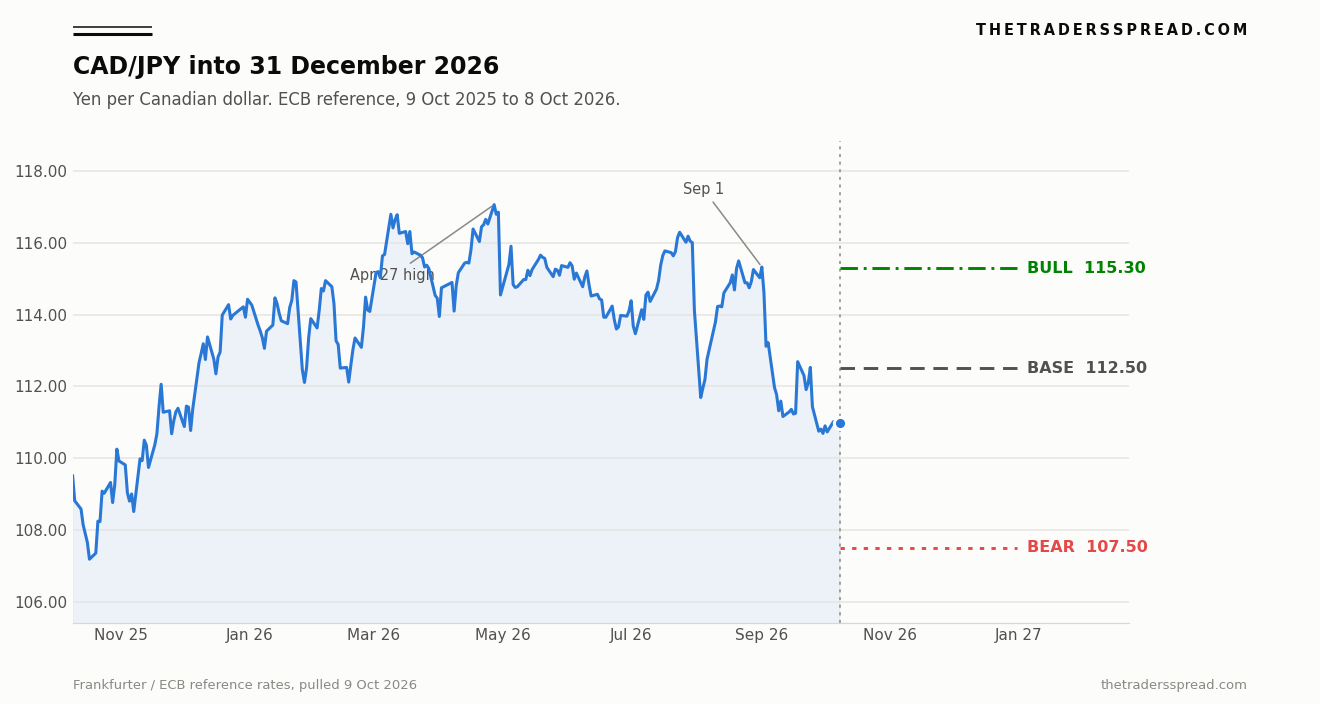
The sample low is 107.18 on October 17, 2025. The high is 117.07 on April 27, 2026. October 8, at 110.98, is 1.46 yen above the year-ago print of 109.52 and 6.09 yen below that high. Citing only one of those distances picks a direction the series does not have.
Early September changed the shape. The reference was 115.33 on September 1, 114.61 on September 2, 113.12 on September 3, 113.22 on September 4, and 111.97 on September 7. September 2 was the Bank of Canada hold. September 4 was the August labor release. The fix does not say which headline did the work. It does say the drop was packed into a few days, and that September 11, at 111.16, was already near where October 8 finished.
The hike day was not a new low. September 17 was 111.25. September 18 was 112.69. September 24, when the new Japanese rate took effect, was 112.53. September 30 was 110.69, the low of that drift. October 8 was 110.98. Since the vote, the reference has lived between about 110.69 and 112.69. A base of 112.50 sits near the top of that band. It is not the April high, and it is not the September 1 print.
| Reference date | CAD/JPY | What the calendar shows |
|---|---|---|
| October 17, 2025 | 107.18 | Low of this sample |
| April 27, 2026 | 117.07 | High of this sample |
| September 1, 2026 | 115.33 | Last print before the early-September drop |
| September 11, 2026 | 111.16 | Before the September 18 Bank of Japan vote |
| September 18, 2026 | 112.69 | Decision day, guideline raised to around 1.25% |
| September 30, 2026 | 110.69 | Low of the post-decision drift |
| October 8, 2026 | 110.98 | Latest ECB reference used here |
| Scenario | Level | Versus 110.98 | What it is near |
|---|---|---|---|
| Bull | 115.30 | +4.32 yen, about 3.9% | 0.03 yen under the September 1 print of 115.33 |
| Base | 112.50 | +1.52 yen, about 1.4% | Inside the September 18 to September 24 cluster |
| Bear | 107.50 | -3.48 yen, about 3.1% | 0.32 yen above the October 17, 2025 low of 107.18 |
A live screen will not sit on 110.98. At 06:40 UTC on October 9, Yahoo Finance showed CADJPY=X at 111.26, about 0.28 yen above the October 8 fix. That is an indicative mid, taken before the labor release, not an ECB reference. When the two disagree, this note uses Frankfurter. The fix is one number a day, and 158.28 divided by 1.4262 lands on 110.98, not on 111.26.
Oil near $91, and two dollar legs that are not this cross
Both central banks are explicit about crude. On September 2 the Bank of Canada said the Middle East conflict was keeping energy prices high, and that CPI near 3% was mainly gasoline. On September 18 the Bank of Japan said crude had been high since early spring for the same conflict, and that the effect was still pushing producer prices up, alongside AI-related demand and a weaker yen. Neither text is a CAD/JPY model. Both are a reason not to treat this cross as a pure rate-gap trade this quarter.
The oil figure here is narrow. Yahoo Finance showed front-month NYMEX light sweet crude, ticker CL=F, at $90.80 at 06:40 UTC on October 9. The October 8 point on that series was $91.49. Prints in the days before ran from $88.28 on October 7 to $92.87 on October 1. Refined products are a different market. The desk's heating-oil scenarios cover that barrel, not this pair.
The dollar legs get one sentence each. On the October 8 ECB reference, one US dollar bought 1.4262 Canadian dollars. On the same reference, one US dollar bought 158.28 yen. Neither print is CAD/JPY. The cross is the ratio. A move in USD/JPY with USD/CAD unchanged changes the cross one for one. A move in both, same direction, can leave CAD/JPY flat. That is why the path above comes from the Canadian-dollar base series, not from a yen headline.
GBP/CAD is a different Canadian cross, with its own cases. That forecast is not an input here. "The Canadian dollar" is not one trade. Against the yen, the live question is the Japan gap and the labor print.
RelatedUS 10-Year Yield Explained: What 5.31% Does to Prices
Tariffs are context, not a yen coefficient. Statistics Canada put the twelve-month layoff rate at 0.9% in industries tied to US demand and 0.7% elsewhere. Macklem said the newer round covered about 5% of exports to the United States. Neither claim is a CAD/JPY level.
Base, bull, and bear into December 31
The base case is 112.50 on December 31, 1.52 yen above the October 8 reference and inside the band traded after the Bank of Japan moved. It assumes September employment near the calendar's small rebound, an October 28 hold at 2.25% with headline inflation at 3.0%, and no further Tokyo hike on October 30. That is a drift back toward September 18 to 24.
The bull case, 115.30, gives back the early-September drop. It is about 3.9% above 110.98 and just under the September 1 print of 115.33. It is not a break of the April high at 117.07. It needs unemployment at 6.4% or lower, a hold in Ottawa, and a hold in Tokyo. The yen has to stop firming.
The bear case, 107.50, is about 3.1% under 110.98 and just above the October 17, 2025 low of 107.18. It becomes the working path if a weak labor print puts a cut on the October 28 table and Tokyo hikes on October 30. A Japanese move from 1.25% to 1.50%, with Canada still at 2.25%, narrows the gap from 1.00 percentage point to 0.75. A Canadian cut to 2.00% on top of that hike narrows it to 0.50. That is a return to last autumn's low, not a break under it.
What changes the view is the September actual, then the October 30 Bank of Japan decision, then oil. Near +6,100 jobs and 6.5% unemployment leaves 112.50 in place. A large job loss with unemployment through 6.5% shifts weight to 107.50. A rebound that pulls unemployment back through 6.4% pulls 115.30 forward. Another Tokyo hike means September was not the last move of 2026. Crude sliding well clear of the high-$80s to low-$90s would remove a support both banks are treating as a price risk.
The range already traded sits between 110.69 on September 30 and 112.69 on September 18. It does not confirm or kill 112.50. The level that retires the base case on this map is 107.50. These are scenarios for December 31, not a recommendation and not an instruction to take a position.
Questions the release will not answer by itself
What is the CAD/JPY forecast into December 31, 2026?
The base case is 112.50 yen per Canadian dollar, about 1.4% above the October 8 ECB reference of 110.98. The bull case is 115.30, near the September 1 print. The bear case is 107.50, just above the October 17, 2025 low. The lean is mildly higher, with low conviction, because the Bank of Japan meets two days after the Bank of Canada. The chart horizon is December 31, 2026.
Has the September Labour Force Survey been released?
Not at the time of writing. Statistics Canada scheduled the September survey for October 9, 2026, covering the week of September 13 to 19. This note was completed before the 8:30 a.m. Eastern release. August, published September 4, showed employment down 42,000 and unemployment unchanged at 6.4%. The +6,100 and 6.5% figures above are a calendar consensus, not an official print.
How wide is the policy-rate gap?
The Bank of Canada's overnight target is 2.25%, held on September 2. The Bank of Japan's call-rate guideline is around 1.25%, set on September 18 and effective September 24. The difference is 1.00 percentage point, down from 1.25 percentage points when the Japanese guideline was around 1.0% after June 16. The next Canadian decision is October 28. The next Japanese meeting is October 29 and 30.
Why is the reference 110.98 if a live quote differs?
Frankfurter's ECB reference for October 8 is 110.98, and the dollar rates that day divide to the same number. A Yahoo Finance indicative mid for CADJPY=X was 111.26 at 06:40 UTC on October 9, before the labor release. The fix is one daily print. The live quote moves. Bull, base, and bear in this note are measured from the fix.
What would retire the 112.50 base case?
A September labor miss that puts an October 28 cut back in play, another Bank of Japan hike on October 30, or both. Either change shrinks the rate gap the base case assumes will stay near one percentage point. A move to 107.50, close to the October 2025 low, is where this map says the base case is the wrong description. Chop between 110.69 and 112.69 is the range already traded since the September hike.
This is analysis, not a recommendation. Exchange rates move, scenarios fail, and capital is at risk. The levels above describe paths for CAD/JPY into December 31, 2026. They are not instructions to take a position in the currency or in any related contract.