

The USD/THB forecast on Tuesday afternoon, 13 October 2026, still started from 33.615 on Bangkok dealing screens, and the print was not Tuesday's. It was the European Central Bank reference for Monday 12 October, taken the same afternoon from Frankfurter, because the next ECB fix had not been published. The Bank of Thailand had already told the market that Friday 16 October is an extra holiday for financial institutions in the capital, so the Thai Overnight Repurchase Rate will not appear that day. On the central bank's compound the learning centre still carries the institution's name in metal letters over the door. Delegates are in the city anyway. The Nation has reported that the IMF and World Bank meetings remain on track, and none of those meetings will print a December value for the dollar in baht. That job is still a forecast.
The rate gap is the obvious story, and the wrong one for the last twelve weeks. From the 12 February low of 31.00 to the 23 July high of 33.825, the ECB series rose 9.11 percent while the Fed was on hold and the Bank of Thailand sat at 1.00 percent. Since that high, USD/THB has chopped between 32.675 on 21 August and 33.825. Monday's 33.615 is 0.210 under the high. Surach Tanboon, senior director in the Bank of Thailand's Monetary Policy Department, said on 19 September that the Thai-US gap was already priced and that baht moves were the dollar's. From 33.355 on 18 September the fix is up 0.78 percent. A bull case at 34.80 needs a fresh break. A bear case at 32.40 is a give-back toward 11 May's 32.415. The gap explains the spring. It does not pick December.
One baht of distance is not the same event in both directions.
Key facts
- USD/THB ECB reference 33.615 on 12 October 2026, up 3.29 percent from 32.545 on 13 October 2025 and up 6.12 percent from 31.675 on 31 December 2025 — ECB reference rates via Frankfurter, retrieved 13 October 2026
- 2026 extremes on that series are 31.00 on 12 February and 33.825 on 23 July; Monday's print is 0.62 percent under the high, and the rise from 11 September's 33.065 is 1.66 percent — ECB via Frankfurter, 13 October 2026
- The Monetary Policy Committee voted unanimously on 26 August 2026 to keep the policy rate at 1.00 percent — Bank of Thailand press release No. 31/2026
- The Federal Reserve raised the funds target range by a quarter point to 3.75–4 percent on 16 September 2026, 12–0, and meets next on 27–28 October — FOMC statement, 16 September 2026, and the Board's calendar, updated 7 October 2026
- THOR was 0.99451 percent on 12 October 2026; the one-month, three-month and six-month averages were 0.99530, 0.99478 and 0.99593 percent — Bank of Thailand, published 12 October 2026
- Headline CPI rose 2.82 percent year on year in September, the index at 102.93 against 100.11 a year earlier; core rose 1.50 percent, and the January–September headline average was 1.54 percent — Trade Policy and Strategy Office, 6 October 2026
- Foreign arrivals from 1 January to 3 October totalled 23,452,895, down 3.88 percent year on year, with revenue of 1,142.485 billion baht, down 2.26 percent; the week of 27 September–3 October rose 8.24 percent to 522,532 — Surasak Phancharoenworakul, Minister of Tourism and Sports, reported by The Nation on 5 October 2026
The spring rally already happened
Measure the gap in the units the two central banks actually set. Thailand's policy rate is 1.00 percent. The Fed's target range, in force since the September decision, runs from 3.75 to 4 percent. That is 275 basis points from the floor of the US range to the Thai policy rate, and 300 from the ceiling. The September Summary of Economic Projections put the median appropriate funds rate at 4.1 percent at the end of 2026, up from 3.8 percent in June, with total PCE inflation at a 3.7 percent median for this year. The statement that day, approved 12–0, said inflation remained elevated. If Bangkok stays at 1.00 and the 4.1 percent funds median is delivered, the gap from the Thai policy rate to that median is 310 basis points.
Local money markets are not arguing with the hold. On 12 October THOR, the overnight private repurchase rate, fixed at 0.99451 percent. Compounded averages sat at 0.99530 percent over one month, 0.99478 over three months and 0.99593 over six months. A six-month baht rate a hair under the policy rate is a curve that has not been asked to price a Bank of Thailand hike. The dollar leg is where the uncertainty lives.
Christopher J. Waller, a governor of the Federal Reserve Board, put numbers on that uncertainty in Istanbul on 8 October. "Sixteen of the 18 participants who submitted dots anticipated at least one more hike during the two remaining meetings this year," he said in the speech. Four of those sixteen expected two. Futures prices as of 7 October, he added, showed traders seeing "an 85 percent chance of at least one hike by the end of the FOMC's December meeting and nearly 20 percent chance of two hikes." Further increases, if the data cooperate, do not have to arrive at back-to-back meetings. The Board's calendar puts those meetings on 27–28 October and 8–9 December.
Don Nakornthab, secretary of the Monetary Policy Committee, announced the 26 August hold. "The Thai baht against the U.S. dollar has been volatile, driven by geopolitical developments in the Middle East and shifting market expectations regarding the Federal Reserve's monetary policy trajectory," the Bank of Thailand release said. Growth was low and uneven. Export and investment gains from the technology cycle relied on imported inputs. SME loans were still contracting. Inflation was projected lower than before, mainly on energy, but expected to rise through the rest of the year.
September's CPI is that rise, not a new regime. Nantapong Chiralerspong's Trade Policy and Strategy Office reported headline inflation of 2.82 percent year on year, from 2.53 percent in August, with the index at 102.93 against 100.11. Core was 1.50 percent. The January–September average of 1.54 percent sits mid-band in the 1–3 percent target. The ministry narrowed its 2026 headline forecast to 1.8–2.2 percent, from 1.5–2.5 percent.
Governor Vitai Ratanakorn, reported by The Nation on 13 October, still put growth near 2.3 percent, exports at 17–18 percent and inflation around 2.2 percent. Potential growth, he said, was near 2.7 percent, and household debt 86–87 percent of GDP. The same piece said the IMF had lifted its 2026 Thailand forecast to 2.1 percent from 1.9 percent. The Fund's own table was not opened, so the revision is carried as The Nation stated it.
Bangkok is not pricing a hike
On 19 September, three days after the Fed moved, Surach told The Nation the gap was a limited outflow risk because markets had already looked through it. Net international reserves, he said, were above $300 billion and covered short-term external debt 2.8 times. Net inflows into Thai assets had totalled about 50 billion baht since the start of 2026, mostly equities. Japan's increase to 1.25 percent, on an 18 September vote of seven to two, left Japanese borrowing costs close to Thailand's. A yen that is no longer a deep funding contrast against the baht takes one cross-rate story off the table. The dollar remains the one that matters.
From 2 January's 31.39 the reference is up 7.09 percent, and from the February low 8.44 percent. After 23 July the floor is still 32.675, on 21 August. Monday sits in the upper third of a band already traded.
A forecast that multiplies the policy gap into a fresh year-end level will overshoot that tape. The gap was wide while USD/THB went from 31 to the mid-33s. It is still wide. The fix has stopped making new highs. The offshore yuan forecast on this desk is the regional cousin: a dollar leg can dominate after the local story has already been repriced. China's rates are not Thailand's. The next three months are about whether the rerating extends.
The desk's US 10-year explainer covers the long-end channel. Waller's dots still point to more tightening into December, which keeps a bid under the yields hedged against the baht. That bid is already inside a price that failed at 33.825 in July.
Three levels on one reference rate
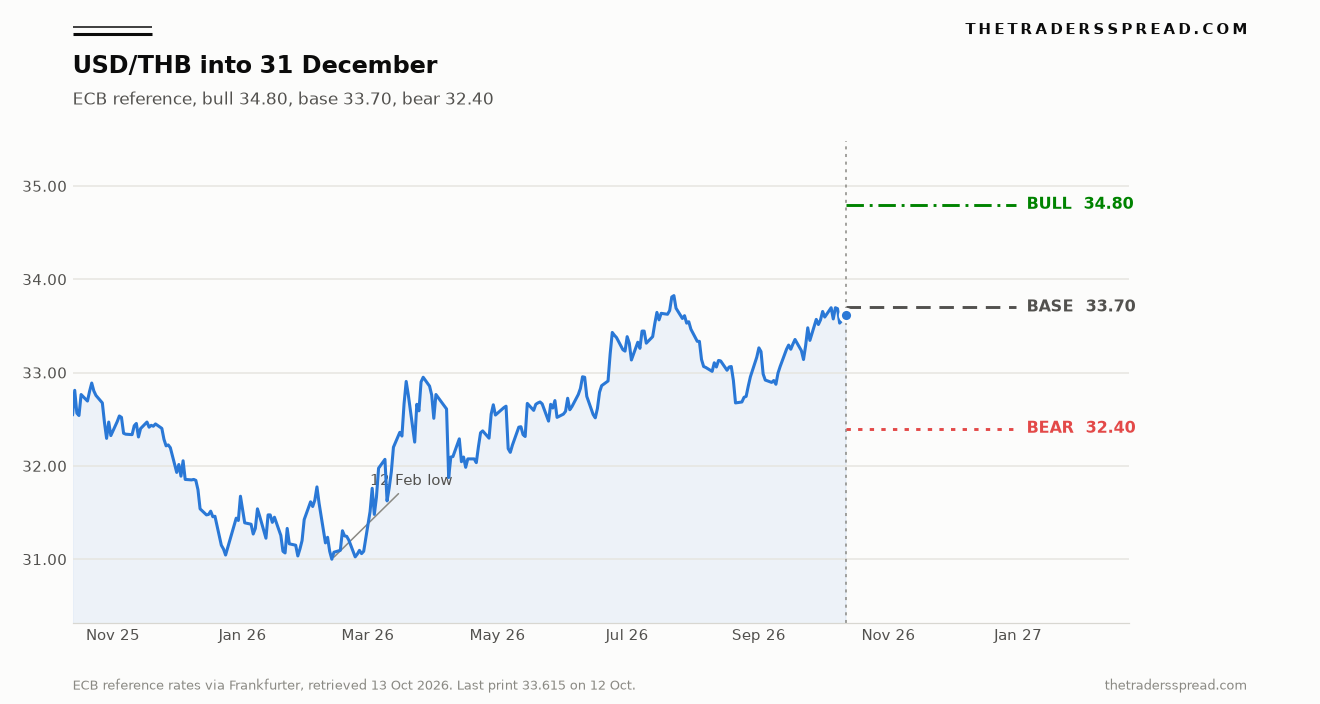
The chart is the ECB reference from 13 October 2025 through 12 October 2026, projected to 31 December. The 13 January 2025 peak of 34.775, the high of the longer pull back to the start of 2025, sits outside the frame. It still defines the bull case.
| Path to 31 December 2026 | Level | Versus 33.615 | What has to be true |
|---|---|---|---|
| Bull | 34.80 | +1.185 baht, or +3.53 percent | The 23 July high of 33.825 breaks and holds, and the Fed's extra hike is not shrugged off |
| Base | 33.70 | +0.085 baht, or +0.25 percent | The post-July range survives the 27–28 October Fed meeting and the holiday-shortened Bangkok week |
| Bear | 32.40 | −1.215 baht, or −3.61 percent | Price gives back the late-summer rise and revisits the 11 May reference of 32.415, through the 21 August low of 32.675 |
The title numbers sit almost the same distance from Monday's fix, 1.185 baht above and 1.215 below. Reaching 34.80 means a 2026 high and a test of 34.775 on 13 January 2025, a print not revisited since. Reaching 32.40 means 32.415, the 11 May reference, a level the series has already traded. One is a retest of an older extreme. The other is a return.
The base at 33.70 needs the least new information. It is 0.085 above Monday, inside the first half of October, when references ran from 33.53 on 9 October to 33.695 on 5 October and again on 7 October. It does not need the July high to break, or the August low. It is a stalled rerating, if the Fed delivers a debate rather than a shock and Bangkok's extra Friday is a hole in the fixing calendar rather than a hole in policy.
Nothing in the table is an instruction. A close through one of the levels changes the map. It does not tell anyone to transact.
Tourists, gold paperwork, and a full reserve chest
The baht's supports are slower than a Fed meeting, which is why they belong in a December forecast. They are also weaker, year to date, than a holiday headline suggests.
Tourism and Sports Minister Surasak Phancharoenworakul said arrivals from 27 September to 3 October rose 8.24 percent, to 522,532, about 74,647 a day. China's Golden Week supplied 133,946 of them, up 41.98 percent on the week. He expected the next week to cool. The year does not look like the week. From 1 January to 3 October, The Nation's account of his briefing put arrivals at 23,452,895, down 3.88 percent, and receipts at 1,142.485 billion baht, down 2.26 percent. One strong week can still feed baht demand in the high season. It does not close a year that is behind.
Gold's rulebook changed in the same fortnight. The Nation reported on 9 October that Exchange Control Officer Notification No. 38, gazetted on 7 October and effective the next day, makes ordinary inflows of $200,000 or more show their source, with a Know Your Business waiver. Gold has no waiver and no size threshold. Banks must take documents for gold-related deals of any amount, including baht proceeds through a non-resident account. Cash foreign currency stays on the standard procedure only up to $15,000 a customer a day.
Notification No. 38 is not a target for USD/THB. Resident gold buying has been a mechanical seller of baht in past episodes, and paper on every ticket slows the part of that flow that used the foreign-exchange window as a convenience. If the path to 34.80 needs unexamined gold outflows, the rule is a friction. If gold was never the marginal seller, the rate gap still sets direction. From 8 October's 33.685 to 12 October's 33.615 the fix eased 0.07 baht. Five days is noise.
Reserves are why 32.40 is a dollar view, not a funding scare. Surach's figure, net reserves above $300 billion and 2.8 times short-term external debt, matches the August line that Thai bond yields stayed broadly stable while yields abroad rose. A move toward 34.80 that leaves that stock unquestioned is the bull case in this piece.
RelatedGBP/AUD Forecast: 1.9600 Bull Case vs 1.8400 Bear Case
The October Fed decision on the prediction-markets desk is the nearest dated US event. This forecast does not use that contract's price. It uses the statement, the projections and Waller's dots. Bangkok's last vote was 26 August. Reports have put the next review on 28 October, but they sat on Reuters pages that could not be opened, so that date is not treated as a BOT document.
What would change the December map
Base case: 33.70 on 31 December 2026, 0.25 percent above the 12 October reference of 33.615. That is the zone treated as most likely if eleven weeks force no new range. Bull case 34.80, bear case 32.40. The skew leans toward a higher dollar, so the tracked bias is bull, the entry is 33.615, the target is 34.80 and the invalidation is 32.40. Conviction is 3 out of 5. Anything higher would pretend a rate 0.210 under its 2026 high is about to trend the way February did.
Getting to 34.80 means 33.825 breaks and holds across the October and December Fed meetings, with THOR still near 1 percent. The level then tests 34.775, the 13 January 2025 reference, rather than a price this series has never printed. The gap from Monday is 3.53 percent. July is the objection: the attempt stalled, and the tape since August fits a gap already absorbed.
Getting to 32.40 means the stall breaks the other way. A weekly reference under 32.675, the 21 August low, would mean the post-July range had failed, and 32.40 would mean it had reached the 11 May shelf at 32.415. That asks for a Fed holding twice, against the September dots, or for Bangkok to stop calling 1.00 percent appropriate because inflation presses the ceiling of the 1–3 percent band. A 2.82 percent September, inside a 1.8–2.2 percent ministry year, is not that signal, and one Golden Week does not offset a 3.88 percent drop in year-to-date arrivals. No September current-account figure was retrieved, so this bear case is the chart.
Between those paths, the centre moves if either central bank touches its own instrument. A BOT rate change rewrites THOR and the gap together. A December projection that pulls the end-2026 funds median from 4.1 percent back toward June's 3.8 percent takes the US half out of the bull case. A break of 33.825 that fails inside a week turns 34.80 into a level 2026 has already rejected. Any of those would make 33.70 the wrong centre.
Questions the fix leaves open
What is the USD/THB forecast into 31 December 2026?
The base is 33.70, against the ECB reference of 33.615 on 12 October 2026. The bull case is 34.80 and the bear case is 32.40. The bull case needs a break of the 23 July high at 33.825 that holds. The bear case needs a return through the 21 August low of 32.675 toward 11 May's 32.415. The centre of the forecast is the base, not the outer numbers in the title.
Why can the baht stay soft if the Bank of Thailand is not cutting?
Because the Thai curve is already on the floor the committee set, and the US curve is not. THOR and its six-month average were both just under 1 percent on 12 October, against a 1.00 percent policy rate held on 26 August. The Fed's range is 3.75–4 percent, with a September median of 4.1 percent for year-end. That gap can hold USD/THB up even when Bangkok is done easing.
How much of this is the dollar rather than Thailand?
Most of the recent move, on the Bank of Thailand's own account. Surach said on 19 September that baht moves were primarily the dollar's and that the gap had been priced. From 18 September's 33.355 to 12 October's 33.615 the reference rose 0.78 percent. The larger rerating, 9.11 percent from the February low to the July high, is the part the gap can still claim.
What would make 32.40 more relevant than 34.80?
A Fed that skips the extra hike the September dots lean toward, or a Bank of Thailand that stops treating 1.00 percent as the right accommodative setting. A weekly reference under 32.675 would say the post-July range had broken first. Tourism closing the year-to-date arrivals gap would help the baht. Gold paperwork under Notification No. 38 might slow one selling channel. It is too new to carry the bear case alone.
Where does the 33.615 figure come from?
It is the ECB reference, expressed as baht per dollar, for 12 October 2026, retrieved on 13 October through Frankfurter. It is not a Bangkok onshore fixing and not a bank's dealing quote. The next ECB reference was not out at the time of writing. On Friday 16 October, a Bangkok bank holiday, THOR will not be published.
Disclaimer
This is analysis for traders and market professionals, not a recommendation to take a position in USD/THB or any other instrument. Scenarios can be wrong, and foreign exchange can move through these levels without notice. Capital is at risk. The levels above are conditions around a published reference rate, not instructions.