

GBP/AUD cannot be, at the same time, a cross that has already paid for the Reserve Bank's hike and a cross that still owes another one. The pair finished the 9 October ECB reference session at 1.8938 Australian dollars per pound. Frankfurter returned that rate at 08:18 GMT on 10 October, a Saturday, so the reference date is Friday's fix. The print sits 6.6% under the 2.0266 rate of 10 October 2025, and 1.6% above the 1.8634 low of 13 May 2026. On 24 September the Australian Bureau of Statistics put the unemployment rate at 4.6%. On 29 September the Reserve Bank of Australia raised the cash rate by a quarter of a point to 4.60%. A higher jobless rate and a fresh hike are not a comfortable pair of facts. A cross already back beside its February close, with Thursday's labour force release still ahead, is the awkward third.
Friday's fall was an Australian dollar move, and the 4.6% figure the Board hiked after is not the clean deterioration the headline suggests. Frankfurter took the direct quote from 1.9021 on 8 October to 1.8938 on 9 October. Built from the ECB's euro reference rates, the same two sessions read 1.90205 and 1.89375, a decline of 0.44%. AUD/USD on that table was 0.69811, up 0.54% from 0.69435, the largest rise against the dollar among the G10 currencies that day. GBP/USD was 1.3220, up 0.10% from 1.3207. The cross cheapened because the Australian dollar outran sterling. Reading 1.8938 as a weak-pound print picks the wrong leg, and it will do so again if Thursday's surprise is an Australian one.
Key facts
- GBP/AUD 1.8938 on the 9 October 2026 ECB reference rate, via Frankfurter, retrieved 10 October 2026 at 08:18 GMT. The euro-derived cross was 1.89375, down 0.44% from 1.90205.
- Over the year from 10 October 2025 the cross fell from 2.0266, a drop of 6.6%. The high in that window was 2.0696 on 17 October 2025. The low was 1.8634 on 13 May 2026.
- Reserve Bank cash rate target 4.60%, effective 30 September 2026, after a 25 basis point rise decided on 29 September. Next decision 3 November 2026, 2.30pm Sydney time. Source: Reserve Bank of Australia.
- Bank of England Bank Rate 3.75%, held on 17 September 2026 by a 6-3 vote, with three members voting for 4%. Next decision 5 November 2026. The gap to the Australian cash rate is 85 basis points. Source: Bank of England.
- Australian unemployment 4.6% in August, seasonally adjusted and in trend, released 24 September 2026. Employment rose by 39,000 and unemployment by 28,000 people. Participation rose 0.2 percentage points to 67.1%. Source: Australian Bureau of Statistics.
- Australian CPI rose 4.0% in the twelve months to August 2026, up from 3.5% to July. Trimmed mean inflation was 3.6% for a third month. Released 30 September 2026. Next CPI release 28 October 2026. Source: Australian Bureau of Statistics.
- September labour force release: Thursday 15 October 2026, 11:30am AEDT. The September survey window ran from 30 August to 12 September, and it closed before the cash-rate rise.
Thursday is a September survey.
Back at the February close
The path into 1.8938 is a round trip, not a breakdown. On 30 January the ECB reference rate for the cross was 1.9627. By 27 February it was 1.8957, a fall of 3.4% in a month, and the largest single leg of the year's decline. The 9 October print of 1.8938 is 19 pips under that February close. Everything between late February and now, the spring slide, the May low, the summer bounce, has been given back.
The low of the window is 1.8634 on 13 May, 304 pips under Friday's rate and 8.5% under the 17 October 2025 high of 2.0696. Month-end May had already bounced, to 1.8724 on 29 May. The recovery carried the cross to 1.9197 on 30 June and 1.9124 on 31 July. From that 30 June close to Friday is a drop of 1.3%. September's bounce, to 1.9069, was gone by 9 October.
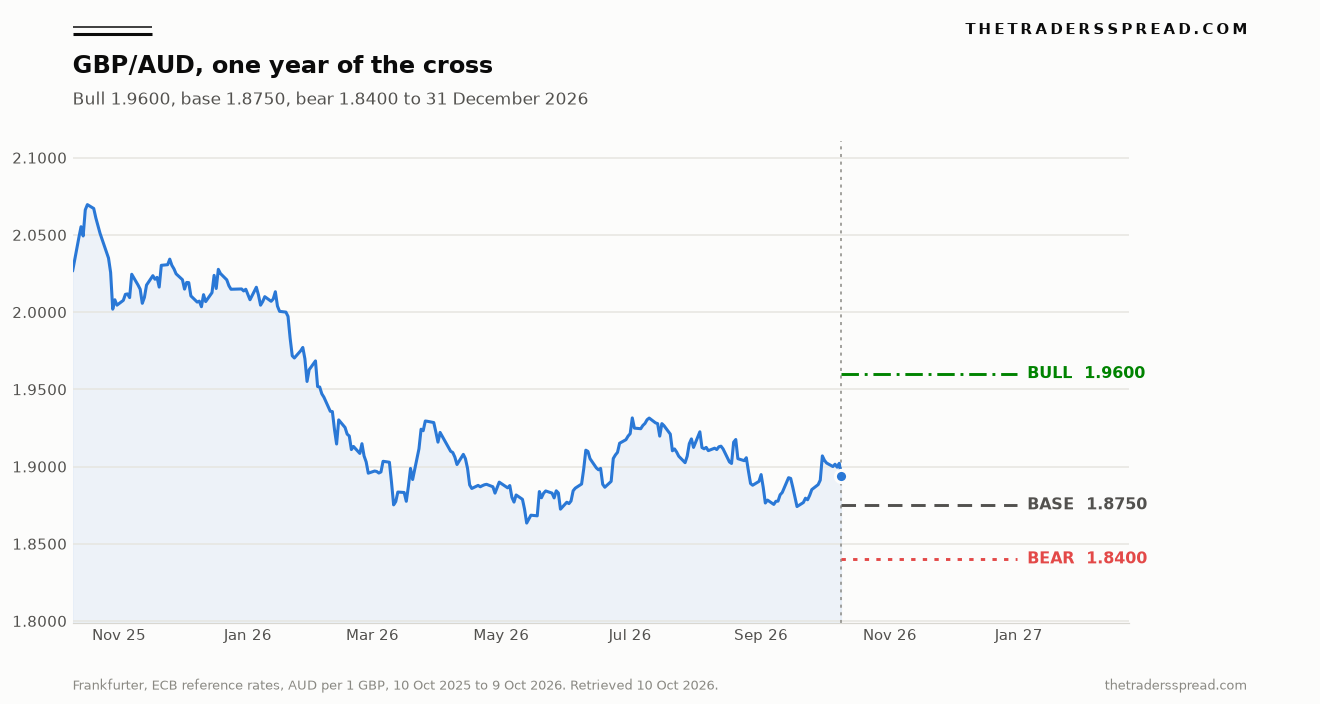
Month-end reference rates, Australian dollars per pound, from the same Frankfurter series:
| Session | GBP/AUD | What it marks |
|---|---|---|
| 31 Oct 2025 | 2.0045 | Still above 2.00 after the mid-October high |
| 31 Dec 2025 | 2.0148 | Year-end, before the January air pocket |
| 30 Jan 2026 | 1.9627 | Last close near the bull case of 1.9600 |
| 27 Feb 2026 | 1.8957 | The break. Friday's 1.8938 is 19 pips under this |
| 29 May 2026 | 1.8724 | Month-end, 90 pips off the 13 May low of 1.8634 |
| 30 Jun 2026 | 1.9197 | Summer high-water mark on a month-end basis |
| 30 Sep 2026 | 1.9069 | The day the new 4.60% cash rate took effect |
| 9 Oct 2026 | 1.8938 | Latest ECB reference rate |
Two distances fix the cases. 1.9600 is 27 pips under the 30 January close, a return to the last print above 1.96, not a run at the 17 October 2025 high of 2.0696. 1.8400 is 234 pips under the May low of 1.8634. The year's range, 2.0696 to 1.8634, was a little over 2,000 pips. Getting to 1.8400 by 31 December would use about a quarter of it.
The 4.6% print the hike did not wait out
On 24 September the ABS released Labour Force, Australia, for August. The seasonally adjusted unemployment rate rose to 4.6%. Sean Crick, head of labour statistics at the bureau, said: "This month there was 39,000 more people in employment, and 28,000 more people in unemployment." Part-time employment rose by 46,000. Full-time employment fell by 6,000. Participation rose 0.2 percentage points to 67.1%. Underemployment fell 0.1 percentage points to 6.2%. Hours worked rose by 14 million after falling by the same amount in July. Over the year, employment and hours were up 1.6% and 1.7%.
More people were in work, and more people were unemployed, because the labour force grew. Crick's release notes a higher proportion than in recent years of people moving from outside the labour force straight into unemployment. The rate rose because the denominator grew. Full-time work fell.
The bureau then attached a warning the forecast has to keep. It has changed the supplementary survey collection so that the old February and August adjustment is no longer applied. The ABS says that adjustment may have been picking up some ordinary seasonality, and that removing it could have nudged the August seasonally adjusted estimates. Its sensitivity tests put any impact inside normal sampling error, and it calls the August figures fit for use. It also says the trend series is the better guide to underlying behaviour. The trend unemployment rate rose marginally, to the same 4.6%.
So the figure the Reserve Bank had in hand on 29 September was a 4.6% unemployment rate on both the adjusted series and the trend, an employment gain concentrated in part-time work, and a participation rate at 67.1%. The Board raised the cash rate anyway.
The inflation print arrived the next morning. On 30 September the ABS said the consumer price index rose 4.0% in the twelve months to August, up from 3.5% to July. Rachael McCririck, head of price statistics at the bureau, said: "Housing was the largest contributor to annual inflation in August, rising by 5.7 per cent." Trimmed mean annual inflation, she said, "remained steady at 3.6 per cent for the third consecutive month in August." Both sit above the Reserve Bank's 2% to 3% band. The cash-rate rise took effect the same day. The Board had already moved.
Thursday's release will not answer whether 4.60% has cooled hiring. The August media notes record the September survey reference period as 30 August to 12 September 2026. The hike was decided on 29 September and took effect on 30 September. The sample closed more than a fortnight earlier. Anyone treating the 15 October number as the economy's reply to the new cash rate is early by a month. It is a pre-hike photograph, published after the hike, of a labour market the Board has already shown it will tighten through.
The ABS calendar puts the release at 11:30am AEDT on Thursday 15 October, reference period September 2026. The next Reserve Bank meeting is 3 November. September CPI is due on 28 October, between the two. A soft labour number can take a November hike off the table before that CPI arrives. A firm one leaves the Board's line, that it will lift the cash rate further if needed, looking like a live option.
Eighty-five basis points, and two calendars
The cash rate target is 4.60%. Bank Rate is 3.75%. The gap is 85 basis points in Australia's favour, and it widened on 29 September rather than on anything the Bank of England did.
The Reserve Bank's decision that afternoon was a 25 basis point increase. The cash-rate page now shows 4.60%, effective 30 September, with the next update at 2.30pm on 3 November 2026. The Board described three increases already delivered this year, said financial conditions had tightened and the economy appeared to be slowing, and still judged inflation too high. It said it would raise the cash rate further if needed. A quarter-point rise on 3 November would take the target to 4.85% and the gap over Bank Rate to 110 basis points, if London has not moved.
London's last move was a hold. At the meeting ending 16 September, published on 17 September, the Monetary Policy Committee voted 6-3 to keep Bank Rate at 3.75%. Three members voted for 4%. The Bank's rate page puts inflation at 3.1%, against a 2% target, and says it will rise further because Middle East energy prices are still volatile. Reuters, reporting the decision the same day, said the Bank thought inflation could reach slightly over 4% in early 2027, and that active gilt sales would pause for six months.
Andrew Bailey, Governor of the Bank of England, put the conditional in plain language. Reuters quoted him on 17 September: "So far higher global energy costs have had a limited effect on price and wage setting in the UK. But the longer this volatility persists, the bigger the impact it will have on inflation, and the more likely it is we will need to raise Bank Rate to ensure that inflation falls back to our 2% target." That is not a promise of a hike on 5 November. It is three of nine votes already there, and a Governor describing the condition under which he would join them. The same Reuters report placed the UK budget on 28 October, four days before the Reserve Bank meets and eight days before the Bank of England does.
The arithmetic of the gap from here is small enough to write down.
- Both banks hold. The gap stays at 85 basis points. That is the base case for the cross: the existing premium is allowed to lean on GBP/AUD, without a new one being added.
- The Reserve Bank rises by 25 basis points and the Bank of England holds. The gap goes to 110 basis points. That is the fuel for a break of 1.8634.
- The Bank of England rises by 25 basis points and the Reserve Bank holds. The gap narrows to 60 basis points. That is the fuel for a return toward 1.9600.
- Both rise by 25 basis points. The gap is unchanged at 85 basis points, and the cross has to be explained by something other than the relative policy rate. Growth, the labour print, or the energy shock doing different work in the two economies.
None of those four is a trade. They are the ways the two calendars can rewrite the 85 basis points that Friday's price already reflects. The dollar yield story is a third calendar, and it is the subject of the US 10-year yield note on this desk. GBP/AUD does not need that yield to have a policy gap. It has one, measured in Australian cash against British Bank Rate.
Sterling against the Swiss franc is a different second currency. The GBP/CHF forecast does not tell you whether Australian unemployment at 4.6% survives a second month, and it should not be asked to. The euro side of sterling, in the EUR/GBP forecast, shares the Bank of England meeting on 5 November and shares none of the Reserve Bank meeting on 3 November. Same pound. Different cross.
Three numbers for 31 December
The horizon is 31 December 2026. The reference rate is 1.8938. Weights below are this desk's scenario weights, not prices taken from an options market. They sum to 100, and they are meant to be moved by Thursday and by the two November meetings.
Bull case, 1.9600, weight 25%. That is 662 pips above the reference rate, about 3.5%, and 27 pips under the 30 January close. It needs September unemployment high enough that a 3 November hike comes off the table, and it needs the 5 November vote to tip from a 6-3 hold toward a rise in Bank Rate. It is not a return to the October 2025 high.
RelatedGBP/CAD Forecast: 1.94 Bull Case vs 1.83 Bear Case
Base case, 1.8750, weight 45%. That is 188 pips under the reference rate, about 1.0%, and it sits between Friday's print and the May low without requiring a break of 1.8634. Both banks hold in November, or both hike and cancel each other in the gap. The 85 basis point premium is left to lean on the cross, and December looks more like the 29 May month-end of 1.8724 than like January. This weight is the largest because it asks the two banks not to surprise each other.
Bear case, 1.8400, weight 30%. That is 538 pips under the reference rate, about 2.8%, and 234 pips under the 13 May low. It needs a September labour print firm enough that 4.6% looks like a peak rather than a new trend, the trimmed mean still at 3.6% or higher at the 28 October CPI, and a Reserve Bank hike on 3 November against an unchanged Bank Rate on 5 November. A break of 1.8634 is the price of a wider gap, not a view that sterling collapses on its own.
The probability-weighted level of those three cases is about 1.8858, roughly 80 pips under Friday's reference rate. That is why the bias on the cross is lower, and why the conviction is only moderate. The centre of the distribution sits under 1.8938. The mode sits at 1.8750, not at 1.8400. Thursday can move both.
What would change the weights is specific. Unemployment well clear of 4.6%, with participation no longer climbing, would cut the bear weight, because it would challenge another hike on 3 November. A Bank Rate rise on 5 November, with the cash rate left at 4.60%, would do the same from the sterling side and line 1.9600 up with a gap of 60 basis points. The other way: a steady or lower unemployment rate and a 4.85% cash rate in November would retire 1.9600. A close through 1.9600 is the level at which the lower bias is wrong.
A rate-gap cross with the yen on the other side is argued in the CAD/JPY forecast. The mechanism rhymes. The dates do not. Nothing in that note sets 1.9600 or 1.8400 for this pair, and nothing here should be read back onto it.
Questions the release will be asked
What is the GBP/AUD forecast to 31 December 2026?
From the 9 October reference rate of 1.8938, the base case is 1.8750, the bull case is 1.9600 and the bear case is 1.8400. The weights are 45%, 25% and 30%. The weighted level is about 1.8858. All three are scenarios for the ECB reference rate on this cross, and the bull case has to stay above 1.8938 just as the bear case has to stay below it.
Why did GBP/AUD fall on 9 October?
The direct quote went from 1.9021 to 1.8938, and the euro-derived cross from 1.90205 to 1.89375, a fall of 0.44%. The session belonged to the Australian dollar, as the dollar rates in the second paragraph show. It was not a day on which sterling gave way on its own.
When does the next Australian labour force release hit this cross?
Thursday 15 October 2026, 11:30am AEDT, for the September reference period. The survey window was 30 August to 12 September, so the print describes a labour market that had not yet seen the 4.60% cash rate. The Reserve Bank meets on 3 November. September CPI is due on 28 October.
How wide is the gap between the cash rate and Bank Rate?
It is 85 basis points, 4.60% against 3.75%. A Reserve Bank hike on 3 November with no change in London would make it 110. A Bank of England hike on 5 November with no change in Sydney would make it 60. If both move by the same quarter point, the gap does not change and the cross needs a different explanation.
What would make 1.9600 or 1.8400 the wrong case?
1.9600 is the wrong story if the cross gets there while both central banks have hiked and the gap is unchanged. The level can be visited for other reasons. The weight on it would then need rewriting. 1.8400 is the wrong bear case if 1.8634 holds through a November in which the Reserve Bank does not hike. A break of the May low needs the wider gap a further Australian hike would open.
This article is market analysis, not financial advice. Capital is at risk in foreign exchange. The figures above are scenarios for GBP/AUD to 31 December 2026. They are not a recommendation, and they are not an instruction to deal in the cross or in any other instrument.