

EUR/SEK finished the ECB reference day of 13 October 2026 at 11.1698, 1.4% under the 11.331 high of 30 September, and the two facts around that price do not agree. On 8 October, at the Ruter Dam event in Stockholm, Governor Erik Thedéen set a weaker krona beside high energy prices and supply disruptions, the mix he said could drive inflation well above the 2% target. The figure in front of him was not above 2%. Statistics Sweden's flash CPIF for September was 1.5%, up from 0.7% in August and still under the target. A soft currency argues for a higher policy rate. A below-target index argues for waiting. The cross is where that disagreement gets a price. Later today the Bureau of Labor Statistics publishes the US consumer price index for September, at 08:30 Eastern. It will not settle this cross.
The price is not marking the forecast. It is marking the gap that already exists. On 14 October the ECB's deposit facility rate was 2.50%, 75 basis points above the Riksbank's policy rate of 1.75%, so holding the euro against the krona still pays. The inflation gap runs the other way and it is wide. Eurostat's flash, out on 2 October, put euro-area HICP at 3.8% in September, up from 3.2% in August, with energy at 18.8%. Sweden's flash CPIF is 1.5%, and CPIF excluding energy did not move, stuck at 0.5%. EUR/SEK near 11.17 is today's carry. The Riksbank's 24 September forecast is a different document: the 2027 policy rate was lifted to 2.3% from 1.9% in June, and the board said increases would begin this year if the outlook held. The cross has been asked to price 75 basis points. It has not been asked to price that path.
Six readings fix the argument. Each one is dated.
- EUR/SEK 11.1698 on 13 October 2026, 1.2% above the 11.038 reference of 14 October 2025 — ECB via Frankfurter, 14 October 2026
- One-year high 11.331 on 30 September 2026 and one-year low 10.5205 on 30 January 2026, a 7.7% rise from trough to peak — ECB via Frankfurter, 14 October 2026
- Policy rate held at 1.75% from 30 September 2026; the 2027 forecast is 2.3%, against 1.9% in the June report — Riksbank, 24 September 2026
- Flash CPIF 1.5% in September, from 0.7% in August, with CPIF excluding energy unchanged at 0.5% — Statistics Sweden, 7 October 2026
- Euro-area HICP flash 3.8% in September, from 3.2% in August, and energy at 18.8% — Eurostat, 2 October 2026
- ECB deposit facility 2.50% on 14 October, 75 basis points over the Riksbank, while SWESTR fixed at 1.642% on 12 October — ECB and Riksbank, 13 and 14 October 2026
Thedéen has a November in mind. SWESTR does not.
The board did not hike on 24 September. It left the policy rate at 1.75%, applicable from 30 September, and said the rate should rise by more than the June forecast had projected, so inflation could stabilise around 2%. The conditional was plain. If the outlook for inflation and activity held, increases would begin this year.
The numbers under that sentence are gentler than the sentence.
The September forecast puts the 2026 policy rate at 1.8% on average, the same as June, and 2027 at 2.3%, up from 1.9%. The fourth-quarter average is 1.85%, against 1.82%. The first quarter of 2027 is 2.07%, against 1.89%, and the second is 2.24%, against 1.93%. CPIF for 2026 was revised to 1.5% from 1.1%, GDP to 2.8% from 2.2%. Unemployment is still 8.6%. A recovery, not a boom.
An unchanged 1.75% for all 92 days of the fourth quarter averages 1.75%, ten basis points under 1.85%. A 25 basis point hike delivers those ten points if it runs for about 37 days, which lands around 25 November. In force from 4 November it would cover 58 days and pull the average toward 1.91%. The published 1.85% can contain a November move. It does not require one, and a quarter-point in the week of the meeting would overshoot it.
On 8 October at Ruter Dam, Thedéen said the economy had performed better than expected, "whilst the risks of inflation overshooting the target have increased", and that in September he had argued for a rise in the near term. Then the line that moved the conversation: "I said that it may be reasonable to raise the policy rate as early as in November. I also considered the forecast for next year, which indicates further increases, to be reasonable yet associated with considerable uncertainty." His worry, he said, was "the risk that the combination of supply-related cost increases and strong demand will begin to affect companies' pricing on a broader front."
SWESTR has not taken that side. The krona overnight rate fixed at 1.642% on 12 October, published at 09:00 on 13 October, on SEK 83,135 million of volume and 272 transactions. That is 10.8 basis points under the policy rate, inside a 1.60% to 1.65% trim. The overnight market is still living at the rate the board already has. The next meeting is 3 November. The decision is published on 4 November.
He also flagged the global bond move. Higher long-term rates could dampen growth through borrowing costs and asset prices. Sweden, with low government debt, was less vulnerable, but the move still reprices a small currency. See the US 10-year yield. Context, not this forecast.
A 7.7% rise, then a 1.4% give-back
On 14 October 2025 the ECB reference was 11.038. A year later it is 11.1698, a 1.2% rise a carry book can swallow. The path inside the year is the story.
The low was 10.5205 on 30 January. From there to 11.331 on 30 September the cross rose 7.7%. The same 11.331 printed on 1 October. By 13 October it was 11.1698, a 1.4% give-back, about 16 öre. Most of the year's rise in EUR/SEK happened between late January and the end of September. October has been a pause.
Nineteen of the 255 reference days printed at 11.20 or higher, every one of them between 11 September and 7 October. The camp lasted about four weeks, and the cross has already walked out of it. On 9 October the reference was 11.1675. It then stopped.
The 10.70 bear case is not exotic. It last printed on 11 March, at 10.6543, and 35 reference days between mid-January and that date were at or under 10.70. Nothing since 1 June has printed below 10.789. A move to 10.70 by 31 December hands back the summer, not the year. The January low is a different call, and it is not the one on this page.
EUR/NOK is the other Scandinavian euro cross, with a different central bank and a different oil beta. Do not paste a level from one onto the other. The krona leg here is Swedish growth at 2.8% in the Riksbank's 2026 forecast, a policy rate stuck at 1.75% through a year of holds, and a governor who has started naming November.
The levels, drawn against the reference rate
Spot is the ECB reference of 13 October, 11.1698, retrieved on 14 October through Frankfurter. Bull is 11.55. Base is 11.05. Bear is 10.70. The horizon is 31 December 2026. Bull is above the live reference. Bear is below it. Base is below it too, by about 1.1%.
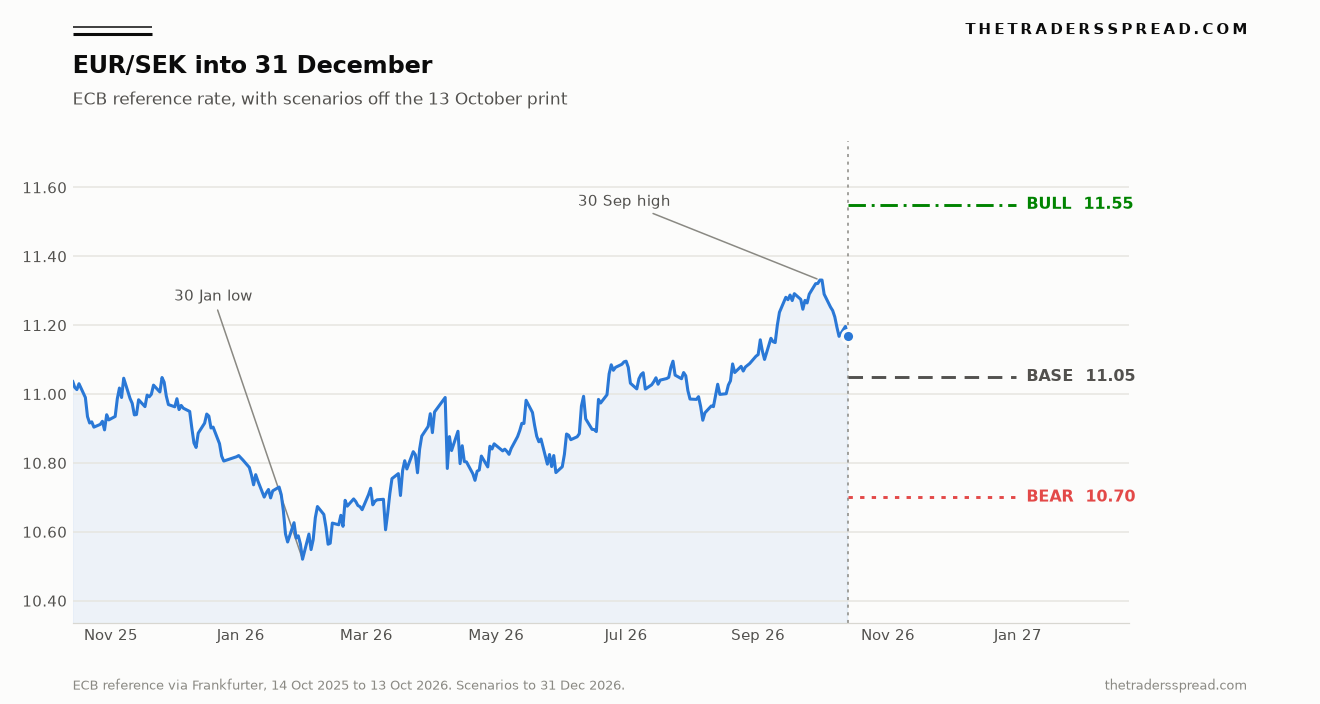 The reference rate, and the three levels out to 31 December.
11.55 is about 3.4% above 11.1698 and about 1.9% above the September high: a new high, not a fantasy. 11.05 is a drift back toward early July, when the reference was 11.0955, and early September, when it was 11.1145. 10.70 is 4.2% under the latest reference, back in March's zone, and still about 1.7% above the January low.
| Sweden | Euro area | |
|---|---|---|
| Policy rate | 1.75% from 30 September 2026 | Deposit facility 2.50% on 14 October 2026 |
| Latest inflation | CPIF flash 1.5% in September | HICP flash 3.8% in September |
| Ex-energy reading | CPIF excluding energy 0.5% | HICP excluding energy, food, alcohol and tobacco 2.5% |
| 2026 growth forecast | GDP 2.8%, Riksbank September forecast | 0.9%, ECB staff September baseline |
| 2027 path | Policy rate 2.3%, from 1.9% in June | HICP 2.5% in the September staff baseline |
| Next dated event | Rate announcement 4 November 2026 | Full September HICP on 16 October 2026 |
On the two central banks' own 2026 growth numbers, Sweden is the stronger economy and it still yields less. The ECB raised its three key rates by 25 basis points on 10 September. The deposit facility went to 2.50%, the main refinancing rate to 2.65% and the marginal lending facility to 2.90%, with effect from 16 September. Staff, in that same baseline, see growth at 0.9% in 2026, 1.4% in 2027 and 1.5% in 2028, and headline inflation at 3.0%, 2.5% and 2.1%. The krona is not cheap because Sweden is the weak side of the pair.
Same energy shock, two inflation rates
Carl Holmberg, a price statistician at Statistics Sweden, put the Swedish half in one sentence on 7 October. Preliminary figures, he said, showed the CPI and CPIF rates rising in September, "which is mainly due to rising energy prices." The flash had CPI at 1.1%, from 0.3% in August, up 0.9% on the month. CPIF rose 0.9% on the month, from 0.7% to 1.5% on the year. CPIF excluding energy was unchanged at 0.5%, and up 0.1% on the month. The regular publication is scheduled for 14 October. Until it replaces the flash, 1.5% and 0.5% are the figures Thedéen was answering.
Eurostat's flash of 2 October, still an estimate, is the euro-area half. HICP is expected at 3.8%, from 3.2%. Energy is expected at 18.8%, from 14.3%. Services 3.2%, from 3.0%. Food, alcohol and tobacco 1.4%, from 1.1%. Non-energy industrial goods 1.1%, from 1.2%. Strip out energy, food, alcohol and tobacco and the rate is expected at 2.5%, from 2.4%. Full September HICP is due on 16 October.
Both headlines were pushed by energy. The floors are not. Sweden's ex-energy CPIF is 0.5%. The euro area's core flash is 2.5%, under an energy rate of 18.8%. Frankfurt is already at 2.50%. Stockholm is still describing a first hike. Sweden buys a large share of its traded goods in euros, so a rate near the year's high raises krona prices of that basket even while domestic ex-energy inflation is asleep. Thedéen is not claiming the 2% target has already been missed. He is claiming the currency, the energy price and the demand pulse can manufacture the miss together.
EUR/CHF faces the same European energy number with a different second currency. With energy inflation at 18.8%, every euro cross is partly an energy cross, and the central bank on the euro side has already moved.
What knocks 11.05 over
The lower call dies in distinct ways. If the final September CPIF, due from Statistics Sweden on 14 October, does not look like the 1.5% flash, November changes before it starts. A print back toward August's 0.7%, or an ex-energy rate that slips from 0.5%, lets the board treat "may be reasonable" as a remark. The cross would then be free to retest 11.33 on carry alone.
A hold on 4 November, with the fourth-quarter average left near 1.75% rather than 1.85%, is the other Swedish failure. Thedéen was careful: November was reasonable, and it was not decided. In that world the September line that increases begin this year was a scenario, and the scenario failed. EUR/SEK does not have to rally far for 11.05 to be the wrong side of the news. A return to the 30 September high would do it.
Frankfurt can kill it without Stockholm doing anything wrong. If energy at 18.8% forces another ECB increase before year-end, a Swedish hike of 25 basis points against an ECB hike of 25 leaves the gap at 75 basis points, which is where it is today. The krona would have done the domestic thing and gained nothing on the interest rate.
RelatedAUD/CAD Forecast: 1.0250 Bull Case vs 0.9480 Bear Case
The US CPI this afternoon is easy to misread. A hot print supports the dollar. It does not pick a winner between the euro and the krona, though the krona has behaved like a higher-beta European currency all year. The euro's other major leg is EUR/GBP, and it will not answer the Swedish question. A quieter risk sits in the GDP revision: the 24 September release said temporary factors explained some of the second-quarter strength. Give that half back and the 2.3% path for 2027 looks early.
The call into 31 December
The base case is 11.05 by 31 December, about 1.1% below 11.1698, weight 50%. It needs a hike on 4 November, or a forecast read as one immediately after, and no further ECB increase this year. The carry gap would narrow from 75 basis points toward 50. Another tenth of a krona, after the slip from 11.331 to 11.17, is a return to the 1 July print of 11.0955 and the 1 September print of 11.1145. Not a new regime.
The bear case is 10.70, 4.2% below the reference, weight 30%. It last printed on 11 March at 10.6543. Getting there means November is delivered and the 2027 path, 2.07% then 2.24%, is treated as the plan, while euro-area energy inflation stops giving Frankfurt a fresh reason to hike. The January low of 10.5205 is not required.
The bull case is 11.55, 3.4% above the reference and about 1.9% above the 30 September high, weight 20%. It is the invalidation. It needs the energy shock to stay bid, the ECB to be the central bank that hikes next, and the Riksbank to wait. A hold that leaves the fourth-quarter average near 1.75%, plus another leg in euro-area energy, is the path. A hot US CPI helps only if it cheapens the krona against the euro by accident.
Weight the three and the result sits within a couple of öre of 11.05. The bias is bearish because the base and the fatter tail are both below 11.1698. Conviction is 2 out of 5. A fifth of the weight is still above the high of the year. A final CPIF that breaks the flash, a November hold that pushes the first increase into 2027, or an ECB move that rebuilds the 75 basis point gap would each put 11.05 on the wrong side of the news.
Questions that keep coming back
What is the EUR/SEK forecast into 31 December 2026?
The base case is 11.05, against an ECB reference of 11.1698 on 13 October 2026. The bull case is 11.55 and the bear case is 10.70. Weights are 50%, 20% and 30%. The bias is toward a lower cross, with conviction at 2 out of 5, because the Riksbank's path has turned and the interest gap still favours the euro. These are scenarios, not instructions to transact.
Why talk about a hike if CPIF is 1.5%, under the 2% target?
Because the Riksbank is not setting policy off September alone. The flash jumped from 0.7% to 1.5% on energy, ex-energy inflation is 0.5%, and the September forecast lifted 2026 GDP to 2.8% from 2.2%. Thedéen said on 8 October that a weaker krona, energy and supply disruptions could drive inflation well above 2%, and that a November rise may be reasonable. The target has not been missed. The board is weighing the risk that the currency helps miss it.
When is the next Riksbank decision, and what did September actually change?
The board meets on 3 November 2026 and publishes the decision on 4 November. September left the policy rate at 1.75% from 30 September and raised the 2027 rate forecast to 2.3% from 1.9%. The fourth-quarter average in that forecast is 1.85%. A 25 basis point hike in the week of 4 November would pull that average closer to 1.89% than to 1.85%. The published path is a blend, not a date.
How does euro-area inflation get into a Swedish cross?
Through the euro side of the price and through the energy bill. Eurostat's 2 October flash put HICP at 3.8% and energy at 18.8%. The ECB deposit rate is 2.50%, 75 basis points above the Riksbank. Sweden imports a large share of traded goods against the euro, so a EUR/SEK rate near 11.17 raises krona prices even while CPIF excluding energy sits at 0.5%. The same energy shock is in both prints. The policy response is not.
What would make the 11.05 base case the wrong level?
Three dated risks. A final September CPIF, scheduled for 14 October, that does not resemble the 1.5% flash. A 4 November hold that pushes the first hike into 2027 and leaves the fourth-quarter average near 1.75%. Or an ECB increase before year-end that keeps the carry gap at 75 basis points even if Sweden hikes. Any one of those puts 11.05 on the wrong side of the news. US CPI does not replace those three.
Is the January low of 10.52 part of the bear case?
No. The bear case is 10.70, last an ECB reference on 11 March 2026 at 10.6543. The January low of 10.5205 would retrace the whole 7.7% rise into 30 September, and nothing since 1 June has printed below 10.789. Handing back the summer is the bear case. Handing back the year is a different call, and it is not this one.
This is analysis, not a solicitation to transact. Scenarios are readings of the cross, not instructions. Foreign exchange moves, and capital is at risk. Figures are from the ECB reference rate via Frankfurter, the Riksbank, Statistics Sweden, Eurostat and the ECB, on the dates named above. The final Swedish CPI for September and the US CPI for September were still ahead when this was written.