

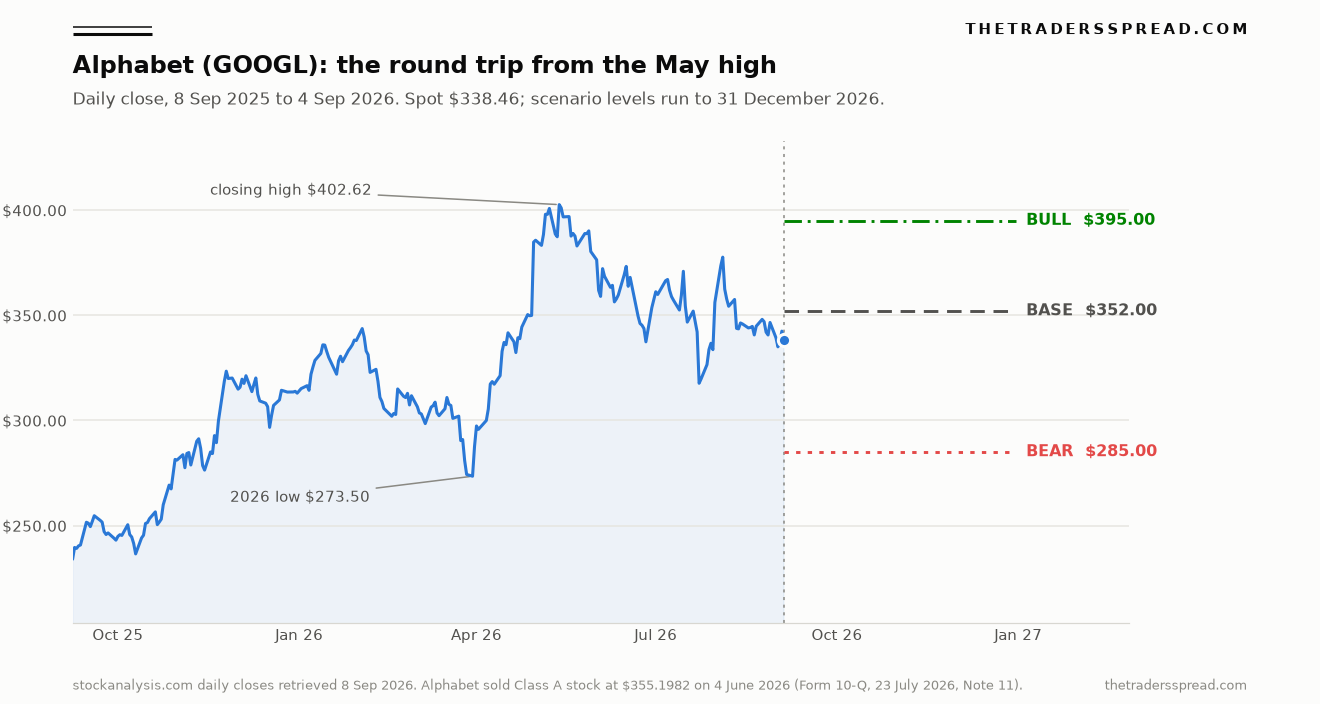
Negative $5,855 million. That is Alphabet's own free cash flow for the June 2026 quarter, printed in the company's own non-GAAP reconciliation table at the back of the Q2 2026 earnings release of 22 July 2026. Operating cash flow came in at $39,069 million. Purchases of property and equipment came in at $44,924 million. The difference is the first negative figure in the four quarters that table covers, and it arrived in the same three months that produced $112.1 billion of net income available to common stockholders and diluted earnings per share of $9.11, up 294% year over year. Alphabet (GOOGL) closed at $338.46 on 4 September 2026, 15.9% below its 13 May closing high of $402.62. The gap between those two facts is the whole argument.
Here is what almost nobody connected. Of the $138.8 billion of pre-tax income Alphabet booked in Q2, $99,031 million came from a single line: gain on equity securities, net. That is 71% of pre-tax income sitting in a mark on holdings that generated no cash, and the balance sheet shows where it lives. Non-marketable securities went from $68,687 million at the end of 2025 to $131,461 million on 30 June 2026. Alphabet's private AI and space holdings were revalued upward by roughly $63 billion in six months while the operating business burned money to build data centres. Strip the mark out and the same quarter delivers about $2.61 of earnings per share rather than $9.11. That single adjustment moves the trailing multiple from 17 times to roughly 35 times, and it explains why a stock that grew revenue 24% has spent four months going backwards.
Key facts
- Q2 2026 free cash flow was −$5,855m, down from +$24,461m in Q3 2025, +$24,551m in Q4 2025 and +$10,116m in Q1 2026 — Alphabet Q2 2026 earnings release, 22 July 2026
- Gain on equity securities, net was $99,031m in Q2 2026 against $1,286m a year earlier, contributing 71% of pre-tax income — Alphabet Form 10-Q, Note 7, filed 23 July 2026
- Google Cloud revenue rose 81.8% to $24,768m and Cloud operating income tripled to $8,814m, a 35.6% segment margin against 20.7% a year earlier — Alphabet Form 10-Q, Note 15, 23 July 2026
- Alphabet spent $80.6bn on capital expenditure in the first half of 2026 against $39.6bn in the first half of 2025, and repurchased $0 of stock against $28,706m in the same period of 2025 — Alphabet Form 10-Q, 23 July 2026
- Long-term debt went from $46,547m on 31 December 2025 to $98,165m on 30 June 2026, before a further $25bn of senior notes closed on 10 August 2026 — Alphabet Form 10-Q and Form 8-K, 10 August 2026
- Alphabet raised $49.6bn of net equity and preferred capital in the first week of June 2026 and filed a further $40bn at-the-market equity programme, undrawn at 30 June — Alphabet Form 8-K, 4 June 2026, and Form 10-Q Note 11
- Spot $338.46 on 4 September 2026 sits 0.7% above the 200-day moving average of $335.94 and 4.7% below the $355.1982 at which Alphabet sold Class A stock on 4 June — stockanalysis.com daily closes, retrieved 8 September 2026
The quarter that earned $112bn and burned $5.9bn
Take the operating business on its own and it is in excellent health. Revenue of $119,796 million was 24.2% above the June 2025 quarter, the twelfth consecutive quarter of double-digit growth. Operating income of $40,770 million expanded the margin to 34.0% from 32.4%. Google Search and other advertising grew 16.8% to $63,271 million on paid clicks up 13% and cost-per-click up 3%, which is the healthy version of that pair: volume leading price, not the reverse. Google Cloud is the part that changed shape. Revenue of $24,768 million was up 81.8%, and segment operating income of $8,814 million was 3.1 times the prior year, lifting Cloud's margin past 35% for the first time.
Sundar Pichai, CEO of Google and Alphabet, framed it this way in the 22 July release: "Q2 was an amazing quarter, with Alphabet revenues growing 24% year-over-year and Google Cloud revenues accelerating to 82% growth, driven by demand for AI infrastructure and AI solutions." He is not overselling the top line.
The cash statement tells the second half of the story. Alphabet spent $44,924 million on property and equipment in the quarter, equal to 37.5% of revenue. Depreciation ran $13.6 billion across the half against $9.5 billion a year earlier, so the income statement has not yet absorbed most of what the cash statement already paid for. Long-lived assets climbed from $261.8 billion at the end of 2025 to $338.9 billion on 30 June. Headcount rose 6.3% to 198,933.
| Metric | Q2 2025 | Q2 2026 | Change |
|---|---|---|---|
| Revenue | $96,428m | $119,796m | +24.2% |
| Google Cloud revenue | $13,624m | $24,768m | +81.8% |
| Operating income | $31,271m | $40,770m | +30.4% |
| Other income (expense), net | $2,662m | $97,983m | +3,581% |
| Diluted EPS | $2.31 | $9.11 | +294% |
| Capital expenditure (H1) | $39.6bn | $80.6bn | +103% |
| Free cash flow | +$24,461m (Q3 2025) | −$5,855m | negative |
| Interest expense | $261m | $1,278m | +390% |
| Diluted shares | 12,198m | 12,309m | +0.9% |
Source: Alphabet Form 10-Q filed 23 July 2026 and Q2 2026 earnings release, 22 July 2026. Alphabet discloses quarterly free cash flow only from Q3 2025, so that column shows the earliest quarter in its own table rather than Q2 2025.
What Alphabet did in the first week of June
Between 1 and 5 June 2026, Alphabet did something it has never done at scale. On 4 June it sold 29 million Class A shares at $355.1982 and 29 million Class C shares at $351.8018 in an underwritten public offering, and concurrently placed 14 million Class A and 14 million Class C shares privately with an affiliate of Berkshire Hathaway Inc. Net proceeds: $20.5 billion from the public book, $10.0 billion from Berkshire. A day later it closed 385 million depositary shares representing 19 million shares of 6.25% mandatory convertible preferred stock, netting a further $19.0 billion. The company's own release totals the week at $49.6 billion, "to be used for general corporate purposes, including capital expenditures to scale AI infrastructure and global compute."
On 1 June it also signed an equity distribution agreement for an at-the-market programme of up to $40 billion, initially with three banks. On 6 August it amended that agreement to add thirteen more, taking the syndicate from three managers to sixteen. Alphabet states the ATM proceeds are "primarily intended to be used to meet tax obligations associated with employee equity grants" and that none had been drawn at 30 June. Both things are true at once: the stated purpose is administrative, and a company does not expand a placing syndicate five-fold for an instrument it never intends to use.
Then came the debt. A $20 billion dollar tranche plus £5.5 billion of sterling notes closed on 13 February. Nine billion euros and C$9.5 billion closed on 11 May, followed by ¥576.9 billion of yen notes on 21 May. On 10 August Alphabet closed a further $25 billion of dollar senior notes across ten tranches, priced at a weighted-average 5.61% on the eight fixed-rate pieces by my calculation from the 8-K, and running out to 6.500% on paper maturing in 2066. Alphabet is now funding forty-year money at a coupon roughly five times its own trailing free cash flow yield of 1.29%.
What the dilution actually is, and is not
The scare version writes itself, and it is wrong on the arithmetic. Shares outstanding went from 12,088 million at the end of 2025 to 12,230 million on 30 June, a rise of 1.17%. The mandatory convertible converts on or about 15 May 2029 at between 2.2520 and 2.8160 Class A shares per preferred share for Series A, and 2.2740 to 2.8420 Class C for Series B, which on 19 million preferred shares is 43 to 54 million common shares, or 0.35% to 0.44% of the current count. Alphabet also paid $1.0 billion for capped calls struck at $532.6704 for Class A and $527.7974 for Class C, specifically to blunt that conversion. The dilution is a rounding error on a $4.14 trillion company.
The signal is not. Alphabet returned $45,709 million to shareholders through buybacks in 2025 and $28,706 million in the first half of that year alone. In the first half of 2026 it repurchased nothing. Zero. The company that spent a decade as the market's most reliable share-count shrinker has become a net issuer of equity and preferred stock, at prices its own stock has since fallen below. The 4 June book was struck at $355.1982; spot is $338.46. Everyone who bought that deal, Berkshire included, is 4.7% underwater four months later.
The preferred carries a real cost too. A 6.25% coupon on $19.25 billion of liquidation preference is roughly $1.2 billion a year, payable quarterly, and the first payment landed on 15 August 2026. Interest expense of $1,278 million in Q2 is already a $5.1 billion annual run rate net of $363 million capitalised, and the August notes are not in that number yet. For a business that recently had almost no interest cost, the fixed charges are becoming a line that matters. Rate relief is not obviously coming either: prediction markets currently price a 92.85% chance of zero Fed cuts in 2026.
The legal calendar nobody has priced
Three antitrust matters sit at different stages, and only one of them is resolved. The European Commission's 2018 Android decision, reduced on appeal to a €4.1 billion fine, became final in July 2026 when the European Court of Justice denied Alphabet's appeal. Alphabet paid $5.2 billion in cash including accrued interest in July, after the 30 June balance sheet date. Anyone modelling Alphabet's cash from the Q2 balance sheet alone has already missed that outflow.
The US Search case produced a final judgment in December 2025 imposing restrictions on how Google distributes its services and requiring it to share certain search data with, and offer syndication services to, competitors. Alphabet appealed in January 2026 and moved to pause parts of the remedy; the court denied the stay as premature. The Department of Justice and state Attorneys General cross-appealed in February. Nothing is settled.
The ad technology case is the live one. In April 2025 the Eastern District of Virginia ruled that Google's publisher tools unfairly excluded rivals. A separate remedies proceeding ran in September 2025, closing arguments were heard in November 2025, and Alphabet's own 10-Q says it is "awaiting a final judgment" while noting that "the DOJ's remedy proposal includes structural remedies that could have a material adverse effect on our business." Separately, the Commission's September 2025 self-preferencing decision imposed a €3.0 billion fine against which Alphabet posted bank guarantees rather than cash, and that appeal is pending. Google Network revenue, the segment most exposed to a structural ad-tech remedy, is the only line at Alphabet that shrank in Q2, down 0.7% to $7,303 million.
What the consensus misses
Screens show Alphabet on about 17 times trailing earnings, which for a business compounding revenue at 24% looks like an obvious mispricing. It is an artefact. Trailing twelve-month diluted EPS of $19.91 contains the Q2 equity-securities mark and the smaller Q1 one; the underlying operating engine produced $147,628 million of operating income over the same twelve months, which at the 19.1% effective tax rate Alphabet ran in the first half is about $9.70 per diluted share. That puts the stock nearer 35 times core operating earnings, which is a full price rather than a bargain, and it is roughly where Apple traded before its own margin question landed.
Two commitments also sit outside the headline capex number. Alphabet has entered leases, primarily data centres, that have not yet commenced, carrying $85.2 billion of future payments over terms running to 26 years, plus a $5.8 billion short-term commitment beginning in the third quarter. And the Cloud backlog, which Pichai described in the 29 April release as "nearly doubling quarter on quarter to over $460 billion", stood at $519.5 billion on 30 June, of which $513.9 billion is Cloud. That is roughly 13% sequential growth after a near-double. Backlog is still enormous, and its growth rate has already turned.
The counterparty view deserves a hearing. Nvidia guided to $108 billion for its October quarter and Amazon is running the same capex playbook, so Alphabet is not building into a vacuum. Its $513.9 billion of contracted Cloud commitments is the best evidence the spend is demand-led, and the Q2 margin shows the unit economics work at scale. The question is not whether the investment pays; it is how many quarters of negative free cash flow the equity tolerates before the discount rate on that promise changes.
The call: $395 bull, $352 base, $285 bear to 31 December 2026
Base case, $352 by 31 December 2026 (probability 45%). Alphabet reports Q3 in late October on the cadence of its last four releases, though no 8-K has yet fixed the date. Cloud growth decelerates from 82% toward the 60s as the Wiz contribution laps into the base, capex stays near $45 billion a quarter, and free cash flow stays around break-even. The stock grinds back toward the $355.1982 at which the company itself sold equity in June, which is the most honest anchor available: it is the price a well-advised issuer and a large private buyer agreed on with the same filings in front of them.
Bull case, $395 (probability 25%). Free cash flow turns positive in Q3 because capex plateaus rather than climbing again, Cloud margin holds above 35%, and the ad-tech remedy lands behaviourally rather than structurally. That combination takes the multiple back toward the May high without needing a single further dollar of mark-to-market help. It stops short of the $402.62 closing high because the interest and preferred charges are permanent now.
RelatedCoreWeave (CRWV) Falls 15.5% as 2031 Yield Nears 16%
Bear case, $285 (probability 30%). The March 2026 base, where Alphabet closed at $287.56 on 31 March after a $273.50 low, is the technical floor. Getting there needs two of the following: a structural ad-tech remedy, a second consecutive quarter of negative free cash flow, a downward revaluation of the non-marketable book that reverses part of the $99 billion gain, or an ATM draw that is visibly larger than employee tax withholding requires. One-year realised volatility of 31.4% puts a one-standard-deviation band at $284 to $403 over this horizon, so neither wing is an extreme outcome.
What would change my mind. A Q3 print with positive free cash flow and capex guided flat moves me out of the bear zone entirely; that is the single number to read first in late October. In the other direction, a Q3 filing showing shares sold under the ATM programme in excess of the employee tax obligation, or any restart of the buyback funded by new debt, would tell me management's own read of the cash position is worse than the balance sheet suggests. A downward mark on non-marketable securities would do the same, which is why the valuations attached to private AI companies matter more to Alphabet's reported earnings than they should.
FAQ
Did Alphabet really report negative free cash flow?
Yes, on its own definition. The Q2 2026 earnings release of 22 July 2026 shows net cash provided by operating activities of $39,069 million less purchases of property and equipment of $44,924 million, giving free cash flow of −$5,855 million for the quarter. Trailing twelve-month free cash flow was still positive at $53,273 million, so the burn is one quarter deep, not a trend.
Why is reported EPS so much higher than the operating business justifies?
The June quarter included a $99,031 million net gain on equity securities, largely unrealised marks on non-marketable holdings, which the balance sheet shows rising from $68,687 million to $131,461 million over six months. That gain produces no cash and can reverse. Excluding it, Q2 earnings per share were nearer $2.61 than the reported $9.11.
How much debt does Alphabet now carry?
Long-term debt was $98,165 million on 30 June 2026, against $46,547 million at the end of 2025 and $23,607 million a year earlier. The $25 billion of senior notes that closed on 10 August 2026 is not in that figure, so the pro-forma stack is above $123 billion. Cash and marketable securities were $242,474 million, so Alphabet remains substantially net cash.
Is the mandatory convertible preferred a dilution threat?
Not materially. The 19 million preferred shares convert on or about 15 May 2029 into between 43 and 54 million common shares, under 0.45% of the 12,230 million shares outstanding, and Alphabet bought $1.0 billion of capped calls struck at $532.6704 for Class A to reduce even that. The 6.25% coupon, roughly $1.2 billion a year, is the more durable cost.
What is the single biggest binary risk on the calendar?
The remedies judgment in the Department of Justice ad technology case in the Eastern District of Virginia. Closing arguments were held in November 2025 and Alphabet's 10-Q describes the DOJ proposal as including structural remedies that "could have a material adverse effect on our business." The state Attorneys General trial in the Eastern District of Texas follows that decision.
Where does the $285 bear level come from?
It is the top of the February–March 2026 consolidation, where Alphabet closed at $287.56 on 31 March after a 2026 closing low of $273.50 on 30 March. It also sits within one standard deviation of spot on one-year realised volatility of 31.4%, so it is a plausible destination rather than a crash.
Disclaimer
This article is analysis and information only. It is not investment advice, a recommendation, or an offer to transact in any security. The scenarios, probabilities and price levels are the author's own estimates derived from public filings and market data retrieved on 8 September 2026, and they may be wrong. Past performance does not indicate future results. Trading and investing carry risk, including the risk of losing your entire capital. Do your own research and consider taking advice from a regulated professional before making any financial decision.