

Anthropic is not the favourite to complete 2026's largest initial public offering because traders have read its paperwork. There is no paperwork. As of 31 August 2026, an EDGAR company search for "anthropic" returns 35 registrants, and every single one is a third-party feeder vehicle with a name like "Anthropic Apr 2026 a Series of CGF2021 LLC". Filter that same search to Form S-1 and the SEC returns the phrase "No matching companies." No Anthropic PBC registrant exists on the Commission's books. Yet the largest-IPO-of-2026 market on Polymarket priced Anthropic at 60.6 cents when we pulled the order book at 09:11 UTC on 31 August, against SpaceX at 35.0 cents. The market is paying six-to-four on a listing that has left no trace in the only public record that matters.
Here is the part almost nobody is pricing. Polymarket runs a second, separate market on where Anthropic's own first-day market capitalisation lands, and that ladder puts 68.5% of its probability mass below $2.5 trillion. SpaceX has already listed, on 15 June 2026, and closed its first session at a market cap of roughly $2.53 trillion. So the two markets are quoting incompatible views of the same company: one says Anthropic is 60.6% to both list this year and beat SpaceX, the other says that even if Anthropic lists at all, it clears SpaceX's number roughly a quarter of the time. Both books were live and two-sided when we queried them, seconds apart. One of them is wrong by a very wide margin.
Key facts
- Anthropic leg: 60.6c mid, 0.600 bid / 0.612 ask, $958,270 traded, $88,166 resting liquidity — Polymarket gamma-api, 31 August 2026, 09:11 UTC.
- SpaceX leg: 35.0c mid, 0.34 bid / 0.36 ask, $838,509 traded — Polymarket gamma-api, 31 August 2026, 09:11 UTC.
- SpaceX first trading day was 15 June 2026 and it closed at $192.50 — Nasdaq closing prices via stockanalysis.com, pulled 31 August 2026.
- Shares outstanding immediately after the offering, with the greenshoe fully exercised: 7,463,530,243 Class A plus 5,695,668,265 Class B, or 13.16bn in total — SpaceX Form 424B4 prospectus, 12 June 2026.
- That implies a first-day closing market cap of about $2.53 trillion, the figure the market's own rules use to resolve.
- Anthropic strike ladder: 68.5% of mass below $2.5tn, 26.7% at or above — Polymarket gamma-api, 31 August 2026, 09:11 UTC.
- Zero Anthropic registration statements on EDGAR; 35 name matches, all Form D feeder funds — SEC EDGAR company search, 31 August 2026.
The bar is already set, and it is $2.53 trillion
The resolution language is unusually precise, and it is what makes this market analysable rather than a beauty contest. Polymarket's rules state that the contract "will resolve to the company that achieves the highest market capitalization in U.S. dollars based on the official closing price on its first trading day in 2026", with market cap "defined as the total number of outstanding shares multiplied by the closing share price on the first trading day". The company must complete its IPO between 1 January and 31 December 2026.
That wording freezes SpaceX's number permanently. Space Exploration Technologies Corp, CIK 0001181412, listed on Nasdaq under SPCX and traded for the first time on 15 June 2026, closing at $192.50 after pricing at $135.00 the previous Friday, a first-day gain of 42.6%. Three separate primary disclosures give the share count, and they agree. The prospectus filed on 12 June 2026 states 7,463,530,243 Class A and 5,695,668,265 Class B shares outstanding immediately after the offering assuming full exercise of the over-allotment option, which the company's later 10-Q confirms was exercised. The 30 June 2026 balance sheet shows 13,176 million common shares. The 10-Q cover page reports 13,181,779,945 shares as of 28 July 2026. Multiply any of the three by $192.50 and you land between $2.533tn and $2.538tn.
This matters because a widely circulated figure for the SpaceX IPO is $1.77 trillion. That number is real, but it is the valuation at the $135.00 offer price, not at the first-day close: 13.16bn shares times $135.00 is $1.776tn. The market does not resolve on the offer price. Anyone carrying the $1.77tn number in their head is understating the bar Anthropic must clear by roughly $760 billion, which is most of the reason the mispricing has survived.
SpaceX's chief executive framed the listing in the prospectus itself: "You want to wake up in the morning and think the future is going to be great, and that's what being a space-faring civilization is all about," wrote Elon Musk, founder, Chief Executive Officer, Chief Technical Officer and Chairman of the board at SpaceX, in the Form 424B4 filed on 12 June 2026. Whatever one makes of the rhetoric, the arithmetic beneath it is now fixed and public.
Who is on the other side of this trade
The order book gives a fairly clear picture of positioning. The Anthropic leg has taken $958,270 in cumulative volume and holds $88,166 of resting liquidity, with a 1.2-cent spread. The SpaceX leg has taken $838,509 and holds $30,364, quoted 34 bid at 36. The event as a whole carries $716,652 of liquidity, $5,765,461 of lifetime volume, $633,552 of open interest and just $10,899 of turnover in the past 24 hours. This is a market with real size and thin recent flow, which is the classic profile for a stale consensus.
There is a second structural reason SpaceX may be trading cheap, and it has nothing to do with the resolution rules. SPCX closed at $141.50 on 28 August 2026, its 52-week range running from $104.83 to $225.64. The stock is 26.5% below its own first-day close. A trader watching the ticker fall all summer would reasonably feel less enthusiastic about the SpaceX leg. But the contract does not reference the current price at all. It references the 15 June close, which is already in the books and cannot move. Confusing a live price with a settled one is a familiar failure mode on venues where a single ticker appears in several different contracts, and we flagged the same pattern when the Iran blockade market held 23.5% on a question whose hazard rate had already collapsed.
Third, the event carries an enormous amount of dead structure. Of 74 legs, only 12 have ever traded. One is "Other". The remaining 61 are named "Placeholder A" through "Placeholder BH", each quoted 0 bid at 1.00, each with no volume, no liquidity and no last trade. They exist so that the negative-risk mechanism can add candidates later. They also make the board considerably harder to read than it looks.
The xAI leg deserves its own paragraph, because it is the most misleading number on the page. The interface displays it at 25.5%. Its actual book is 0.01 bid at 0.50, with no volume, no last trade and $360 of liquidity, and the API flags it inactive. It is a dormant quote, not a price. More to the point, SpaceX's own 10-Q states that on 2 February 2026 the company "completed its acquisition of X.AI Holdings Corp", after which xAI "became a wholly-owned subsidiary". Polymarket's rules say a listed company "may resolve to 'No' as soon as it becomes unable to complete an IPO, including due to acquisition, merger, or absorption by an entity that is already publicly traded". xAI was absorbed by a company that is now publicly traded. That leg is finished; it simply has not been closed out.
What the odds board says, and what the strike ladder says
Strip out the dormant xAI quote and the 61 placeholders, and the 12 live legs sum to 97.7%. Anthropic 60.6, SpaceX 35.0, OpenAI 1.65, and nine names at 0.05 each: ByteDance, Stripe, Databricks, SHEIN, Waymo, Revolut, Discord, Perplexity AI and Kraken. That is a coherent book. Those 12 mid-prices sum to 97.7% while the ask side sums to 99.8%, so there is no free basket sitting there, and the tight sum is itself evidence that someone is watching the arithmetic.
Now put the companion strike ladder on Anthropic's own market cap next to it. Pulled at the same moment, it reads: below $1.25tn 2.1%, $1.25–1.5tn 1.65%, $1.5–1.75tn 8.6%, $1.75–2.0tn 21.5%, $2.0–2.25tn 17.1%, $2.25–2.5tn 17.5%, $2.5–2.75tn 13.15%, $2.75–3.0tn 5.05%, above $3.0tn 8.5%, and no IPO at all by end-2027 at 1.15%. These are not dead quotes. The $2.0–2.25tn leg is 0.170 bid at 0.172, a two-tenths-of-a-cent spread, and every rung has traded between $24,000 and $81,000.
Interpolating uniformly within the $2.5–2.75tn bucket, the mass sitting above SpaceX's $2.533tn bar is 24.96 points of a 96.3-point book, or 25.9% normalised. Conditional on Anthropic listing at all, it is 26.2%. That number is a ceiling, and it does not depend on any view of ours about timing: even if Anthropic were certain to list before 31 December, the strike ladder says it beats SpaceX only about 26% of the time. The first market pays 60.6.
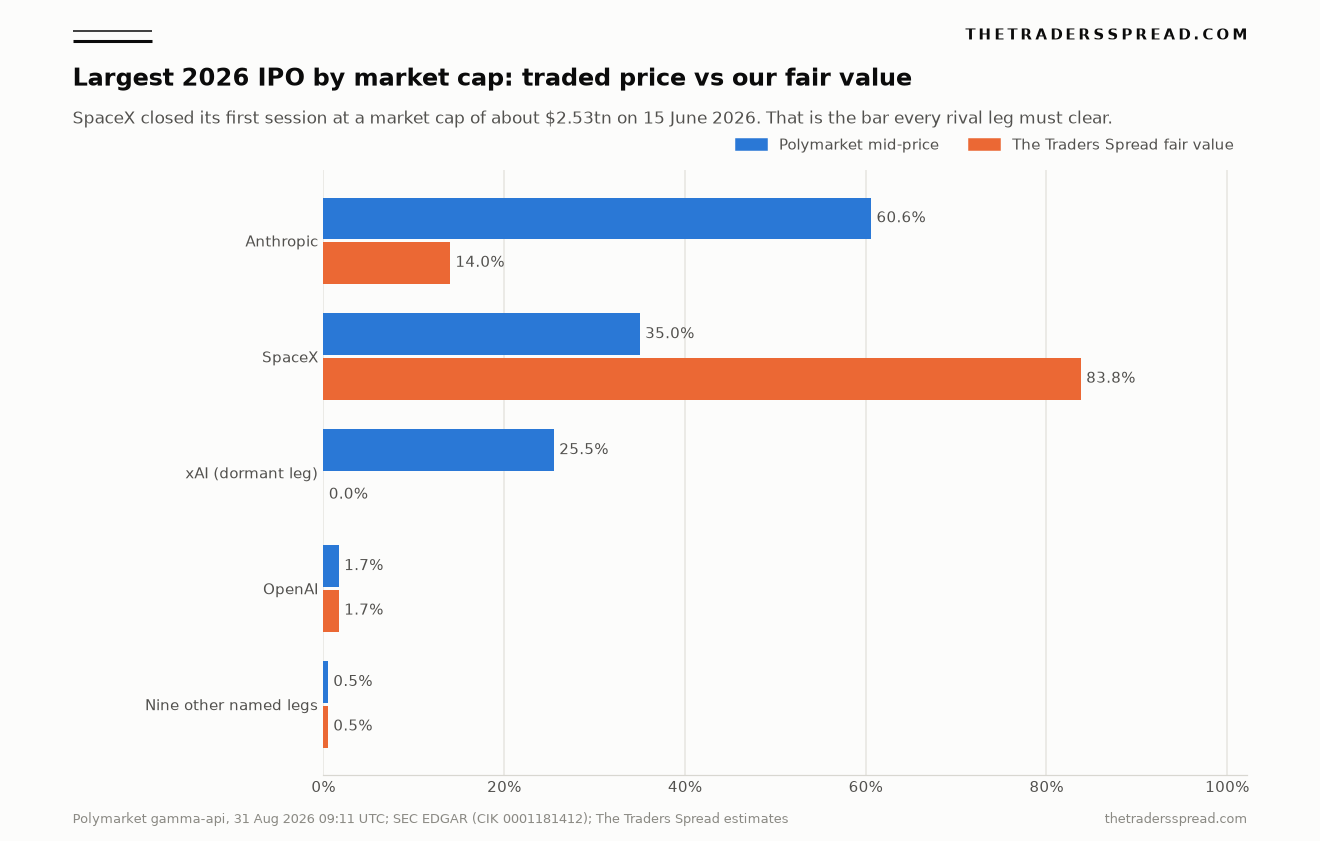
| Leg | Polymarket mid, 31 Aug 09:11 UTC | Volume | Our fair value | Gap |
|---|---|---|---|---|
| Anthropic | 60.6% | $958,270 | 14% | Market above |
| SpaceX | 35.0% | $838,509 | 84% | Market below |
| xAI (dormant) | 25.5% displayed | none | 0% | Rules-resolved |
| OpenAI | 1.65% | $529,026 | 1.7% | In line |
| Nine other named legs | 0.05% each | $108k–$657k | 0.5% total | In line |
The registration clock the SEC actually runs
The obvious objection to a bearish read on Anthropic is that a confidential filing would not appear on EDGAR at all, and that objection is correct. Under the SEC's Division of Corporation Finance procedures, an issuer may submit a draft registration statement for non-public staff review provided it confirms it will publicly file "at least 15 days prior to any road show or, in the absence of a road show, at least 15 days prior to the requested effective date". Polymarket's own auto-generated context blurb on the event asserts that Anthropic made a confidential submission in June. We could not verify that at any primary source, and by construction nobody outside the process can. It is worth adding that the same blurb states the SpaceX IPO at "$1.77 trillion", which is the offer-price figure the resolution rules do not use.
What we can do is measure how long the process actually takes, because SpaceX left a complete public docket. Its confidential draft went in on 30 March 2026. An amended draft followed on 7 May. The public S-1, file number 333-296070, landed on 20 May. Staff comment letters are dated 19 May, 29 May and 2 June; amendments followed on 1 and 3 June; the registration went effective on 11 June; the prospectus was filed on 12 June; the stock traded on 15 June. Confidential submission to first trade: 77 days. Public S-1 to first trade: 26 days.
There are 122 days between 31 August and 31 December. On the SpaceX template, a confidential process starting today would still clear the year comfortably, and a public S-1 filed as late as the first week of December would too. This is why we treat the timing argument as the weaker of the two legs of the case, and say so plainly. The absence of a public S-1 on 31 August constrains the probability of a 2026 listing; it does not come close to eliminating it.
The wider policy setting is unusually active. Jim Moloney, Director of the Division of Corporation Finance at the SEC, noted on 10 June 2026 that "in the mid-1990s, more than 7,800 companies were listed on U.S. exchanges. That number has now fallen by roughly 40 percent." SEC Chairman Paul S. Atkins put the same trend differently at the Small Business Capital Formation Advisory Committee on 21 July 2026: "During the decade of the 1990s, there were approximately 4,000 IPOs. In the 25 years since then, there have been only 3,200." Four rule proposals aimed at reversing that are in flight, including registered offering reform and filer status reform. None of them changes the 15-day public-filing gate that governs whether a confidential Anthropic file becomes visible before it prices.
Where this leaves the price
Our fair value for the Anthropic leg is 14%, with a defensible band of 10% to 21% and a hard ceiling of 26%. The derivation has two terms and both are stated. The first is the probability Anthropic's first trading day falls inside calendar 2026, which we put at 55% and which is the only genuinely subjective input here. The second is the probability its first-day close exceeds $2.533tn given that it lists, which the companion strike ladder puts at 26.2%. At 40% listing odds fair value is 10.5%; at 75% it is 19.7%; at absolute certainty it is 26.2%. There is no listing probability, up to and including one, that reaches 60.6.
Two caveats belong on the record. First, the companion market's horizon runs to end-2027, not end-2026, and one of its legs is explicitly "No IPO by December 31, 2027". Its distribution is therefore conditioned on a longer window than the leg we are pricing, and a 2027 listing would plausibly carry a different valuation to a 2026 one. The comparison is indicative, not arithmetic, and we would not run it as a clean conditional. Second, our uniform interpolation inside the $2.5–2.75tn bucket is an assumption; the true shape could be skewed either way.
RelatedSerbia Parliamentary Election: Vučić at 60.5%, Fair Higher
By the same construction, the SpaceX leg screens at roughly 84% against a 35.0 mid, since it resolves yes unless somebody clears $2.533tn before the year ends. A 49-point gap on a market that has traded $5.77m is large enough that the first duty is to check one's own work rather than the market's, and the honest answer is that the companion ladder could simply be the stale book. Against that, its spreads are tighter than the main event's. Readers who want the current state of the IPO odds board can see every leg live. What would change our mind is straightforward: a public Anthropic S-1 carrying a share count and an indicative range that puts $2.5tn-plus in play, or a sustained repricing of the strike ladder above $2.5tn. Absent either, the two markets cannot both be right. We have covered similar cross-market breaks in the Brazilian presidential book and in September Fed pricing, and the resolution is usually that the thinner, less-watched contract turns out to be the accurate one.
Frequently asked questions
Does the market resolve on the offer price or the first-day close?
The first-day close. Polymarket's rules define market capitalisation as total shares outstanding multiplied by the closing share price on the first trading day, using the primary exchange's official listing page. For SpaceX that is the 15 June 2026 close of $192.50 against roughly 13.16bn shares, which is about $2.53tn, not the $1.78tn implied by the $135.00 offer price.
Why is Anthropic showing 60.6% if it has not filed anything?
A confidential draft registration statement submitted for non-public SEC review does not appear on EDGAR, so the absence of a filing is not proof that no process is under way. What the absence does establish is that as of 31 August 2026 the public record contains nothing, and that under SEC procedure any confidential file must become public at least 15 days before a road show.
What is the xAI leg doing at 25.5%?
Displaying a stale number. Its book is 0.01 bid at 0.50 with no volume and no last trade, and the API marks it inactive. SpaceX's 10-Q records that it completed the acquisition of X.AI Holdings Corp on 2 February 2026, making xAI a wholly-owned subsidiary of a company that has since listed. The event rules resolve such a leg to no.
How long does a US mega-cap IPO actually take?
SpaceX offers the only fully documented 2026 template. Its confidential draft was submitted on 30 March 2026 and the stock traded on 15 June 2026, a span of 77 days. From the public S-1 on 20 May to first trade was 26 days. Three SEC staff comment letters were issued in between, dated 19 May, 29 May and 2 June 2026.
Do the legs add up to 100%?
The 12 legs that have ever traded sum to 97.7% on mid-price and 99.8% at the ask. The event also carries 61 untraded legs, "Other" plus "Placeholder A" through "Placeholder BH", which exist to let the negative-risk structure admit new candidates and which contribute nothing to the sum.
Where does the 26% ceiling come from?
From Polymarket's separate ladder on Anthropic's own first-day market cap. Interpolating uniformly, 24.96 points of that 96.3-point book sit above $2.533tn, which is 26.2% once you condition on a listing happening. Multiplying by any listing probability can only reduce it, which is why 26% is a ceiling rather than an estimate.
Analysis, not advice. Nothing here is a recommendation to transact in any market or instrument. Prediction market contracts can settle at zero and capital is at risk. Figures were pulled on 31 August 2026 and prices move.