

What is TSMC (TSM) actually being asked to price on 15 October: the profit Hsinchu has just published, or a slide that was already eight sessions old? The ADR finished the New York regular session on 14 October at $430.00, down $15.12, or 3.4%, from the prior close of $445.12, on volume of 15,167,154 shares. That session ended at 16:00 EDT. The earnings release is dated 15 October, and extended hours had already stopped the night before, last marked at $422.55. At 06:50 UTC on the 15th, when these quotes were pulled, the NYSE cash market was still shut. The 3.4% cannot be a verdict on net income of NT$763.06 billion. It is the last finished US session standing in front of that number. The print and the decline are on different clocks.
Stay inside the company's own table and the quarter splits. Operating income was NT$876.45 billion, up 14.3% from the second quarter. Net income was up 8.0%. Pre-tax income, the line between them, was up only 5.6%. Take operating income off pre-tax income and the gap, where non-operating items sit, shrinks from NT$95.83 billion in the second quarter to NT$34.59 billion in the third. Year on year, net income still rose 68.7%. Quarter on quarter, net-income growth is a fraction of operating growth, and the bridge is that smaller non-operating contribution. The drop from pre-tax income to net income was NT$147.98 billion, against NT$155.87 billion a quarter earlier, so the slowdown did not come from a heavier charge below the pre-tax line.
Key facts
- The ADR closed at $430.00 on 14 October, down 3.4% from $445.12, on volume of 15,167,154 — StockAnalysis quote for TSM, retrieved 15 October 2026
- Taipei ordinary shares, ticker 2330, closed at NT$2,440 on 15 October, down 2.0% from NT$2,490 — Yahoo Finance, retrieved 15 October 2026
- Third-quarter revenue was NT$1,494.24 billion, or $46.72 billion, and net income was NT$763.06 billion — TSMC earnings release, 15 October 2026
- Diluted earnings were NT$29.43 a share, or $4.60 per ADR unit. Gross margin was 66.4%, operating margin 58.7%, net profit margin 51.1% — TSMC earnings release, 15 October 2026
- Dollar revenue finished above the company's $44.6 billion to $45.8 billion guidance range, and the operating margin finished above the 56% to 58% range — TSMC quarterly results page, 15 October 2026
- Fourth-quarter guidance is revenue of $52.3 billion to $54.3 billion, gross margin 65.0% to 67.0%, operating margin 56.5% to 58.5%, at an assumed NT$31.8 per dollar — TSMC quarterly results page, 15 October 2026
- 2-nanometer was 8% of wafer revenue, 3-nanometer 33%, 5-nanometer 28% and 7-nanometer 10%. Nodes of 7-nanometer and tighter were 79% — TSMC earnings release, 15 October 2026
What the 15 October release contains
Consolidated revenue NT$1,494.24 billion. Net income NT$763.06 billion. Diluted earnings NT$29.43, stated as $4.60 per ADR unit. Against the third quarter of 2025, revenue rose 50.9% and both net income and earnings rose 68.7%. Against the second quarter of 2026, revenue rose 17.6% and net income rose 8.0%. The accounts are consolidated and prepared under TIFRS. In dollars, revenue was $46.72 billion, up 41.2% from a year earlier and 16.2% from the prior quarter. The quarterly results page puts the quarter's average rate at 31.98 New Taiwan dollars per US dollar, against a guidance assumption of 32.0. That rate is why the NT-dollar growth and the US-dollar growth are not the same number.
Gross margin is stated at 66.4%, operating margin at 58.7%, net profit margin at 51.1%. The prior-quarter percentages are not printed, but the table supplies them. Second-quarter gross profit of NT$860,311 million on net sales of NT$1,270,381 million is 67.7%. The year-ago gross margin, same method, is 59.5%. So 66.4% is 1.3 percentage points under the previous quarter and 6.9 points above the year-ago quarter. Operating margin a quarter earlier works out to 60.3%, and net margin to 55.6%. Every absolute profit line is higher than both comparison columns. The rates are not.
| 3Q26 | 2Q26 | 3Q25 | QoQ | YoY | |
|---|---|---|---|---|---|
| Net sales | 1,494,243 | 1,270,381 | 989,918 | +17.6% | +50.9% |
| Gross profit | 992,379 | 860,311 | 588,543 | +15.4% | +68.6% |
| Operating income | 876,445 | 766,603 | 500,685 | +14.3% | +75.0% |
| Pre-tax income | 911,039 | 862,430 | 525,369 | +5.6% | +73.4% |
| Net income | 763,064 | 706,562 | 452,302 | +8.0% | +68.7% |
| EPS (NT$) | 29.43 | 27.25 | 17.44 | +8.0% | +68.7% |
Figures are millions of New Taiwan dollars, except earnings per share. Two footnotes matter. The third-quarter column has not been approved by the board. And NT$29.43 rests on 25,932 million weighted-average shares. Divide net income of NT$763,064 million by that share count and the earnings figure closes. A second check: NT$29.43 divided by 31.98 is about $0.921, and the stated ADR earnings of $4.60 divided by that amount is 5.0. At the quarter's rate, one ADR unit lines up with five ordinary shares.
Node mix is in the prose, not only the table. 2-nanometer was 8% of wafer revenue, 3-nanometer 33%, 5-nanometer 28%, 7-nanometer 10%. Advanced technology, defined in the release as 7-nanometer and tighter, was 79%. The 3-nanometer family is still the largest slice. The 2-nanometer family is no longer a rounding error inside a quarter whose gross margin dipped. The release also locates the company: a pure-play foundry founded in 1987, 305 process technologies and 12,682 products for 534 customers in 2025, headquarters in Hsinchu. Wendell Huang, senior vice president and chief financial officer, is the named spokesperson.
The ADR's path into that morning
The 3.4% is one session. The chart is the year of closes around it, with no path drawn past the last print.
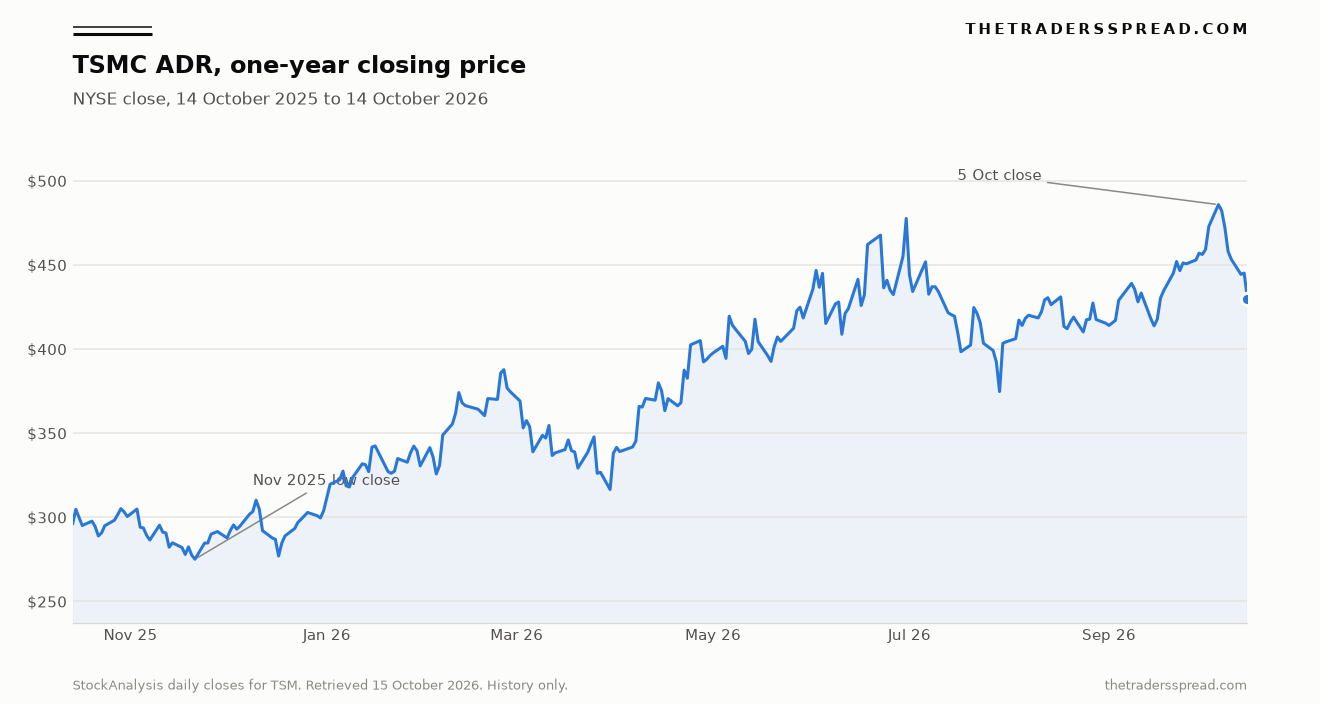
From the 14 October 2025 close of $295.94 to the 14 October 2026 close of $430.00, the closing price rose 45.3%. That is the traded close on the StockAnalysis history, retrieved 15 October 2026, not a dividend-adjusted total return. The closing low on the series was $275.06 on 21 November 2025, the same session as the intraday low of $266.82. The closing high was $485.80 on 5 October 2026, the same session as the intraday high of $487.47. Both intraday extremes match the quote object's 52-week high and low. From the 5 October close to the 14 October close is a decline of 11.5% in eight sessions. The release did not start it.
The last fortnight, close by close: $456.19 at the end of September, $459.20 on 1 October, $472.78 on 2 October, $485.80 on 5 October, then $482.30, $472.20, $457.99 on 8 October (down 3.0% that day), $453.31, $444.35 on 12 October, $445.12 on 13 October. The 14 October bar opened at $436.25, traded between $428.06 and $440.39, and closed at $430.00. The open alone was 2.0% under the prior close. Volume of 15.17 million shares was nearly double the prior session's 8.33 million.
| Listing | Window | Last price | Reference | Move |
|---|---|---|---|---|
| TSM, NYSE regular | 14 October 2026 | $430.00 | $445.12 prior close | Down 3.4% |
| TSM, extended hours | 14 October, to 19:59 EDT | $422.55 | $430.00 regular close | Down 1.7% |
| 2330, Taipei | 15 October 2026 | NT$2,440 | NT$2,490 prior close | Down 2.0% |
StockAnalysis shows the extended-hours mark at $422.55 as of 14 October, 7:59 pm EDT. That is 23:59 UTC, hours before a release dated the next Taipei morning. From the 13 October close of $445.12 to $422.55 is about 5.1%, and it is still the pre-release tape. Yahoo Finance showed 2330 at NT$2,440 on 15 October, previous close NT$2,490, down 2.0%, with the official time at 05:30 UTC. Minute bars that session ran from about NT$2,435 through a range of NT$2,430 to NT$2,450 and never revisited NT$2,490. Taipei spent the day already lower and finished as the release carried a 15 October date. The ADR had not been given a cash session at all.
Where the wafers went
The release stops at nodes. The call, as reported in Taipei the same morning, filled in the platforms. Nextapple's account of Wendell Huang says dollar revenue of $46.7 billion beat the top of the prior guide, which the release already shows, and then gives the split the release omits. High-performance computing revenue rose 22% from the second quarter and was 68% of the total. Smartphone revenue rose 10% and was 21%. Automotive rose 23% and was 4%. Internet of things rose 5% and was 4%. Consumer electronics fell 12% and was 1%. He tied the 1.3-point gross-margin decline mainly to the early 2-nanometer ramp, and he put return on equity at 45.5%. Those percentages are call commentary carried by Lu Cheng-che on 15 October. They are not lines in the two-page release.
On that telling, two-thirds of the quarter sat in high-performance computing, and that bucket grew faster than the company. Phone silicon grew and was a fifth of revenue. The consumer-electronics slice shrank and was already tiny. The customer names are not in the release. Designers whose leading-edge parts run through this foundry include Nvidia and AMD, with Apple on the phone side and Broadcom among the custom accelerators. Nvidia's own guidance jump is a separate tape, and it is the demand the call just described without naming the buyer. Read next to the nodes, 3-nanometer plus 2-nanometer is 41% of wafer revenue, and 5-nanometer is another 28%. An end-market share and a manufacturing mix are not the same ratio. Both say the quarter was won at the leading edge, which is also where the dilution is supposed to live.
The margin argument taken to the call
Guidance is not in the two-page release. It is on the quarterly results page, beside the quarter just printed. Actual revenue $46.72 billion against a guide of $44.6 billion to $45.8 billion. Rate 31.98 against an assumption of 32.0. Gross margin 66.4% against 65.0% to 67.0%. Operating margin 58.7% against 56.0% to 58.0%. Revenue cleared the top of the range by $0.92 billion. The gross margin landed inside the band, 0.4 points above its midpoint. The operating margin cleared the top of its band by 0.7 points. Against the company's own ranges, this was a revenue beat and an operating-margin beat. The gross margin was inside a corridor already drawn.
The fourth-quarter column is the new information. Revenue $52.3 billion to $54.3 billion. Assumed rate 31.8. Gross margin again 65.0% to 67.0%. Operating margin 56.5% to 58.5%. The revenue midpoint is $53.3 billion, which is 14.1% above third-quarter revenue of $46.72 billion. The band runs from 11.9% above to 16.2% above. Those percentages are arithmetic on the page's figures, not a sentence the company printed. At 31.8, the dollar band is roughly NT$1,663 billion to NT$1,727 billion. The gross-margin midpoint of 66.0% sits 0.4 points under the 66.4% just reported. The operating-margin midpoint of 57.5% sits 1.2 points under the 58.7% just delivered.
Huang's comment, again via Nextapple, matches the gross-margin step and adds a cause. The fourth-quarter midpoint is about 0.4 points under the third quarter, he said, mainly because the 2-nanometer ramp is now fast and because overseas fabs cost more, with productivity, cost work and capacity moved across nodes offsetting part of the drag. The same report has full-year 2026 gross-margin dilution from overseas fabs closer to 2 percentage points, widening to 3 to 4 points in later years as the US build speeds up. It also has management reiterating a 2026 capital-expenditure range of $60 billion to $64 billion, with investment over the next three years clearly larger than over the past three. The presentation and the management report on the investor site returned an access block from this desk, so those points stay with the call report. The guidance band does not. It is on the results page.
C.C. Wei, the chairman, supplied the demand sentence. Yahoo Finance Taiwan quoted him, in Chinese, as saying 「第二波AI需求正強勁興起」: a second wave of AI demand is rising strongly. In reported speech rather than quotation marks, the same piece has him saying consumer electronics and some price-sensitive markets are still under pressure, while AI accelerators and a new class of agentic-AI processors are that second wave, with AI server processors expected to contribute around 40% of 2026 revenue. The 40% is Yahoo's paraphrase of his expectation. It is not a line in the earnings release.
A 2-nanometer share that has reached 8% of wafer revenue inside a quarter is a ramp, and a new node usually costs gross margin before it earns it back. The tools sit with the equipment supplier. ASML's run into its own 14 October print is the other side of the same spend. AMD's decline against an unchanged margin guide is a contrast, not a comparable: a designer can disappoint holders by failing to lift a margin, while this foundry can print a higher operating profit and still guide the next gross-margin midpoint down by a fraction of a point. The questions rhyme. The accounts do not.
What this changes
The 3.4% is the setup, not the score. The 14 October close is not an earnings reaction, and neither is $422.55 in extended hours. Both prints are earlier than the release. Taipei closed down 2.0% after a session that never regained NT$2,490, and that session finished as the release was dated. The first cash market that can trade NT$29.43, the 66.4% gross margin and the fourth-quarter band is the NYSE open on 15 October. When these prices were taken, that open was still ahead.
What the open can react to is narrower than one profit headline. Revenue, net income and earnings are higher than both columns in the release. The pace is not. Operating income grew 14.3% quarter on quarter and net income grew 8.0%, because the non-operating gap fell from NT$95.83 billion to NT$34.59 billion. The new gross-margin range is the same 65% to 67%, so its midpoint sits 0.4 points under the quarter just reported. The new operating-margin range sits below what the third quarter delivered. Revenue guidance at the midpoint asks for another 14% sequential increase. A session can like the revenue band and dislike the margin step. Those are different bets.
RelatedJPMorgan (JPM) Forecast: $368 Bull vs $283 Bear Case
Two points outlast the open. The board has not approved the figures. The call report puts overseas-fab dilution at closer to 2 points of 2026 gross margin, and 3 to 4 points later if the US build accelerates, against capital expenditure of $60 billion to $64 billion. That changes what a higher quarter means for the margin, beside a revenue band of $52.3 billion to $54.3 billion. If high-performance computing was 68% of revenue, the argument from here is accelerator demand, the 2-nanometer curve, and how much gross margin Arizona keeps.
None of that is a price at which the decline has to end. The 11.5% drop from the 5 October close happened before the profit existed. The 45.3% one-year rise in the closing price is still there. The session that can separate those two facts had not started.
Questions desks are asking
Did TSMC shares fall because of the third-quarter profit?
No. The 3.4% is the NYSE session on 14 October, from $445.12 to $430.00. The release is dated 15 October. Extended trading ended at $422.55 the night before, and New York's cash market had not opened by 06:50 UTC on the 15th. Taipei closed at NT$2,440, down 2.0%, after a day between NT$2,430 and NT$2,450. Any earnings reaction belongs to a session that had not happened when these prices were taken.
What did TSMC report for the third quarter of 2026?
Revenue of NT$1,494.24 billion, or $46.72 billion. Net income of NT$763.06 billion. Diluted earnings of NT$29.43, or $4.60 per ADR unit. Gross margin 66.4%, operating margin 58.7%, net profit margin 51.1%. Revenue rose 17.6% from the second quarter and 50.9% from a year earlier. Net income rose 8.0% and 68.7% on those same comparisons. The figures are under TIFRS, and the board had not approved them.
How did that compare with the company's own guidance?
The results page shows a third-quarter guide of $44.6 billion to $45.8 billion of revenue, gross margin of 65% to 67%, and operating margin of 56% to 58%, at an assumed 32.0 rate. Actual revenue was $0.92 billion above the top of the range. Gross margin of 66.4% landed inside the band. Operating margin of 58.7% was above its band. The average rate, 31.98, was close to the assumption. That comparison does not need an outside consensus.
What has TSMC guided for the fourth quarter?
Revenue of $52.3 billion to $54.3 billion, gross margin of 65.0% to 67.0%, operating margin of 56.5% to 58.5%, at NT$31.8 per dollar. The revenue midpoint of $53.3 billion is 14.1% above third-quarter revenue, calculated from those figures. The gross-margin midpoint of 66% is 0.4 points under the 66.4% just reported. Huang, in a Taipei report of the call, tied that step to the 2-nanometer ramp and to higher costs at overseas fabs.
Why did net income rise more slowly than operating income?
Operating income rose 14.3% from the second quarter and net income rose 8.0%. Pre-tax income rose only 5.6%. The gap between operating income and pre-tax income, where non-operating items sit, fell from NT$95.83 billion to NT$34.59 billion. The further drop from pre-tax income to net income was smaller than a quarter earlier, not larger. The slower net-income growth is that smaller non-operating contribution, visible in the release.
Which figures are in the release, and which are call commentary?
Revenue, profit, earnings, margins and the node mix are in the 15 October release, which says the board has not approved them. The fourth-quarter band is on the results page. Platform mix, the 45.5% return on equity, overseas-fab dilution and the $60 billion to $64 billion capital-expenditure range are from Nextapple's report of Huang. Wei's line on a second wave of AI demand is from Yahoo Finance Taiwan.
This is news and analysis, not a recommendation to trade TSMC or any other security. Prices move and capital is at risk. Figures come from the sources named, on the dates named, and the company can still revise a quarter the board has not approved. Nothing here is an instruction to take a position in the ADR, the ordinary share, or any customer or supplier named in passing.