

Salesforce did not rise 4% or 5% on Bank of America's double-upgrade. Those readings are the middle of Monday's session, or the high, not the close. The NYSE close on 12 October 2026 was $233.92, up $4.79 from Friday 9 October's $229.13, which is 2.09%. Nasdaq's historical table and the StockAnalysis quote print the same open, high, low and close: $236.65, $240.90, $231.48 and $233.92. The high was 5.14% above Friday. From there to the close the shares gave back $6.98. Piero Cingari at Benzinga, filing at 11:40 a.m. Eastern, had the stock about 3% higher, around $235, after a touch of $240.90. The touch is the official high. The 3% line is a trade that had not finished. A 5% figure is Friday's close to Monday's high. Only 2.09% is the close-to-close move.
The stranger fact is how little of the rewrite reached the price. Tal Liani, the BofA Securities analyst, did not nudge a target. He moved Salesforce from Underperform to the firm's highest rating and lifted his target from $160 to $285, a 78.1% increase, setting the new figure at 16 times estimated calendar-2027 free cash flow where the old one had used nine times. The revenue edits under that multiple were tenths of a point: fiscal 2028 growth to 9.9% from 9.5%, fiscal 2029 growth to 10.1% from 9.9%, at $50.9 billion and $55.98 billion, as Cingari reported. Six weeks earlier, on 27 August, the same shares closed at $252.05, up 22.58% in one session after the fiscal second-quarter release. Monday's close is 7.19% below that print. A near-doubling of a multiple, dropped into a fade the market had already traded, produced a 2.09% day.
Key facts
- Monday 12 October closed at $233.92, up $4.79, or 2.09%, from Friday 9 October's $229.13 — Nasdaq historical quotes and StockAnalysis, retrieved 13 October 2026
- The session high was $240.90, 5.14% above Friday's close, and the close gave back $6.98 of it — same prices, 13 October 2026
- Nasdaq volume was 8,878,863 shares, 1.90 times Friday's 4,681,533, while StockAnalysis volume of 8,878,923 was 8.5% under the prior 20-session average of about 9.70 million — Nasdaq and StockAnalysis, 13 October 2026
- Liani's target went from $160 to $285, and the multiple he cites from 9 times to 16 times calendar-2027 enterprise value to free cash flow — Piero Cingari, Benzinga, 12 October 2026
- Second-quarter fiscal 2027 revenue was $11.345 billion, including $456 million from Informatica, and current remaining performance obligation was $33.5 billion, up 14% in constant currency — Salesforce Exhibit 99.1, 8-K filed 26 August 2026
- A $2.613 billion gain on strategic investments added $2.53 to non-GAAP diluted earnings per share of $5.90 in that quarter — same exhibit
- The 12 October close is 11.7% below the 31 December 2025 close of $264.91, and 7.19% below the 27 August close of $252.05 — StockAnalysis session closes, price change not total return, 13 October 2026
The close was $233.92
Volume did not confirm a rush.
Friday's Nasdaq print was 4,681,533 shares. Monday's was 8,878,863, or 1.90 times a quiet Friday, and 8.5% under the prior twenty-session StockAnalysis average of about 9.70 million. The vendors differ by a few thousand shares, not on the prices.
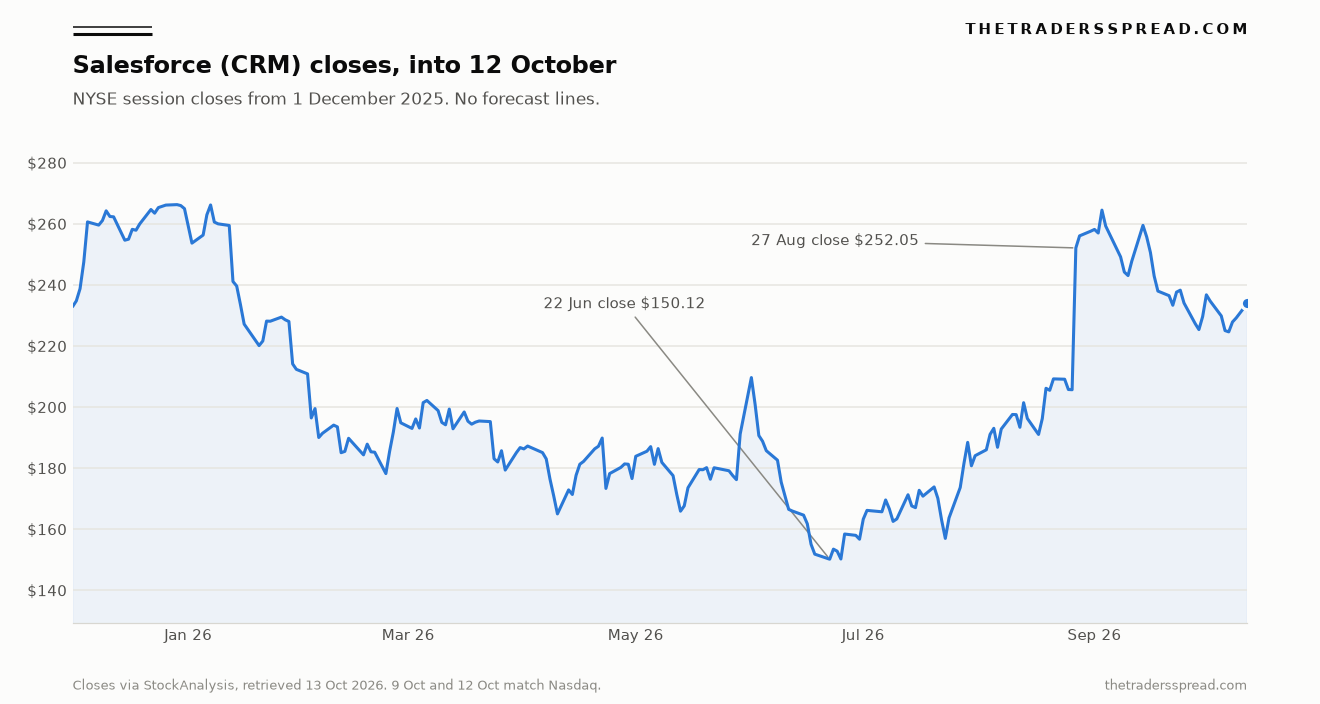
The chart is history only, with no scenario lines. The 22 June close of $150.12 was the lowest close in this history. The intraday low that day was $146.32. From the close to Monday is 55.8%. From the intraday low it is 59.9%, the "about 60%" some commentary used. Those are different windows from the 2026 price change.
| Window | Starting price | Against Monday's $233.92 |
|---|---|---|
| Close to close, the headline | Friday 9 October, $229.13 | +2.09% |
| Friday close to Monday's high, not a close | $240.90 at the high | +5.14% at the high, then back |
| Since 1 October | $236.69 | −1.17% |
| Since the earnings reaction | 27 August, $252.05 | −7.19% |
| Since 31 December 2025 | $264.91 | −11.7% |
| Since the highest close in this history | 29 December 2025, $266.23 | −12.1% |
| Since the 22 June close | $150.12 | +55.8% |
Each figure is a price change between StockAnalysis closes, or between Friday's close and Monday's high, worked on 13 October 2026. None is a total return. "Down about 11% this year" tracks the 31 December close. A "13%" retreat tracks the 29 December intraday high of $269.11, which leaves Monday 13.1% lower. The stories disagreed about the session and about which old price to subtract.
Earnings day, 26 August, closed at $205.62. The next session closed at $252.05, up 22.58%, on 55,517,471 shares. Monday's volume was about a sixth of that. A 3 September close of $264.43 then faded to $229.13 by 9 October. Monday put back $4.79 of a drop of more than $30. On the chart the upgrade is the small hook at the right edge.
October was already down before Monday. The 1 October close was $236.69, and Monday still finished 1.17% under it. The argument this note joins is the same one in the selloff that took in Palantir and in the longer disagreement on Oracle.
Liani rewrote the multiple
"If anything, AI should deepen dependence on these platforms," Tal Liani, analyst at BofA Securities, said in the note Cingari reported. The prior worry was disintermediation: an assistant answers, and the user never opens the application. After conversations with chief information officers, he now thinks large enterprises are unlikely to rip out the platforms that hold their logic, data, workflows and compliance rules. Smaller firms might still try cheaper tools.
Cingari set out four layers from the Dreamforce stack: data, on Informatica and Data 360; the core applications; Agentforce; and the interface, including Slack and Claudeforce, which puts Salesforce data inside Anthropic's Claude. Liani's point, as Benzinga rendered it, is that Salesforce need not own every screen. It has to stay the system that decides what an agent may see and what it may do. On that reading, "SaaSpocalypse" overstates the chance the company becomes a database anyone can query.
The figures are not symmetrical. A target of $285 against $160 is a 78.1% lift. Sixteen times free cash flow against nine times is a 77.8% lift in the multiple. The growth rates moved 0.4 of a point and 0.2 of a point. The $50.9 billion and $55.98 billion are his estimates. Company guidance, in the 26 August exhibit, still stops at fiscal 2027, at $46.1 billion to $46.4 billion. He is mostly paying a different multiple.
He also used two markers from the reported quarter. Agentforce annual recurring revenue of $1.5 billion, up more than 240%, is in the filing as well as in the note. About half of quarterly Agentforce bookings, he said, came from customers refilling usage credits. That is his evidence of repeat consumption. The exhibit does not split bookings that way. Keep the "half" as his, dated 12 October.
Benzinga's panel, in the same article, had 31 analysts and an average target of $275. Liani's $285 sits 3.6% above it. Monday's news, on that tally, was a former sceptic joining a spot others already occupied. Other sites publish different counts. This piece uses Cingari's and does not average the averages. The gap from Monday's close to $285 is 21.8% of his target. From Friday's $229.13 it is 24.4%. Same target, different denominator.
The $5.90 was not the run-rate
"We just delivered one of our best quarters ever, outperforming across every key metric," Marc Benioff, chair and chief executive of Salesforce, said in the earnings release filed on 26 August, for the quarter ended 31 July. He continued: "AI is delivering value across every layer of our platform. We're seeing incredible demand for our AI and data products, with ARR about to cross $4 billion."
Revenue was $11.345 billion against $10.236 billion, the 11% the release quotes, including $456 million from Informatica. Strip that out, this desk's arithmetic and not a company "organic" label, and revenue is $10.889 billion, up 6.4%. Subscription and support was $10.820 billion, including $440 million from Informatica, against $9.690 billion. Without that $440 million the line is $10.380 billion, up 7.1%. The headlines include a business Salesforce did not own a year earlier.
Current remaining performance obligation was $33.5 billion, up 14% in constant currency. Total remaining performance obligation was $66.3 billion, up 11%. The near-term book grew faster than recognised revenue. The third-quarter guide for it is about 14%, with Contentful and Fin left out.
GAAP diluted earnings were $4.29. Non-GAAP diluted earnings were $5.90. Net income was $3.526 billion. Gains on strategic investments were $2.613 billion, adding $2.43 to the GAAP per-share figure and $2.53 to the non-GAAP figure. Take $2.53 off $5.90 and $3.37 remains. Larry Dignan, editor in chief of Constellation Insights, reported that the street had looked for non-GAAP earnings of $3.27 on revenue of $11.23 billion, and that the gain was largely the Anthropic stake. The exhibit records the dollars and does not name the holding.
Third-quarter non-GAAP earnings were guided at $3.42 to $3.44, beside that $3.37 and nowhere near $5.90. The full-year non-GAAP guide is $16.67 to $16.71, assuming the investment book does not move again. Free cash flow in the quarter was $1.1 billion, up 81%. The full-year growth guide is about 4% to 5%. The quarter is not the rate being pointed at for the year.
"NNAOV growth is the strongest it's been in four years, keeping us on track for second-half organic revenue reacceleration," Robin Washington, president and chief financial and operating officer, said in the release. The bridge on the raised guide is more specific. Revenue guidance rose $200 million, or $300 million in constant currency: $100 million organic, $200 million from Contentful and Fin, and a $100 million currency headwind. The deals had not closed. Except for cRPO, the new revenue guide is conditional on them. The organic piece is the smallest part of the constant-currency raise.
Agentforce and Data 360 annual recurring revenue reached nearly $3.9 billion, up over 210%. Agentforce alone exceeded $1.5 billion, up over 240%, and from this quarter that metric includes Slackbot and Headless 360. The growth rate uses the new perimeter. No bridge to the old one was published. Usage is separate: 3.2 billion agentic work units in the quarter, up 97%, and 7.0 billion to date.
On the call, as Dignan reported it, Benioff said "apps are not dying, in fact they're growing," and that nine of the ten AI companies use Salesforce and Slack, with spend up 435% year over year. That 435% is a chief executive via a reporter, not a table. It is the argument Liani adopted seven weeks later, after the shares had already traded 22.58% and then faded. A separate software multiple, moving on a different story, is Adobe after it named its next chief executive.
One ruler, not a market value for 12 October. Diluted shares in the July quarter were 821 million, a weighted average. The $25 billion accelerated repurchase was expected to settle in October, and no later filing in hand states the shares retired. Times $233.92, that count is about $192 billion. Times the $4.79 rise, about $3.9 billion. Times the $125 gap in Liani's target, about $103 billion. The tape traded the first increment.
A small agreement, the same morning
Salesforce also said on Monday that it had agreed to acquire Loops and fold it into Tableau. Cingari noted the agreement beside the upgrade. The company's newsroom page did not open from this desk. It returned a regional block. The account below is from pages that did.
Meytal Vaizberg, in Globes on 12 October, reported a definitive agreement, no disclosed price, and a close expected in early November. Loops was founded in 2020 by Tom Laufer, the chief executive, and Ido Adiv, the chief technology officer. Globes put capital raised at $14 million and called the deal Salesforce's tenth acquisition in Israel. Meir Orbach at Calcalist estimated about $30 million and wrote that the price was not disclosed. The estimate is his. The non-disclosure is both reporters'.
"Tableau's mission has been helping people see, understand and act on data. Loops accelerates this mission, using powerful agentic AI to uncover the drivers behind business performance and surface where teams and agents can take action in real time," Mark Recher, executive vice president and general manager of Tableau, said, as Globes quoted him.
RelatedCrown Castle (CCI) Rises 15.6% on SpaceX's $8bn Spectrum Buy
A dashboard says what happened. Loops, on that description, is built to say why a metric moved, which is the interface layer in the note. Even if Orbach's estimate is the right order of magnitude, it is a rounding error beside a $4.79 move on the July diluted share count. The deal is not why the shares closed up 2.09%. What large customers will still contract is the constraint on both, and it is the subject of Accenture's latest quarter.
What this changes
The usable fact from Monday is the close. Salesforce finished at $233.92, up 2.09% from $229.13, inside $231.48 to $240.90, on volume that was ordinary once Friday is set aside. A 3% or 5% headline is a different clock. The later print of $234.33 is not a new official close.
The note changes one sceptic, not the estimate map. Liani left Underperform and a $160 target for his firm's highest rating and $285, almost entirely by moving nine times free cash flow to sixteen. On Benzinga's tally the average target was already $275. That is information about him. The August release, traded at 22.58% in a day and partly reversed since, is the larger fact about the company. Monday is still 7.19% under 27 August and 11.7% under the last close of 2025.
Before the next print, three filed items outrank the rating label. Revenue is guided at $11.42 billion to $11.5 billion, with a bit more than four points from Informatica, non-GAAP earnings at $3.42 to $3.44, and current remaining performance obligation growth at about 14% with Contentful and Fin excluded. A cRPO print that slips from 14% would press his multiple harder than a quiet week, because his case is that dependence shows up in the contracted book. The 240% Agentforce rate now includes Slackbot and Headless 360, so the next disclosure has to separate consumption from a wider label. And the $25 billion accelerated repurchase was due to settle in October. Until a filing states the shares retired, 821 million remains a July-quarter ruler. Loops, on Globes' timing, will not be inside that revenue guide.
None of this is an instruction. The $285 and the 16 times are Liani's. The close-to-close move was 2.09%. The chart is a recovery from a June close of $150.12 that stalled after August.
Questions the tape leaves open
How much did Salesforce stock rise on 12 October 2026?
The official close was $233.92, up $4.79 from Friday 9 October's $229.13, or 2.09%. Nasdaq and StockAnalysis agree on the open, high, low and close. The high of $240.90 was 5.14% above Friday and was not the close. A morning note of about 3%, near $235, described a trade still going at 11:40 a.m. Eastern. The later print of $234.33 did not replace 4:00 p.m.
What did Bank of America actually change?
Tal Liani moved Salesforce from Underperform to his firm's highest rating and raised his target from $160 to $285. He tied $285 to 16 times estimated calendar-2027 free cash flow, against nine times before. Fiscal 2028 and 2029 revenue estimates went to $50.9 billion and $55.98 billion. The multiple did almost all the work. Those figures are his, as reported by Benzinga on 12 October, not this desk's.
Why was non-GAAP earnings $5.90 if the next quarter is guided near $3.43?
For the quarter ended 31 July, non-GAAP diluted earnings were $5.90 and GAAP earnings were $4.29. The exhibit says investment gains of $2.613 billion contributed $2.53 of the non-GAAP figure. Removing that leaves $3.37. Third-quarter guidance is $3.42 to $3.44, and it assumes no further move in the investment portfolio. The $5.90 print was not the run-rate the company is guiding.
Did the 240% Agentforce growth compare like for like?
The company said Agentforce annual recurring revenue exceeded $1.5 billion, up more than 240%, and that from this quarter the metric includes Slackbot and Headless 360. The growth rate uses the new perimeter. No bridge to the old definition appears in the exhibit. Separately, it reported 3.2 billion agentic work units in the quarter, up 97% from the quarter before, and combined Agentforce and Data 360 revenue of nearly $3.9 billion a year, up more than 210%.
Is Salesforce stock up for 2026?
Not on a price basis. Monday's $233.92 is 11.7% below the 31 December 2025 close of $264.91, using session closes and ignoring dividends. It is 12.1% below the 29 December close of $266.23, and 13.1% below that day's intraday high of $269.11. It is also 7.19% below the 27 August close. From the 22 June close of $150.12 it is up 55.8%. The year and the rebound answer different questions.
Did Salesforce disclose what it is paying for Loops?
No. Globes and Calcalist both reported on 12 October that the price was not disclosed, with a close expected in early November and the technology headed into Tableau. Calcalist estimated about $30 million. Globes reported $14 million raised since a 2020 founding. Mark Recher, who runs Tableau, said Loops extends the work of seeing data and acting on it. The estimate is not a company figure.
Disclaimer
This is news and analysis, not a recommendation or a personal instruction. Targets, ratings and estimates cited above belong to the analysts, reporters and companies named, with the dates given. They are not levels set by The Traders Spread. Prices move, and capital is at risk. The share-count illustrations use the July quarter's weighted-average diluted shares and are not a statement of value on 12 October 2026.