

One dollar and seven cents. That is what Amazon (AMZN) spent on property and equipment in the twelve months to 30 June 2026 for every single dollar of cash its operations produced. Gross purchases of property and equipment ran to $173.0 billion against operating cash flow of $161.4 billion, and the arithmetic ends where you would expect: free cash flow was an outflow of $7.6 billion, against an inflow of $18.2 billion a year before. Those figures come from the company's second-quarter results exhibit, filed on 30 July 2026. On the same call, chief executive Andy Jassy raised full-year cash capex guidance to roughly $220 billion from about $200 billion. The stock closed at $258.90 on 3 September 2026 and traded at $260.13 in Thursday's pre-market.
A retailer that outspends its own cash generation is not a retailer any more. It is a utility developer with a storefront attached, and the question is whether it should be priced like one.
The number nobody divides
Here is a calculation almost no coverage of this quarter has run. Amazon discloses net additions to property and equipment by segment, and operating income by segment. Put one over the other and you get the return AWS is actually earning on the capital it deploys. In the first half of 2025, AWS produced $21.71 billion of operating income against $36.51 billion of net additions: 59.5 cents per dollar of capital put in the ground. In the first half of 2026 the same two lines read $30.78 billion against $90.12 billion. That is 34.2 cents. The quarterly cut says the same thing, 63.3 cents in Q2 2025 falling to 34.2 cents in Q2 2026, so this is not a timing artefact. Strip the roughly $600 million energy-derivative gain that finance chief Brian Olsavsky said landed mainly in AWS and the latest figure is nearer 33 cents. AWS is growing faster than it has in eighteen quarters and its capital productivity has fallen by two-fifths in a year. Both are true, and the space between them is the whole argument over this stock.
Key facts
- Capex was 107% of operating cash flow over the twelve months to 30 June 2026, and trailing free cash flow was negative $7.6 billion (Amazon 8-K exhibit 99.1, 30 July 2026).
- AWS net sales grew 36.8% to $42.23 billion in Q2 2026, with segment operating margin at 39.4%, or about 38.1% excluding an energy-derivative benefit (Amazon 8-K exhibit 99.1, 30 July 2026, and Q2 call remarks).
- Contracted revenue not yet recognised, primarily AWS, was approximately $496 billion at 30 June 2026, with a weighted-average remaining life of 6.4 years (Amazon 10-Q, 31 July 2026).
- AWS depreciation rose 66.3% year on year in the first half of 2026, roughly double the segment's 32.7% revenue growth (Amazon 10-Q, 31 July 2026).
- Long-term debt went from $65.65 billion to $128.89 billion in six months, with a further $25.0 billion of notes priced after the quarter closed (Amazon 10-Q, 31 July 2026).
- Advertising services reached $19.81 billion, up 26%, the fastest-growing line outside AWS (Amazon 8-K exhibit 99.1, 30 July 2026).
- Spot $258.90 on 3 September 2026 against a 52-week range of $196.00 to $287.20 (stockanalysis.com quote API, pulled 4 September 2026).
Depreciation is a clock that does not stop
AWS added $48.60 billion of property and equipment in the June quarter alone. A year earlier the figure was $16.04 billion. The segment's net balance climbed from $190.06 billion at the end of December to $263.75 billion at 30 June, a rise of 38.8% in six months.
Amazon's own framing of the payback is the fairest place to start. "For servers and networking equipment, on average, it takes a little less than three years to break even on that investment," Jassy, President and CEO of Amazon, told analysts on the 30 July call. "The servers currently have a useful life of at least five to six years." Justin Post, an analyst at Bank of America, called the framework useful: "Management provided a much-needed framework on data center returns, with buildings having a 30yr life, server & networking assets having payback periods of less than 3yrs, and then strong returns over the remaining 3yr useful lives," he wrote on 31 July, per CNBC's roundup of sell-side notes.
Read the accounting disclosure alongside it and one word moves. Amazon's FY2025 10-K puts servers and networking equipment at "Five to six years". Jassy said "at least five to six years," and described "finding ways to extend the useful life of this equipment without sacrificing customer experience." Amazon has form: it stretched server lives from five to six years effective January 2024, worth $3.2 billion of avoided depreciation, then shortened a subset back to five effective January 2025, costing $1.4 billion. The books say five to six. Management is signalling longer, and any future extension would flatter reported margin without changing a single machine.
Meanwhile the charge compounds. AWS depreciation ran at $8.08 billion in Q2 2026, up 66.7% year on year, against revenue growth of 36.8%. Annualise it and you get $32.3 billion of yearly depreciation on an asset base of $263.75 billion, an implied blended remaining life of about 8.2 years. Shells and land stretch that blend, and honestly so. But the fastest-growing part of the base is the equipment inside the buildings, and on a six-year average the current AWS assets alone would carry roughly $44 billion of annual depreciation, about 36% above today's run rate, before Amazon spends another dollar.
It is spending a great deal more than another dollar.
Dividing the backlog by its own disclosed life
The bull rebuttal is the backlog, and it is a serious one. Amazon disclosed approximately $496 billion of performance obligations at 30 June 2026: contracted revenue on deals longer than a year, not yet in the income statement. Headlines ran that against AWS's $148.4 billion of trailing revenue and concluded that three years of the cloud business is already sold.
Read the next sentence of the filing. Amazon gives the weighted-average remaining life of those contracts as 6.4 years. Spread evenly, $496 billion over 6.4 years is about $77.5 billion a year, against an AWS run rate of roughly $169 billion annualised off the June quarter. The backlog is not three years of cover. It is a contracted floor under just under half the current run rate, extending most of the way to 2033. That remains the strongest single fact in the bull case. It is simply not the fact that was reported.
Two counterparties dominate it. AWS and OpenAI expanded an existing $38.0 billion arrangement by a further $100.0 billion over eight years in Q1 2026; AWS and Anthropic expanded theirs by more than $100.0 billion over ten years in Q2. Both, the 10-Q notes, carry contractual obligations tied to the performance of AWS chips.
Which raises the circularity. In the same quarter that Anthropic committed to spend more than $100 billion with AWS, Amazon booked $53.4 billion of non-operating pre-tax income attributed primarily to its investments in Anthropic. That mark was 66% of Amazon's entire pre-tax income for the quarter. Reported diluted earnings were $5.75 a share; strip the $53.4 billion out, tax the remainder at the quarter's own 22.5% rate, and the figure is about $1.95, close to the $1.97 adjusted number the sell side compared with its estimates. Amazon is supplier to, and investor in, the counterparties behind a large slice of its backlog. That is neither improper nor unusual in an infrastructure cycle, but it means the earnings multiple on most screens describes something other than the operating business.
| AWS capital productivity | Q2 2025 | Q2 2026 | H1 2025 | H1 2026 |
|---|---|---|---|---|
| Net additions to property and equipment | $16.04bn | $48.60bn | $36.51bn | $90.12bn |
| Segment operating income | $10.16bn | $16.62bn | $21.71bn | $30.78bn |
| Operating income per $1 of capex | $0.633 | $0.342 | $0.595 | $0.342 |
| Segment depreciation and amortisation | $4.84bn | $8.08bn | $9.23bn | $15.35bn |
| Operating margin | 32.9% | 39.4% | 36.1% | 38.6% |
Source: Amazon 10-Q for the period ended 30 June 2026 and 8-K exhibit 99.1, filed 30 and 31 July 2026. Ratios by TheTradersSpread. Q2 2026 operating income includes a roughly $600 million energy-derivative benefit.
The retail margin that was a tariff refund
North America operating margin came in at 7.9% against 7.5% a year earlier, read widely as evidence that retail is finally compounding profitability alongside the cloud. The footnote is worth checking.
In the accounting policies note of the 10-Q, Amazon discloses approximately $640 million of tariff refunds received under the International Emergency Economic Powers Act during the quarter, recorded primarily as a reduction to cost of sales and landing primarily in North America. Take it out and North America operating income is $8.48 billion on $116.18 billion of sales: a margin of 7.30%, below the 7.51% earned in Q2 2025. The improvement reverses.
Amazon adds, in the same note, that this "represents the significant majority of refunds we expect to receive". It does not recur. Olsavsky flagged the same item on the call alongside the energy-derivative gain, putting the pair at roughly $1.2 billion of the quarter's operating income between them.
International offers no relief either: 4.1% operating margin in Q2 2026, identical to Q2 2025, and 3.1% on a trailing basis. Retail is running to stand still while the cloud carries the group. Advertising is the genuine bright spot, at $19.81 billion and growing 26% against 15% for online stores and 12% for subscriptions. On a trailing basis it is a $76 billion business earning software-like incremental margins inside segments reported at 7% and 4%.
Who is paying for the concrete
Capital of this scale has to come from somewhere, and the funding trail gets the least attention.
Amazon issued $37.0 billion of dollar notes in March 2026, €14.5 billion of euro notes the same month, CHF 2.8 billion in May and C$14.0 billion in June, carrying values totalling roughly $66.9 billion in the first half. Long-term debt nearly doubled, from $65.65 billion at the end of December to $128.89 billion at 30 June. It arranged a $17.5 billion delayed-draw term loan on 8 June whose commitments lapse on 30 September unless drawn. Then the subsequent events note discloses a further $25.0 billion of dollar notes issued after the quarter end, in eight tranches running to 2066.
Here is the detail that matters. Cash and marketable securities stood at $122.99 billion on 30 June, against $123.03 billion in December. Amazon raised close to $67 billion of term debt in six months and its liquid balance ended the period fractionally lower. Every dollar went into the ground. Anyone modelling this company off the December balance sheet, or off a cash pile that looks reassuringly stable, is modelling a company that no longer exists.
Interest expense followed, at $1.31 billion in the June quarter against $516 million a year earlier. The notes carry a combined weighted-average remaining life of 14.2 years, so the debt is termed out sensibly. But the 6.25% coupon on the longest post-quarter tranche sits above the 6.05% ceiling on the March issue, a small, real signal about what the market now charges Amazon to fund this build.
What the capex line leaves out
Three commitments sit outside the property and equipment number and outside most models.
The first is $29.27 billion: the twelve-month increase in property and equipment acquired but not yet paid for, sitting in accounts payable rather than cash capex. Consolidated net additions in the first half were $118.65 billion on an accrual basis against $98.41 billion of cash purchases. Cash capex understates what has been committed.
The second is Globalstar. Amazon agreed on 13 April 2026 to acquire the satellite operator, in a deal reported at roughly $11.6 billion, at $90.00 a share in cash or 0.3210 Amazon shares, and the registration statement went effective on 18 August. The structure says something about Amazon's own paper: the exchange ratio is fixed at 0.3210 below an Amazon measurement price of $280.38, so at $258.90 the stock election is worth $83.11 against $90.00 in cash. Holders of about 57.6% of the voting power delivered written consent, so there is no shareholder meeting. James Monroe III, Executive Chairman of the Board of Globalstar, told holders the company "has not solicited and is not soliciting your adoption of the merger agreement or a proxy" in the information statement filed on 18 August 2026.
The third is litigation. Xockets filed a complaint in May 2026 against Amazon, AWS, Annapurna Labs, Nvidia and Microsoft at the International Trade Commission over EC2 P6e-GB200 UltraServers, seeking injunctive relief, and the ITC opened an investigation in June. Amazon disputes the allegations. An exclusion order is a low-probability, high-impact risk for a company whose growth runs through accelerator supply. The chip-side context sits in our coverage of Nvidia's guidance and AMD's margin trajectory.
The call
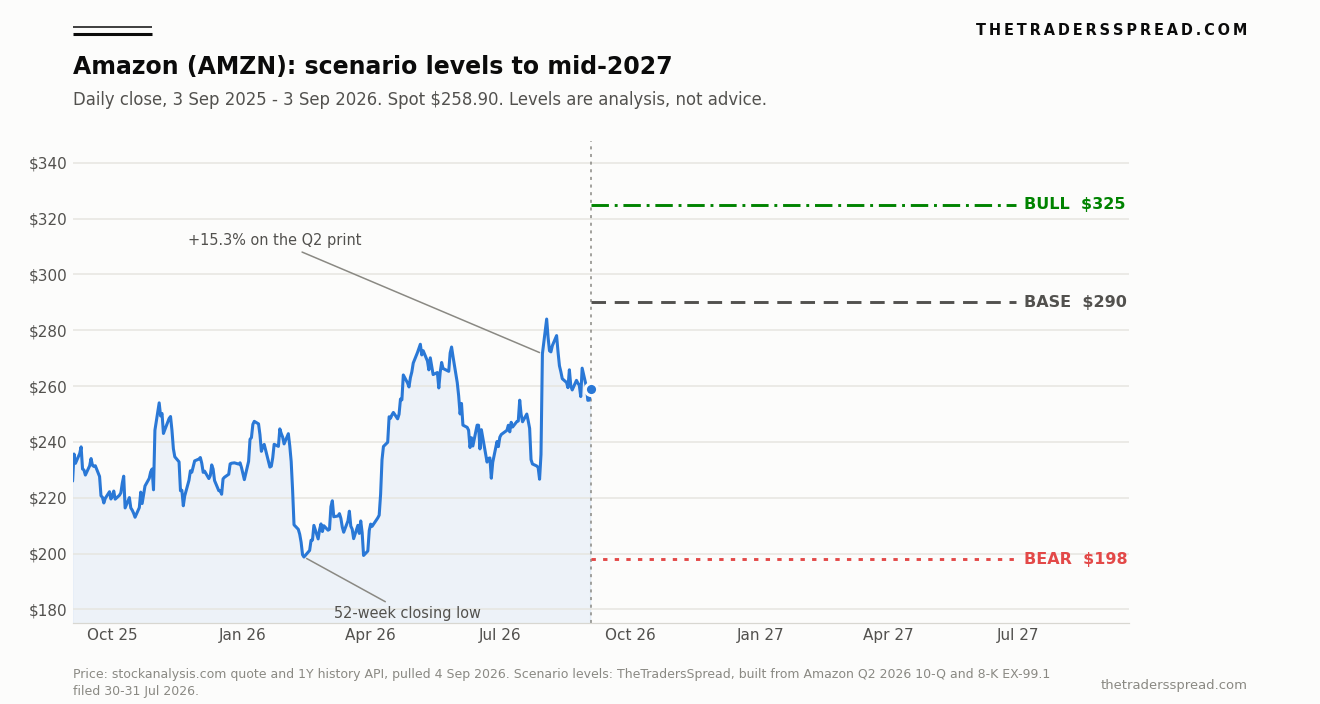
The market's verdict on 31 July was emphatic. AMZN gained 15.32% that session, closing at $271.58 on its way to $284.02 on 3 August, when it crossed a $3 trillion market capitalisation for the first time. It has given most of that back, closing at $258.90 on 3 September against a 50-day average of $253.32. "The market is rewarding evidence," Maria Ripps of Canaccord Genuity wrote on 31 July, "with AWS re-accelerating as margins expand, demand visibly outrunning capacity into 2027, and enterprise inference adoption still early."
Base case, $290, 45% probability. Third-quarter guidance of $22.5 billion to $26.5 billion in operating income against $17.4 billion a year ago implies about 41% growth at the midpoint, even though the revenue guide came in under consensus on Prime Day timing. AWS holds a 37% to 39% margin through 2027 because backlog conversion narrowly outruns the depreciation step-up, advertising keeps compounding in the mid-twenties, and retail margin stays flat once the tariff refund washes out. Operating income near $130 billion in 2027 on a mid-thirties multiple of clean earnings lands around $290, roughly 12% above spot.
Bull case, $325, 30% probability. The depreciation lag proves benign because utilisation on the new fleet runs ahead of schedule, and the $496 billion obligation converts faster than its 6.4-year average life implies. AWS margin holds near 40% while revenue growth stays above 35%, Trainium keeps taking share of Amazon's silicon cost line, and free cash flow turns positive during 2027 as the capex curve flattens. A useful-life extension on servers, which Jassy hinted at, would add to reported margin on its own. That supports $325, about 26% above spot.
RelatedJPMorgan (JPM) Forecast: $368 Bull vs $283 Bear Case
Bear case, $198, 25% probability. Depreciation catches up before revenue does. AWS margin retraces toward 30% as the 2026 vintage of assets charges through the income statement in full, free cash flow stays negative into 2028, and the market re-rates a capital-intensive business on capital-intensive multiples. Add a stumble at either OpenAI or Anthropic and the backlog's concentration becomes a discount rather than a premium. $198 is a 23% drawdown and sits just above February's closing low of $198.79.
What would change my mind. On the bearish side: an AWS segment operating margin below 35% for two consecutive quarters, or trailing free cash flow still negative at the Q2 2027 print. On the bullish side: AWS depreciation growth decelerating below revenue growth, which would say the lag has been absorbed, or a quarter in which net additions to property and equipment fall sequentially while AWS growth holds above 30%. A close below $232 would surrender the entire post-earnings gap and invalidate the constructive reading of the chart whatever the fundamentals say. See also our Okta bull and bear case and the Palantir software-selloff analysis.
FAQ
Why is Amazon's free cash flow negative if profits are at a record?
Free cash flow subtracts purchases of property and equipment from operating cash flow. Amazon generated $161.4 billion of operating cash in the twelve months to 30 June 2026 but spent $173.0 billion on property and equipment, producing a $7.6 billion outflow. Reported net income also includes $53.4 billion of non-cash marks on investments, which flatters profit without producing cash.
How big is the AWS backlog and how quickly does it convert?
Amazon disclosed approximately $496 billion of contracted revenue not yet recognised at 30 June 2026, with a weighted-average remaining life of 6.4 years. Spread evenly that is about $77.5 billion a year, against an AWS run rate of roughly $169 billion annualised from the June quarter. It is a floor under part of the business, not a guarantee of the whole.
What is the depreciation risk in plain terms?
Amazon has bought assets far faster than it has charged for their wear. AWS depreciation grew 66.3% in the first half of 2026 while AWS revenue grew 32.7%. Because depreciation on assets already bought continues regardless of demand, any slowdown in cloud revenue would compress margin quickly.
Has Amazon raised debt since the last balance sheet date?
Yes. The 10-Q's subsequent events note discloses $25.0 billion of dollar notes issued after 30 June 2026, with maturities between 2029 and 2066 and coupons of 4.60% to 6.25%, on top of roughly $66.9 billion raised in the first half and a $17.5 billion delayed-draw term loan arranged in June. Cash and marketable securities were nonetheless flat, at about $123 billion.
How much is Amazon planning to spend in 2026?
Roughly $220 billion of cash capital expenditure, raised on the July call from about $200 billion, with Jassy attributing the increase to the higher cost of memory. He said the company still would not have enough capacity to meet demand in 2026, and expected the same in 2027.
This article is analysis and information only. It is not investment advice, a recommendation, or an offer to transact in any security. Scenario levels and probabilities are the author's estimates and may be wrong. Amazon's own filings warn that its results are inherently unpredictable. Capital is at risk and past performance does not indicate future results. Readers should conduct their own research and consider advice from a regulated professional before making any financial decision.