

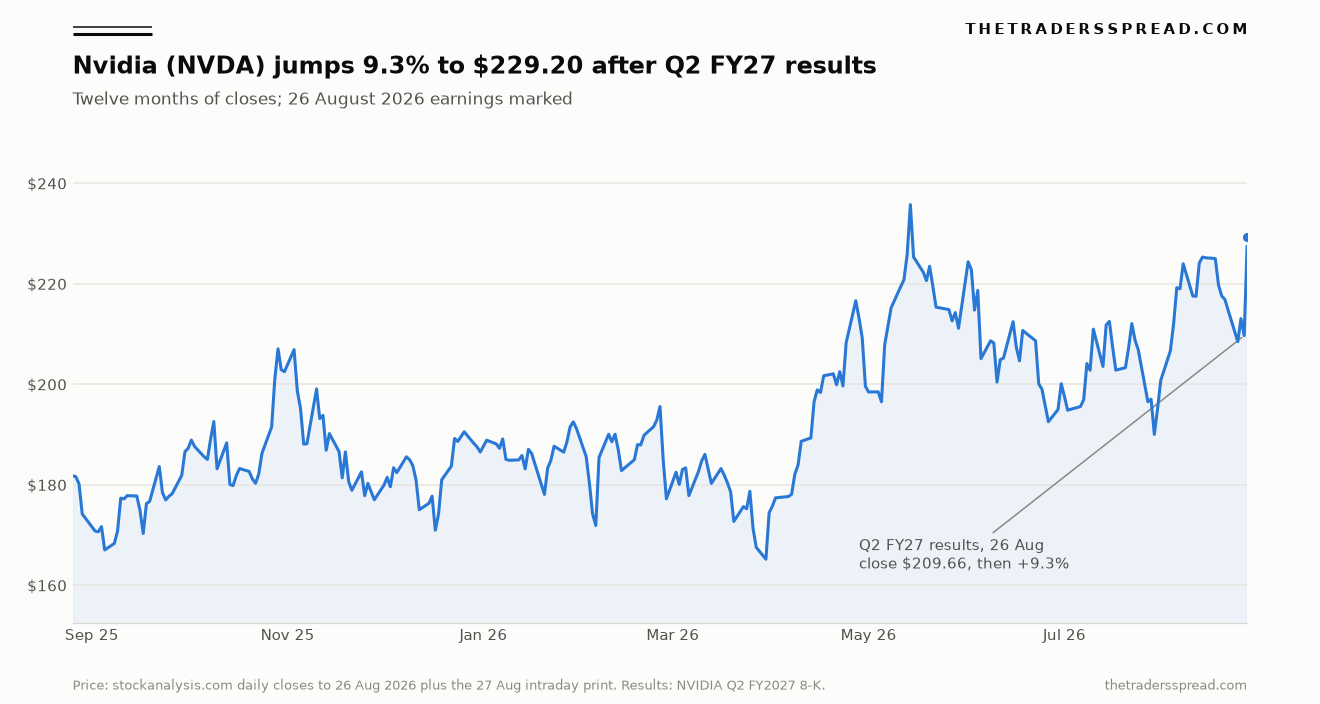
The margin scare lasted about twelve hours. Nvidia (NVDA) told the market on 26 August 2026 that gross margin would fall in the current quarter, the stock dipped in after-hours trade, and by the following session it was up 9.3% at $229.20 on 181.8 million shares. The reason is arithmetic rather than sentiment, and almost nobody stated it plainly: a one-point decline in gross margin on a revenue base guided 12% higher is not margin compression in any sense that matters to an equity holder. Nvidia earned $72.2 billion of gross profit in the quarter just reported. On its own third-quarter guidance it will earn roughly $79.9 billion — about $7.8 billion more, while the percentage margin goes down. The percentage fell; the money rose.
There is a second thing in this release that deserves far more attention than the margin line, and it is one sentence long. Nvidia's third-quarter outlook of $108.0 billion carries the explicit note that the company "is not assuming any Data Center compute revenue from China." The single largest geopolitical risk attached to this stock has been written out of the company's own forecast. That reframes what an investor is actually buying: not a business exposed to an unresolved export-control fight, but one whose guidance is already clean of it. Every quarter that China stays closed costs Nvidia nothing against this number, and any re-opening is upside that sits outside the model entirely. Having followed three years of export-control cycles on this name, this is the first guide that removes the argument rather than hedging it.
Key Facts: Nvidia Q2 FY2027 at a Glance
- Revenue $96.221 billion, up 18% quarter-on-quarter and up 106% year-on-year — NVIDIA Q2 FY2027 results, 26 August 2026
- Data Center revenue $89.0 billion, up 18% sequentially and up 117% year-on-year — NVIDIA, 26 August 2026
- Gross margin 75.0% on both GAAP and non-GAAP measures, against 74.9% in Q1 FY27 and 72.4% a year ago — NVIDIA, 26 August 2026
- GAAP earnings per diluted share $2.46; non-GAAP $2.22, the latter up 120% year-on-year — NVIDIA, 26 August 2026
- Q3 FY2027 revenue guided to $108.0 billion ±2%, assuming zero Data Center compute revenue from China — NVIDIA, 26 August 2026
- Q3 gross margin guided to 74.0% ±50bp; GAAP operating expenses about $9.2 billion — NVIDIA, 26 August 2026
- NVDA $229.20, up 9.32% on 27 August 2026 on 181,836,303 shares, against a prior close of $209.66 — stockanalysis.com
What Nvidia Actually Reported, and Why the Stock Moved
Nvidia closed its second quarter of fiscal 2027 on 26 July 2026 and reported on 26 August. Revenue of $96.221 billion compared with $81.615 billion in the prior quarter and $46.743 billion in the same quarter a year earlier. That is a doubling of the business in twelve months at a scale where doubling is supposed to be arithmetically impossible. Consensus had been looking for roughly $92.2 billion, so the print cleared expectations by about $4 billion.
Data Center did essentially all of the work. That segment produced $89.0 billion, or 92.5% of group revenue, and grew 117% year-on-year. Every other line Nvidia reports — gaming, professional visualisation, automotive — is now a rounding adjustment on an AI infrastructure company. Treating NVDA as a diversified semiconductor name is a category error; it is a single-product cyclical with an extraordinary product.
Profitability held up better than the headlines implied. GAAP and non-GAAP gross margins both printed 75.0%, up from 74.9% sequentially and 72.4% a year ago. Net income reached $53.954 billion and non-GAAP earnings per diluted share came in at $2.22, up 19% on the quarter and 120% on the year. Operating expenses were $8.408 billion, up 10% sequentially against 18% revenue growth — operating leverage is still widening, not narrowing.
So why did the stock wobble before it ran? Because the outlook contains a visible negative: third-quarter gross margin is guided to 74.0%, a full point below the quarter just delivered, which management has attributed in part to memory prices. Read alone, that is a deceleration signal on the most-watched metric in the semiconductor industry. Read alongside the revenue guide, it is the price of buying scarce memory to build more product than the company has ever shipped. The market took the second reading, and it took it decisively.
"AI has reached its inflection point. It's doing useful work. Its tokens are productive and profitable. Now, compute is revenue," said Jensen Huang, founder and Chief Executive Officer at NVIDIA, in the results release. The last clause is the one that matters commercially: it reframes GPU purchases as revenue-generating capacity for the buyer rather than speculative capital expenditure, which is precisely the argument a hyperscaler finance director needs in order to keep signing cheques.
Who Is Buying, and What They Have Committed To
The demand side of this release is unusually concrete. Nvidia said the Vera Rubin platform is ramping into full production, with racks running at partners including CoreWeave, Google Cloud and Microsoft Azure. That is a named, in-production customer list at the top of a product cycle, not a design-win pipeline.
Beyond the release itself, CNBC reported from the earnings call that Amazon Web Services has agreed to purchase two million Nvidia GPUs and adopt the company's new Vera CPU, that Nvidia's supply commitments more than doubled from $119 billion to $279 billion, largely on memory procurement, and that Huang forecast fiscal 2028 revenue growth of about 70%, well above analyst estimates. Those figures come from the call rather than the filed release, and are worth treating as management commentary rather than audited disclosure — but the supply-commitment number in particular is the clearest available evidence that the company is pre-buying capacity for demand it believes is contracted.
The capital return tells the same story from the other direction. Nvidia returned approximately $26.0 billion to shareholders during the quarter through buybacks and dividends, and declared a quarterly dividend of $0.25 per share payable on 1 October 2026 to holders of record on 10 September. A company genuinely worried about a demand cliff does not hand back $26 billion in a single quarter while simultaneously doubling its forward supply commitments. Those two decisions are only coherent together if management believes the order book is real.
For traders, the practical consequence is that NVDA has become the index. On a day when Nvidia added 9.3%, the entire AI-adjacent complex re-rated with it. Anyone running exposure to the equity desk is carrying correlated risk whether or not they hold the ticker, and the live prices on our markets page show how tightly the semiconductor and megacap complex now moves together.
The Numbers Behind the Margin Argument
Here is the calculation that resolves the entire margin debate, using only Nvidia's own reported and guided figures. In the second quarter the company converted $96.221 billion of revenue at a 75.0% gross margin into approximately $72.2 billion of gross profit. On third-quarter guidance of $108.0 billion at 74.0%, it converts into approximately $79.9 billion.
| Measure | Q2 FY27 actual | Q3 FY27 guide | Change |
|---|---|---|---|
| Revenue | $96.2bn | $108.0bn | +12.2% |
| Gross margin | 75.0% | 74.0% | −1.0 pt |
| Gross profit | ~$72.2bn | ~$79.9bn | +$7.8bn (+10.7%) |
| GAAP operating expenses | $8.4bn | ~$9.2bn | +$0.8bn |
| China Data Center compute in guide | — | Zero assumed | — |
Gross profit rises by roughly $7.8 billion while operating expenses rise by about $0.8 billion. Nearly $7 billion of incremental gross profit falls toward operating income in a single quarter. That is why a one-point margin decline was bought rather than sold, and it is a distinction that percentage-only commentary systematically misses.
The second synthesis is the China line combined with the growth rate. Nvidia is guiding to 12.2% sequential growth while assuming no Data Center compute revenue from China at all. Consider what that implies about the rest of the world's demand: the company can absorb the complete removal of what was historically one of its largest regional markets and still guide to its largest revenue quarter ever. It also means the usual bear argument — that an export-control tightening would crater the forecast — no longer applies to this particular number, because there is nothing left in it to remove.
On the price itself, NVDA has traded between $165.17 and $235.74 over the past twelve months. At $229.20 the stock sits about 2.8% below that high, having gained 6.4% over thirty days before this move. The post-earnings jump did not create a breakout; it restored one that had been fading since late July.
The Regulatory Overhang That Has Not Gone Away
Writing China out of the guidance removes a forecasting risk. It does not remove a business risk, and the distinction matters for anyone sizing a position.
Nvidia's Data Center compute business in China has been constrained by successive rounds of United States export controls administered by the Bureau of Industry and Security at the Department of Commerce. The company's own risk disclosures list changes in applicable laws and regulations among the factors that could cause results to differ materially from forward-looking statements. Guiding to zero is a prudent accounting of an unpredictable policy environment, not a declaration that the matter is settled.
There is a second, quieter regulatory dimension: concentration. When a single company supplies the overwhelming majority of accelerators for a technology that governments have designated as strategically critical, competition authorities take an interest. Nvidia's position — 92.5% of its own revenue from one segment, and a dominant share of that segment's global market — is the kind of structure that attracts scrutiny in the United States, the European Union and the United Kingdom alike, particularly around bundling of hardware with networking and software.
For retail participants accessing this name through contracts for difference rather than shares, there is a further consideration that has nothing to do with Nvidia and everything to do with venue. Overnight financing, dividend adjustments around the 10 September record date, and gapping risk through earnings are all borne by the position holder. Our broker comparison sets out where those costs differ, and the individual reviews — Plus500 among them — cover how each venue handles corporate actions on single-stock CFDs.
What This Changes
Three things are different after this release, and none of them is the share price.
The bear case has to be rebuilt. For two years the standard short thesis rested on two legs: China exposure and margin normalisation. The guidance removes the first by assumption and the second by arithmetic, because dollar gross profit rises even as the percentage falls. A credible bear case now has to argue that hyperscaler capital expenditure itself rolls over — a much harder claim to make while AWS is reportedly contracting for two million GPUs and Nvidia has doubled its own supply commitments.
RelatedCrown Castle (CCI) Rises 15.6% on SpaceX's $8bn Spectrum Buy
Memory is now the constraint to watch, not demand. Management attributed part of the margin step-down to memory pricing. That points the analytical work at HBM supply and at the memory makers' pricing power, which is where the incremental margin pressure on this business will come from over the next several quarters. The question is no longer whether Nvidia can sell what it makes; it is what it must pay to make it.
The concentration risk has moved from Nvidia to everyone else. With 92.5% of revenue in one segment and a customer list dominated by a handful of hyperscalers, the fragility in this system now sits in the buyers' capital budgets rather than in Nvidia's order book. Watch the capital expenditure guidance from Microsoft, Alphabet, Amazon and Meta far more closely than the next Nvidia print — those four disclosures now lead the semiconductor cycle rather than follow it.
What would change this reading: a hyperscaler trimming its capital expenditure guidance, HBM pricing rising faster than Nvidia can pass through, or a China re-opening large enough to make the zero assumption look conservative rather than prudent. The first two are the risks; the third is the option that nobody currently pays for.
Frequently Asked Questions
What did Nvidia report for Q2 FY2027?
Revenue of $96.221 billion for the quarter ended 26 July 2026, up 18% sequentially and 106% year-on-year, with Data Center revenue of $89.0 billion. Gross margin was 75.0% on both GAAP and non-GAAP measures, GAAP earnings per diluted share were $2.46, and non-GAAP earnings per diluted share were $2.22.
Why did Nvidia stock jump 9.3%?
The revenue beat and the third-quarter guide of $108.0 billion outweighed a one-point guided decline in gross margin. Because the revenue base is guided 12.2% higher, gross profit still rises by roughly $7.8 billion quarter-on-quarter despite the lower percentage margin. The market priced the dollar figure rather than the ratio.
Does Nvidia's guidance include China?
No. The company stated explicitly that its third-quarter outlook assumes no Data Center compute revenue from China. That makes the $108.0 billion figure independent of any further export-control developments, and means a re-opening of that market would represent upside not currently reflected in guidance.
Why is Nvidia's gross margin falling?
Management pointed to memory pricing as a contributing factor. Nvidia is procuring large volumes of high-bandwidth memory to support production of the Vera Rubin platform, and input costs have risen. Guidance is for 74.0% ±50 basis points in the third quarter, against 75.0% delivered in the second.
What is the Vera Rubin platform?
Vera Rubin is Nvidia's current-generation accelerated computing platform, which the company confirmed is ramping into full production with racks operating at partners including CoreWeave, Google Cloud and Microsoft Azure. It pairs the Rubin GPU architecture with the Vera CPU, and is the product behind the third-quarter revenue guide.
What should traders watch next?
High-bandwidth memory pricing, because that is where guided margin pressure originates, and the capital expenditure guidance from the major cloud providers, because their budgets now set the ceiling on Nvidia's addressable demand. The dividend record date of 10 September 2026 also matters for anyone holding leveraged exposure through the payment.
Analysis and information only; not investment advice. Contracts for difference and leveraged products carry a high risk of rapid loss. Prices cited are as at 27 August 2026. Featured image: Nvidia headquarters, Santa Clara, by Coolcaesar, CC BY-SA 4.0 via Wikimedia Commons.
