

JPMorgan (JPM) has the third-quarter dial-in printed on its own investor-relations site. The notice is dated 17 September 2026. It sets the conference call for 8:30 a.m. New York time on Tuesday 13 October, passcode 1364784, and it schedules the figures for about 7:00 a.m. The price those figures will meet is the New York close StockAnalysis recorded on Friday 9 October: $332.99, up $1.57, or 0.47%, on 5.06 million shares. This desk pulled the quote at 06:49 UTC on Monday 12 October, before the opening auction.
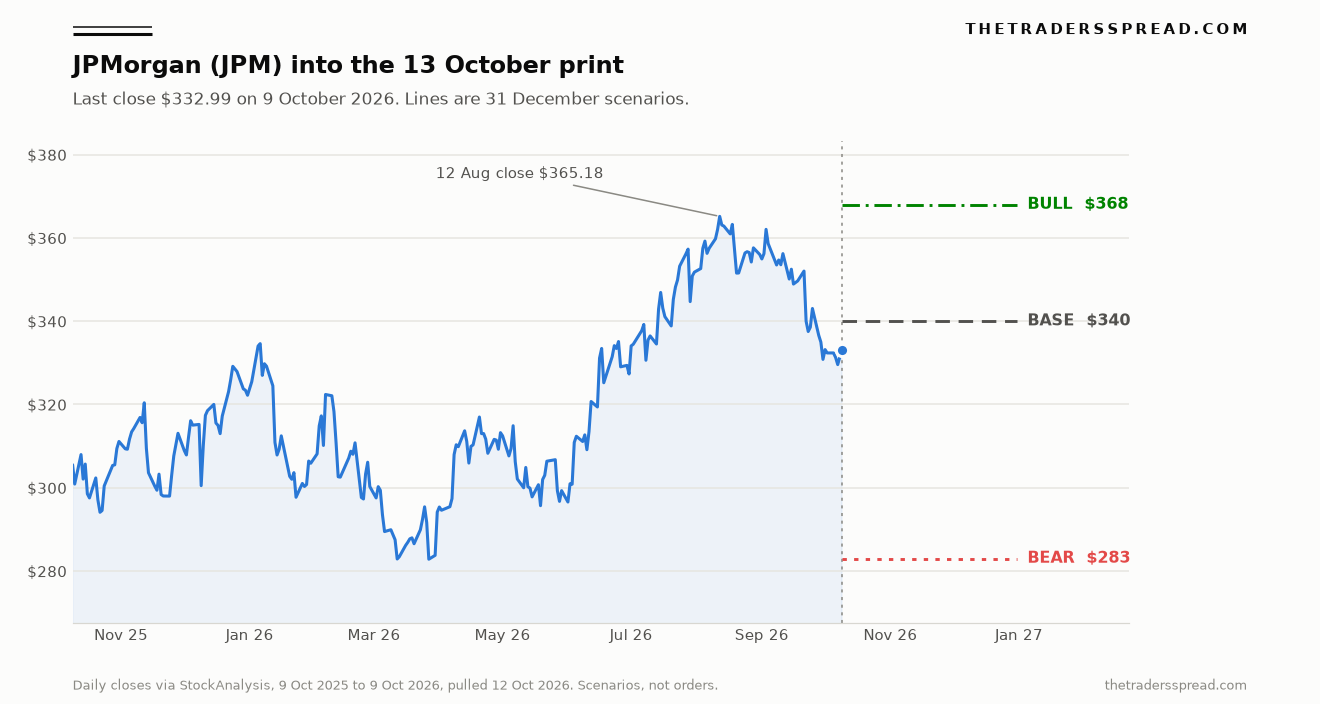
The 14 July earnings release carries the address 270 Park Avenue. The photograph with this piece is 383 Madison Avenue, the Midtown tower shot from 30 Rockefeller Plaza in April 2021. Friday's close sits $32.19 under the 12 August print of $365.18, the highest close in the one-year daily series used here.
Read that $32.19 against the second-quarter bridge, and the path looks like accounting rather than a fresh view of the franchise. Reported profit was $21.2 billion, $7.70 a share. The 14 July release assigns $1.27 of that EPS to a $4.6 billion net gain on Visa shares and $0.29 to gains on certain equity investments. Exclude both and the firm shows $16.9 billion, $6.14 a share, and a 23% return on tangible common equity. Jamie Dimon, chairman and chief executive, called that ex-items quarter the product of a particularly favorable environment with an elevated level of market activity. Jeremy Barnum, chief financial officer, set full-year net interest income at about $105.5 billion on the same morning. Tuesday asks whether that run-rate still belongs with a share price of $332.99, equal to 2.94 times tangible book of $113.35 at 30 June. The $7.70 does not travel with it.
Seven figures, each tied to a document or a pull from this session.
- Last regular-session close $332.99 on 9 October 2026, up $1.57 or 0.47%, inside a 52-week range of $279.10 to $366.50 — StockAnalysis quote API, retrieved 12 October 2026
- One-year move from the $305.53 close on 9 October 2025, up 9.0%; year-to-date from the $322.22 close on 31 December 2025, up 3.3% — StockAnalysis daily history, same retrieval
- Second-quarter 2026 net income $21.2 billion, or $7.70 a share; excluding the Visa and equity-investment gains, $16.9 billion, or $6.14, and a 23% ROTCE — JPMorgan Chase earnings release, 14 July 2026
- Managed revenue $58.0 billion, net interest income $25.6 billion, Markets revenue $12.1 billion (up 35% from a year earlier), provision for credit losses $2.5 billion — same release
- Tangible book value per share $113.35 and book value per share $133.01 at 30 June 2026; standardized CET1 capital $303 billion, ratio 14.1% — earnings release, 14 July 2026
- Full-year 2026 outlook on the call: net interest income about $105.5 billion, about $96.5 billion excluding Markets, adjusted expense about $107.5 billion, Card net charge-off rate about 3.2% — Jeremy Barnum, earnings call, 14 July 2026
- Third-quarter results at about 7:00 a.m. New York time on Tuesday 13 October 2026, call at 8:30 a.m. — JPMorgan Chase investor-relations notice, 17 September 2026
The $7.70 that will not be repeated
The bridge is in the notes. Significant items were a $4.6 billion net gain on Visa shares in Corporate, plus $1.0 billion of gains on certain equity investments, $763 million of that in Corporate and $263 million in the Commercial & Investment Bank. After tax, the firm says removing them cuts net income by $4.2 billion, from $21.2 billion to $16.9 billion, and cuts earnings per share by $1.56, from $7.70 to $6.14. Reported return on tangible common equity falls from 29% to 23%.
The Visa line has a date. On 13 April 2026 Visa opened an exchange offer for Class B-2 common stock. On 11 May it accepted the tender of 18.6 million Class B-2 shares for a mix of Class B-3 and Class C. The gain sits on the Class C stock, held at fair value. A tender that closed in May does not come back in the third quarter. Lining Tuesday's earnings per share up against $7.70 lines a normal quarter up against that exchange.
Dimon pointed at the ex-items profit. "The Firm reported very strong results in the quarter, generating net income of $16.9 billion and an ROTCE of 23%, excluding gains related to Visa and certain equity investments," he wrote. Managed revenue was $58.0 billion, up 27% from a year earlier, or 15% without the items. Net interest income was $25.6 billion, up 10%.
Markets supplied the growth most likely to fade. Markets revenue was $12.1 billion, up 35%. Fixed income was up 6%. Equities were up 86%. On the 14 July call, Jeremy Barnum, chief financial officer, called the equities quarter exceptionally strong and tied it to highly dynamic conditions in derivatives, cash and prime balances. Investment banking fees were up 30%, the highest since 2021 on Dimon's account. Barnum said the pipeline was still there, and that activity seemed to be drawing in more activity, with conversion dependent on conditions.
A pipeline is not a print.
The quieter lines are what a December price can rest on. Net interest income excluding Markets was $23.7 billion, up 4%, with higher balances offset in large part by lower rates. Consumer and community banking revenue was $20.3 billion, up 8%. The commercial and investment bank did $24.9 billion, up 27%, still holding the Markets surge. Asset and wealth management revenue was $6.9 billion, up 19%, with assets under management of $5.1 trillion and long-term net inflows of $50 billion.
Three multiples of the June book
Friday's $332.99 is 2.94 times tangible book value per share of $113.35, and 2.50 times book value per share of $133.01. Both are as of 30 June 2026. Tangible book is up 10% from a year earlier. The JPMorgan stock forecast below does not invent a December book. It applies three round multiples to the last printed tangible book and rounds to the dollar.
Three and a quarter times $113.35 is $368.39, which rounds to a bull case of $368, 10.5% above the Friday close. That sits $1.50 above the 52-week high of $366.50 on the quote feed and $2.82 above the 12 August close of $365.18. Three times tangible book is $340.05, a base case of $340, 2.1% above the close. Two and a half times is $283.38, a bear case of $283, 15.0% below the close. The bear print is a dollar above the lowest close in the one-year series, $282.84 on 27 March 2026, and about $4 above the 52-week low of $279.10.
| Case | 31 December level | Versus $332.99 | Multiple of $113.35 |
|---|---|---|---|
| Bull | $368 | +10.5% | 3.25x |
| Base | $340 | +2.1% | 3.00x |
| Close, 9 October 2026 | $332.99 | 0 | 2.94x |
| Bear | $283 | -15.0% | 2.50x |
The low close was 27 March, the high close 12 August. By 9 September the close was still $354.71, so the drop into Friday is 6.1% in a month and 8.8% from the August close of $365.18. Friday's 5,058,748 shares were about 41% under the 8.61 million average of the prior 20 sessions.
August's $365.18 close was 3.22 times June tangible book, already close to the bull case. The market paid that while the Visa quarter was the freshest print, then gave it back through September. The base case of $340 says the give-back stops a little above Friday. The bull case says the August multiple returns if Tuesday leaves the July guide intact. The same 31 December date is the horizon in the S&P 500 year-end forecast. The bank does not have to follow the index.
Book will not sit still. The second quarter distributed a common dividend of $4.0 billion, or $1.50 a share, and $6.2 billion of net common repurchases. The last-twelve-month net payout was 73%. Barnum said the board intends to lift the quarterly dividend to $1.65 a share in the third quarter, pointing to the June stress-test release. The cases stay on June's $113.35 rather than a guessed December book. A retained quarter would make $368 a slightly lower multiple by year-end, and $283 a slightly harsher one.
Four guide numbers, and a card rate above one of them
Barnum's outlook on 14 July was specific. Net interest income excluding Markets about $96.5 billion for the full year. Total net interest income about $105.5 billion, with Markets net interest income about $9 billion making the difference. Adjusted expense about $107.5 billion, the increase from the prior guide coming mostly from volume- and revenue-related costs after the quarter beat. Card net charge-off rate about 3.2%, which he described as better than the firm had expected. He had just walked the ex-Markets net interest income figure up from $95 billion.
Set the quarter beside those annual numbers without pretending the definitions match. Net interest income of $25.6 billion, times four, is $102.4 billion, about $3.1 billion under the $105.5 billion guide. Excluding Markets, $23.7 billion annualises to $94.8 billion, about $1.7 billion under $96.5 billion. Reported expense of $27.3 billion annualises to $109.2 billion, above the $107.5 billion adjusted-expense outlook. Adjusted and reported are not the same measure. The revenue guide asks for a small step up from the quarter. The expense guide asks for a small step down from it.
Credit is where the guide and the quarter already disagree. The release prints a Card Services net charge-off rate of 3.34% for the second quarter. The full-year expectation is about 3.2%. For the year to land on 3.2%, later quarters have to come in below the quarter just reported, unless earlier quarters were soft enough to carry the average. The documents opened for this piece do not include a first-quarter card rate, so no required second-half rate is invented here. A third-quarter card rate still near 3.34%, with another reserve build, fights the guide. A rate under 3.2%, with a stable reserve, supports it.
Credit costs were $2.5 billion. Net charge-offs were $2.4 billion. The net reserve build was $149 million, mostly wholesale, against a $439 million build a year earlier. Beside that, Dimon listed geopolitical tensions and wars, sticky inflation, large fiscal deficits and elevated asset prices. "We cannot predict how these forces will ultimately play out," he wrote.
Average loans were $1.5 trillion, up 10% from a year earlier. Average deposits were $2.7 trillion, up 7%. Cash and marketable securities were $1.5 trillion. Standardized CET1 capital was $303 billion, the ratio 14.1%, the advanced ratio 14.2%. Barnum said the standardized ratio fell 20 basis points in the quarter because higher risk-weighted assets and distributions more than offset earnings. He put the RWA increase at about $103 billion, largely Markets financing and lending. The release prints standardized RWA at $2.1 trillion.
How a move in the long bond feeds into prices is a separate arithmetic, set out in the note on the 10-year yield. This forecast does not import a yield from that piece as if it were Monday's rate. JPMorgan's second-quarter discussion said lower rates had already offset a large part of the balance-driven gain in net interest income excluding Markets. A guide of $105.5 billion is, in Barnum's framing, market dependent. Tuesday's rate-path commentary will move the share as much as the penny of EPS.
The bear case is the spring close, not a collapse
$283 is not a model of a funding crisis. It is 2.50 times June tangible book, rounded, near the 27 March close. From $332.99 that is a 15% decline. The share has already travelled further than that inside this year, from March to August and part of the way back. A return to the spring close is what the chart shows if two things happen together: the July net-interest-income guide is cut, and the multiple compresses from 2.94 times tangible book toward the 2.50 times already paid for ordinary book value.
Equities revenue up 86% will not be the base this forecast uses, any more than $7.70 will. A quieter Markets quarter can leave consumer and wealth fees intact and still take the growth rate off the page. The VIX note on this site is about the formula and the 30-day window, not Monday's print. An equities book that rose 86% can miss a hard compare if clients hedge less. That is a weak revenue quarter without a weak credit quarter. Credit's own door is a card rate still near 3.34% and a wholesale build larger than $149 million.
A 73% net payout, and the stated move to a $1.65 dividend, slows the book the multiple sits on. The August multiple is harder to pay if book is going out the door while Markets financing is still growing the denominator of the capital ratio.
RelatedHelen of Troy Earnings: HELE Rose 3.9% at the Close
One worse path sits outside $283 on purpose. A guide cut, a card rate above 3.34%, and a ratio pushed toward the mid-13s can travel through the spring close toward the $279.10 low. The bear case here is the spring close, reached by multiple and by a guide cut, not a new crisis low. If the print is worse than that, this bear case was not low enough. The invalidation further up the page, at the April close, would already have gone.
Weights for 31 December
The desk's bias is neutral. The weights are 45% on the base case of $340, 30% on $368 and 25% on $283. They are editorial weights, not a traded probability. The weighted level is about $334, roughly a dollar above Friday's $332.99. A map centered on the last trade is not a bull case and not a bear case.
Base is the heavy weight because the July guide sits close to the quarter just printed, and the share has already given back much of the Visa-quarter multiple. Four times second-quarter net interest income is $102.4 billion, about $3.1 billion under $105.5 billion. The open item is the card rate, 3.34% against a year of about 3.2%. A 23% ex-items return on tangible equity, with $303 billion of CET1 capital, is why the trip back to the March close carries less weight.
The bull case needs the guide held or raised, card losses down from 3.34% toward 3.2%, and Markets solid rather than another 86% equities quarter. That path gets back to the August close and a dollar or two through the 52-week high, a 10.5% move. Miss it and the April print is close.
A higher net-interest-income guide, or a card rate under 3.2% without a larger reserve build, shifts weight toward $368. A cut to $105.5 billion, or another quarter near 3.34% with a bigger build, shifts weight toward $283. A close under $310.33, the 9 April 2026 print, retires the base case. That close is the invalidation. The reference price is $332.99 and the target on this neutral call is $340. Conviction is 3 out of 5, because the arithmetic is checkable and Tuesday can still gap the share through either side. The scenarios run to 31 December 2026. They are not instructions.
Frequently asked questions
When does JPMorgan report third-quarter 2026 results?
The firm's investor-relations notice of 17 September 2026 schedules the release for about 7:00 a.m. New York time on Tuesday 13 October, and the call for 8:30 a.m. The dial-in is 1-888-324-3618 in the United States and Canada, passcode 1364784. A telephone replay runs from about 11:00 a.m. that day through 29 October. This piece uses that notice rather than a third-party calendar.
What is the JPMorgan stock forecast to 31 December 2026?
The bull case is $368, the base case is $340 and the bear case is $283. They are scenarios for the year-end close, built as 3.25, 3.00 and 2.50 times tangible book value per share of $113.35 at 30 June 2026, rounded to the dollar. The last close in the map is $332.99 on 9 October. Bias is neutral because a 45/30/25 weighting of base, bull and bear lands near $334, about a dollar above that close.
How much of the second-quarter profit was the Visa gain?
The release reports a $4.6 billion net gain on Visa shares, equal to $1.27 of the $7.70 of earnings per share. Further gains on certain equity investments added $0.29. After tax, the items account for $4.2 billion of net income and $1.56 of EPS. Excluding them, net income was $16.9 billion, or $6.14. Visa opened the exchange on 13 April 2026 and accepted 18.6 million Class B-2 shares on 11 May.
What would retire the base case of $340?
A close under $310.33, the 9 April 2026 print in the StockAnalysis daily history, retires the idea that year-end belongs near $340. That price is the invalidation on this piece. The bear case at $283 is a further scenario, not the same line: a return to the 27 March close of $282.84 if the July net-interest-income guide is cut and the multiple compresses to 2.5 times June tangible book. One can arrive without the other.
Is the $105.5 billion net interest income figure a floor?
No. Barnum gave it on 14 July as the full-year 2026 expectation, alongside about $96.5 billion excluding Markets, adjusted expense of about $107.5 billion, and a Card net charge-off rate of about 3.2%. The second-quarter Card Services rate on the release was 3.34%, already above that year. The guide can be revised on Tuesday morning. Treating $105.5 billion as a floor would be a different forecast from the one written here, and it is not this one.
This is analysis, not a recommendation and not an instruction to trade. Scenarios can be wrong. Capital is at risk. Prices, ratios and dates are taken from the JPMorgan Chase documents and the StockAnalysis pull named above, retrieved on 12 October 2026. The bull, base and bear levels are year-end scenarios for the share price. They are not orders.