

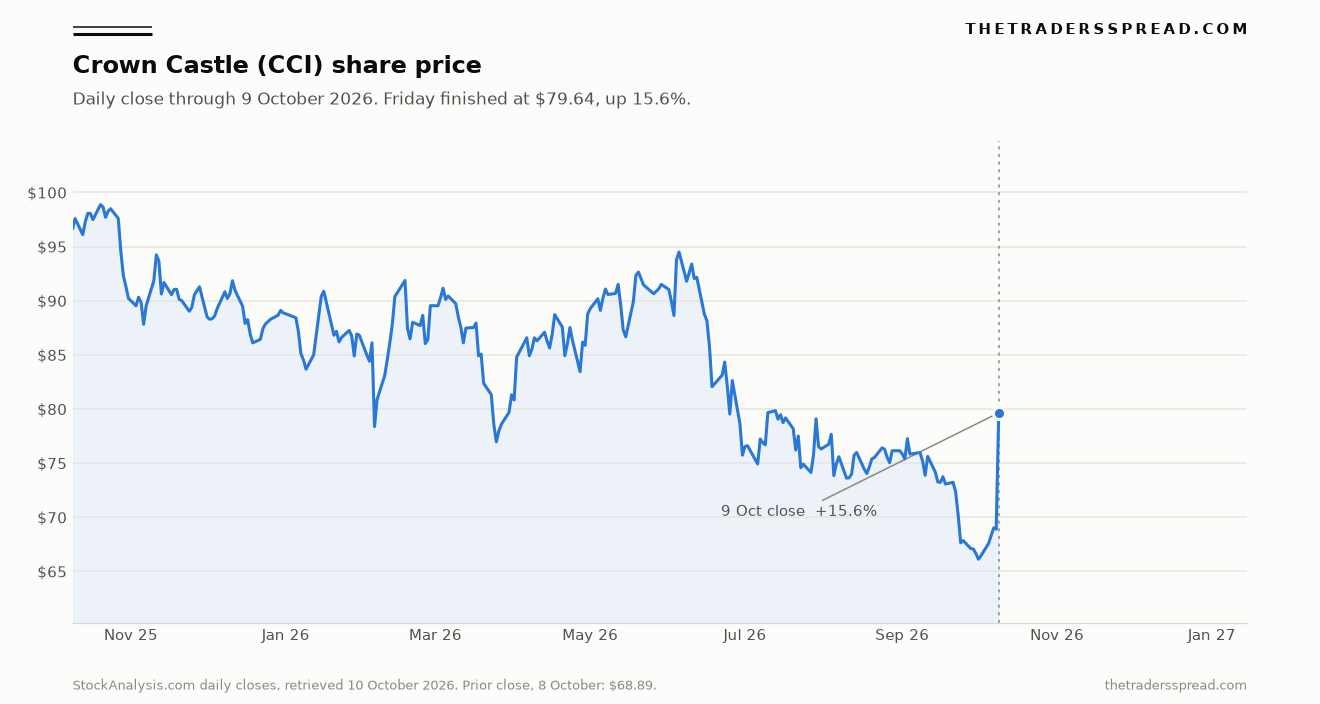
Crown Castle (CCI) rose 15.6% on Friday 9 October and closed at $79.64, up $10.75 from Thursday's $68.89. Across a full year of sessions that is the largest one-day gain in the stock. The next largest, on 4 June, was 5.83%. Volume was 14.4 million shares, 3.9 times the 3.68 million average of the prior 20 sessions. The close prices a tenant that does not exist yet. After Thursday's bell, SpaceX agreed to buy Grain Management's nationwide 800 MHz portfolio. Neither company stated a price. Light Reading and Reuters both relayed a Wall Street Journal report that the cash figure is about $8 billion. The transfer still needs FCC approval. Crown Castle owns none of the licences. It owns the steel. The awkward part of the print is the gap between those two facts.
Grain took this same portfolio from T-Mobile on 11 August for $2.9 billion in cash plus Grain's own 600 MHz licences, on T-Mobile's account of the close. Two months later the airwaves are reported moving again at about $8 billion in cash. August was not a clean cash price, because Grain also handed over spectrum, so the gap is not a profit multiple. Crown Castle stock holds none of that spectrum. On the 426 million shares the company reported outstanding at 30 June, Friday's close marks the equity at about $33.9 billion, roughly $4.6 billion more than the same count on Thursday's $68.89. The shares remain 10.2% below the 2 January close of $88.70, and 20.8% below the $100.50 high on 23 October 2025.
Five numbers, each sourced
- Friday close $79.64, up $10.75, or 15.6%, from $68.89. Open $74.32, range $73.75 to $79.79, volume 14,393,049. StockAnalysis.com, retrieved 10 October 2026.
- About $8 billion in cash is the Wall Street Journal figure, relayed by Light Reading and Reuters. Grain's own 8 October release discloses no price. The FCC has not approved the transfer.
- $2.9 billion in cash, plus all of Grain's 600 MHz licences, is what T-Mobile said it received when the earlier sale closed, announced 11 August 2026. FCC approval of that swap was 1 July.
- T-Mobile, AT&T and Verizon were 42%, 28% and 23% of second-quarter 2026 last-quarter-annualised site-rental revenue. Crown Castle Q2 supplemental, Exhibit 99.2, as of 30 June.
- 39,741 towers, about 40,000 in the company's wording, 2.0 tenants on average, five years of term left, $26 billion of remaining contracted receivables. Same filing.
- 2026 AFFO guidance, issued 22 July, is $4.53 to $4.65 a share. Organic site-rental billings in that outlook are down $90 million to $120 million once a $220 million DISH termination is included.
- The dividend in the supplemental's market table is $1.06 a share. Four quarters is $4.24, a 5.3% yield on Friday's close against 6.2% on Thursday's. First-half common dividends paid were $932 million.
A price for spectrum Crown Castle does not own
Grain's release, Washington, 8 October, is short on purpose. SpaceX will acquire 100% of the nationwide 800 MHz portfolio. Closing depends on FCC approval and ordinary conditions. The note does not mention Crown Castle, American Tower or SBA Communications. It says the spectrum is to support direct-to-device service, so Starlink Mobile can reach customers from the ground and from space.
David Grain, founder and chief executive, put his name on the sentence that carries the scale without promising a build. "This agreement with SpaceX brings that capability to bear at extraordinary scale, with the potential to change where and how Americans connect." That line is in Grain's 8 October announcement.
What the portfolio is shows up more clearly in Grain's 11 August release, the day the firm finished buying it from T-Mobile. Grain calls it 800 MHz Band 26, covering cities and rural markets, with about 14 MHz of blended depth. Low-band spectrum travels through walls and trees. Most phones already tune it, so a buyer does not need a new handset. Coverage of Thursday's agreement, including Light Reading, describes the block as up to 14 MHz of paired spectrum. A coverage layer, not a fat slice of capacity.
SpaceX, in an 8 October update that Light Reading quotes, said the block "addresses one of the key remaining technical gaps" on the way to Starlink Mobile becoming "a major mobile carrier in the US," sitting under the company's 2 GHz holdings as the coverage layer. Once the FCC signs off, the same update says, Starlink Mobile would run "a flexible architecture combining our satellite-to-mobile constellation in space with an advanced terrestrial deployment." Elon Musk, SpaceX's chief executive, wrote on X that day, in a line Light Reading reproduces: "This is the last critical piece of the spectrum puzzle needed for SpaceX to provide complete phone coverage in America."
"Complete" is a claim. Fourteen megahertz is not a national capacity network. Reuters, in the same 8 October story, noted that the FCC had cleared a 15,000-satellite direct-to-device application. Satellites do not, alone, explain a 15.6% move in a tower REIT. The phrase that does the work is the terrestrial half of SpaceX's sentence. Light Reading, reading the public-interest filing, reports that SpaceX plans standards-based radios into antennas on towers, rooftops and other structures, aimed at the build deadlines already on these licences.
No master lease came with any of that. SpaceX is a listed company on its own, and the path of those shares through the lock-ups is a separate piece: SpaceX through three lock-up releases. Thursday's contract is a spectrum contract.
Landlords up, the three tenants down
Friday's session made the split obvious. The three carriers that supplied 93% of Crown Castle's second-quarter site-rental revenue fell. The landlords rose. Reuters had each carrier down around 6% in Thursday's after-hours trade. The Friday closes, taken from the same StockAnalysis feed as Crown Castle, were larger than that evening print.
| Name | 8 Oct close | 9 Oct close | Change | Move |
|---|---|---|---|---|
| Crown Castle (CCI) | $68.89 | $79.64 | +$10.75 | +15.6% |
| American Tower (AMT) | $166.73 | $182.24 | +$15.51 | +9.3% |
| SBA Communications (SBAC) | $170.01 | $182.49 | +$12.48 | +7.34% |
| T-Mobile (TMUS) | $171.31 | $148.58 | −$22.73 | −13.27% |
| AT&T (T) | $24.59 | $22.18 | −$2.41 | −9.81% |
| Verizon (VZ) | $45.64 | $41.65 | −$3.99 | −8.75% |
Regular-session closes and the feed's percentage, StockAnalysis.com, retrieved 10 October 2026. Not Thursday's after-hours marks, and not a mid-afternoon snapshot. Crown Castle opened at $74.32, so $5.43 of the $10.75 was the gap and $5.32 came after the open. The high was $79.79, fifteen cents over the close. The low was $73.75, still $4.86 above Thursday, so the prior close was never revisited. After the bell the shares were $79.71, up 0.09%. The day's range was more than $6, which is why an afternoon print and the close are different numbers.
Both sides of the table can be logical for a day. They cannot both be fully realised in the cash flows. A carrier that loses subscribers has less reason to keep every colocation. A carrier that answers by densifying has more. Friday priced the second reading into the towers and the first into the carriers.
Crown Castle rose further than American Tower or SBA Communications. Its supplemental describes towers spread through the United States, and since 1 May the company has had one reportable segment: towers. A US spectrum headline has no other geography on these accounts to dilute it. That is a statement about Crown Castle, not a measured split of either peer.
One year of the share price
The chart is the daily close for a year through Friday. The spike at the right edge is the news. To the left is a stock that leaked lower from autumn 2025, failed a spring rally, and ground down to an intraday low of $65.32 on 5 October. Friday's close is 21.9% above that low and still well under last October and under January.
Under the line is a rent roll. At 30 June, Crown Castle reported 39,741 towers, which it also calls approximately 40,000 towers and rooftops across the US. Average tenancy 2.0. Weighted-average remaining term five years. Contracted receivables still to collect: $26 billion. Fifty-six percent of sites are in the top 50 basic trading areas, 71% in the top 100. The ground is 57% leased and 43% owned. Figures are from the Q2 2026 supplemental exhibit filed with the SEC.
The vintage split matters more than the round 40,000. Towers from 2006 and earlier: 11,153 of them, 2.5 tenants, about $130,000 of annualised cash site rent, a 19% cash yield. Towers from 2007 on: 28,588, 1.9 tenants, about $80,000 of cash rent, a 9% yield. The supplemental states those per-tower dollars in thousands. Another radio on an existing mast is cheap next to the rent, which is why a third tenant is the increment this model wants. The newer, larger cohort earns less per tower than the old one.
The customer list is narrow. Last-quarter-annualised for the second quarter: T-Mobile 42% of site-rental revenue with about six years left, AT&T 28% with about three, Verizon 23% with about five, everyone else 7%. The renewal calendar makes the AT&T weight sharper than 28%. Annualised cash rent coming up for renewal was $22 million in the back half of 2026 and $89 million in 2027. In 2028 it jumps to $866 million, and AT&T is $774 million of that. Verizon's 2028 line is $32 million. T-Mobile's is $27 million. One existing tenant's renewals dominate the year a fourth network would be trying to start.
Second-quarter site-rental revenue was $967 million, against $1,008 million a year earlier. AFFO was $488 million, or $1.13 a share, against $444 million, or $1.02. The 22 July outlook held full-year AFFO per share at $4.53 to $4.65. Core leasing of $60 million to $70 million and escalators of $95 million to $105 million sit in that bridge. After ordinary non-renewals, Sprint cancellations and the $220 million DISH termination, organic site-rental billings for 2026 are modelled down $90 million to $120 million. Friday bid for revenue the outlook does not contain.
Net debt at 30 June was $17.1 billion, a 3.7% weighted-average stated rate, 6.3 times. Total debt and other obligations were $18.2 billion. The fiber and small-cell sale closed on 1 May at a gross contractual price of $8.5 billion, net cash $8.4 billion after $124 million of adjustments still open to a true-up. First-half cash flow shows $1,017 million of stock purchases. A reported $8 billion spectrum price and the $8.5 billion Crown Castle received in May are similar headlines on different assets. Only one is this company's cash.
A coverage layer is not a lease
The rally reads a spectrum signature as a future colocation. People paid to read these contracts refused that shortcut on Friday, under their own names.
Craig Moffett of MoffettNathanson, in a note Jeff Baumgartner reported at Light Reading, put it this way. "SpaceX management is correct in noting that lowband spectrum is necessary for coverage and in-building penetration. But SpaceX is still far from having the assets needed to offer a service that would be competitive with the services offered by the Big Three carriers." His conclusion, unchanged from earlier work: Starlink's workable route is an MVNO with one of the three. An MVNO rides someone else's radios. It does not add a fourth logo to the rent roll.
Walt Piecyk at LightShed took the other physical reading and still did not sign a lease. He doubts this spectrum goes on satellites. "Lowband frequencies require massive antennas, which are not ideal for satellites produced at scale." He expects 800 MHz as the ground layer under the satellite network, "T-Mobile's layer cake on steroids." A ground layer needs sites. It does not name Crown Castle, set a rent, or say how many of the 39,741 towers get a radio. Rooftops, new builds and the other two public landlords are all available.
Kutgun Maral at Evercore ISI called 14 MHz "relatively modest" and "more of a coverage fix than a capacity solution," and also the clearest sign yet that Starlink Mobile is moving from a wholesale add-on toward a direct US service. Both halves fit. Coverage spectrum makes an indoor story possible. It does not fill a city, and Thursday's papers carried no construction budget.
Roger Entner, founder of Recon Analytics, told Light Reading the build is a matter of timing. "It's going to happen. It's not an if; it's a when." Friday showed Grain was not the end buyer. It did not show a mast going up.
The option pays only if SpaceX builds on leased macro sites, if Crown Castle wins a share of that build, and if the incumbents do not cut an offsetting amount of tenancy. None of that was announced on 8 October. Until the FCC approves the transfer, Grain still owns the licences.
What this changes
The yield moved because the price moved and the dividend did not. Four quarters at $1.06 is $4.24: a 6.2% cash yield on Thursday's $68.89, and 5.3% on $79.64. Against the $4.59 midpoint of 2026 AFFO guidance, that $4.24 is about 92% of guided AFFO per share. Thursday's contract does not change the dividend.
A tower REIT is a long string of contracted rent, so the Treasury yield sits in the same conversation. What a 5.31% 10-year does to prices is the subject of our 6 October explainer. That 5.31% belongs to that piece, not to a Treasury quote for today. The October policy decision is on the prediction-markets desk. Friday was not a rates shock. Rates still set the multiple on a 5.3% payout once the tenant story goes quiet.
Four facts would revise Friday. None of them is a price.
RelatedConstellation Energy (CEG): $360 Bull vs $248 Bear
An FCC delay or a refusal comes first. Grain's release makes approval a condition. What remains, if it fails, is the July outlook, the 2028 book and a 5.3% yield.
The shape of the ground network is the second. Sites, which is Piecyk's reading, is what the stock bought. An MVNO, which is Moffett's, adds no logo to the rent roll. A rooftop overlay barely touches the suburban lattice. Mentioning towers in a filing is permission, not an order.
The 2028 AT&T renewal is the third: $774 million of annualised cash rent inside an $866 million year, about three years out from June. A new tenant matters if it exists before that negotiation. It matters less if AT&T pushes price because a new retailer has appeared.
The DISH hole is already in the guide. The $220 million termination is why organic billings are negative. About $4.6 billion of Friday's equity mark-up, on the June share count, is a deposit until someone signs a lease.
$79.64 sits between a $65.32 low four sessions earlier and a $100.50 high eleven months earlier. It is not an instruction to add or to cut. Until an FCC order, a lease, or the carriers' next comments on tower spending, Friday is a one-day record in a stock that is still down on the year.
Questions the close leaves open
Why did Crown Castle stock rise 15.6% on 9 October 2026?
Crown Castle stock closed at $79.64, up $10.75 from $68.89, after SpaceX agreed to buy Grain's nationwide 800 MHz portfolio. The reported cash price is about $8 billion, a Wall Street Journal figure carried by Light Reading and Reuters. Buyers treated a possible ground network as a future tenant. Crown Castle announced no contract with SpaceX.
Did SpaceX or Grain confirm the $8 billion?
No. Grain's 8 October release says SpaceX will acquire 100% of the portfolio and that the FCC must approve. It states no price. SpaceX's public comments, as carried by Light Reading, describe the spectrum and a hybrid network. They do not state a consideration. The $8 billion is a Journal report, attributed to people familiar with the matter. It can be revised.
Does Crown Castle have a new tenant because of this deal?
Not on any document from the company, from Grain, or from SpaceX through Friday. The tower count, 39,741 at 30 June, and the 2.0 average tenancy do not change because two other parties signed a spectrum contract. A lease would be a different event. An MVNO with an existing carrier could mean no new tenant at all.
How concentrated is the rent the rally is betting on?
In the second quarter of 2026, T-Mobile, AT&T and Verizon were 42%, 28% and 23% of last-quarter-annualised site-rental revenue. AT&T's remaining term was about three years, and $774 million of its annualised cash rent falls in the 2028 renewal year. Those three stocks fell on Friday, by 13.27%, 9.81% and 8.75%, while their landlord rose.
What did Friday do to the dividend yield?
The supplemental shows $1.06 paid in the second quarter. Annualised, $4.24 against $79.64 is 5.3%, versus 6.2% against Thursday's $68.89. The dividend did not change. The price did. Against the $4.59 midpoint of 2026 AFFO guidance, $4.24 is about 92%. First-half common dividends were $932 million. This is arithmetic, not a view on whether the payout holds.
What would make Friday's move look wrong?
An FCC delay or refusal. A ground plan that is an MVNO, or a thin rooftop overlay that barely touches macro towers. A carrier response that cuts colocation faster than any new radios are added. Any of those leaves the July outlook: AFFO of $4.53 to $4.65 a share, organic billings down after DISH, and a 2028 renewal cliff. The 15.6% would be a one-day mark the cash flows never joined.
This is analysis, not a recommendation to buy, sell or hold any security. Capital is at risk. The 426 million shares used for equity value are Crown Castle's 30 June 2026 count. Prices are regular-session closes from StockAnalysis.com on 10 October 2026. Operating figures are from the second-quarter 2026 supplemental unless another source is named. About $8 billion is a press report, not a company disclosure.