

Having tracked Johnson & Johnson (JNJ) since the Kenvue separation left New Brunswick with two segments instead of three, I read 13 October as a mix problem, not a miss on the whole company. The share closed at $248.61, down $15.12, or 5.73%, from the prior close of $263.73. Volume was 16.65 million shares, about 2.5 times the average of the twenty sessions before the print. Reported third-quarter sales were $25.399 billion, up 5.9% from a year earlier, and adjusted earnings were $2.59 a share. Full-year adjusted-earnings guidance moved up six cents, to an $11.10 midpoint. I have watched this name hand back a rally before. I have not watched it hand back the late-summer extension in a single session while the guide was still being lifted. MedTech, not the medicine franchise, is what the tape chose to price.
The useful split was already in the chart before the release. From the 3 September close of $278.43 to the 12 October close of $263.73, the share had fallen 5.28%. The earnings session then took another 5.73%, to $248.61. That is 10.71% under the September close and 11.55% under the 2 September intraday high of $281.07. Half the drawdown was a September de-rating. The print confirmed it. Innovative Medicine sales were $16.757 billion, up 7.9% operationally. MedTech sales were $8.642 billion, up 2.5%. A six-cent raise in the 2026 earnings midpoint has to sit next to a figure the chief financial officer told investors to put in 2027 models: $1.36 a share of combined dilution from Firefly Bio and Sail Biomedicines. The tape did not mark down a weak company. It refused to capitalize a 2026 beat while a 2027 bill was being read out in the same hour.
Key facts
- Official close $248.61 on 13 October 2026, down $15.12 or 5.73% from $263.73, with a session range of $245.17 to $256.18 and volume of 16.65 million shares — StockAnalysis quote, 13 October 2026 close
- Third-quarter reported sales $25.399 billion, up 5.9% from $23.993 billion; adjusted diluted earnings $2.59, down 7.5% from $2.80; GAAP diluted earnings $0.09 — Johnson & Johnson earnings release, 13 October 2026
- Innovative Medicine sales $16.757 billion, up 7.9% operationally; MedTech sales $8.642 billion, up 2.5% operationally; Stelara cut about 690 basis points from Innovative Medicine growth — same release
- Full-year reported-sales midpoint raised to $101.2 billion and adjusted earnings midpoint raised by $0.06 to $11.10, from $11.04 on 29 July — same release
- Firefly Bio and Sail Biomedicines modelled as a combined $1.36 drag on 2027 adjusted earnings; the Firefly acquisition was $1 billion and closed in the quarter — Joe Wolk, prepared remarks, 13 October 2026
- Board declared a fourth-quarter dividend of $1.34 a share, payable 8 December to holders of record on 24 November; four quarters at that rate is $5.36, a 2.16% yield on the $248.61 close — company dividend release, 13 October 2026, and the StockAnalysis close
Two businesses, one multiple
Johnson & Johnson's own tables make the mix obvious. Worldwide operational sales grew 6.0%. In the prepared remarks the same morning, Chairman and Chief Executive Officer Joaquin Duato said that 6% operational growth was ahead of analyst consensus, and that the quarter put the company on track to clear $100 billion of annual revenue for the first time in its 140-year history.
"Johnson & Johnson's strong third-quarter performance and increased sequential growth reflect the accelerating momentum of our focused portfolio," Duato said in the earnings release. The sentence is about the portfolio. The multiple, on the day, was about the slower third of it.
Innovative Medicine, at $16.757 billion, was roughly two-thirds of the quarter. Operational growth of 7.9% already includes a scar: Stelara took an approximate 690 basis point bite. What remained still grew. Duato said oncology grew about 17% and Tremfya sales rose 68%. A pure-play forecast, such as the Eli Lilly year-end framing, lives or dies on one growth line. Here the growth line was real, and it was not enough, because MedTech grew 2.5% on both a reported and an operational basis. Currency did not explain the device quarter.
Geography repeats the point at group level. U.S. sales were $14.959 billion, up 9.1%. International sales were $10.440 billion, up 1.5% as reported and 1.8% operationally. The summary release does not split MedTech into a U.S. and international pair. Wolk named the soft spot later: Cardiovascular and Surgery outside the United States.
Adjusted earnings per share fell 7.5%, from $2.80 to $2.59, while sales rose 5.9%. That is the mixed print without a consensus figure the company did not publish. GAAP earnings were $210 million, or $0.09 a share, against $5.152 billion and $2.12 a year earlier. The release ties that collapse to the talc resolution, Firefly and Sail. Nobody should treat $0.09 as a run-rate.
From $184.66 to an open gap
The one-year tape is why $248.61 feels like a verdict.
On 14 October 2025 the share closed at $190.85. The 52-week low, $184.66, printed on 29 October 2025. By 31 December 2025 the close was $206.95. From there to $248.61 is a 20.1% gain for 2026 so far, and the move from $190.85 is about 30.3% across the StockAnalysis one-year window retrieved on 14 October 2026. The 27 February 2026 close was $248.43. The 13 October close is eighteen cents away.
The spring low is the other anchor. The 2026 intraday low was $200.91 on 5 January. The May and early-June cluster is the one that matters now: $220.37 on 11 May, $220.84 on 1 June, and a 29 May close of $225.33. From that floor the share ran to an intraday high of $281.07 on 2 September and a closing high of $278.43 on 3 September. The StockAnalysis 52-week high matches the 2 September print. The air then came out slowly. The 1 October close was $258.66. The 12 October close, the night before the print, was $263.73, still 5.28% under 3 September.
Only then did the gap open. On 13 October the share opened at $254.56, traded down to $245.17 and up to $256.18, and finished at $248.61. The session low was about 7% under the prior close. The close recovered $3.44 from that low, so this was not a liquidation into the bell. The hole between $263.73 and the $254.56 open was never filled. A return to $258 would sit inside that hole, a little above the session high, and almost on the 1 October close.
After the official close, StockAnalysis showed an after-hours print near $249.07, up 0.19%, as of 7:59 p.m. Eastern. It did not repair the session. The scenarios below use $248.61.
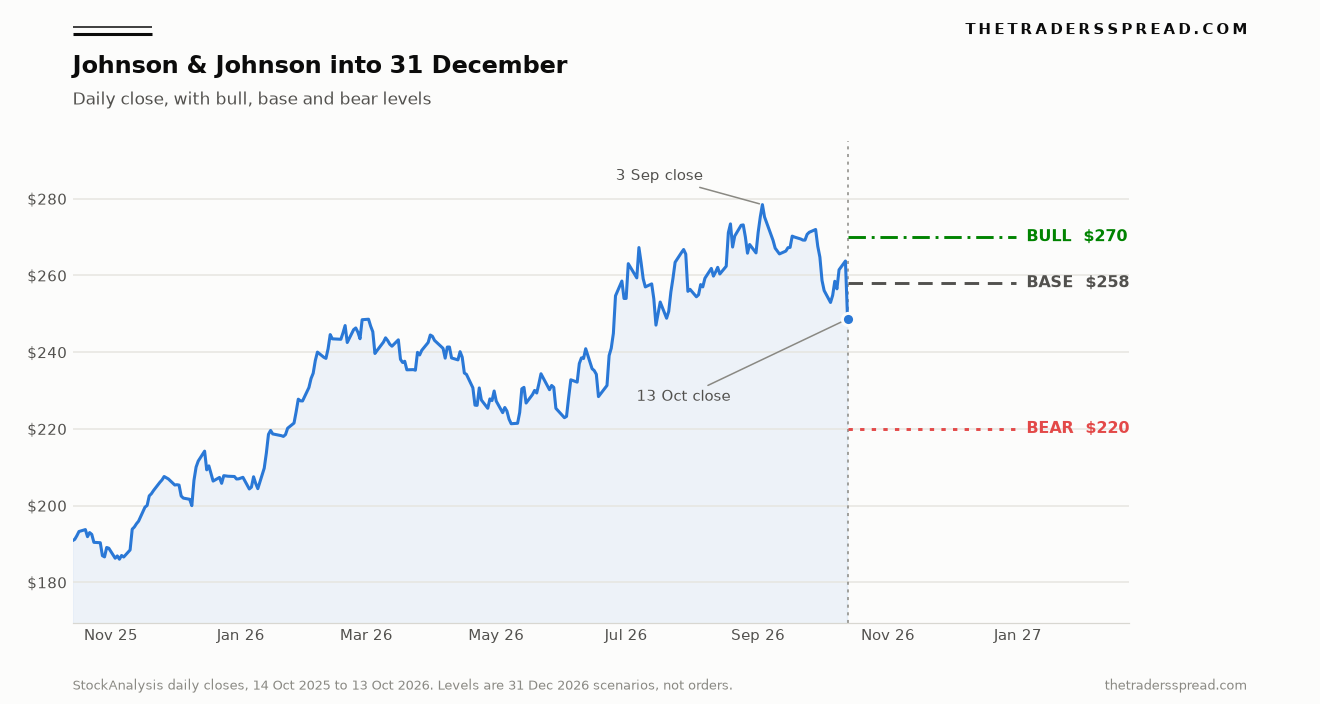
| Scenario | Level | Versus the $248.61 close | Multiple of the $11.10 guide |
|---|---|---|---|
| Bull | $270 | +8.6% | 24.3 times |
| Base | $258 | +3.8% | 23.2 times |
| 13 October close | $248.61 | reference | 22.4 times |
| Bear | $220 | -11.5% | 19.8 times |
Those multiples are arithmetic on the company's adjusted-earnings midpoint, not a promise the guide arrives cent for cent. At $248.61 the share is on 22.4 times that midpoint. None of the three paths requires a new high. The bull case, $270, is still under the 1 September close of $271.19. The bear case, $220, is the May and June floor, not a return to the January low near $201 and not a retest of $184.66.
A beat the tape would not keep
Joe Wolk, executive vice president and chief financial officer, said the quarter was driven by Innovative Medicine, that this more than offset headwinds in parts of MedTech, and that the company had exceeded expectations on both the top and the bottom line. Then the sentence the multiple actually traded:
"We are clear on where MedTech performance needs to improve, specifically Cardiovascular and Surgery outside the U.S., and are taking action to strengthen results."
Duato had already said the segment fell short of the company's own expectations, even as his conviction in the longer direction had not changed. Direction and quarter are different things. Shockwave, inside cardiovascular, grew 17%. Electrophysiology, contact lenses and trauma were the other drivers the release was willing to name. A segment can hold a fast product and still miss if international surgery and cardiovascular are the lines Wolk flagged.
Ottava does not repair that inside 2026. The Food and Drug Administration granted De Novo authorization in July. The first customer is signed, and the company itself puts a meaningful surgery contribution at the end of the decade, not in this quarter. A Johnson and Johnson stock forecast that leans on the robot to hold the 2026 multiple is reading the wrong year.
Volume says the disagreement was real. The 16.65 million shares on 13 October compared with an average of about 6.61 million over the twenty prior sessions, a ratio of 2.5. Heavy volume on a down day, after a guide raise, is the footprint of holders cutting a position built into the September high. The same shape has shown up elsewhere this season. Jabil's drop after a fiscal fourth-quarter beat was a different industry and a larger percentage. The mechanism rhymes. A beat is not a floor.
Fourth-quarter numbers will not be out before 31 December. Year-end is about digestion: the 24 November ex-dividend date, the 8 December review, and the talc threshold. Not another print.
Bills that arrive after this year
The six-cent raise is real, and it is small beside the items Wolk walked through after it.
On 29 July the adjusted-earnings midpoint was $11.04. On 13 October it was $11.10, inside a tighter range of $11.05 to $11.15. Reported sales moved to $101.0 billion to $101.4 billion, midpoint $101.2 billion. The top of that range did not change. Operational sales are guided to $100.7 billion at the midpoint, growth of 6.9%.
Wolk said that excluding a $0.64 impact from Firefly and Sail, reported adjusted-earnings growth in 2026 would approach 9%. The guided growth at $11.10 is 2.9%. The difference is the deals. For 2027 he asked the street to model a combined $1.36 a share of dilution from the same two transactions, and he parked a fuller outlook at the 8 December review. Until that day, $1.36 is a plug, not a year. Firefly itself is finished: a $1 billion acquisition closed in the quarter, adding a degrader-antibody platform aimed at difficult tumors, including KRAS. Sail is the July collaboration on in-vivo CAR-T. Neither is a product launch. Both are a claim on future earnings per share.
Talc is why GAAP earnings are not usable. Wolk said a July agreement to resolve ovarian talc litigation for $5.5 billion is reflected in the third-quarter GAAP results. It needs participation of at least 95% of the remaining ovarian claims. "We are trending to meet the 95% threshold," he said. Trending is not closed. Neither a shortfall nor a clearance sits inside the $11.10 adjusted guide, because the company does not forecast GAAP earnings.
Cash is not the constraint. Wolk put cash and marketable securities near $17 billion and debt near $45 billion, so net debt is about $28 billion. Quarterly free cash flow was more than $6 billion, and the full-year guide is about $21 billion. The dividend of $1.34 is payable 8 December, the same day as the review, with the ex-dividend date on 24 November. Four quarters at that rate is $5.36, a 2.16% yield on $248.61. Enough to nudge the share by roughly the dividend. Not enough to choose between $220 and $270.
Margin and currency both point past this year. Wolk now expects adjusted operating margin to fall about 60 basis points, better than July's 75, with Firefly and Sail a 150 basis point drag on their own. The euro averaged $1.15 against a $1.12 spot the week before the print. If that spot holds, 2027 has a currency headwind the 2026 guide does not include.
Orthopaedics is easy to over-trade. Wolk said the separation of DePuy Synthes is still aimed at mid-2027, and that the company is leaning toward a spin under Namal Nawana. "That has always been our base plan," he said. Mid-2027 is outside this window. A hint on 8 December that the path is slipping can move the 2026 share. A lean toward a spin is a sentence, not a filing, so it sits in the bear case and does not earn a sum-of-parts premium in the bull case.
RelatedMaxLinear (MXL) Falls 12.7% in the 8 October Session
Single-product news can still reprice a smaller name in one session. Amgen's move on a Sjögren's phase 3 result was one readout. Johnson & Johnson stacked several such headlines beside a MedTech miss, a talc charge and a 2027 dilution plug. The medicine headlines did not hold the share.
Base, bull and bear into 31 December
The central case is $258 by 31 December 2026. Weight: 45%. That is 3.8% above the close and 23.2 times the $11.10 midpoint, almost the 1 October close of $258.66, inside the gap between $263.73 and the $254.56 open. It needs the market to live with a 2.5% MedTech quarter beside a six-cent guide raise, and to trade back through the earnings-day high of $256.18. No new view of 2027 is required.
The bull case is $270. Weight: 30%. That is 8.6% above the close and 24.3 times the guide, back under the 1 September close of $271.19. It needs the 8 December review to show Wolk's international device work taking hold, talc participation still heading through 95%, and the $1.36 treated as a cost growth can carry.
The bear case is $220. Weight: 25%. That is 11.5% under the close and 19.8 times the guide. The 11 May low was $220.37 and the 1 June low was $220.84, so the share has traded this floor. A second drop equal to the 11.55% already given up from $281.07 also lands near $220, which I use only as a scale check. Year-end there would mean the December outlook left the dilution uncovered. The 5 January low of $200.91 follows only if $220 fails.
The weighted figure is $252.10, about $3.50, or 1.4%, above the close. That is a distribution near the traded price, not a direction. Reference: $248.61. Central case: $258. A daily close under $220 retires the base, because the bear level would then be the price. Conviction is three out of five. The next sales print falls after 31 December.
I would raise the bull weight if the 8 December review shows international demand stabilizing and a 2027 bridge that absorbs the $1.36. I would raise the bear weight if that review leaves the dilution uncovered, or if $220 breaks first. A drift back through $256, with no new document, would be the base case arriving early. Conditions for redrawing the map, not instructions.
Questions the tape is leaving open
Why did Johnson & Johnson fall after it raised guidance?
Reported sales rose 5.9% to $25.399 billion and the adjusted-earnings midpoint moved from $11.04 to $11.10. The share still closed down 5.73%. MedTech grew 2.5%, and both Duato and Wolk said that missed the company's own expectations, with the weak spot in Cardiovascular and Surgery outside the United States. The same morning, investors were handed a $1.36 dilution figure for 2027. The guide raise was a 2026 event. The bill that moved the price was a 2027 event.
What is the Johnson and Johnson stock forecast into year-end?
From the $248.61 close on 13 October 2026, the central case is $258 by 31 December, a 45% weight. The bull case is $270, a 30% weight, still under the early-September shelf. The bear case is $220, a 25% weight, in line with the May and June lows. The weighted figure is $252.10. Fourth-quarter results will not be published inside that window. The path depends on the 8 December review, the 24 November dividend and the talc threshold.
How should the $1.36 of deal dilution be read?
Wolk asked investors to model a combined $1.36 a share hit to 2027 adjusted earnings from Firefly Bio and Sail Biomedicines. In 2026 the same deals are a $0.64 item. He said growth would approach 9% without them, against 2.9% at the guided midpoint. The $1.36 is not a forecast of 2027 earnings. It is a deduction the company has already named. Whether underlying growth covers it is the question held for 8 December.
Does the $1.34 dividend change the year-end level?
The board declared $1.34, payable 8 December to holders of record on 24 November, which is also the ex-dividend date. Four quarters at that rate equal $5.36, a 2.16% yield on the $248.61 close. The cash is real, and the date can nudge the share by about the dividend. A yield a little above 2% does not choose between $220 and $270. The payment falls on the same day as the business review, which is the larger event.
What if MedTech does not improve before year-end?
No new MedTech sales figure arrives before 31 December. The test inside the horizon is what management says on 8 December about Cardiovascular and Surgery outside the United States, and whether the share holds above the spring floor near $220. A close under that floor would make the bear case the price, rather than a scenario. Ottava's ramp is a late-decade project on the company's own timeline, so it does not stand in for a better device quarter.
This is analysis, not a recommendation to transact. The levels, multiples and weights are an opinion about how the 13 October evidence fits together, written on 14 October 2026 from the StockAnalysis close and from Johnson & Johnson's own release and prepared remarks. They are not an instruction. Prices move, guidance changes, and capital is at risk.