

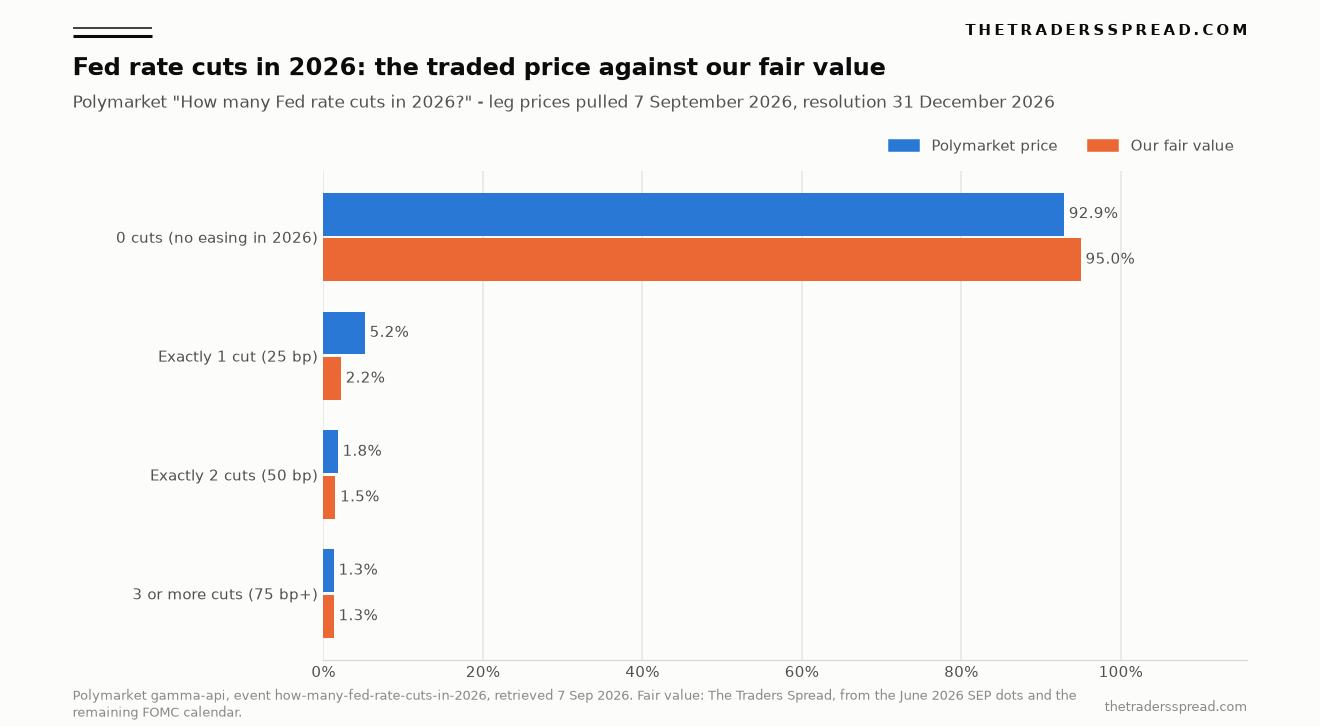
Turn to Figure 2 of the projection materials the Federal Reserve published on 17 June 2026 and count the dots in the column headed 2026. Eight sit at 3.625 percent, the midpoint of the range the Committee has held all year. Three sit at 3.875. Five sit at 4.125. One sits at 4.375. And one, a single dot belonging to a single unnamed participant, sits at 3.375. That lone dot is the entire official case for a Federal Reserve rate cut this calendar year. Seventeen of eighteen policymakers put their own preferred path at the current level or above it. Nine of them, half the room, put it higher. Polymarket runs a contract on exactly this question, and it currently prices the outcome that lone dot is voting against at 92.85 percent.
Here is the part the headline volume figure hides. The event advertises roughly $51.5m of lifetime turnover, which reads like a deep, well-arbitraged market. It is not one market; it is thirteen separate binary legs, and nine of them are priced at fifteen hundredths of one percent or less. Those nine dead legs carry $34.67m between them, 67.3 percent of the event's entire volume. The two deepest order books in the whole event sit on the eleven-cut leg ($531,729 of liquidity) and the ten-cut leg ($523,107), both quoted at five basis points of probability. The leg that actually answers the question, the zero-cut leg, carries $293,130. So the contract everyone quotes is thinner than the tail nobody trades. You can put the referral trail on it yourself at the Polymarket event page for "How many Fed rate cuts in 2026?" and read the book leg by leg. Links to Polymarket are affiliate links, from which The Traders Spread may earn a commission at no cost to you.
Key facts
- The zero-cut leg trades at 92.85 percent on $8,140,383 of volume against $293,130 of posted liquidity — Polymarket gamma-api, event
how-many-fed-rate-cuts-in-2026, retrieved 7 September 2026. - The thirteen legs sum to 101.05 percent, so the overround-adjusted price of the zero-cut leg is 91.89 percent, not 92.85 — same pull, our arithmetic.
- The June 2026 dot plot put 17 of 18 participants at or above the current midpoint for end-2026, with a median of 3.8 percent against 3.4 percent in March — Summary of Economic Projections, 17 June 2026.
- CME SOFR options put the probability of the rate sitting below the target range over the three months from 16 December at 2.84 percent, and above it at 79.22 percent — Atlanta Fed Market Probability Tracker, observation date 3 September 2026.
- Headline PCE inflation ran 3.7 percent year on year in July and core PCE 3.3 percent — Bureau of Economic Analysis, released 28 August 2026.
- August payrolls rose 162,000 and unemployment held at 4.1 percent, with July revised up by 44,000 from a 23,000 decline to a 21,000 gain — BLS release USDL-26-1435, 4 September 2026.
- Three FOMC meetings remain in 2026: 15–16 September, 27–28 October and 8–9 December — Federal Reserve meeting calendar.
What the contract settles on, and what its book looks like
The market resolves on the number of 25 basis-point reductions in the federal funds target range delivered during the 2026 calendar year, with settlement dated 31 December. The range has been 3.50 to 3.75 percent since the cut of 10 December 2025, and the effective fed funds rate printed 3.63 percent on 3 September, per the New York Fed's reference rate feed. Five meetings have already come and gone this year without a move. That is the mechanical reason the zero-cut leg is so expensive: five of the eight chances to cut have already expired worthless.
This is not the same instrument as the single-meeting contract we priced on 28 August in Fed September Decision: Hike Odds Jump 16 Points on Warsh. That one settles on what the Committee does on 16 September and nothing else, and its live question is whether the Fed raises. This one settles on a count across the whole year and cannot be resolved by any single meeting except downward. A hike in September does not settle this contract; it merely makes the zero-cut outcome close to arithmetically certain, because a Committee that has just tightened does not reverse itself six weeks later without a rupture.
| Leg | Polymarket price | Volume | Liquidity | Our fair value |
|---|---|---|---|---|
| 0 cuts (0 bp) | 92.85% | $8.14m | $293,130 | 95.0% |
| 1 cut (25 bp) | 5.15% | $2.92m | $335,649 | 2.2% |
| 2 cuts (50 bp) | 1.75% | $3.02m | $184,512 | 1.5% |
| 3 cuts (75 bp) | 0.45% | $2.77m | $253,119 | 0.8% |
| 4 or more cuts | 0.85% | $34.67m | $3.26m | 0.5% |
Leg prices, volume and liquidity from Polymarket gamma-api, retrieved 7 September 2026. The "4 or more" row aggregates the nine legs from four cuts to twelve-plus.
Read the table's fourth column and the pricing stops looking like a considered distribution. Depth is posted almost uniformly across legs whose probabilities differ by three orders of magnitude. A market maker quoting a one-tick spread on the eleven-cut leg risks nothing and books turnover, which is why $531,729 sits there and why the twelve-plus leg is priced above the seven, eight, nine, ten and eleven-cut legs. That non-monotonicity is not a view about catastrophe. It is the tick floor. Anyone checking these figures against the live book can do so on the event's own page.
The Committee's own arithmetic points the other way
Everything the FOMC has published since March has moved away from easing. The June projections lifted the 2026 median policy rate from 3.4 to 3.8 percent while raising the median PCE inflation forecast from 2.7 to 3.6 percent, a nine-tenths upgrade in a single quarter driven largely by the energy shock running out of the Middle East. We covered the market pricing of that conflict separately in Iran Blockade Odds at 23.5% on Polymarket Look Too High.
Then the statement itself changed shape. The 29 April communiqué still carried the full data-dependence boilerplate and a dissent from Governor Stephen Miran, who wanted to cut. By 17 June the statement had been cut to a paragraph ending in a flat declarative sentence: "The Committee will deliver price stability." On 29 July the vote was 9 to 3, and all three dissenters — Beth Hammack of Cleveland, Neel Kashkari of Minneapolis and Lorie Logan of Dallas — wanted a quarter-point increase. Not a single participant dissented for easing.
Beth M. Hammack, President and Chief Executive Officer of the Federal Reserve Bank of Cleveland, published her reasoning two days later. "Inflation has been too high for too long," she wrote. "Given the stability of the labor market, with the unemployment rate near my estimate of maximum employment, I view high inflation as the more pressing problem. A higher federal funds rate would help restrain economic activity and reduce inflationary pressures. I preferred to move at our recent meeting because I did not see the current policy stance as appropriately restrictive." Businesses in her district, she added, "describe pricing pressures as broadening rather than fading."
The minutes of that meeting, released 19 August, record that "many participants assessed that policy tightening would likely be necessary if inflation did not decline," and that some thought financial conditions "might not currently be sufficiently restrictive." The same document notes that the median respondent to the Open Market Desk's survey of market expectations expected no change in the policy rate this year or next, and a first cut in early 2028.
Kevin Warsh, Chairman of the Board of Governors of the Federal Reserve System, marked his hundredth day in the job at Jackson Hole on 28 August. His keynote did not read like a man looking for a reason to ease. "I would be hard pressed to describe broad financial conditions as restrictive," he said, before setting a bar: "We must be confident that underlying inflation is moving to our objective, clearly and at sufficient speed. Otherwise, we have work to do." Of the 199 components of the PCE basket, he reported, 54 percent had risen more than 3 percent over twelve months, against 32 percent in the two decades before the pandemic.
The dovish end of the Committee has not offered a counterweight so much as a narrower version of the same conclusion. Governor Christopher J. Waller, speaking at the Reuters NEXT Newsmaker Interview in Washington on 3 September, made the point about as plainly as a sitting governor can. "If there is continued progress toward our 2 percent goal, then I am willing to support holding the policy rate at its current level," he said. "But if inflation comes in hot, I would consider a rate hike." He added that he judges policy "currently only slightly restricting aggregate demand." Waller was one of the two dissenters who wanted a cut in January. Eight months later his stated choice set runs from hold to hike, and the word cut does not appear in his reaction function for 2026 at all. You can read the full remarks for yourself.
Three meetings, and the data that will and will not reach them
Timing does most of the work here, and almost nobody prices it properly.
Three meetings remain: 15–16 September, 27–28 October and 8–9 December. The September meeting carries a new Summary of Economic Projections, so the dot distribution described above gets refreshed nine days from now. Before the Committee convenes, it will see one more inflation print: the August CPI, scheduled for 08:30 Eastern on 11 September. It will not see August PCE, because the Bureau of Economic Analysis has that release dated 30 September, a fortnight after the decision.
That release date matters for a second reason. Waller flagged a pending change in how the Commerce Department estimates fees paid to stock market traders, a "nonmarket" imputation that he expects "could lower 12-month PCE inflation by a few tenths of a percentage point." BEA's annual update of the national accounts begins on 30 September. So the single largest downward revision to the Fed's preferred inflation gauge available this year is a measurement change, and it lands between the September and October meetings, in time to inform the last two decisions of 2026.
Then the calendar closes. The October CPI arrives on 10 November. The November CPI is scheduled for 10 December, one day after the Committee's final decision of the year. Whoever wants a December cut has to build the case out of the October inflation report and two employment reports, against a Committee whose median dot is above the current rate.
Those employment reports are not cooperating. August payrolls rose 162,000, unemployment held at 4.1 percent, average hourly earnings rose 0.3 percent to $37.75, and both June and July were revised up — July by 44,000, from a 23,000 decline to a 21,000 gain. The three-month average is now above 71,000 a month. There is no labour-market emergency in that data, and a labour-market emergency is the only thing that has ever moved this Committee from a tightening bias to a cut inside a quarter.
The precedent that rhymes, and it is not comfortable
On 7 August 2007 the FOMC held at 5.25 percent and wrote that "the Committee's predominant policy concern remains the risk that inflation will fail to moderate as expected." Forty-two days later, on 18 September 2007, the same Committee cut fifty basis points. Nothing in the inflation data had resolved. The credit market had broken.
One of the governors voting in both meetings was Kevin M. Warsh.
That is the honest case for the seven percent the market puts on some easing this year, and it is why our fair value is 95 rather than 99. The 2026 expansion has an unusually narrow spine. Warsh himself noted that more than half of this year's capital expenditure growth can be ascribed to the artificial intelligence buildout, that credit spreads sit near the low end of their historical ranges, and that banks report commercial and industrial lending standards on the easier end of theirs. Waller attributed the resilience of consumption partly to "the rise in wealth from the increase in equity prices this year." An economy whose growth, credit and consumption lean on the same capital cycle is one where a financing accident propagates quickly. Our gold price work and our EUR/USD forecast both carry the same tail on the other side of the trade.
The call: fair value 95 percent against a traded 92.85
We are pricing the zero-cut leg. Build it meeting by meeting, conditional on no cut having happened yet.
September first. SOFR options put the probability that the rate sits below the current range over the three months from 16 September at 0.31 percent, and the probability that it sits above at 82.26 percent. The most dovish voter on the Committee has publicly defined his choice as hold or hike. Call it 0.5 percent. October next: a cut there requires the August and September inflation reports to collapse and the September meeting not to have tightened, which the same options surface says is a four-in-five likelihood. Call it 1.5 percent. December last, with one extra month of data and the BEA revision in hand, but also with the possibility that a September hike has already happened: 2.5 percent. Add 50 basis points of probability for an inter-meeting emergency move of the kind that produced September 2007.
RelatedFed December Decision Odds: 25bp Hike at 78.5 Cents
Compounding those gives roughly a 4.9 percent chance of at least one cut, so 95.0 percent for the zero-cut leg. Cross-checks bracket it. The June dot plot has 17 of 18 participants at no cut, or 94.4 percent, and that survey predates the July hawkish turn. The SOFR options surface implies about 97 percent. Our number sits between them, and above both the raw traded price of 92.85 percent and the overround-adjusted 91.89 percent.
What that gap is worth is a separate question. At 92.85 cents the leg pays 7.70 percent gross if it resolves yes, which annualises to 26.6 percent over the 115 days to settlement and looks generous. Weight it by a 95 percent fair value and the expected return falls to 2.32 percent, or about 7.5 percent annualised. The collateral is USDC and earns nothing, while the effective fed funds rate is 3.63 percent. Roughly half the apparent edge is simply the carry you give up, and what remains compensates for a binary that pays zero in the tail. The leg is quoted continuously on the zero-cut market.
What would change our mind. A three-month core PCE run rate below 2.5 percent in the 30 September release combined with a sub-50,000 payroll print would put a December cut genuinely in play and take fair value below 92. A high-yield spread widening of more than 150 basis points, or a funding-market dislocation of the kind that forced the 2007 pivot, would do it faster and harder. In the other direction, a hike on 16 September takes fair value to 98 and the contract stops being interesting.
FAQ
What exactly resolves this market?
The number of 25 basis-point reductions the FOMC makes to the federal funds target range during the 2026 calendar year, settled 31 December 2026. Five of the year's eight meetings have already passed with no change, so only September, October and December can still move the count. A hike does not push the count negative; there are no legs below zero.
Does the June dot plot commit the Fed to anything?
No. The Summary of Economic Projections records each participant's own view of appropriate policy under their own forecast, not a Committee decision or a promise. It has been wrong in both directions before. Chairman Warsh is publicly sceptical of forward guidance, telling Jackson Hole he stands "committed to a discipline, not to a decision." Treat the dots as evidence about the room, not a schedule.
Why does the overround adjustment matter?
The thirteen legs sum to 101.05 percent rather than 100. Anyone quoting the zero-cut leg at 92.85 percent as a probability is reading a price that includes a 1.05-point margin spread across the strip. Normalising gives 91.89 percent. That is the number to compare against a model, and it widens the gap to our 95 percent fair value rather than narrowing it.
Could the Fed cut without inflation falling?
Historically yes, and that is the whole tail. September 2007 is the cleanest example: a Committee that had just written down inflation as its predominant concern cut 50 basis points six weeks later because credit markets seized. The trigger was never the inflation data. It was funding. That path is live in 2026 because credit spreads and lending standards are both unusually loose.
How does the liquidity picture affect execution?
The zero-cut leg shows $293,130 of posted liquidity against $8.14m of lifetime volume. Moving the price from 92.85 to 95 means lifting most of the visible book, so the quoted price is more fragile than the headline $51.5m event turnover suggests. Thin books on high-probability legs are a recurring feature of this venue, as we found in the 2028 Democratic nominee market.
Where can I see the live prices?
The rates and macro contracts sit in the economics section on Polymarket. Every figure in this piece was pulled from the gamma API on 7 September 2026. Prices on a four-month contract move with every inflation print, and the August CPI on 11 September is the next one that matters.
Disclaimer
This article is analysis and information, not investment advice, and nothing in it is a recommendation to take any position in any contract or instrument. Prediction market contracts are binary and can settle at zero, meaning the loss of the entire amount committed. Prices and data cited were accurate at retrieval on 7 September 2026 and change continuously. Your capital is at risk. Do your own research before acting.