

CoreWeave (CRWV) fell 15.5% on Wednesday 14 October 2026. The close went from $77.81 on 13 October to $65.78, a loss of $12.03 a share, on volume of 107.3 million. That is the window behind the headline: one session, close to close, taken from StockAnalysis daily history retrieved on 16 October. Unrounded, the move is 15.46%. The stock opened at $71.74, never traded above $72.52, and finished $1.37 above the session low of $64.41. It was the air pocket in a slide that had already carried the shares from $91.72 on 6 October to $77.81 the day before. No other session in that slide was close to this size. The 8 October drop was 7.8%, from $88.45 to $81.58. Wednesday was the day the equity caught a credit market that had already moved.
Thursday 15 October did not repeat it. The shares opened at $61.43, 6.6% under Wednesday's close, and printed $59.51. That low matches the 52-week low on the StockAnalysis quote for the same session. They then closed at $69.69, up 5.94% on the day, a 17.1% rebound off the low, with 131.1 million shares changing hands. After the bell the quote was $68.10, down 2.28% from the official close, timestamped 7:59 p.m. EDT. The same afternoon CNBC had the yield to maturity on the 9.75% notes due 2031 at 15.78%, and the five-year credit default swap spread above 1,140 basis points at the wide, last near 1,038. CoreWeave stock and the bond yield told opposite stories on the same afternoon. Averaging Wednesday and Thursday into one sell-off erases a 15.5% down day and a 5.9% up day, and it hides the split between the share price and the unsecured debt.
Key facts
- CoreWeave (CRWV) fell 15.5% on Wednesday 14 October 2026, from a close of $77.81 to $65.78, on 107.3 million shares — StockAnalysis daily history, retrieved 16 October 2026.
- Thursday 15 October closed at $69.69, up 5.94%, after a session low of $59.51, the 52-week low, on 131.1 million shares — StockAnalysis quote and history, 16 October 2026.
- The yield to maturity on the 9.75% notes due 2031 reached 15.78% on Thursday, and the five-year CDS spread went above 1,140 basis points before settling near 1,038 — CNBC, 15 October 2026.
- The $1.25 billion of 9.625% notes due 2032 were described, on a chart posted Tuesday, as touching a 15% yield and closing at 14.5% — Yahoo Finance, 14 October 2026, citing Chamath Palihapitiya. Principal amount from the Form 10-Q debt table, filed 12 August 2026.
- At 30 June 2026, recourse debt net of issuance costs was $31.405 billion and non-recourse debt net was $3.663 billion. Scheduled principal was $35.551 billion. Operating lease liabilities were $16.319 billion — CoreWeave Form 10-Q for the quarter ended 30 June 2026, filed 12 August 2026.
- Second-quarter revenue was $2.575 billion, the operating loss was $49 million, interest expense net was $640 million, and the net loss was $626 million. Revenue backlog was described as about $104 billion — CoreWeave earnings release, 11 August 2026.
- CoreWeave says it is investing $1.8 billion to redevelop a former pharmaceutical research building at 2000 Galloping Hill Road, Kenilworth, New Jersey, into the NEST 11 data centre, and funding about $150 million of substation and electrical work for a planned 40 megawatt load — CoreWeave project page, retrieved 16 October 2026.
Wednesday fell. Thursday did not.
Start with Tuesday, because the equity move on Wednesday had a prologue. Yahoo Finance, in a piece published 14 October, reported that Chamath Palihapitiya had posted a chart of $1.25 billion of CoreWeave bonds due in 2032. On his account the yield "touched 15% today, then closed at a new high" of 14.5%. He asked whether the AI build-out was creating a private credit bubble. Elon Musk, who owns the platform, replied with one word: "Yikes."
That 14.5% close is a chart from a social-media post, not a Tradeweb print this desk retrieved. In the debt note to the Form 10-Q filed on 12 August 2026, the 2032 9.625% senior notes are $1,250 million of principal, inside the recourse stack, maturing in July 2032. A coupon of 9.625% and a talked yield near 15% are different numbers. The gap is what the market is charging to hold the paper.
Wednesday's tape then did the catching up. Volume of 107,334,557 was more than three times Tuesday's 33,933,806. The whole range sat below the prior close: high $72.52, low $64.41.
Thursday's path was the reverse shape. A gap down to an open of $61.43, a low of $59.51, a high of $69.76, and a close of $69.69. The close-to-close gain of $3.91 is the +5.94% in the quote feed. The low-to-close rebound of $10.18 is 17.1%. Volume rose again, to 131,149,434. Anyone who looked only at the closing print saw a bounce. Anyone who looked at the low saw a new 52-week low printed the same day.
From Tuesday's $77.81 to Thursday's $69.69 the shares were still down 10.4%. From the 6 October close of $91.72 they were down 24.0% by Thursday. From the $150.40 intraday high on 16 October 2025, also the 52-week high on the quote, Thursday's close sat 53.7% lower. The headline uses Wednesday alone because that session has one direction and a size nothing else in the fortnight matches. Thursday has to be named beside it.
Two closes, and the chart
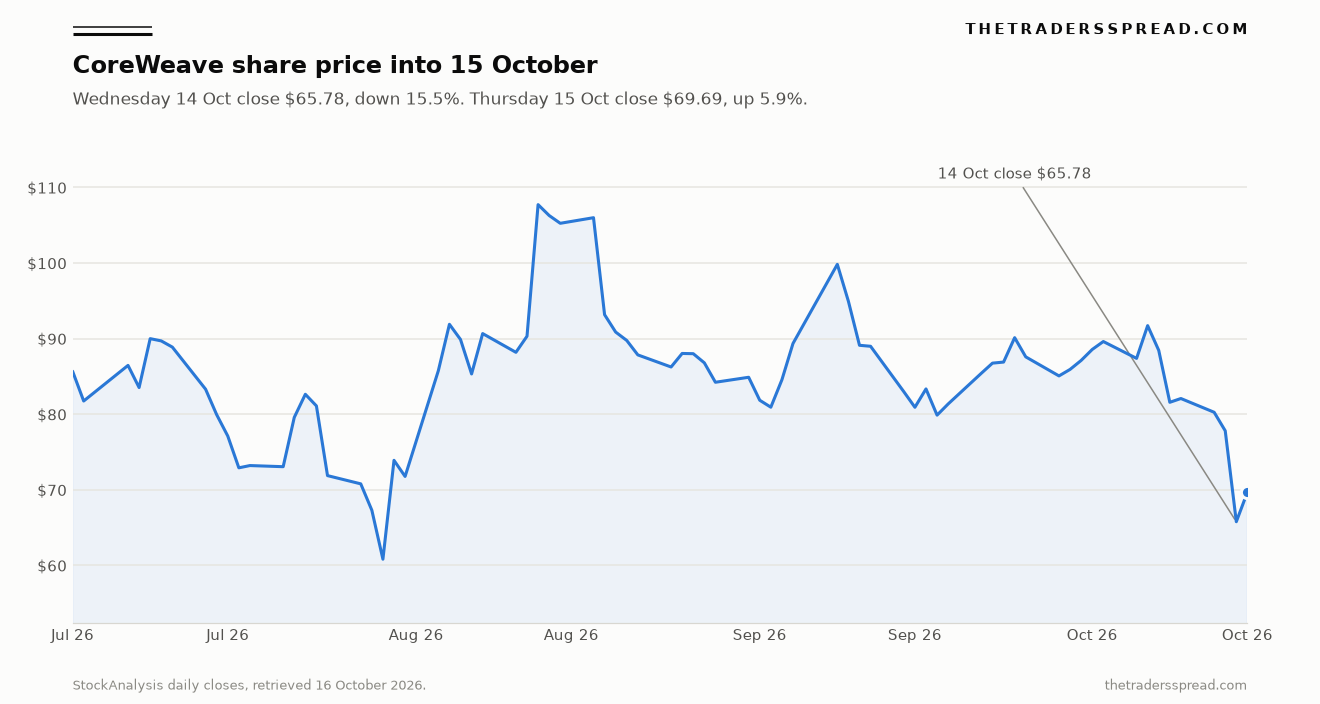
The chart below is the daily close from 1 July 2026 through 15 October. No projected levels. The callout marks Wednesday's $65.78 close. The last point, slightly higher, is Thursday.
| Session | Open | High | Low | Close | Close-to-close | Volume |
|---|---|---|---|---|---|---|
| Tue 13 Oct | $76.32 | $78.94 | $76.11 | $77.81 | −3.05% | 33.9 million |
| Wed 14 Oct | $71.74 | $72.52 | $64.41 | $65.78 | −15.46% | 107.3 million |
| Thu 15 Oct | $61.43 | $69.76 | $59.51 | $69.69 | +5.94% | 131.1 million |
Prices and volumes are StockAnalysis daily bars, retrieved 16 October 2026. Close-to-close percentages use the prior session's close. Thursday's low of $59.51 is the 52-week low on the quote pulled at the same time. After hours, that feed showed $68.10 at 7:59 p.m. EDT on 15 October.
| Credit reading | Figure | When reported | Source |
|---|---|---|---|
| 2032 9.625% notes, $1.25 billion principal | Yield said to have touched 15%, then closed at 14.5%, on a posted chart | Tuesday 13 Oct | Yahoo Finance, 14 Oct 2026 |
| 2031 9.75% notes, yield to maturity | 15.78% | Thursday 15 Oct | CNBC, 15 Oct 2026 |
| Five-year CDS spread | Above 1,140 bps intraday; last near 1,038 bps | Thursday 15 Oct | CNBC, 15 Oct 2026 |
| Oracle five-year CDS spread | 282 bps, about 10% higher on the week | Thursday 15 Oct | CNBC, 15 Oct 2026 |
The equity bounce and the bond yield did not reconcile on Thursday. A close of $69.69 repaired $3.91 of a $12.03 loss. It did not, on the CNBC figures, pull the 2031 yield back to the coupon. The 9.75% notes due October 2031 are $2,750 million of principal in the same recourse table as the 2032s. Coupon 9.75%. Reported yield 15.78%. The stock can finish green while that gap stays open, and on 15 October it did.
What 1,000 basis points is saying
Gavan Nolan, executive director of fixed income pricing at S&P Global Market Intelligence, told CNBC that a CDS spread of 1,000 basis points or more is generally a sign of credit distress. CoreWeave's five-year spread, on that article, had been above 1,140 basis points during Thursday and was last near 1,038, which CNBC described as a 16% rise on the week and 164% higher than a year earlier. Nolan's point was not that demand for the computers is fictional. He said nobody serious is questioning the contracts with the large hyperscalers. The open question is whether the cash arrives.
"It's obviously heavily negative free cash flow at the moment, and it needs that cash flow to arrive really to justify all the capex that it's spending," Nolan said, as quoted by CNBC on 15 October.
The Evercore ISI trading desk, in the same piece, put the mood more bluntly. The market was "basically saying 'no mas' to AI debt without operating cash flow support." That is a desk comment, not a default notice. It does describe why a 15% handle on a 9.75% coupon matters more to credit than a 5.9% equity bounce matters to the same people. Insurance on the debt got more expensive on the day the shares closed up.
Jim Reid, identified by CNBC as global head of macro and thematic research, said this kind of concern "can prove to be a self-fulfilling prophecy, and risks triggering broader issues in other AI-related names." He put Oracle's five-year CDS at 282 basis points, about 10% higher on the week, and said a downgrade from its BBB rating would risk pushing investment-grade-only holders into forced sales. A few hundred basis points is not CoreWeave's market. The rhyme is the direction. Our Oracle (ORCL) forecast is an equity piece, not a read on that spread.
Deutsche Bank, CNBC reported, put the backlog above $100 billion, with around two-thirds against investment-grade counterparties including Microsoft, Meta, IBM and Caterpillar. CNBC said the firm reiterated a positive rating on Wednesday and treated the dislocation as an opportunity. That is the bank's note, not a view from this desk. It also did not stop Thursday's CDS from sitting near 1,038 basis points.
The June balance sheet the yield is arguing with
The figures the yield is marking are already in the quarterly filing.
For the three months ended 30 June 2026, the earnings release of 11 August reported revenue of $2.575 billion, against $1.212 billion a year earlier. The operating loss was $49 million. Interest expense, net, was $640 million, against $267 million. The net loss was $626 million, or $1.14 a share on 551 million weighted-average shares. Depreciation and amortisation was $1.393 billion. Adjusted EBITDA was $1.510 billion, a 59% margin. Adjusted operating income was $128 million, a 5% margin against 16% a year earlier.
Revenue more than doubled, and adjusted EBITDA was positive. The GAAP loss sat under the operating line. SEC company facts show cash paid for property and equipment of $7.695 billion in the first quarter and $14.117 billion in the first half, about $6.4 billion of it in the second quarter, against revenue of $2.575 billion. First-half revenue was $4.653 billion.
Cash at 30 June was $5.524 billion. Recourse debt, net of issuance costs, was $31.405 billion, and non-recourse debt $3.663 billion: $35.068 billion together. Principal still to repay was $35.551 billion, of which $4.413 billion falls in the rest of 2026, $6.184 billion in 2027, $4.416 billion in 2028, $2.421 billion in 2029, $3.221 billion in 2030 and $14.896 billion after that. Operating lease liabilities were $16.319 billion. Debt plus those leases is $51.4 billion, the stack behind CNBC's line on more than $51 billion of debt and obligations. A lease is not the same claim as an unsecured note.
The 9.75% notes due October 2031, $2.75 billion, and the 9.625% notes due July 2032, $1.25 billion, sit in the recourse list. Non-recourse debt is a DDTL 4.0 facility plus OEM financing. A 15.78% yield prices the unsecured paper, not the collateralised facility. Contract coverage over years, and the rate charged to hold the note this week, are different questions.
Remaining performance obligations were $103.7 billion. The earnings release called revenue backlog about $104 billion and said the figure leaves out more than $25 billion of commitments added early in the third quarter. Recognition still depends on delivery. Interest expense, net, was $1.176 billion in the first half. Cash of $5.5 billion does not fund the capex beside it.
The build has an address. CoreWeave's project page, retrieved 16 October, says the company is investing $1.8 billion to turn a former research building at 2000 Galloping Hill Road, Kenilworth, into NEST 11, and about $150 million into substation work for a planned 40 megawatt load. The photograph here is not that hall. It is the Kenilworth Municipal Building at 567 Boulevard, taken in 2019 by Alyssa Maree Padovano. Livingston, the dateline on the earnings release, is the headquarters. Kenilworth is the site.
CoreWeave rents out Nvidia chips and funds much of that hardware with debt. A gap between the coupon and the yield lands in the share price the same week.
What Intrator told staff
CNBC, which said it had obtained the memo, reported that chief executive Mike Intrator wrote to employees on Wednesday: "When you are building a new type of technology company there will be periods of time when the market misunderstands and acts irrationally." He added, in that account: "We are confident in our backlog which more than supports all of our debt obligations."
RelatedSalesforce (CRM) Rises 2.09% After BofA's Double Upgrade
Yahoo Finance, citing Bloomberg, carried further lines from the memo: confidence in the business model and in "the relentless discipline around the financial engine we have built," and a claim that weakness and delays in rivals' attempted IPOs and debt financings were "bleeding into the narrative around CoreWeave." The two outlets do not print one identical text. Both attribute the words to the Wednesday memo. Neither is a filing. The 10-Q is the list of obligations the memo says the backlog covers.
The memo explains the management view. It does not change Wednesday's close, and it was already in the market before Thursday's session, which still opened at $61.43 and still saw the 2031 yield reported at 15.78%.
What this changes
Wednesday showed the equity will reprice a credit move in one session when the volume is there. Thursday showed the equity close and the unsecured yield can point different ways inside a day. A desk marking CoreWeave off the share price would have called Thursday a repair. A desk marking the 2031 yield, or a five-year CDS spread still near 1,038 basis points, would not. Both readings are in the same day's sources.
The bounce did not refinance anything. A 5.9% rise does not put the 2031s back at a 9.75% coupon, shrink the $35.551 billion principal schedule, or turn performance obligations into cash. The backlog is the objection to a lazy default story: $103.7 billion of obligations, a company figure near $104 billion, and more than $25 billion of later commitments, a large share of them, on the Deutsche Bank note, with investment-grade names. The stress is the other number. Thursday's reported yield was 15.78% on a 9.75% coupon, and the CDS spread was still past the 1,000 basis point line Nolan called distress. The $1.8 billion Kenilworth hall is still in the plan.
What would change this record is a yield or a filing, not a price target. If the 2031 and 2032 notes move back toward their coupons, Wednesday will look like a one-session overshoot. If the five-year CDS stays through 1,000 basis points while the stock is green, Thursday's close was an equity liquidity event, not a verdict on the debt. The next quarterly report is the other test: whether those early-third-quarter commitments arrive as cash, or only as a larger backlog, while interest and capex keep the gap Nolan described. The memo below is management's view. The two sessions are the market's reply, and the stock's reply was not the bond's.
Questions the tape leaves open
Did CoreWeave stock fall or rise in this sell-off?
Both, on different days. From the 13 October close of $77.81 to the 14 October close of $65.78, CoreWeave (CRWV) fell 15.5%. On 15 October it closed at $69.69, up 5.94% from that $65.78, after trading as low as $59.51. Across the two closes, from $77.81 to $69.69, the shares were still down 10.4%. The headline uses the Wednesday window only.
What yield was reported on the 2031 bonds?
CNBC reported on 15 October that the yield to maturity on the 9.75% bond due in 2031 reached 15.78%. The notes are $2.75 billion of principal in the 30 June debt table. A separate $1.25 billion issue of 9.625% notes due 2032 was described the day before, via a chart Yahoo Finance reported, as touching 15% and closing at 14.5%. This desk did not open a live bond feed, so those are the published figures, dated as above.
How much debt did the June filing show?
Recourse debt net of issuance costs was $31.405 billion. Non-recourse debt net was $3.663 billion. Future principal payments totalled $35.551 billion. Operating lease liabilities were $16.319 billion. Add the carrying value of the debt to the lease liabilities and the sum is $51.4 billion. Cash was $5.524 billion. All of those are as of 30 June 2026, from the Form 10-Q filed on 12 August.
Does the backlog cover the debt?
Intrator's memo says yes. The June scale is $103.7 billion of performance obligations and a company backlog near $104 billion, before a further $25 billion of commitments. Interest expense, net, was $640 million in the quarter. The backlog is revenue still to be delivered, not cash. Whether it covers the debt depends on delivery and on how fast new capex is funded. The filing states that dependency. It does not close the argument.
Did Thursday's bounce end the move?
The close did not say so. The shares finished up 5.9% and the after-hours quote was already back at $68.10. The 2031 yield, as reported that afternoon, was 15.78%, and the five-year CDS spread was still near 1,038 basis points after trading above 1,140. A higher equity close beside a wider credit spread is a split tape, not an all-clear. The next filing and the notes' yields are the checks.
This article is analysis, not a recommendation, and it does not instruct any transaction in CoreWeave shares, bonds or credit default swaps. Prices move, and you can lose money. Every figure is tied to the source and the date named beside it. Share prices were retrieved from StockAnalysis on 16 October 2026 and will have moved by the time you read this.