

Fed December decision odds put a quarter-point increase at 78.5 cents. That yes price is the 25-basis-point hike leg, read from Polymarket's Gamma API at 06:48 UTC on 15 October 2026: bid 78, ask 79, last trade 79. No change was 19.5 cents. A 25-basis-point cut was 0.8 cents, and a larger cut 0.4. The target range is already 3.75 to 4.00 percent, after a 12-0 hike on 16 September, and the New York Fed's effective rate was 3.88 percent on 13 October, on $106 billion of volume. Charging 78.5 cents for another increase on 9 December calls a second step the modal outcome, not a pause. The hike leg had $870,058 of volume inside an event of $3.50 million, with $799,565 of liquidity. This is not a one-lot print. Links to Polymarket are affiliate links, from which The Traders Spread may earn a commission at no cost to you. The board is the December decision market.
Read 78.5 cents as the chance the Fed hikes once more this year and the number lies. The contract pays on the change in the upper bound at the December meeting, against the range in force the day before, not on the year-end level and not on whether 2026 contains a cut. That full-year question is a different subject, already covered on the cuts board. October is still open. At 06:50 UTC the same morning its 25-basis-point hike leg was 28.5 cents and no change was 71.5. September's dots had room, at the centre, for one further quarter-point this year. Once October is allowed to spend some of that room, 78.5 cents for December alone is a rich price for what may be a second step.
Key facts
- 25bp-hike yes price 78.5 cents, bid 78, ask 79, last trade 79 — Polymarket Gamma, 15 October 2026, 06:48 UTC
- Event volume $3.50 million and liquidity $799,565; the hike leg alone had $870,058 of volume and $192,372 of liquidity — Polymarket Gamma, 15 October 2026
- Target range 3.75 to 4.00 percent after a 12-0 hike on 16 September; effective funds rate 3.88 percent on 13 October, on $106 billion — FOMC statement, 16 September 2026; New York Fed, 13 October 2026
- CPI-U up 0.6 percent in September and 3.7 percent on the year; core CPI up 0.3 percent and 2.6 percent — Bureau of Labor Statistics, retrieved 15 October 2026
- Median appropriate funds rate 4.1 percent at the end of 2026 and again at the end of 2027 — FOMC Summary of Economic Projections, 16 September 2026
- Two-year Treasury yield 4.82 percent and 10-year 5.19 percent — U.S. Treasury daily par yield curve, 14 October 2026
- Unemployment 4.2 percent and payroll employment up 29,000, preliminary, in September — BLS latest numbers, retrieved 15 October 2026
What 78.5 cents actually settles
Polymarket defines the rate here as the upper bound of the target range. The event resolves to the change in that upper bound versus the level in place before the 8-9 December meeting. An unlisted size is rounded up to the nearest 25 basis points. The resolution source is the FOMC statement. If none has appeared by the following meeting, 26-27 January 2027, the rules send the event to "No change." The Committee has not missed a statement.
The release is Wednesday 9 December, 2:00 p.m. Eastern, with a new Summary of Economic Projections. October, on 27-28, has no projections. The contract is blind to the dots that come out the same afternoon. A hike with a softer 2027 median, or a hold with a harder one, can move bonds and still leave this yes-leg on the other side of the bet.
Two further consequences sit in the wording.
The 25bp-hike leg pays only if the upper bound is 25 basis points higher than the day before the meeting. Tone does not settle it. October can change what those 25 basis points mean. From a 4.00 percent upper bound, a yes takes the range to 4.25. From 4.25, the same yes takes it to 4.50. Same leg, different event. Our October decision note is the earlier read. At 06:50 UTC on 15 October that hike leg was 28.5 cents, bid 28 and ask 29, on about $40.4 million of event volume.
The book against a 70-cent fair value
Five yes prices were live at 06:48 UTC. Added up they come to 101.95 cents, the usual overround. Divide 78.5 by that sum and the hike leg is about 77 percent of the book, not 78.5. The gap that matters is larger than that rounding. Fair value on the hike leg is 70 cents. The leg trades 8.5 cents above it, and the bid-ask is a cent wide, so the gap is not the spread.
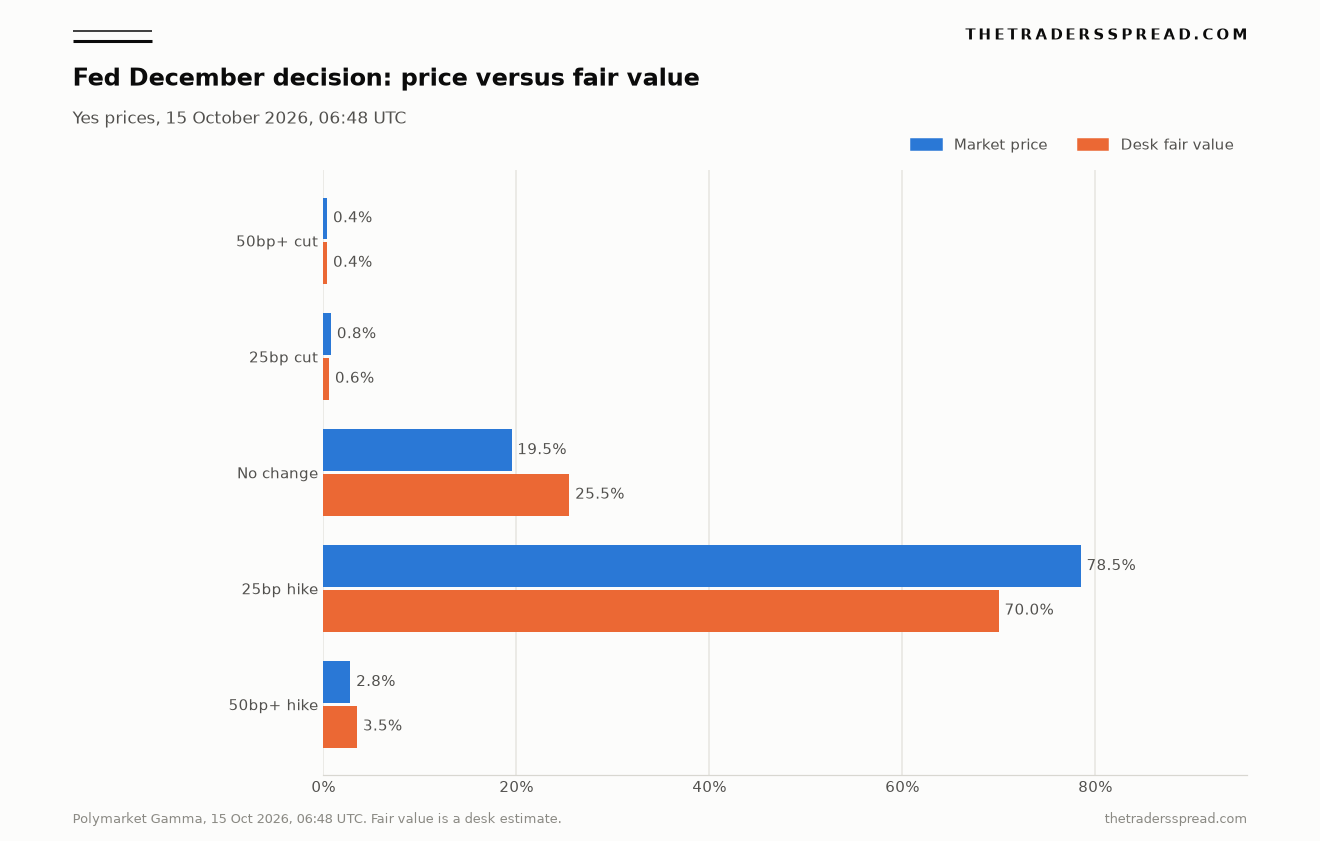
| Outcome | Yes price | Volume | Liquidity | Desk fair value |
|---|---|---|---|---|
| 50bp or larger cut | 0.4 cents | $658,352 | $110,237 | 0.4 cents |
| 25bp cut | 0.8 cents | $672,918 | $165,406 | 0.6 cents |
| No change | 19.5 cents | $800,875 | $204,458 | 25.5 cents |
| 25bp hike | 78.5 cents | $870,058 | $192,372 | 70.0 cents |
| 50bp or larger hike | 2.75 cents | $501,059 | $115,377 | 3.5 cents |
Volume and liquidity are Gamma fields from that pull. Fair-value cents sum to 100. No leg is a dead 0 or 100 on an empty book. The thinnest liquidity is still above $110,000. Heavy volume on the cheap cut legs is what old no's look like after months of two-way flow.
The 70 is the middle of a range the September dots still allow, once October's price is treated as having spent some of those dots. EY's reading of the 16 September projections lines up with the 16-versus-2 split Reuters reported that afternoon. Twelve of 18 participants looked for one more quarter-point in 2026. Four looked for 50 basis points more, meaning two quarter-point steps, not one 50-point move. Two looked for no further change. Kevin Warsh, listed first among the twelve voters in the minutes, did not submit a dot. The median of those who did is 4.1 percent at the end of 2026, the midpoint of a 4.00 to 4.25 percent range, and the median for the end of 2027 is 4.1 percent again. The centre did not, in September, want the rate higher next year than at the end of this one.
Force those counts to live with an October hike price of 28.5 cents and December's hike probability has a ceiling near 83 cents and a floor near 60. The ceiling stuffs October into the four participants who wanted two hikes, about 22 percent, and lets only the leftover 6 points come from single-hikers who have now spent their increase. The floor takes the whole October hike out of the twelve single-hikers, so their step never reaches December, while the four who wanted two steps still deliver one if October is a hold.
Sixty to 83 is the band. Split October's 28.5 cents in proportion to the 12-and-4 mix and about 21 points land on people who will not hike again, about 7 on people who will. What remains for December is roughly 67.5 cents. We sit at 70, a small step up from that proportional case and nowhere near the ceiling. The step is the 14 October inflation print and a two-year yield, 4.82 percent, that sits above a 4.1 percent median dot. Seventy cents is the fair value stored on this piece. The leg at 78.5 trades above it.
Collins spoke on Tuesday. CPI landed on Wednesday.
The minutes of 15-16 September, released on 7 October, are plainer than the speech circuit. Most participants assessed that another increase in the target range would likely be appropriate by year-end, and that they would take each meeting as it came. "Another increase" and "by year-end" are the load-bearing words. The sentence is not an increase at each of the two meetings still on the calendar.
All participants supported the September quarter-point, to 3.75 to 4 percent. The statement was the 12-0 text: activity at a solid pace, job gains keeping up with the workforce, unemployment little changed, inflation still elevated. Staff put total PCE at 3.8 percent in August and core PCE at 3.4. The projections had real GDP at 2.3 percent this year and 2.4 next, PCE at 3.7 percent then 2.3, core PCE at 3.4 then 2.5, unemployment at 4.1. Inflation risks were skewed higher. Almost all participants called labour-market risks roughly balanced. Several said the policy rate was not restrictive, or only mildly so.
Susan Collins, president of the Federal Reserve Bank of Boston, said on Tuesday 13 October that she had backed the September hike and that she expected "it will be appropriate to raise rates a bit further before the end of the year to ensure a timely and durable return of inflation to the Committee's 2% target," Reuters reported. "A bit further" is one move, and she said it before the CPI, not after. Reuters added that a range of officials had been pointing at December rather than 27-28 October. That is reporting, not a vote.
Wednesday's figures are the Bureau of Labor Statistics, not a paraphrase. The CPI-U rose 0.6 percent in September and 3.7 percent over the year. Core CPI rose 0.3 percent and 2.6 percent. Energy was up 20.4 percent on the year and gasoline 34.2 percent. Food was up 2.5 percent. A Reuters poll had looked for core at 2.5 percent. The beat is a tenth, not a new regime, and it sits beside a year-ahead PCE median the Committee had already published at 3.7 percent. CPI and PCE are different indexes. Treating one 3.7 as confirmation of the other is sloppy. So is claiming the Committee was ambushed. Staff walked into September with August PCE already at 3.8 percent.
Eugenio Aleman, chief economist at Raymond James, took the timing the other way. On 14 October he wrote that inflation was broadening out, "something that is not a good omen for the Fed and would raise the probability for an increase in rates at the end of the October FOMC meeting," Reuters reported. Citigroup, the holdout for no further move this year, switched the same day to a quarter-point increase in December, again per Reuters. A research note's "December hike" often means the funds rate is 25 points higher at year-end. October can deliver that. This contract would then be a bet on a further step, and the sentence would not map onto the yes leg one for one.
Why 83 cents is the wrong place to sit
The top of the band is available only if October's 28.5 cents are almost entirely the people who wanted two hikes. There are not enough of them. Four of 18 is 22 percent. At least 6 points of the October price have to be participants who wanted a single extra hike. If they move on 28 October, they have spent the increase the median dot was counting. The 2027 median at 4.1 percent does not hand them another one.
Could the dots be stale on the hawkish side? Core CPI was a tenth above the Reuters poll, and several participants had already called policy only mildly restrictive. The two-year at 4.82 percent on 14 October sits 94 basis points above the 13 October effective rate of 3.88 percent. The New York Fed had not published a rate for the 14th when we pulled the series, so the dates differ by a day. That gap says 3.88 percent is not the two-year average the cash market expects. It does not make 9 December an 80 percent event.
The one-day curve move is the quieter fact. From 13 to 14 October the two-year yield went from 4.79 percent to 4.82, and the ten-year from 5.21 to 5.19, on the Treasury's daily par curve. Three basis points on the two-year, the day of the CPI beat, is a twitch. The spread between them narrowed from 42 basis points to 37. If the print had reset the reaction function, the two-year was the place to see it.
Hiring does not rescue the 83-cent reading. The BLS strip on the CPI page shows unemployment at 4.2 percent in September and payrolls up 29,000, marked preliminary, against 4.1 percent in the August minutes. That is not a reason to rush a second hike into the meeting a week before the 3 November midterms.
September cuts both ways. Hike odds jumped into that decision, covered when the September contract repriced, and the Committee delivered a unanimous quarter point. Hammack, Kashkari and Logan had wanted a hike in July and lacked the votes. By September they were inside a 12-0. Waiting one meeting turned a dissent into the consensus, which is a reason to skip October. It is not a reason to ignore a live October hike price of 28.5 cents. A skip is the 71.5-cent outcome on that other book. It is not yet a fact.
The call
The leg being judged is the 25-basis-point increase at the 8-9 December meeting. It traded at 78.5 cents at 06:48 UTC on 15 October 2026. Fair value is 70 cents, stored as 0.70. The market sits above that fair value. Nothing on this page is an instruction to transact.
RelatedBank of England November Decision: 25bp Hike at 89.5%
Seventy cents is that proportional reading, plus a small allowance for the core CPI tenth and a two-year yield above the median dot. Keep the 12 / 4 / 2 split and the band is still about 60 to 83 cents. The top needs October's hikers to be almost exactly the four participants who wanted two steps, and 28.5 cents is already larger than that group. Collins, the minutes and a 2027 median that does not fall keep 70 off the floor. A 2.6 percent core rate does not justify the ceiling.
No change, 19.5 cents in the market, is 25.5 cents in this set. The 50-basis-point-or-larger hike is a 3.5-cent tail against a market price of 2.75. The four participants who wanted 50 basis points more wanted two quarter-point steps across two meetings, not a 50-point move on 9 December. Cuts stay under a cent. Reversing a hike the minutes described as insurance against inflation staying high would take a different set of data from the one published on 14 October.
What moves the 70. An October hike leg through 50 cents would pull more of the single increase forward and push December fair value down, widening the gap. The flip is the opposite tape: October's hike leg back near 10 or 15 cents, with inflation still hot, so the year-end increase lands on 9 December and 78.5 is no longer rich. A soft run of PCE and CPI that knocks this leg under 60 cents, dots unchanged, would make it cheap. Neither is this morning's tape.
Weight the 28 October decision first. Until that upper bound is known, a December yes is not "the hike." It might be the second one. The January fallback in the rules matters only if the Board fails to publish a statement.
Questions the contract actually answers
When does the December 2026 FOMC meet, and when is the statement?
The Board's calendar has the meeting on 8-9 December 2026, and it is one of the four meetings with a Summary of Economic Projections. The statement and the projections come out on 9 December. The press conference follows. Polymarket's rules point at that statement as the resolution source. The next meeting after it, if a statement were somehow missing, is 26-27 January 2027.
Does 78.5 cents mean the funds rate ends 2026 a quarter-point higher?
No. The leg pays on the change at the December meeting relative to the range the day before, not on the change since September. If the Committee hikes on 28 October and holds in December, this yes leg loses even though the rate is higher at year-end than it is today. If it holds in October and hikes in December, the leg wins. Year-end level and meeting step are different bets.
What is the target range going into these two meetings?
The range is 3.75 to 4.00 percent, set on 16 September and effective 17 September. The New York Fed's effective rate was 3.88 percent on 13 October. One more quarter-point takes the range to 4.00 to 4.25 percent, the band whose midpoint is the 4.1 percent median dot. A second quarter-point takes it to 4.25 to 4.50 percent, which is above that median and above the median for the end of 2027.
Why is the October contract in this piece at all?
Because the December rules measure the move from whatever the range is on the eve of the December meeting. On 15 October at 06:50 UTC the October 25bp-hike leg was 28.5 cents and no change was 71.5, on that October market. A 28.5 percent chance of an earlier hike uses up more than the 22 percent of September participants who wanted two hikes. Ignoring it makes December look more certain than the dots can support.
What would make 70 cents the wrong fair value?
A clear signal that October will be a hold, with the hike leg there back near 10 or 15 cents, would push fair value on December up toward the top of the 60-to-83 band. A soft run of inflation that the Committee treats as enough to stop would push it down toward the bottom. The 14 October CPI, a tenth on core and a two-year yield that rose 3 basis points that day, was not large enough to do either.
Disclaimer. This is analysis, not advice and not a solicitation to trade any contract or any fund. Prediction-market prices move and they can be wrong. You can lose money if you choose to trade. Policy votes are not determined by an order book, and nothing on this page tells you to take a side.