

The Serbia parliamentary election is the contract I priced this morning. I did not go to Belgrade for it, and I am not going to invent a long personal file on Serbian politics. At 08:13 UTC on 10 October I pulled Polymarket's gamma API for the book on which electoral list wins the most seats in the National Assembly on 25 October. Aleksandar Vučić - United Serbia was marked at 60.5 cents, bid 60 and offered at 61, last trade 61. The student list was marked at 38.5. Links to Polymarket are affiliate links, from which The Traders Spread may earn a commission at no cost to you. Volumes, bids and the resolution text below are from that pull of the Serbia parliamentary election market, and from the two September polls I then read against it.
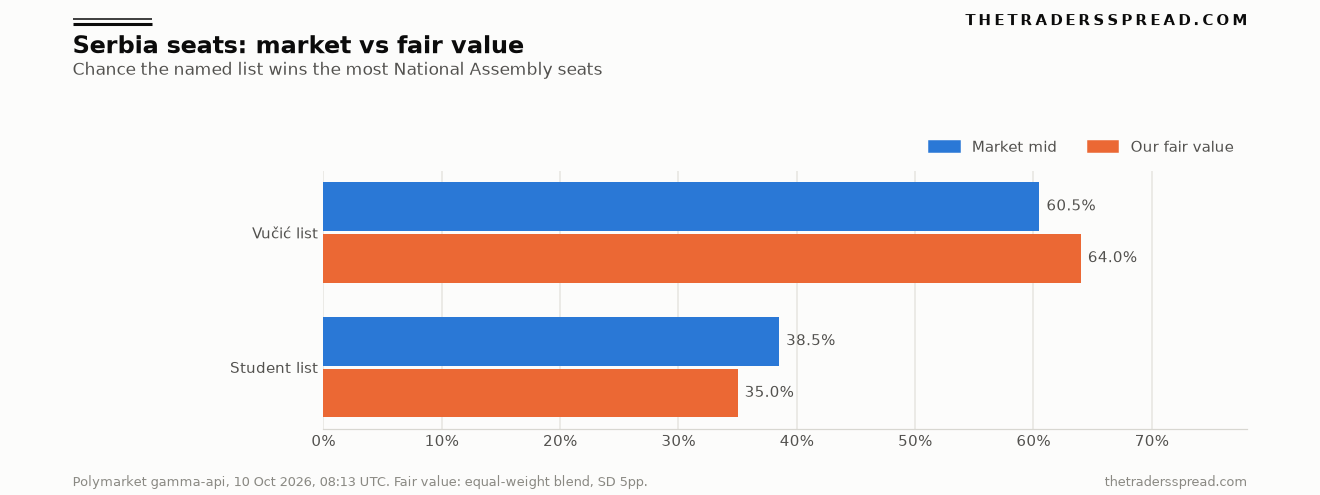
60.5 cents is a probability of finishing first on seats. It is not a vote share. A Faktor Plus print of 48.6 percent does not mean the contract should trade at 49 cents, and it does not mean 60.5 cents is rich. Those are different units. I turned each September poll into a chance that the Vučić list wins the plurality of seats, gave the polls equal weight, and got 64 percent. The mid is three and a half cents under that. The student list, at 38.5, sits a little above the 35 percent I assign it as the residual.
Key facts
- Vučić list at 60.5 cents, bid 60 / ask 61, up 6.5 cents on the day and down 5 on the week. Volume $335,191, liquidity $108,973 - Polymarket gamma-api, 10 October 2026, 08:13 UTC.
- Student list at 38.5 cents, bid 38 / ask 39, down 6 cents on the day. Volume $358,480, liquidity $121,573 - same pull.
- Event volume $701,357, with $123,456 in the prior 24 hours. Displayed liquidity $729,221, mostly on legs at 0.05 cents - same pull.
- Faktor Plus, fieldwork 16-20 September 2026, sample 986, published by Blic and reported by the Bulgarian News Agency on 21 September: United Serbia 48.6 percent, student list 37.1 percent - BTA, 21 September 2026.
- Nova srpska politička misao, fieldwork its author dated to early September, published 30 September: student list 44.4 percent, United Serbia 41.7 percent. Sample size not stated - Magyar Szó, citing Beta, 30 September 2026.
- Our fair value for the Vučić list winning the most seats is 64 percent, stored as 0.64. The market mid is 60.5 percent - model in this piece, inputs dated above.
- Election day is 25 October 2026. The contract pays the list with the most seats. If the result is still not definitive at 11:59 pm ET on 31 March 2027, it resolves to Other - Polymarket rules, via the Republic Electoral Commission where reporting is ambiguous.
What 60.5 cents pays
The rules are narrower than the headlines. Polymarket pays the electoral list that wins the greatest number of seats in the 250-member National Assembly. Lists rank by seats. A tie on seats breaks to valid votes, then to alphabetical order of the listed names. The name has to match the ballot and the official proclamation. How members later organise themselves does not count. A coalition signed the next day does not rewrite the ranking.
Aleksandar Vučić, in remarks Daria Zakharova reported at Politico on 9 September, said: "I am convinced that the citizens of Serbia will choose the right path into the future," and spoke of "preserving our democratic system." Prime Minister Đuro Macut, asking for the dissolution, said: "If we want to mitigate tensions in society there is no better way than to ask people." Both lines are about calling a vote. Politico added that the Serbian Progressive Party had nominated Vučić for prime minister if the party secured a majority. A majority is 126 seats. This contract does not require 126. It requires more seats than any other named list.
The English Wikipedia page for the 2026 Serbian parliamentary election describes one nationwide district, closed lists, the d'Hondt method, a 3 percent threshold and an exemption for ethnic-minority lists. Vučić dissolved the Assembly on 9 September and set 25 October. He resigned the presidency on 27 September to lead United Serbia. Speaker Ana Brnabić is acting president. Ilija Srdanović is the student list's ballot holder.
If the count is still open at 11:59 pm Eastern Time on 31 March 2027, the market resolves to Other. A dispute before that falls to a consensus of credible reporting and, if that is ambiguous, to the Republic Electoral Commission. The end stamp on the book is 25 October 2026, 23:59 UTC. A slow count can shave a little probability off every named Yes. It does not, by itself, open the gap between 60.5 and 64.
Two September polls, 14 points apart
A sentence on a market page is not a poll. The two surveys below each have a pollster, a window and an outlet.
Faktor Plus was in the field from 16 to 20 September, with 986 respondents. Blic published it. The Bulgarian News Agency reported it from Belgrade on 21 September: United Serbia at 48.6 percent, up 1.4 points on that house's previous poll, and the student list at 37.1 percent, up 5.6. Vladimir Pejic, executive director of Faktor Plus, told Blic the campaign was heating up and the figures could still change. He said the Serbian Progressive Party was holding its electorate and that, unchanged, it could count on an absolute majority. He tied the student gain to the People's Movement of Serbia, Ecological Uprising and New Face of Serbia leaving the race.
The English Wikipedia polling table, read on 10 October, puts the prior Faktor Plus survey on 4 September: sample 1,200, United Serbia 47.2, student list 31.5, a lead of 15.7 points. By mid-September the lead was 11.5. The list behind had gained more than the list in front.
Đorđe Vukadinović, of Nova srpska politička misao, told N1 that only two actors had reason to be satisfied, the governing party and the student list, and that both had crossed 40 percent. Magyar Szó, citing Beta, published that on 30 September: students 44.4 percent, United Serbia 41.7. He pointed to a prior NSPM survey of 39.6 and 37.5, which matches the 30 July row, sample 1,000. The September release gives no sample size. Wikipedia notes a Bureau for Social Research review of 32 polls through 8 September 2026 that found agencies often skip the technical detail a reader would need.
He dated the fieldwork to the start of September, before signature collection for the student list, before those three opposition groups stood down, and before a split in Branimir Nestorović's movement and the SPS proceedings against Branko Ružić. Publication on 30 September is not fieldwork on 30 September. On fieldwork, Faktor Plus is the later poll. I will not score a poll by the day a newspaper printed it.
The same Wikipedia page records that opposition outlets and independent media accuse Faktor Plus, and Ipsos, of a pro-government house effect. I do not have a measured size for that effect in this campaign, so I will not invent one. The accusation is a reason to keep NSPM in the blend. It is not a number I can subtract from 48.6.
What 250 seats does to an 11-point lead
Lists under 3 percent of votes cast get nothing, unless they qualify as minority lists. Qualifying lists then take the 250 seats by d'Hondt: each list's votes are divided by 1, 2, 3 and so on, and the 250 largest quotients each earn a seat. The Faktor Plus shares that clear 3 percent are 48.6, 37.1, 4.9 for the Socialists, and 3.6 for the European Serbia list associated with Marinika Tepić and Zdravko Ponoš. They sum to 94.2. NADA at 2.8 falls short.
Renormalise those four and the same method returns 129 seats for the Vučić list, 99 for the students, 13 for the Socialists and 9 for European Serbia. A 30-seat gap. Minority lists are absent from that print, and I am not inventing a total for them. They would have to take seats in a lopsided way to hand the plurality to a list 11.5 points back. Believing that poll on election day means a seat lead, not a photo finish.
The NSPM print is the photo finish: students 44.4, United Serbia 41.7, and an "others" bucket of 13.9 with no party split. If that bucket is too fragmented to clear 3 percent, a two-list allocation produces 129 seats for the students and 121 for the Vučić list. A couple of points of error, or a few of those "others" clearing the line, can flip the order. A 2.7-point student lead is a modest favourite, not a near-certainty.
Seat rules have done this work on other books. The Berlin election piece turned on a seat-tie rule, and the Duma seat-gain contract was also a question about seats. Serbia's rule is simpler, and it is still not the rule people quote when they argue about who becomes prime minister.
| List | Market mid | Bid / ask | Our fair value | Volume |
|---|---|---|---|---|
| Aleksandar Vučić - United Serbia | 60.5% | 60 / 61 | 64% | $335,191 |
| Student list - Students Win | 38.5% | 38 / 39 | 35% | $358,480 |
| Other named lists on the board | 0.05 cent each | no bid, 0.1 cent ask | inside the 1-point tail | a few hundred to about $1,900 each |
The two live mids sum to 99 cents. I keep one point for the long tail and put 35 on the student list. Dačić's Socialists show about $1,921 of volume against about $60,336 of displayed liquidity, and the Hungarian list about $651 against about $59,690, both at 0.05 cents. A 4.9 percent list can win seats and still cannot win the most of them. Event liquidity of $729,221 is mostly those empty ladders. The contracts that trade hold $108,973 and $121,573. The prior 24 hours ran about $73,686 on the Vučić leg and about $49,770 on the student leg.
Where 64 percent comes from
Two scenarios, one error bar. Averaging 48.6 and 41.7 into a fake "true" share, then treating that average as precise, would hide a 14.2-point disagreement on the margin: +11.5 against −2.7.
Inside a scenario, the chance the margin becomes a seat plurality is the normal distribution of that margin divided by 5 percentage points. Faktor Plus's sampling error on its own margin, at n = 986, is about 2.2 points. The same house's lead then moved 4.2 points between its 4 September and 21 September publications. Five points leaves room for one further move of that size. It is a modelling choice, not a historical error I can cite for this contest.
Faktor Plus, margin +11.5, prints Φ(11.5 / 5) = Φ(2.30) = 0.989. NSPM, margin −2.7, prints Φ(−2.7 / 5) = Φ(−0.54) = 0.295. Equal weights, because I will not invent a house-effect coefficient and I will not pretend the later press release is the later fieldwork:
0.50 × 0.989 + 0.50 × 0.295 = 0.642.
Rounded, 64 percent, stored as 0.64. The student figure on the chart is 35 percent. At a standard deviation of 4 points the blend is 0.624. At 6 it is 0.649. At 8 it is 0.646. All of those sit above 60.5.
The weight is the fragile part. Let w be the weight on Faktor Plus. Then 0.989w + 0.295(1 − w) falls through 0.605 when w drops under about 0.45. A reader who puts more than half the weight on the early-September NSPM survey will mark this book rich. I am not doing that. The accusation is unquantified, and the later fieldwork is Faktor Plus, which already includes the groups standing down. Quoting only the 48.6 and calling fair value 99 percent is the matching error in the other direction. Equal weight refuses both.
What would move the 64 percent
The Vučić leg was up 6.5 cents on the day of the pull and down 5 cents on the week. A week earlier the mid was about 65.5 cents, where this model already sat. By the morning of 10 October it was 60.5, with a one-cent spread. The last trade and the ask are both 61, still under 64.
I looked for a poll with fieldwork in the first ten days of October and did not find one. The Wikipedia table still ended with the 21 September Faktor Plus row and the 30 September NSPM publication. About $73,686 through the Vučić leg in 24 hours can lift a book of this depth. It is not a new fact about 25 October. On the live Serbia board the two prices are a complement, one cent of slack aside.
RelatedPutin Out by New Year: The 2026 Leg Trades at 3.15%
A new poll would move the 64 percent. Fieldwork after 1 October, a named agency, a stated sample, and a Vučić margin inside about 4 points, or a student lead, replaces a September scenario. CRTA's 15 July survey, students 44.9 and the SNS-led figure 35.7 on a sample of 2,324, is real and I am leaving it out. It predates the dissolution.
A measured house effect would. If someone publishes Faktor Plus against counted results, in points rather than as an accusation, that number goes into the weight. Until then the weight stays at one half. Under about 45 percent on Faktor Plus, the blend drops below the mid.
A seat quirk would, at the narrow gap only. At 11 points I do not see minority lists handing the plurality to the second-place list. At 2.7 points I do, which is why that scenario is 0.295. The Sweden book was a case where a traded probability and a fair value built from the rules sat several points apart. Serbia's rules are on the page. I have used them.
The protests set the October date. They are not an extra term. A canopy at Novi Sad station collapsed on 1 November 2024 and killed 16 people, and BTA says the student list opened its campaign there on 10 September. Wikipedia cites 100,000 at Slavija Square on 22 December 2024 and a figure above 325,000 for 15 March 2025. Crowd size is not a vote, and I am not subtracting a 2023 result from 48.6. The model uses the two poll shares.
The stored reading on the Vučić leg is that the traded price sits below our fair value. Fair value is 0.64. The mid is 0.605. The ask is 0.61. Nothing in that is an instruction to take a side. A three-and-a-half-cent gap, on a one-cent spread, with fifteen days left and two polls fourteen points apart, is a small edge with a wide argument around it. Polymarket will keep reprinting the mid. The 64 percent moves when the inputs move.
Questions the book keeps attracting
When is the Serbia parliamentary election, and what is on the ballot?
Voting is on 25 October 2026 for all 250 seats in the National Assembly: one nationwide district, closed lists, d'Hondt, a 3 percent threshold, and an exemption for minority lists. Vučić dissolved parliament on 9 September. Polls run from 07:00 to 20:00, with silence for the two days before voting day.
Does the Polymarket contract pay the next prime minister?
No. It pays the electoral list with the most seats under its ballot name. A list can finish first and still fall short of the 126 seats needed to govern alone. A list can finish second and still enter a cabinet. Ties on seats break to votes, then to alphabetical order. If no definitive result exists by 11:59 pm ET on 31 March 2027, the contract resolves to Other.
Why is 60.5 percent not a rich price against a 48.6 percent poll?
Because 48.6 percent is one survey's share of decided voters, and 60.5 percent is a traded chance of winning the most seats. An 11.5-point lead, run through d'Hondt, is a large seat lead in the illustration above. The NSPM survey has the students ahead by 2.7 points and pulls the blend down. Equal weight of the two chances is 64 percent, which is above the mid.
Which polls are inside the 64 percent, and which are out?
In: Faktor Plus, fieldwork 16-20 September, n = 986, reported by BTA on 21 September, and NSPM, early-September fieldwork, published by Magyar Szó on 30 September with no sample size. Out: CRTA's July survey, older Faktor Plus waves except as context for the lead, and any market-page figure that does not name a pollster, a window and an outlet.
What would make 60.5 cents look rich instead?
A weight under about 45 percent on the Faktor Plus scenario. That is open to a reader who treats the pro-government accusation as decisive. I do not have a measured house effect, and the later fieldwork already includes the withdrawals Pejic cited. A named October poll with a small or negative Vučić margin would replace the scenarios rather than reweight them.
Why ignore the lists priced at 0.05 cents?
A few hundred or a couple of thousand dollars of volume, at a half-tenth of a cent, is not a traded chance of winning the most seats. Several of those legs still show about $60,000 of displayed liquidity, which is why $729,221 overstates the depth on the two live contracts. Seats for a small list are not the same thing as the most seats.
This is analysis of a prediction-market price, not advice and not a recommendation to take either side of a contract. Fair value here is a desk model with stated inputs, and those inputs can be wrong. Prices move. Resolution can pay a list the model treats as unlikely, or Other if the count is still open on 31 March 2027. You can lose money. The Traders Spread does not provide personalised financial advice.