

An Indiana data-center moratorium is not already law, and a county ordinance cannot enact one. Marion County stopped new approvals through 31 December 2027. Fort Wayne failed 4-4 on 13 October to pass a one-year pause and killed a study commission 3-5. Adding those votes and calling the sum a state statute answers a question this contract does not ask.
The split that matters is inside the book. On the gamma-api print at 07:15 UTC on 14 October 2026, YES by 31 December 2027 was 16.5 cents, up 7 cents on the day. The 30 June 2027 YES was 9.5 cents, up 1 cent. The General Assembly's FAQ puts sine die no later than 29 April in an odd year, inside both contracts. The extra probability prices enactment after 30 June: a special session only the governor can call. On 7 October regulators approved service for a Google project in Morgan County. The richer leg needs that governor to halt a buildout those regulators just agreed to serve.
Key facts
- The 31 December 2027 YES price is 16.5 cents, on $2,632,226 of volume and $863,695 of liquidity, bid 16 cents and ask 17 — Polymarket gamma-api, 14 October 2026
- That leg is up 7 cents on the day and on the week; the 30 June 2027 YES is 9.5 cents, up 1 cent, on $83,053 of liquidity — Polymarket gamma-api, 14 October 2026
- YES needs a statewide statute or constitutional provision by 11:59 p.m. Eastern Time; local pauses, tax changes and executive orders do not qualify — Polymarket event rules, re-read 14 October 2026
- Regulators on 7 October 2026 approved service to Google's 390-megawatt Monrovia data center; AES estimates $1.3 billion of infrastructure and says Google covers 100 percent of the incremental cost — WFYI, 12 October 2026; AES Indiana, 7 October 2026
- Governor Mike Braun signed House Enrolled Act 1210 on 12 March 2026 after a 91-3 House vote and a 48-0 Senate vote; the Star reported a local share of up to 1 percent of the sales-tax break on data-center electricity — Indianapolis Star, 12 March 2026; LegiScan, 27 February 2026
- Marion County's pause runs at least through 31 December 2027 after a 23-1 council vote on 10 August and a 6-0 commission vote on 19 August; Fort Wayne's pause failed 4-4 on 13 October — Indiana Public Radio, 20 August 2026; WPTA, 13 October 2026
What the wording pays on
The event rules, re-read from gamma-api on 14 October, are the trade. YES needs a state law, or a constitutional provision, creating a statewide moratorium, enacted by 11:59 p.m. Eastern Time on the leg's date. Enactment means signature, a veto override, or a bill that becomes law unsigned. A chamber vote is not enough. A promise to sign is not enough. The clock is the enactment date, not the effective date.
The measure has to halt approval, permitting, construction, interconnection or operation of all new data centers, or of every new one above 100 megawatts, across the state. A city pause fails. So does a pause limited to part of the state, a tax-incentive change on its own, an executive order, and a statute that only lets the governor impose a pause later if he chooses.
One path survives. A suspension until a condition is met can qualify, if a court can check the condition without waiting on the agency's own findings. "Pause until the study is finished" loses. "Pause until a named date" can win.
The board is the Indiana data-center moratorium event on Polymarket, opened on 29 September 2026. Links to Polymarket are affiliate links, from which The Traders Spread may earn a commission at no cost to you. Four deadlines share one definition. Only the date moves.
House Enrolled Act 1210 is what the legislature passed instead. Governor Mike Braun signed it on 12 March 2026. Jake Allen at the Indianapolis Star reported that companies receiving a future sales-tax exemption must share up to 1 percent of the exempted tax on their electricity bill with local government, each quarter. LegiScan records the conference report at 91-3 in the House and 48-0 in the Senate on 27 February. A skim on a tax break is not a moratorium. The rules say an incentive change, alone, does not resolve YES.
Marion County is the freeze people cite, and the wrong instrument. The council voted 23-1 on 10 August 2026. Indiana Public Radio reported the Metropolitan Development Commission enacted it 6-0 on 19 August, through at least 31 December 2027. DC Blox, Metrobloks and Sabey, already zoned, sit outside it. Michael-Paul Hart, councilor for District 20 on the Indianapolis City-County Council, the lone no, said the pause runs "until there's a new city council in place" in 2028. Dan Boots, councilor for District 3 on the same council, answered that Hart "was the sole vote against it." Both were discussing city zoning.
Fort Wayne failed at a smaller version of the same idea. WPTA reported on 13 October that drafts from Rohli Booker, councilwoman for the 6th District on the Fort Wayne City Council, would not have touched the Google campus already underway. She said, "If there was ever a perfect time to pause, it's now," and that the state "has made it very clear that it wants these types of developments." Nathan Hartman, a councilman on the same body, said he was "still a no" and "not convinced that this is good policy." The pause died 4-4. The task force died 3-5.
A 7-cent gap, and no session to spend it in
Figures below are gamma-api outcomePrices at 07:15 UTC on 14 October 2026. The displayed YES is not always the last print. On the December 2027 leg the screen says 16.5 cents, the last trade was 16, and the book is 16 at 17.
| Leg | YES | Bid / ask | Last | Volume | Liquidity | Day change |
|---|---|---|---|---|---|---|
| 31 December 2026 | 1.95 cents | 1.9 / 2.0 | 2.2 cents | $209,663 | $100,842 | down 0.5 cent |
| 30 June 2027 | 9.5 cents | 9 / 10 | 10 cents | $400,278 | $83,053 | up 1 cent |
| 31 December 2027 | 16.5 cents | 16 / 17 | 16 cents | $2,632,226 | $863,695 | up 7 cents |
| 31 December 2028 | 27 cents | 26 / 28 | 27 cents | $618,039 | $30,513 | up 0.5 cent |
Event volume was $3,860,206, with $1,077,729 of liquidity and $467,652 traded in the prior day. The 2026 leg still has $100,842 of liquidity. It cheapened 2.25 cents on the week while December richened. $325,202 of the day's flow sat in the December 2027 leg.
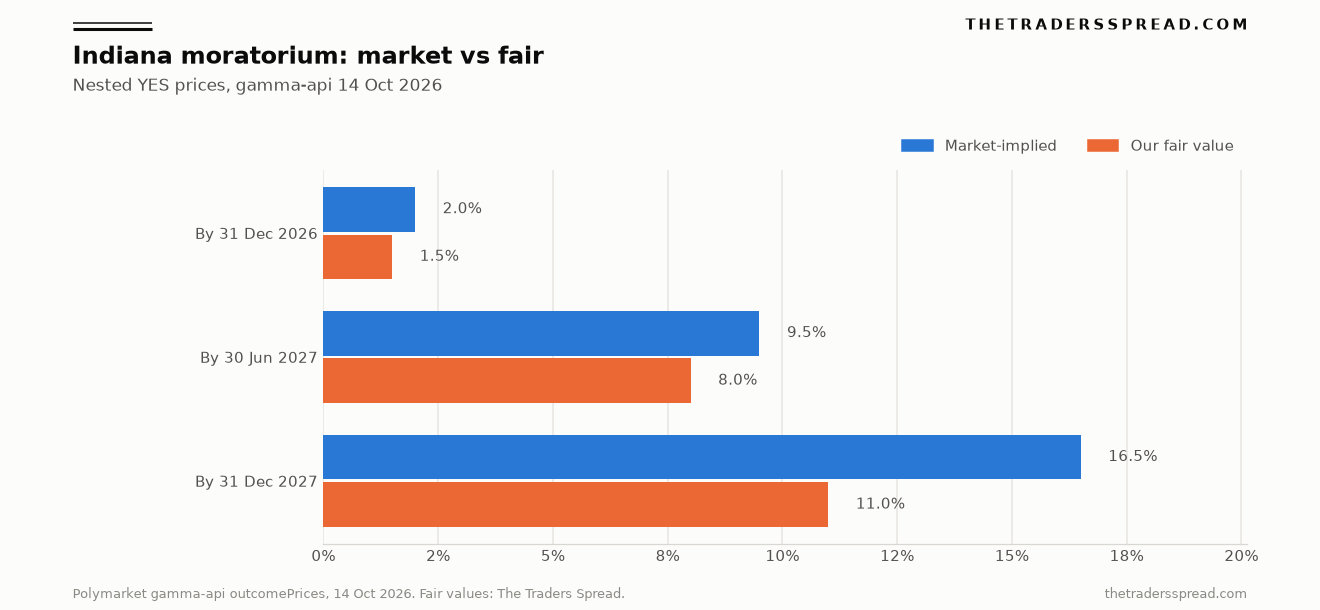
The bars nest. A YES by June is also a YES by December. Fair value nests the same way: 1.5 percent by the end of 2026, 8 percent by 30 June 2027, 11 percent by 31 December 2027. The market is at 1.95, 9.5 and 16.5. June is close. December is not.
June's book is the thin one, $83,053 against $863,695, with a one-cent spread, so subtracting the two prices is rough. Even then the market charges about 7 points for enactment after 30 June, and a similar slice for everything before it. Only one of those windows holds an ordinary session.
The day's change and the week's change on the December leg are the same number, plus 7 cents, so the move printed inside a day. Nothing checked on 14 October ties that order to a filing. Fort Wayne's failed pause the night before is a strange reason for a higher statewide YES.
The 31 December 2027 contract leads because that is where the size is. A deep book can still be aimed at a headline the rules throw out. 16.5 cents is a price, not evidence a bill exists.
The commission plugged the project in
On 7 October 2026 AES Indiana said the commission had approved a large-load plan the utility estimates will produce about $770 million in customer savings. That figure is AES's estimate, not cash already credited on a bill. The plan covers "Google's data center in Morgan County," and Google's rates "will cover 100% of the energy, infrastructure, transmission, and generation costs." Google also took an 80 percent minimum-demand obligation. Brandi Davis-Handy, president of AES Indiana, called the order "an important milestone for Indiana's future."
WFYI reported on 12 October that the approval was unanimous, for a 390-megawatt project in Monrovia, the first data-center filing under House Enrolled Act 1007 of 2025. That statute tells large users to cover 80 percent of costs assigned to them. AES puts the infrastructure at $1.3 billion. WFYI put the Monrovia project itself, batteries and solar included, at $737.3 million. Different scopes. Do not add them.
Joby Jerrells, a commissioner at the Indiana Utility Regulatory Commission, said the deal "exceeds" the statutory test "substantially," after AES testified Google would pay at least 100 percent. WFYI reported the order still assigns existing customers a share of some upgrades. Ben Inskeep, program director at the Citizens Action Coalition, said on 2 September, "We are pleased that the Commission recognized that these developments warrant a very close look." A rehearing is not a moratorium. The docket is still about connecting the load.
The same megawatts show up in the equity market from the other side of the meter. Our note on Constellation Energy prices dispatchable power. It does not price an Indiana statute.
The industry's answer is a rulebook. On 5 October Mirror Indy reported that the American Infrastructure Alliance, 20 organizations, had started working Indiana officials in September, one of seven launch states. Graham Newhall, a spokesperson for the American Infrastructure Alliance, said the issue is "very top of mind" and that the effort was not "a flash-in-the-pan effort to try to sway voters" a month from the election. Then the sentence that touches this contract: "A moratorium doesn't answer any of those questions."
The same article cites an August report from Indiana University's Environmental Resilience Institute: at least 24 counties with moratoriums, three with bans. An August survey the alliance paid for found just over two-thirds of Hoosiers negative on data centers and 17 percent positive. Support for more of them rose from 19 percent to 44 percent once guardrails were described. Their theory is rules, not a statute.
Kokomo wrote rules. The session wrote a skim.
Kokomo is that substitute in office. Mirror Indy reported that Tyler Moore, mayor of Kokomo, had just announced a Digital Realty proposal of 476 acres and 3 million square feet. In an August op-ed the paper quoted, Moore said nearby communities were "reaching for moratoriums," then: "But moratoriums are not a plan, and, by law, they cannot last forever." He said the project would take no tax abatement and would use union labor. A Facebook post the paper described put expected property-tax revenue at $44 million to $55 million a year once the campus is complete in 2033. Mike Young, business manager of IBEW Local 873 in Kokomo, called moratoriums something that "feel like action, but they're a delay tactic, not a strategy."
A hostile thread under the mayor's post is not a Senate vote. Celestica's forecast on this site prices the boxes those halls are built around, not the bill. Nvidia's contract to finish 2026 as the largest company prices demand one step further up. Neither asks whether a Hoosier statute gets a signature.
The session that could have written one already ended. Both chambers of the 124th General Assembly have adjourned sine die. The General Assembly's FAQ sets the outer bounds: no later than 14 March in an even-numbered year, and no later than 29 April in an odd-numbered year. Days outside that are on the governor's call. There is no ordinary vehicle left in 2026, which is what the 1.95-cent leg is pricing. House members serve two-year terms, so the House that gavels in for 2027 is chosen this November. A new House is why 11 percent is not 2. A governor who signed the skim, and a session that dies at the end of April, are why 11 percent is not 16.5.
What would make 16.5 cents look cheap
One document would do it. A bill for the 2027 session, with a committee chair as author, that suspends permitting or interconnection for new data centers above 100 megawatts, statewide, mandatory on its face, ending on a date or on a condition a court can check without waiting for an agency to declare its own work finished. That sentence is the contract. A study committee, another skim on the sales-tax exemption, or a fresh stack of county ordinances is not.
RelatedSeptember CPI Odds: The 3.7% Bucket Sits Above Fair
The second document is a sentence from Governor Braun: he would sign that bill, or he is calling a special session and the call names data-center siting. Until one of those exists, the second half of 2027 is a phone call he has not made. If the June leg rises with December, the money is on the regular session and the 8 percent on June is the figure to reopen. A December leg that rises alone is still a price on the half of the year with no ordinary session. A speaker can also bury the bill in one sentence, and the 7 cents can leave the print with no bill behind them.
Where 11 percent comes from
Our fair value on enactment by 31 December 2027 is 11 percent, stored as 0.11. The market's 16.5 cents sits above that, so the comparison on the page is "above fair." That is a statement about the price. It is not an instruction to take either outcome.
The 11 nests in three pieces. Through 31 December 2026 we put 1.5 percent. The regular session is over. A special session in the next eleven weeks, called to stop construction, would break with the March statute and with the 7 October order. The market's 1.95 cents is close to that tail. The chart labels the bar 2.0 percent because it rounds to a tenth.
Through 30 June 2027 we put 8 percent. The extra 6.5 points are a qualifying statute in the regular session. The statutory end of that session, 29 April, falls before the June deadline, so an ordinary enactment settles June and December together. The June market at 9.5 cents is a point and a half above our 8. On an $83,053 book with a one-cent spread, that is not a gap worth a fight of its own.
The last 3 points cover 1 July through 31 December 2027. The market's step from 9.5 to 16.5 charges about 7 points for that window. Three against seven is the argument. The governor who would have to call a special session spent 2026 connecting a 390-megawatt customer, and a regular-session bill does not need July. The June 30, 2027 contract is the ordinary path, on the thinner book.
A chair's bill, or a Braun signal that he would sign, and 11 percent is low. A public no, or a December print that hands the 7 cents back, and 11 percent is high. Until then the price pays for a second-half story the 2026 record does not support.
Questions the wording actually answers
Does the Indianapolis pause settle the contract?
No. The council's 23-1 vote on 10 August, and the development commission's 6-0 vote on 19 August, bind Marion County through at least the end of 2027. The Polymarket rules, re-read on 14 October, say a local moratorium, or one limited to part of the state, does not qualify. Three projects already approved sit outside the freeze. A statewide statute is a different body and a different text.
Would repealing the sales-tax exemption count?
Not by itself. The event text says a suspension of tax incentives or exemption certificates does not qualify. HEA 1210, signed on 12 March 2026, did not even repeal the break. The Star reported a local share of up to 1 percent of the exempted electricity tax, with the exemption left in place. A tax line can ride in the same bill as a real pause. Only the pause, if it meets the other tests, does the work.
Can the governor impose this by executive order?
The contract says no. Executive orders and agency orders do not count. A statute that merely lets him impose a pause if he chooses also fails, because the halt has to be mandatory on its face. His practical role is different. He calls any special session, and he signs or vetoes what the regular session sends up.
Why is December 2027 priced so far above June?
On the 14 October pull, June YES is 9.5 cents and December YES is 16.5 cents. A regular-session law must clear by 29 April in an odd year, so it would settle both. The gap is a price on action after 30 June. June is also thin, near $83,053 of liquidity. We still read about 7 points of the gap as too much.
What would push the 11 percent fair value up?
A 2027 bill, with a chair's name on it, that suspends statewide permitting or interconnection of new data centers above 100 megawatts, on a condition a reader can check. A statement from Governor Braun that he would sign it, or a special-session call that names the subject, would do the same. So would the June leg rising with December, which would mean the money had moved onto the regular session.
Disclaimer
This is analysis of a prediction-market contract, not a recommendation to take either outcome and not advice on any related security. Prices move. The wording resolves on the statute as enacted, not on the headline a reader remembers. The fair value above is a judgment, and it can be wrong. Capital is at risk.