

7.5 cents is what Kharg Island pays, on 17 October 2026, for a loss of Iranian control by 31 December. The Polymarket gamma API that morning showed the December yes token at 0.075, bid 0.07 and offered at 0.08, last trade 0.08, up a cent on the week. The event around that token has matched $76.2 million. Nine earlier deadlines, from 31 March through 30 September, resolved no. Open interest is $976,000 and liquidity is $271,000, both sitting on the two legs still open. About $74.5 million of the matched volume, 97.8% of it, was wagered on dates that have already answered no. The surprise is not that seizing the island is priced as a long shot. It is that the book has resolved no nine times, and 7.5 cents is still the price of a tenth ask.
Read 7.5 cents as an oil-flow price and the mark is wrong. Iranian seaborne crude exports were already at zero as of 5 October, Vortexa told Reuters, down from a 14-day average of 230,000 barrels a day at the start of September. The contract does not pay for a halted barrel. It pays only if Iran loses primary governmental or military control and some other state, occupying force or internationally backed authority has established control. The 31 October leg of the same event is 1.1 cents, so nearly all of the December price is a November and December residual. Links to Polymarket are affiliate links, from which The Traders Spread may earn a commission at no cost to you. The board is the Kharg Island control market. The event slug still says March because that was the first leg. The live question is December.
- December yes token at 7.5 cents, bid 7 cents, ask 8 cents, last trade 8 cents, up 1 cent on the week — Polymarket gamma API, 17 October 2026.
- October 31 yes token at 1.1 cents, bid 1 cent, ask 1.2 cents, last trade 1 cent — Polymarket gamma API, 17 October 2026.
- Event volume $76.2 million, of which $1.67 million is on the two open legs; liquidity $271,000; open interest $976,000; about $55,500 traded in the latest day — Polymarket gamma API, 17 October 2026.
- Iranian seaborne crude exports at zero as of 5 October, from 230,000 barrels a day in early September; 83 million barrels still on tankers, 43 million west of Hormuz — Vortexa, reported by Reuters, 13 October 2026.
- Gulf flows excluding Iran back above 81% of pre-war levels in September, and Iranian LPG exports down 48% on the month — Vortexa, reported by Reuters, 13 October 2026.
- Before the war Kharg handled roughly 90% of Iran's crude exports and lies about 30 kilometres offshore — JP Morgan note, cited by AFP, 11 March 2026.
- Nine dated legs from 31 March to 30 September resolved with the yes token at zero — Polymarket gamma API, through 1 October 2026.
The payout is a transfer of control
Gamma's description, pulled with the prices on 17 October, is stricter than a headline about Kharg being hit.
Yes requires that Iran no longer exercises primary control, and that another state, an occupying force, or an internationally backed authority has established it. Temporary raids, isolated landings, special operations, bombardment, sabotage, naval presence offshore, or a temporary disruption of Iranian activity do not qualify on their own. An announcement is not enough. A negotiated handover counts only once control exists on the ground. If control is contested, unclear, or not sufficiently shown by the deadline, the leg resolves no. Named sources are official statements from the governments and militaries involved, plus a consensus of credible reporting.
A strike on a bunker, a tanker disabled off the coast, an empty jetty, a blockade that stops a barrel: each can be real, and each can fail that test. The December token is a claim about who holds the island, not about barrels loaded.
Farzin Nadimi, senior fellow at the Washington Institute for Near East Policy, put the operational point to AFP on 11 March, early in the war. Kharg, he said, is "almost an entire island of oil facilities and pipelines and tank farms", and "it is very difficult to wage a military operation on that particular island". He also called a move on the island "a very risky move". The quotes are seven months old. They are not a December forecast. They describe the ground the contract is written on: a small export complex, about a third the size of Manhattan in the same AFP account, where a force that wants primary control has to hold the tanks and the berths.
AFP, citing a JP Morgan note that weekend, put Kharg at roughly 90% of Iran's crude exports and about 30 kilometres off the coast. The mainland shore is largely too shallow for the largest tankers, which is why the island became the loading point. Jask, outside Hormuz, opened in 2021 and has not replaced it. Treat the 90% as a March fact. Vortexa's seaborne share for Iran, through 5 October, is zero.
Zero barrels, and the island is still Iranian
Claire Jungman, director of maritime risk and intelligence at Vortexa, told Reuters on 13 October: "The blockade is doing what years of sanctions never managed: it has physically stopped Iranian crude from leaving the Gulf."
The figures under that sentence are dated and narrow. Seaborne crude exports fell to zero in the second week of September from a 14-day average of 230,000 barrels a day, and were still zero as of 5 October. Crude on tankers was 83 million barrels, 43 million of them trapped west of Hormuz. LPG exports dropped 48% on the month. Gulf flows excluding Iran, the same September, were back above 81% of pre-war levels. Jungman added that China needs Iranian barrels less, because Russian supply has filled the gap: Russia was 80% of Vortexa's high-risk exports from Iran, Russia and Venezuela, and the three together shipped 4.73 million barrels a day against 6.39 million a year earlier.
None of that resolves this contract. A barrel that does not leave is not a change of control. On those Vortexa numbers the export stop has already arrived, and every deadline so far has still resolved no. The December yes pays only if the political geography changes as well.
There is a second account, and it does not match the tracker. Ehsan Jahaniyan, deputy governor of Bushehr province, was reported by IRNA on 11 October, in a Maritime News account, as saying that oil-company activity at the terminal was proceeding normally. Iranian sources in the same piece described the oil infrastructure as undamaged and the terminal as under control, after military assets on or near the island had been targeted. The write-up was clear that independent volume confirmation was limited, and that tankers near the island are not completed liftings. We treat the IRNA line as a claim by a provincial official, not as a measured export number.
Both can be narrowly true. A terminal can be under Iranian authority and still not lift a cargo past the blockade. The IRNA line is evidence of a claim of control on 11 October, not a proof against a later change, and not a flow statistic.
August should stay dated. The Maritime Executive on 9 August reported a Windward review: the eastern terminal last had a tanker alongside on 30 July, the western on 18 July, and the LPG berth had been empty since 27 July. Vortexa put the last shipment before 31 July. About 17 tankers sat at anchor. That was a loading shutdown, not a transfer of the island. The 31 August leg of this event later resolved no.
The live board
Two legs are still open. Everything else on the event has resolved.
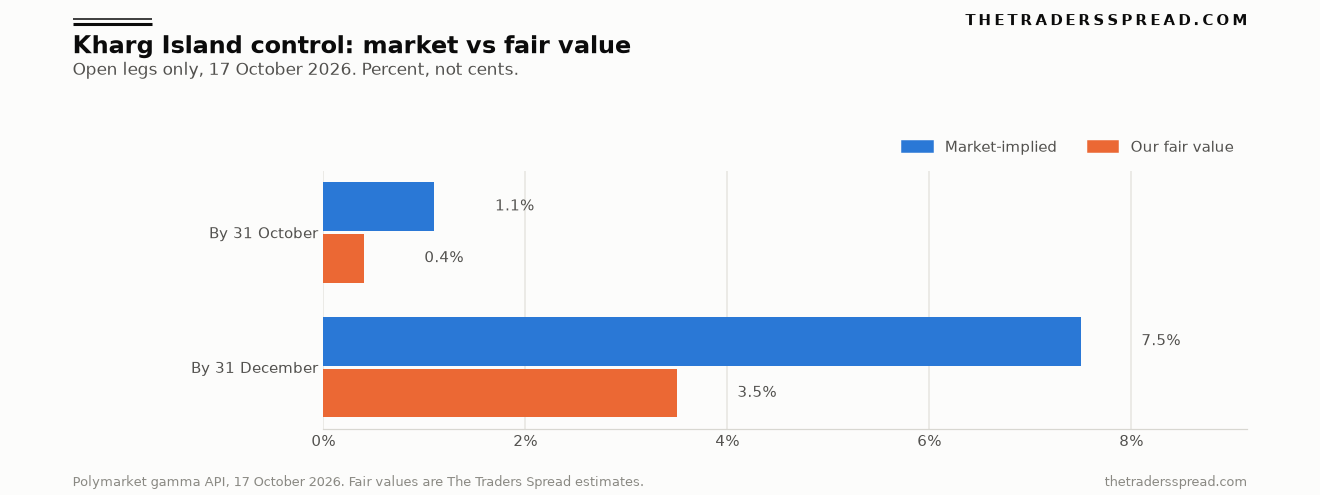
The same Kharg Island event supplies both bars. Blue is the gamma outcome price in percent. Orange is our fair value, also in percent. December, at 7.5 against 3.5, is the leg this piece is marked on. October, at 1.1 against 0.4, is there so December is not read alone.
| Leg | Status on 17 Oct | Market | Our fair value | Volume | Liquidity |
|---|---|---|---|---|---|
| By 31 October 2026 | Open | 1.1% | 0.4% | $793,000 | $106,000 |
| By 31 December 2026 | Open | 7.5% | 3.5% | $876,000 | $165,000 |
| By 30 September 2026 | Resolved no | 0 | n/a | $3.0 million | none |
| By 30 April 2026 | Resolved no | 0 | n/a | $17.4 million | none |
April is in the table because it is the volume peak. That leg matched $17.4 million and resolved no. September, the latest no, matched $3.0 million and was closed by the oracle on 1 October. December, the price people are quoting, has matched $876,000. October has matched $793,000. Hearing "$76 million on Kharg" and picturing that sum on the December token is off by roughly forty times.
Gamma's one-week change on December is plus 1 cent. October's is minus 0.15 cent. About $55,500 traded in the latest day, and about $459,000 over the week. Against a war running since late February, that is a drift, not a new regime.
Nested prices are the cross-check inside the book. Control lost by 31 October is control lost by 31 December, so October should sit at or under December. It does: 1.1 against 7.5. The 6.4 point gap is the market's probability of a first change of control in November or December, ignoring fees. Our fairs, 0.4% and 3.5%, leave about 3 points over the same window. The calendar order is fine. The level on the far leg is the argument.
This event is not the Strait of Hormuz transit book, a different contract covered in a separate note. It is not the blockade question in our September blockade piece, and it is not a US invasion of Iran. A ceasefire dated only through 31 October is another market again. Crude after the strikes is a commodities question, in a separate note on oil. Those prices are not this token.
Nine nos, then two dates
The resolved path is the part a screenshot of the December price leaves out.
Yes settled at zero, and no at one, on 31 March, 15 April, 30 April, 31 May, 24 June, 30 June, 31 July, 31 August and 30 September. Each is marked resolved. Last trades printed at 0.1 cent, or 0.2 cent on 15 April. Liquidity is gone. September's close time on gamma is 1 October 2026. Half a year of the same question, asked on a shortening clock, answered the same way.
Volume followed the anxiety, then faded. April 30 alone is $17.4 million, June 30 is $13.5 million, May 31 is $11.2 million. By September the same question matched $3.0 million. The yes decayed each time a deadline arrived. That pattern is not a proof about December. It is the record the tenth ask has to beat.
Zero in nine trials is not zero on the tenth. The phases of the war were not the same. From here, 14 days remain to 31 October and 75 to 31 December, a shorter stretch than late February to mid-October, which already included strikes, a blockade and a quiet terminal without the resolution condition being met.
These are separate yes/no markets, not one book that has to sum to 100. The open prices, 1.1 and 7.5, sum to 8.6 because the dates are nested, not because they are rival outcomes. Adding them and calling it an 8.6% chance the island falls would double-count October. We do not.
What would make 7.5 cents look cheap
The disconfirmation is a landing that sticks, or a handover that puts someone else in charge.
Gamma will not pay December for another strike on military storage, a tanker disabled nearby, or a week of empty berths. It pays if, by 23:59 Eastern Time on 31 December, reporting and official statements support a finding that Iran has lost primary control and someone else has taken it. A ceasefire clause that mentions the island counts only when the transfer is real. A claim from either capital, without the control, resolves no.
The path that reprices the token is narrow: a garrison that stays, or an authority that actually runs the tanks. Nadimi's March line is why. The objective is the infrastructure, and a tank farm is a bad place to fight if you mean to use it. Months of stopping the barrels without taking the rock have not, through 17 October, turned into a transfer of control.
RelatedIndiana Data-Center Moratorium: 16.5¢ vs Fair Value
IRNA cuts the other way only a little. If the terminal was under Iranian control on 11 October, the October yes is even harder, which is already how 1.1 cents reads. If the terminal is as quiet as early August, the contract still does not pay, because quiet is not conquest. Neither version, alone, makes 7.5 a fair price for December.
There is a scenario in which 7.5 cents is low. A decision, taken in public and matched with the shipping, to seize and hold Kharg before year-end. AFP in March recorded that capturing the island was already being discussed. Discussion in March, then nine resolved nos, is not a plan for November. A real plan would look different, and the fair value would move if that evidence appeared. It is not in the pages opened for this piece.
Fair value sits at 3.5%
Our fair value on the December yes is 3.5%. The market is at 7.5%. The token sits above that fair value. October, on the same method, is 0.4% against 1.1%, and it is not the centre of the call. December is: the leading liquid outcome still open, $165,000 of liquidity against $106,000 on October, and the date the event now runs to. Gamma stamps the leg at 1 January 2027, 04:59 UTC, which is 23:59 Eastern on 31 December.
The 3.5% is a judgement. Nine resolved nos. Rules that exclude the blockade, the strikes and the empty berths. Exports already at zero on the 5 October Vortexa reading, so the barrels have stopped without a change of control. A provincial official still speaking for the terminal on 11 October. A one-cent move on the week. Against that: a live war, March's talk of seizure, and 75 days in which a decision could still be taken. Zero would be too neat. 7.5% charges for outcomes the rules do not pay.
The market's own gap, from 1.1 cents to 7.5, puts 6.4 points on November and December. Ours is about 3. We keep that shape and not that height. The December leg on Polymarket is where the gap is quoted. A reported seizure that meets the gamma test moves the fair value straight away, as does a public operation to take and hold the island. Another strike that leaves Iranian administration in place does not. Another week of zero exports does not. A deal that leaves Iranian authority in place through the new year pushes the mark toward 1% or below.
The stored call is only that gap: price above fair value. It is not an instruction to transact. The screen is 7 cents bid and 8 offered, and 3.5 sits through the bid. Until control itself changes, 7.5 cents is a rich price for a question this book has already asked nine times.
Questions the price gets asked
Does the December contract pay if Kharg is bombed but Iran still holds it?
No. The gamma rules, read on 17 October, say bombardment, sabotage, raids and ships offshore do not qualify on their own. Yes needs Iran to lose primary control and someone else to establish it. A strike that leaves Iranian administration in place resolves no, however tight the blockade around the berths.
Why is the price only 7.5 cents if exports have already stopped?
Because the token is not an export contract. Vortexa, via Reuters on 13 October, had Iranian seaborne crude at zero as of 5 October. That can sit beside an Iranian flag, which is what nine resolved legs already found. A view on barrels is a different risk from the one this yes token pays.
How is this different from a Hormuz transit market?
Hormuz is a strait and a flow of ships. Kharg is an island and a question of who controls it. Transits can collapse, and this site tracks that as its own contract, while Kharg stays Iranian. A Hormuz price is not a proxy for a sovereignty test the rules keep separate.
Why is so much of the $76 million irrelevant to the live price?
$74.5 million of the $76.2 million event volume, 97.8%, printed on legs that resolved no. December has matched about $876,000 and October about $793,000. Open interest is $976,000. The headline volume is a history of expired deadlines, not cash currently attached to December.
What would move the fair value off 3.5%?
Up: a real transfer of control, or a public operation to seize and hold the island. Down: a confirmed deal that leaves Iranian authority in place through year-end, or December arriving with September's facts. Further strikes and a longer stretch of zero exports are already in the mark. They do not, alone, change it.
When does the leg resolve if the facts are muddy?
The December market ends at 23:59 Eastern Time on 31 December 2026. Gamma stamps that as 1 January 2027, 04:59 UTC. If control is contested, unclear, or not sufficiently established, the rules say the leg resolves no. A claim without the control does not win. The question put to the oracle is narrower than the war.
This is analysis, not advice. Prediction-market prices move, and a contract can resolve against either side of a disagreement. Capital is at risk. The fair value above is a judgement from public prices and the reporting cited, dated 17 October 2026, and it will be wrong if the facts of control change.