

At 16:20 UTC on 2 September 2026, the deepest resting order book in Polymarket's largest market did not belong to a politician. It belonged to MrBeast. The YouTuber's leg in the Democratic Presidential Nominee 2028 market was quoted at 0.15% with $2.82m of two-sided depth sitting behind it. Alexandria Ocasio-Cortez, the favourite of the entire board at 19.95%, had $360k. The market's least plausible outcome was carrying 7.8 times the standing liquidity of its most plausible one.
That inversion is the single most useful fact about this market, and it is not visible from the front page. Pull the 128 legs from the Gamma API and the pattern is systematic rather than anecdotal: the 38 legs priced under 1% hold $75.15m of the event's $80.38m of resting depth, or 93.5% of it, averaging $1.98m per leg. The six legs priced at 5% or above, which between them carry 69.1% of the board's probability, hold $2.20m combined and average $366k. Lifetime volume tells the same story from the other end. Legs now trading below a penny account for 85.0% of the $1.27bn that has changed hands. The three names at the top of the board carry 50.75% of the probability and 4.33% of the volume.
The $1.27bn headline is measuring the wrong thing
Every write-up of this market leads with the volume number, and the volume number is real. It is also almost entirely disconnected from the question the market asks.
Rank the 128 legs by lifetime turnover and the top of the list reads: Oprah Winfrey $54.4m, Bernie Sanders $52.7m, Chelsea Clinton $50.3m, Andrew Yang $48.7m, Hunter Biden $44.2m, LeBron James $43.9m, Hillary Clinton $43.8m, George Clooney $43.3m, Tim Walz $43.1m. Every one of those except Sanders is currently priced at 0.15%, the tick above zero. Ocasio-Cortez, sitting at the top of the board, has traded $15.09m. Jon Ossoff has traded $12.86m. Josh Shapiro, the sitting governor of the most consequential swing state in the country, has traded $9.61m across fourteen months.
There is a mechanical explanation, and it is more interesting than "people are betting on celebrities for fun".
Polymarket runs multi-candidate events under a negative-risk structure, which means the NO side of every leg is a first-class instrument. Buying NO on a leg quoted at 0.15% costs 99.85c and returns $1 if that person is not the nominee. The trade is not a forecast about Kim Kardashian. It is a cash-equivalent instrument with a defined maturity, and it generates enormous notional turnover in exactly the legs where nobody has an opinion worth expressing. Layer on Polymarket's maker-reward programmes, which pay for quoted depth rather than for correct quotes, and the near-identical $2.8m books sitting behind Hillary Clinton, Oprah Winfrey, LeBron James, Liz Cheney, MrBeast and George Clooney start to look like what they are: the fingerprint of an automated quoting programme, not the accumulated judgement of a crowd.
The forecasting content of this market is concentrated in about $2.2m of order book. The other $78m is plumbing.
We made a version of this point about a very differently shaped market when Anthropic was trading at 60% to be 2026's biggest IPO with no S-1 on file. The failure mode there was the same one in a different costume: a headline probability that looked precise because a large number sat next to it.
Where the book sums to, and why that matters
Of the 128 legs, 77 are unnamed placeholders with no bids and no volume. Fifty-one carry a live two-sided quote. Add those 51 mid-prices together and the board sums to 94.95%. Sum the best bids and you get 92.00%. Sum the best asks and you get 97.90%.
A market on mutually exclusive outcomes should sum to something at or below 100%, with the shortfall representing the probability that the winner is not on the board. Here the tradeable shortfall is 2.10%. Sweep every live leg at the offer for 97.90c and you are owed $1 on 7 November 2028, provided the eventual nominee is one of the 51 people currently named.
That is 797 days away. A 2.15% gross return over 2.18 years works out at 0.98% annualised, and that is the best case, before the residual risk that the nominee is somebody nobody has listed. Discount a certain dollar due in November 2028 at 4% and it is worth 91.8c today. The arithmetic is visible on the event page to anyone who adds the column up.
The board, in other words, is priced as though capital tied up for twenty-six months has no time value at all.
This is not a free-money observation, because the capital cost is exactly what stops anyone from putting the trade on. It is a calibration observation. Prices on this board are not discounted probabilities. They are undiscounted ones, inflated by roughly six points in aggregate relative to what a present-value buyer would pay, and that inflation is smeared evenly across every leg. Before any judgement about individual candidates, the whole board carries a structural upward bias. The classic favourite-longshot bias, in which the tail is systematically overbid, is present too, but it is second-order next to this.
Reading the top of the board
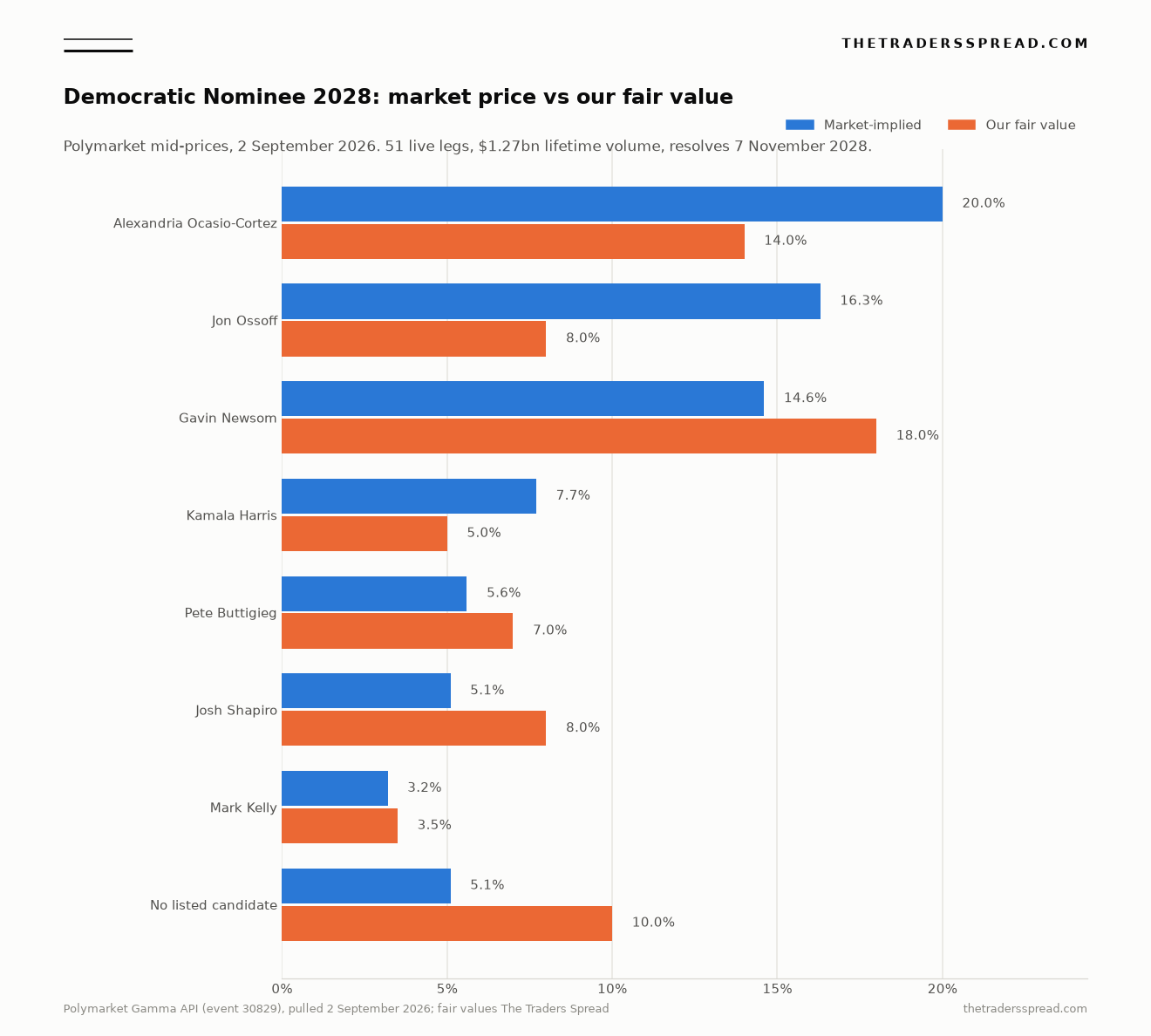
Ocasio-Cortez at 19.95% is the headline, and the headline moved recently. She overtook Gavin Newsom for the first time in mid-August, a shift that drew substantial coverage, including from The Hill's Niall Stanage on 16 August 2026, who noted that most opinion polls still place her third, behind Kamala Harris and Newsom. Asked about a run on ABC News's This Week, she said: "I haven't ruled out the possibility. And I'm very humbled by the tremendous amount of support out there."
Three things weigh against the 20% price.
The first is institutional. No Democrat has been nominated directly out of the House of Representatives in the modern primary era, and no sitting House member has been elected president since James A. Garfield in 1880. The path from a New York congressional seat to a nomination requires clearing a coordination problem that the party's structure has never solved for a House member. James Carville, the veteran Democratic strategist, put the establishment view on Newsmax in blunt terms: "She's not going to run for president because she's not going to have any chance," arguing that Democrats "never nominate the most liberal candidate."
The second is that the 2028 New York Senate seat is a live alternative use of her time, and she has declined to rule that out either. A market pricing her at 20% to be the presidential nominee is implicitly pricing a decision she has not made about which office to seek at all.
The third is the general-election discount that primary voters apply late in the process. Hank Sheinkopf, a veteran Democratic strategist based in New York, framed it as an open empirical question rather than a settled one: "It's a tough race for her. The question is, first of all are there enough voters who want AOC to be president of the United States, and then in particular are there enough people in the heartland?"
None of that makes her a weak candidate. Her small-dollar fundraising base and her communication reach are genuine structural assets, and the progressive primary wins of this cycle, from Abdul El-Sayed in Michigan to Peggy Flanagan in Minnesota, are a real signal that the party's centre of gravity has shifted. We mark her at 14%, not at 5%.
Ossoff at 16.3% is the leg we like least
Jon Ossoff is priced at 16.25% to be the 2028 Democratic nominee. He is also on a ballot in 62 days.
The Georgia senator faces Republican Rep. Mike Collins on 3 November 2026 in a race that has been polled repeatedly and has never looked safe. A Georgia poll reported on 23 July 2026 put him nine points clear; coverage through late August described the margin tightening as Republican outside groups increased their spending. The market is paying 16.25c for an outcome that requires him first to survive a contested Senate race, then to convert a second term into a national nomination against a field containing at least four candidates with larger operations.
He has also said, on the record and recently, that he is not interested. Speaking to MS NOW's Jen Psaki, and quoted by The Hill on 30 August 2026, Ossoff said: "I have zero interest in running for president in 2028, and, frankly, zero interest in the 2028 fantasy football right now."
Politicians disclaim presidential ambition routinely, and the disclaimer is close to worthless as evidence on its own. What is not worthless is the combination: a public disavowal, a competitive race that must be won first, no national fundraising apparatus, and a price that has climbed steeply since early July on momentum rather than on any datable event. Compare the way the Fed September market repriced 16 points in a single session on a named, verifiable catalyst. Nothing comparable has happened to Ossoff. We mark him at 8%.
Newsom is the one leg on the board we mark meaningfully above its quoted price. At 14.55% he sits behind two candidates who have each declined to confirm they are running, while he is term-limited out of Sacramento in January 2027 and has spent 2026 building an explicitly national operation, including a southern tour that pointedly skipped Georgia. He carries obvious liabilities, and California is heavy luggage in a general election. He also has the largest donor network of anyone on this board and the fewest competing obligations after next January. We mark him at 18%.
Harris at 7.70% is priced on a precedent that mostly does not exist. Since the modern primary system began in 1972, no losing major-party nominee has come back to be renominated, with the single exception of Donald Trump in 2024, and that comeback rested on a grip over his party's machinery that Harris does not have. Name recognition is holding the price up. We mark her at 5%.
Buttigieg at 5.55% and Shapiro at 5.05% sit below our estimates for opposite reasons. Buttigieg holds no office, which means no re-election risk and no voting record to defend between now and the primaries, and he has consistently tested best of any Democrat in general-election head-to-heads. Shapiro governs Pennsylvania, the single state most likely to decide 2028, and is on the ballot this November in a race he is widely expected to win. We mark them at 7% and 8%.
RelatedSerbia Parliamentary Election: Vučić at 60.5%, Fair Higher
The residual is where the real mispricing sits
The board leaves 5.05% for "nobody currently listed". We think that number belongs closer to 10%.
The 51 named legs cover essentially every governor, senator and celebrity a US political reporter could name in September 2026. That is a genuinely wide net, and it is why the residual should not be enormous. The primary calendar for 2028 is only now being set, though, with South Carolina confirmed in late August as the first Democratic contest, and the field has no incumbent, no vice-president with a claim, and no consensus heir. Twenty-six months is long enough for a governor nobody is currently discussing to become the obvious answer, and the history of open Democratic fields is a history of exactly that. In August 2006 this market would have been priced on Hillary Clinton. In August 2002 it would have been priced on Al Gore and Joe Lieberman.
Ro Khanna, who is himself in the low single digits on this board, described the field's shape on CNN's State of the Union on 30 August 2026 when Dana Bash asked whether an Ocasio-Cortez run would change his own plans: "It will have no bearing on my decision." A field in which multiple candidates are planning around each other rather than deferring to a frontrunner is a field with a fat tail.
What would have to happen for this estimate to be wrong
The view above is a view about pricing, not a prediction about people, and there are clean tests for it.
If Ossoff wins Georgia on 3 November 2026 by a double-digit margin, the case for marking him at half the market price weakens sharply; a large win in a Republican-leaning state is precisely the event that manufactures a national candidacy. If Ocasio-Cortez files for the New York Senate seat instead, her presidential leg should collapse rather than drift, and our 14% will have been far too generous. If Newsom's post-gubernatorial launch lands badly, or if California's fiscal position deteriorates visibly through 2027, the 18% is too high.
The structural points are more durable than the candidate-level ones. The liquidity inversion, the volume concentration in worthless legs, and the absence of any time discount in the board's total will still be true in six months, because they are properties of the venue rather than of the race. Anyone reading a 20.0% headline off this market is reading a number produced by roughly $360k of resting depth inside a $1.27bn wrapper.
The same caution applies to the other long-dated political books on the platform. We flagged it in the French presidential market, where Le Pen was quoted at 33.4% against Bardella at 2.5%, and again in the Brazilian presidential market with Lula at 61.5%. Long-dated election books on Polymarket's 2028 Democratic board price name recognition efficiently and everything else slowly.
Where our numbers land
Our fair values sum to 100% across the eight buckets in the chart plus the named legs outside the top seven, which we mark collectively at 26.5% against a market 22.75%. The single largest gap is Ossoff, at 8.25 points. The largest gap in the other direction is the unlisted field, at 4.95 points, followed by Newsom at 3.45.
On the market's headline leg, the one that generates every news cycle about this event, we have Ocasio-Cortez at 14% against a quoted 19.95%. The market sits above our estimate. That is a statement about a price, and it is the only statement of that kind in this article.
Watch the depth numbers rather than the volume number. If the six legs at the top of the 2028 Democratic nominee board ever carry more resting size than the celebrity tail, this market will have started answering the question it appears to ask.
Until then it is a very large, very liquid instrument with a very small opinion inside it.
Disclaimer: this article is analysis and information only. It is not investment, trading or betting advice, and it is not a recommendation to take any position in any market. Prediction-market contracts can lose their full value. Prices and market data were pulled from the Polymarket Gamma API on 2 September 2026 and will have moved since. Anyone acting on this material does so at their own risk and should carry out their own research.