

What is the Bank of England November decision actually being asked to settle? Not whether inflation is above the 2% target. The Bank already says it is: consumer prices were 3.1% higher in August than a year earlier, and staff, working off the 14 September energy close, have inflation rising further into early 2027. The priced question is narrower. Will the Monetary Policy Committee lift Bank Rate by 25 basis points at the meeting that ends on 4 November, the one whose minutes are published on 5 November? On 12 October the 25-basis-point increase was marked at 89.5%. No change was marked at 10%. A cut, in either size the contract lists, was marked at 0.05 cents. Bank Rate is 3.75%. A yes on that leg takes it to 4%, and the contract’s rounding puts any smaller rise in the same bucket.
That 89.5% is not a headcount. It is a claim that two of four named holders switch, and that the consumer-price print due at 07:00 on 21 October does not stop them. Links to Polymarket are affiliate links, from which The Traders Spread may earn a commission at no cost to you. On the November Bank of England contract, gamma records a one-month price change of +0.405 on the hike leg, 40.5 percentage points, retrieved on 12 October 2026. The Bank’s Market Participants Survey, which closed on 4 September, still had a median path of an unchanged Bank Rate for a prolonged period. The book has completed a repricing that survey had not made, and it has completed it before the data those swing voters said they were waiting on.
Three hikers are already there. The argument is about the other six.
Key facts
- The 25bp-increase leg was priced at 89.5%, with about $133,854 of volume and $16,554 of liquidity — Polymarket, gamma-api, 12 October 2026
- No change was priced at 10%, on about $100,500 of volume and about $15,129 of liquidity — Polymarket, gamma-api, 12 October 2026
- Bank Rate is 3.75%, and the meeting ending on 4 November publishes its minutes on 5 November 2026 — Bank of England, 17 September 2026
- CPI inflation was 3.1% in August; staff expect around 3.75% in the fourth quarter of 2026 and slightly above 4% in early 2027 — Bank of England minutes, 17 September 2026
- At the 14 September close used in those minutes, Brent was $106 a barrel and UK wholesale gas was 207 pence a therm, up 36% and 78% versus the July Report window — Bank of England minutes, 17 September 2026
- Firms’ year-ahead CPI expectations were unchanged at 3.1% in a September survey of 1,993 companies — Bank of England Decision Maker Panel, published 2 October 2026
Two votes from four names
At the meeting ending on 16 September, the Committee voted 6–3 to keep Bank Rate at 3.75%. Megan Greene, Catherine L Mann and Huw Pill wanted 4%. Andrew Bailey, Sarah Breeden, Swati Dhingra, Clare Lombardelli, Dave Ramsden and Alan Taylor voted to hold. A majority on a nine-member committee is five. The hike leg does not need a conversion of the whole hold camp. It needs two switches, and it does not need them from the two members who used the September minutes to ask for more time.
Dhingra and Taylor are those two. She wanted a clearer read, including on 2027 wage-setting, before second-round effects could be treated as imminent. He put neutral at 3% and put the burden of proof on evidence that those effects are actually coming. Neither belongs in the hike this price implies.
The swing set is Bailey, Breeden, Lombardelli and Ramsden.
Bailey’s public line, on the Bank’s own decision page the day the minutes came out, is the cleanest statement of the condition. “So far, higher global energy costs have had a limited effect on price and wage setting in the UK. But the longer this volatility persists, the bigger the impact it will have on inflation, and the more likely it is we will need to raise Bank Rate to ensure that inflation falls back to our 2% target.” That is Andrew Bailey, Governor of the Bank of England, 17 September 2026, in the Bank’s account of the latest decision. His individual minute is sterner still: holding was appropriate at that meeting, but if the Middle East conflict persists for an extended period, “as appears to be the case”, and the risk of second-round effects increases, “it is likely that policy may have to tighten.”
Two clauses, not one. The conflict has to persist, and second-round risk has to rise. The 89.5% price treats both as done. The September text treated the second as a risk that was growing, not as a fact already in wages. Lombardelli, voting to hold, wrote in the minutes that the outlook for energy prices “could change in the coming weeks, but the case for raising Bank Rate is building the longer the conflict continues without lasting resolution.” Breeden said a move becomes “increasingly appropriate” if those risks crystallise. Ramsden said there “could be a case.” Four conditionals. Two of them have to become votes. That is the distance from a 6–3 hold to a 5–4 hike.
A book, a chart, and a number we will defend
Gamma, read at 06:47 UTC on 12 October 2026, still had the event open. This is not the closed 2025 contract. It ends at 23:59 UTC on 5 November. Event volume was about $304,742, liquidity about $97,102, prior-day volume about $6,213. The hike leg itself had traded about $1,653 that day. The 89.5% mark is not a stale print.
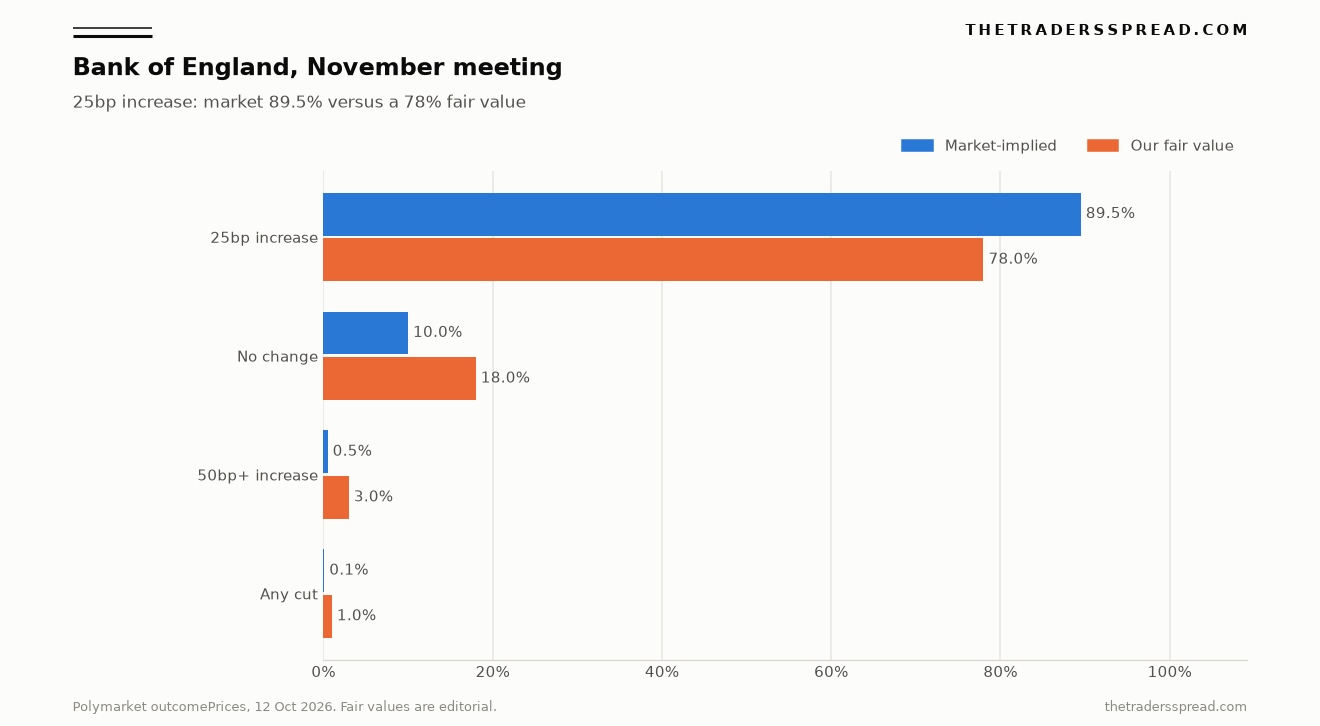
The bars compare outcome prices with an editorial fair value. Nothing on the chart names a side to take.
| Outcome | Market price | Volume | Liquidity | Fair value |
|---|---|---|---|---|
| 25bp increase | 89.5% | $133,854 | $16,554 | 78% |
| No change | 10.0% | $100,500 | $15,129 | 18% |
| 50bp or larger increase | 0.5% | $49,085 | $8,453 | 3% |
| 25bp decrease | 0.05% | $13,766 | $31,292 | 0.7% |
| 50bp or larger decrease | 0.05% | $7,537 | $26,959 | 0.3% |
Prices are gamma outcomePrices on 12 October 2026. The hike leg last traded at 90 cents, bid 89, ask 90, so 89.5% is the midpoint of a one-point book. No change was wider, bid 9 and ask 11. The cut legs are marked at 0.05 cents, under the 0.1-cent tick those books use, despite deeper displayed liquidity. That is not a scenario. Combined fair value on cuts is 1%.
The 78% is a judgement, not a fitted model. The three September hikers are likely to stay: none of them asked for 50 basis points. Two further votes have to come from the four conditionals, not from Dhingra or Taylor. That is still the single most likely result. It is not an 89.5% result while 21 October’s inflation release and the 30 October panel both sit in front of the meeting. The fair values in the table sum to 100%.
The same venue’s Polymarket front page is where the contract sits inside a wider rates complex. One parallel, already written up separately, is the 2026 Fed cuts contract. This note does not reopen that market or import its price. It borrows a single observation: a rates book can look settled while the committee that has to cast the votes has not sat down.
The print that is not in the price
September’s consumer prices are not out. The Office for National Statistics lists the release for 07:00 on 21 October 2026 and, on that page, still marks it unpublished. Nine days after the gamma read. Fifteen days before the November minutes. August, the latest print the Committee used, was 3.1%. About 0.7 percentage points of the 1.1-point overshoot against 2% came from direct energy, mostly motor fuel. Services inflation was 3.4%, flat on July and down from 4.5% in March. The ONS calendar is the date that matters. The figure is not ours to invent.
Staff’s path is dated, and it is specific. Off the 14 September energy close, the minutes have CPI around 3.75% in the fourth quarter of 2026, versus 3.2% in the July Report, and slightly above 4% in the first quarter of 2027. Brent at that close was $106 a barrel, up 36% on the July window. UK wholesale gas was 207 pence a therm, up 78%. The $106 figure is that close, not a live oil quote, and not the scenario pair in the Brent crude piece. This contract pays on Bank Rate.
Firms have not repriced as if a 4% peak were already theirs. The September Decision Maker Panel, fielded from 4 to 18 September and published on 2 October, took 1,993 responses. Own-price growth was 3.7%, which is not a consumer-price bucket. Year-ahead CPI expectations were unchanged at 3.1%, three-year expectations at 2.8%. Wages ran at 4.0%, with 3.4% expected next year. Only 57% of firms expected to raise prices, seven points lower than in April.
The next panel is 30 October. It lands before the vote.
A book at 89.5% on 12 October says those two releases are unlikely to disturb two switches. The Bank’s own line was that “material second-round effects in price and wage-setting” were not yet in the data. Private-sector regular pay in the three months to July was 2.9%, with an underlying read nearer 3.5%. Unemployment to July was 4.9%. GDP rose 0.4% in the second quarter, and staff marked the third quarter up to 0.4% from 0.1%. Activity is not collapsing. Expectations in the panel are not jumping. The price picks one of those facts.
The objection is already in the minutes
Paragraph 28 holds both ideas. Risks had tilted up, and “it was not appropriate to wait too long for evidence of such effects before responding with policy.” In the same paragraph the outlook could still “change materially as events unfolded.” One of those sentences is the whole of the 89.5%. The other is the whole of the hold.
Pill was not pretending this was one oil tick. “A 25-basis point increase in Bank Rate now sends a clear signal of the MPC’s commitment to achieving its price stability mandate amidst the fog of geopolitical conflict and data noise.” Huw Pill, member of the Monetary Policy Committee at the Bank of England, in the 17 September minutes. Greene dated the shock: by that meeting the conflict in Iran had already run more than six months. Mann’s calendar is the one that bites. Staff have CPI somewhat over 4% early in 2027, when pay settlements are struck.
That is the serious case for calling 89.5% roughly fair. It is also why a half-point hike at half a cent looks thin. The rules push a move into the 50-basis-point-or-more leg once it reaches 37.5. Nobody asked for that in September. A 3% fair value is a tail: a hot 21 October print, and a governor who decides a quarter point is not enough. It is larger than 0.5% because half a cent is what a book writes when it has stopped pricing the tail.
The hold is not a fantasy either. It is Dhingra’s case for waiting until first-round effects are legible, Taylor’s comparison, and the chance Bailey’s second clause fails. Taylor noted the curve, from the two-year point out, was already higher than at the final hike of the 2022–23 cycle, when inflation stood at 6.8%, and that Bank Rate sat above his 3% neutral. Two-year fixed mortgage quotes were about 95 basis points higher than before the conflict. For most members that restraint was still “broadly sufficient”. The three hikers do not accept risk premia as a stand-in for Bank Rate.
The Market Participants Survey is the awkward middle. Nearly everyone, window closing 4 September, expected no change that month, and the median after that was an extended hold. The curve disagreed, rising to about 4.9% by the end of 2027, with a good part of the slope in risk premia. By 12 October this leg had travelled the rest of the way. The September median is dead. It is also a reminder of how recently a hold was the median.
Gilts were a different vote
The same meeting pointed the monetary-policy gilt stock, £488 billion on 16 September, at zero, from a peak of £895 billion in February 2022. The pace averages £46 billion a year through 2034. Bank Rate stays the active tool. Auctions pause while the channel is settled, with operating detail due by April 2027. None of that resolves this contract.
What does belong here is the wage round Mann flagged. A quarter-point rise on 5 November would land months before spring 2027 settlements, with staff inflation still seen slightly above 4% early that year. Hikers say second-round effects arrive late by construction, so a committee that waits has missed the round it feared. Holders say own-price expectations, pay expectations and services inflation have not broken that way yet. Both can be true in October. Only one is true of the vote.
RelatedElon Musk Tweets October Odds: The Book Has No Peak
Fast repricings are not a UK specialty. The September Fed decision note recorded one. The 40.5-point move here is this contract’s own gamma field, not a number taken from that piece.
89.5% against a 78% fair value
A 25-basis-point rise is still the most likely single result. Greene, Mann and Pill have voted for it at the last two meetings of this energy shock, and the governor has said that if the conflict continues and second-round risk builds, tighter policy is the likely next step. Nothing from the 17 September minutes through the 2 October panel shows that conflict resolved. A hold is the upset, not the base case. Fair value on the hike leg is 78%.
The traded price is 89.5%, above that fair value, and the gap is wider than the one-point spread. The 25bp-increase leg leaves 10% for no change and half a cent for a larger rise. We have 18% on the hold and 3% on a move of 50 basis points or more, with cuts at a 1% residual. Saying the price is rich is not a claim that the hike fails. It is a claim that the hold is too thin for a committee that has not seen September’s inflation figures and that split 6–3 last time, with an explicit wait inside the majority.
What would move the 78%. A 21 October print that shows the step staff described, up toward 3.75% in the fourth quarter, with services off August’s 3.4%, would pull fair value toward 89.5%. A print still near 3.1%, and a 30 October panel still at 3.1% on year-ahead CPI expectations, would push it down. So would a verified drop in wholesale energy back toward the July path. No 12 October oil close is invented here.
This is not a sterling path. The contract pays on the November change in Bank Rate. A cancellation resolves as no change. An emergency move that is not this meeting does not count. Until 21 October, a book that treats the hike as nearly done is ahead of the evidence the swing voters wrote down.
Questions the contract actually gets
When does the Bank of England November decision resolve?
The Bank will publish the minutes of the meeting ending on 4 November on 5 November 2026. Polymarket’s event uses that release, and the market’s own end is 23:59 UTC on 5 November. It can resolve as soon as the statement with the Bank Rate change is out. A cancellation, or a postponement that slips past the next scheduled meeting, resolves as no change. Moves that are not this meeting are ignored.
What is Bank Rate going into that meeting?
3.75%, where the Committee left it on 17 September by 6 votes to 3. The three dissenters wanted 4%. The Bank’s decision page, updated 18 September, still showed 3.75% as the current rate and 5 November as the next due date. A 25-basis-point rise on this contract takes the rate to 4%. A larger rise is a separate leg.
Why is the hike at 89.5% after a vote to hold?
Because a hold of 6–3 only has to lose two votes to become a hike, and four of the six holders described conditions under which they could move. The price assumes two of Bailey, Breeden, Lombardelli and Ramsden do move, and that Dhingra and Taylor are not required. That reading fits the minutes. It fits less well if you still take their conditions as open, which on 12 October they were.
Is the DMP’s 3.7% a CPI print?
No. In the September panel, 3.7% is firms’ own realised price growth, and also their year-ahead expectation for those own prices. CPI expectations in the same survey were 3.1% at the one-year horizon and 2.8% at three years. The latest official CPI figure the Bank cited was 3.1% for August. September’s CPI had not been published at the time of writing.
What sits inside the 78% fair value?
A judgement that a quarter-point rise is the most likely single result, discounted for two data releases still ahead and for a 6–3 vote that has not yet broken. It is not a model output to several decimals. It is higher than the 10% no-change price and lower than the 89.5% hike price. A hot CPI print on 21 October would close that gap. A soft one would widen it.
This is analysis, not advice, and it is not a recommendation to take either side of the contract. Prediction-market prices move, liquidity on a single leg can be thin, and a contract can resolve at zero. The fair value is an editorial judgement dated 12 October 2026. Capital is at risk.