

The 2026 midterm balance of power cannot be both a 62.5-cent Democratic sweep and a Senate its editor still calls a toss-up. On Polymarket's joint book, at 07:02 UTC on 16 October, Democrats taking both chambers trades at 62.5 cents, and Democrats taking the Senate while Republicans keep the House trades at 1 cent. Those two legs put a Democratic Senate near 63.5 percent, almost always with the House attached. Jessica Taylor, Senate and governors editor at the Cook Political Report, put the Democratic gain at two to six seats on 6 October. Four seats are required, so the band still contains a miss. Two days later, in a Cook video, she said the race was moving toward Democrats and that she still saw a toss-up. Links to Polymarket are affiliate links, from which The Traders Spread may earn a commission at no cost to you.
The nesting is asymmetric, which is the part the headline price hides. Divide the 8.5-cent Republican sweep by the 9.5 cents of combined Republican-House probability and the book says that a Republican House arrives with a Republican Senate about 89 percent of the time. Divide 62.5 by the 91 cents of Democratic-House probability and a Democratic House comes with a Democratic Senate only about 69 percent of the time. A surprise is treated as informative. An ordinary Democratic night is not. The same minute's separate contracts agree: Democrats at 90.5 cents to win the House and 64.5 cents to win the Senate. The joint book is not broken against its own marginals. It is a little expensive against the seat counts.
That gap is the whole of the call.
Key facts
- Democratic sweep trades at 62.5 cents, with $5,616,587 traded and $3,174,060 of liquidity — Polymarket, 16 October 2026, 07:02 UTC.
- Republican sweep trades at 8.5 cents and is the highest-volume leg, at $7,370,993 — Polymarket, 16 October 2026, 07:02 UTC.
- On the separate contracts, Democrats are at 90.5 cents to win the House and 64.5 cents to win the Senate — Polymarket, 16 October 2026, 07:02 UTC.
- The most likely House outcome is a Democratic gain of nine to 19 seats, or 224 to 234 seats — Erin Covey, Cook Political Report, 9 October 2026.
- House projection: a Democratic gain of 10 to 20 seats, against three needed; likely Senate gain of three to five, against four needed — Inside Elections, 15 October 2026.
- 55% of U.S. adults expect a Democratic House and 46% expect a Democratic Senate — Pew Research Center, 5,062 adults, 28 September to 4 October 2026, published 15 October 2026.
Five contracts, one night
This event pays on the pair of chambers, not on either one twice. Control, under the rules pulled with the prices, is a majority of voting seats. A 50-50 Senate goes to the party of the vice president, so Democrats need 51 seats. A House with no majority goes to the party of the first Speaker of the new Congress. If that still leaves the Senate ambiguous, the fallback is the party of the first president pro tempore. Resolution sources are state election authorities, Congress, and a consensus of credible reporting.
Senate races scheduled as of 31 October 2026 are in. A vacancy with no election by then stays with the previous member's party. Runoffs count after November. Independents count once they name a caucus, and the market can stay open for that until 4 January at 11:59 p.m. Eastern. The listed end is 4 November 2026 at 04:59 UTC, so election night and resolution need not match.
Five YES legs were live at the pull. Democrats sweep was 62.5 cents, on $5,616,587 of volume and $3,174,060 of liquidity. A Republican Senate with a Democratic House was 28.5 cents, on $3,551,696 and $2,422,509. A Republican sweep was 8.5 cents, on $7,370,993 and $2,506,193. A Democratic Senate with a Republican House was 1 cent, on $4,279,931 and $485,918. "Other" was 0.15 cents, on $3,141,172 and $200,771. Event volume was $23,960,379. Event liquidity was $8,788,859.
The five YES prices sum to 100.65 cents. Scaling the sweep for that overround takes it from 62.5 cents to about 62.1, which settles nothing below. No leg is a dead zero or a dead 100 on an empty book.
Volume misleads. The Republican sweep has the most of it and a low price, the shape of a contract that has already been repriced. Liquidity ranks the other way: deepest on the Democratic sweep, then the Republican sweep, then the 28.5-cent split. We use prices and liquidity.
The separate books already match
A joint price that fights its own marginals is a different object from a joint price that is simply high. These do not fight. At the same 07:02 UTC pull, Democrats were at 90.5 cents to control the House and Republicans at 9.5. The two sum to a dollar. About $10.2 million has traded the Democratic leg and about $7.6 million the Republican one, inside $17,858,150 of event volume.
Democrats were at 64.5 cents to control the Senate, with the Republican leg at 37.5. Those two sum to 102 cents, so the Senate pair carries a two-cent spread of its own. About $3.9 million has traded the Democratic leg and $2.8 million the Republican one, inside a $6,742,466 event. The joint book's implied Democratic Senate, 62.5 plus 1.0, is 63.5 cents. That sits between the Democratic YES at 64.5 and the complement of the Republican YES at 62.5.
The House check is as tight. A Democratic sweep at 62.5 plus a Republican Senate and a Democratic House at 28.5 is 91.0 cents of Democratic-House probability inside the joint book, against 90.5 on the standalone contract. Half a cent, on books this deep, is agreement. Our notes on House control and Senate control were about those marginals alone. This piece is the joint. Nothing below copies a price out of either of them.
With the marginals in line, the correlation is what is left. A Republican House is priced as rare, and as almost never arriving alone. A Democratic House, the path treated as normal, still leaves about a 31 percent chance Republicans keep the Senate. That is the 28.5-cent leg. Julien Lafargue, chief market strategist at Barclays Private Bank, writing with Judiyah Amirthanathar on 9 October, calls gridlock the likely result and a Republican sweep the shock.
62.5 cents against a 59-cent fair value
Our fair value on the Democratic sweep is 59 cents. The market is 3.5 cents above it. The other three paths we price are much closer, which is why the sweep is the leg this piece centres.
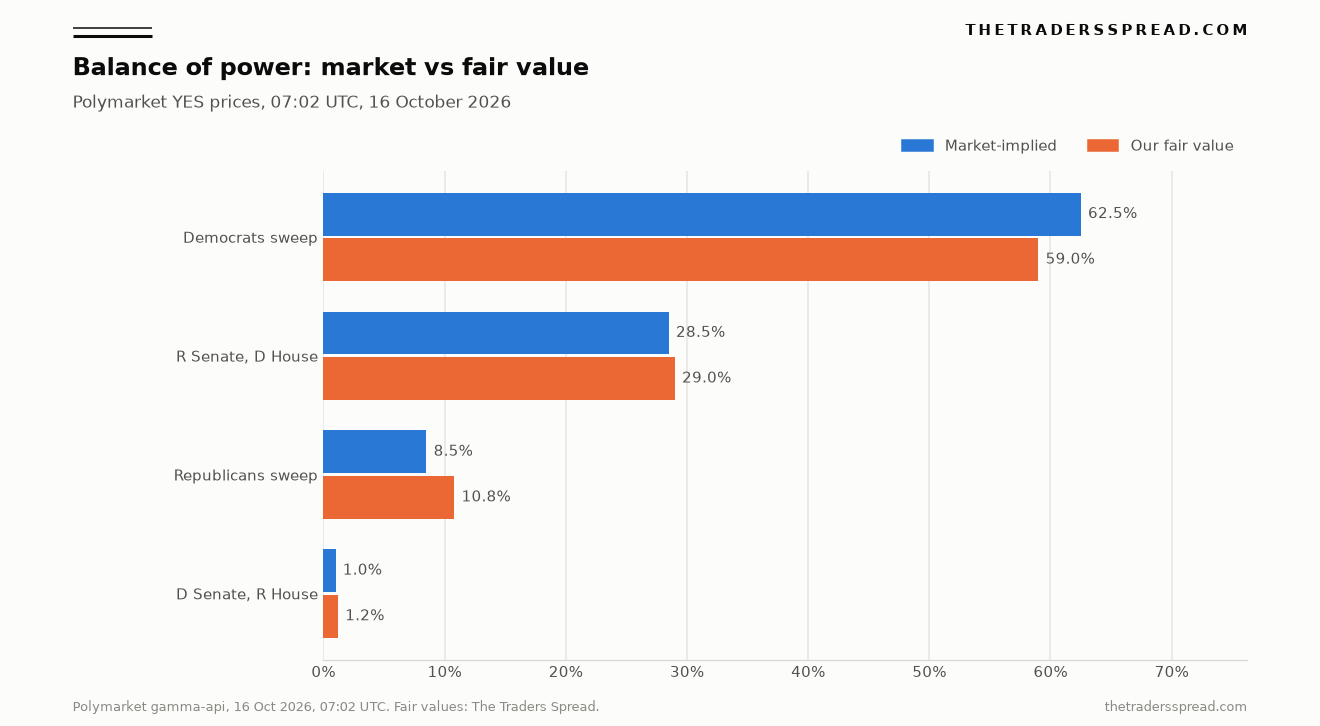
| Outcome | Market YES | Volume | Liquidity | Our fair value |
|---|---|---|---|---|
| Democrats sweep | 62.5 cents | $5,616,587 | $3,174,060 | 59 cents |
| Republican Senate, Democratic House | 28.5 cents | $3,551,696 | $2,422,509 | 29 cents |
| Republicans sweep | 8.5 cents | $7,370,993 | $2,506,193 | 10.8 cents |
| Democratic Senate, Republican House | 1 cent | $4,279,931 | $485,918 | 1.2 cents |
Market figures are Polymarket YES prices at 07:02 UTC on 16 October 2026. Fair values are ours. "Other," at 0.15 cents, is off the chart. Our four paths sum to 100 percent. The rules leave a residue for an unresolved independent, and 0.15 cents is the market's price on that residue.
Three inputs do the work. A Democratic House is 88 percent. A Democratic Senate, if Republicans hold the House, is 10 percent. A Democratic Senate overall is 60.2 percent. The third forces the conditional: 60.2 equals 88 percent times the chance of a Democratic Senate given a Democratic House, plus 12 percent times 10 percent. That conditional is 67.0 percent. Multiply by 88 percent and the sweep is 59 percent. The Republican-Senate and Democratic-House path is 29 percent. A Republican sweep is 10.8 percent. The odd split is 1.2 percent.
The House input sits close to the traded price on purpose. Erin Covey, editor for the U.S. House at the Cook Political Report, wrote on 9 October that heavy Republican spending had yet to move the needle, and that the most likely range was a Democratic gain of nine to 19 seats: 224 at the low end, 234 at the high end. Every integer in that range is a majority. Inside Elections on 15 October raised its House projection to a Democratic gain of 10 to 20 seats and said Democrats need three. A range whose floor is already a majority is why the contract is near 90 cents, and why we are at 88 rather than at 70.
The 12 points we hold back are correlated. The same Inside Elections note said a two-to-four-point Republican improvement late in the campaign could avoid embarrassing losses. Mike Hills, for BBC News on 13 October, cited an average midterm loss of 27 House seats for the president's party back to 1934, with gains in only three of 23 elections. That average is not a forecast. It is why 90.5 cents is not finished. Our House disagreement is two and a half cents.
A toss-up label on a two-to-six range
The Senate is the call. Democrats need a net of four seats. Barclays Private Bank on 9 October counted a 53-47 Republican Senate, with the 47 including two independents who caucus with Democrats. The BBC on 13 October counted 53 Republicans, 45 Democrats and two independents. Fifty seats would leave the Republican vice president breaking ties. Taylor's phrase on 6 October, a gain "squarely within the range of four seats they need," means four sits inside two-to-six. It does not mean the gain sits above four.
Read two through six as five equally plausible integers and three of them clear the line. That is 60 percent. Inside Elections' likely band, nine days later, is three to five: it trims the left edge Taylor still had in range and keeps a miss at three. The same note says a gain of eight is not out of the question. We take 60 percent from the flat reading and add two-tenths for a slightly thinner left tail. That is the 60.2 percent in the model. It is not the traded 64.5, and it is not a coin flip.
On 23 September Taylor called the chamber a true coin flip, with a Democratic net of one to five seats. By 6 October the band was two to six: Kansas to a toss-up, North Carolina to Likely Democrat, New Hampshire to Lean Democrat. The 8 October video kept the toss-up label. We use the newer band. We do not hear "toss-up" as 64 cents while gains of two and three seats are still inside it.
Steven Shepard, associate director of politics at Pew Research Center, wrote on 15 October that Americans see a better Democratic chance in the House than in the Senate. Among 5,062 adults polled from 28 September to 4 October, 55 percent expected a Democratic House and 46 percent a Democratic Senate. On the combination: 41 percent a Democratic sweep, 34 percent a Republican sweep, 14 percent a Democratic House with a Republican Senate, and 5 percent the reverse. Citizen forecasts are not a book. Partisans answer with their own side.
Adults put 34 percent on a Republican sweep the contract now prices at 8.5 cents, and 14 percent on the split priced at 28.5 cents. Traders have collapsed the Republican-sweep paths relative to the public. Handicappers sit between the two. Our 59 cents sits with the handicappers.
Four Senate seats is a list of states. The BBC on 13 October has Democrats defending Michigan, Abdul El-Sayed against Mike Rogers, and chasing Alaska, Iowa and Ohio, states Trump carried widely in 2024. Texas is on the list: James Talarico against Ken Paxton. The Texas contract is one piece of this Senate price, not a stand-in for it. A House gain of 15 seats with a Senate gain of three is still a Republican Senate, and that night sits inside both published ranges.
Cash on one side, ratings on the other
The other side of a 62.5-cent sweep is not an empty campaign. Hills reported that at the end of August the Republican National Committee and allied groups held more than $600 million in cash, against just under $400 million for Democrats, plus more than $400 million at MAGA Inc. In September, Republicans outspent Democrats by $200 million on congressional ads, the BBC said, citing AdImpact. Covey's 9 October line was that the spending had not moved the House. The Senate is the narrower problem, which is why the 28.5-cent leg can survive a House wave.
The published House tallies disagree by a seat or two, and none describes a cushion. Barclays on 9 October had a 218-214 Republican House. The BBC four days later had 218 Republicans plus one independent who votes with them. Inside Elections says Democrats need three. The Senate threshold is four, and both Cook and Inside Elections still publish ranges that cross it. The joint contract nonetheless nests a Democratic Senate inside a Democratic House about 98 percent of the time: 62.5 divided by 63.5. We put that conditional at 67 percent if the House flips, and at 10 percent if it does not. The rare branch matches the market. The common branch is the 3.5 cents.
RelatedECB October Rate Decision: No Change at 90.5 Cents
Lafargue ranked a Republican sweep as the result a rates book is not positioned for, against an 11 December funding deadline in the lame-duck session. He also put the 10-year Treasury yield above 5 percent in that 9 October note. We are not using the yield as a live quote. An 8.5-cent Republican sweep against our 10.8 is a small gap on a low price, not a reason to move the centre of this piece off the 62.5-cent leg.
Where 59 cents leaves the sweep
The Democratic sweep at 62.5 cents trades above our 59-cent fair value. That is the call. Fifty-nine cents is still a clear favourite, so this is not a claim that Democrats miss both chambers. The contract imports a Senate probability near 64 cents into a range whose authors have not cleared four seats. Our House input, 88 percent against a 90.5-cent market, explains only a slice of the 3.5-cent gap.
Hold the House at the market's 90.5 percent and keep our 67 percent conditional, and the sweep comes out near 61 cents. Hold the market's conditional, about 69 percent, and use our 88 percent House, and the sweep is near 61 cents again. Getting to 62.5 takes both richer inputs at once. Three and a half cents is not a broken book. With $3,174,060 of liquidity on the leg, it is not a gap we will call in line either. The direction comes from the published range.
A Senate band that starts at four seats, with two and three dropped, would push our Senate input through the mid-60s and the sweep fair value through the screen price. The reading would reverse. If the standalone Democratic Senate contract traded under 60 cents while the sweep stayed at 62.5, the joint would look richer, not cheaper. A Republican House leg bid from 9.5 cents through 15 would break the 88 percent House input, and the product would have to be rebuilt.
The Republican sweep at 8.5 cents against 10.8, and the 1-cent split against 1.2, are inside the noise of those legs. Our 59 cents refers to this contract on the morning of 16 October.
Questions the price actually raises
What has to happen for the Democratic sweep to pay?
Democrats have to be judged in control of both chambers under the written rules, not under a television call. That means 51 Senate seats, since a tie goes to the Republican vice president, and a House majority, or the Speaker's party if nobody has one. Runoffs count when they finish. Independents count once they name a caucus. One chamber alone is a different leg of the same book.
Why is 62.5 cents not the House price times the Senate price?
Because the chambers are not independent, and the book does not treat them as independent. Multiply 90.5 by 64.5 and you get about 58 cents, next to our fair value rather than next to the traded sweep. The joint price is higher because a Democratic Senate with a Republican House is only 1 cent. Nearly every Democratic Senate path here is packaged with a Democratic House.
Do the House and Senate contracts agree with this one?
Yes, within the spread. The joint book implies a Democratic House near 91 cents, against 90.5 on the House event, and a Democratic Senate near 63.5 cents, inside a Senate pair that prints 64.5 and 62.5. All three events were pulled at 07:02 UTC on 16 October. The argument is about the level those books share, not about a gap between them.
Why has the Republican sweep traded so much at 8.5 cents?
Volume is cumulative. That leg shows $7,370,993 traded, more than the Democratic sweep's $5,616,587, which is the tape of a contract that has been repriced, not a sign it is the contract traders prefer today. Liquidity resting now is deeper on the Democratic sweep, at $3,174,060 against $2,506,193. We read the 8.5-cent price.
What would push the 59-cent fair value through 62.5?
A Senate range that drops the miss. If the likely Democratic gain starts at four seats and runs up from there, the 60.2 percent Senate input is too low and the sweep follows it up. Fresh weight on gains of one or two seats, which Taylor still had in the range on 23 September, would pull 59 cents down. The House would have to be re-rated a toss-up before it did as much work.
This is analysis, not a recommendation to take either side of a contract. Prices move, and these markets resolve on the rules above, which can differ from an election-night call and can stay open through a runoff. Capital is at risk. The Polymarket links in this piece are affiliate links, as disclosed where the book is introduced.