

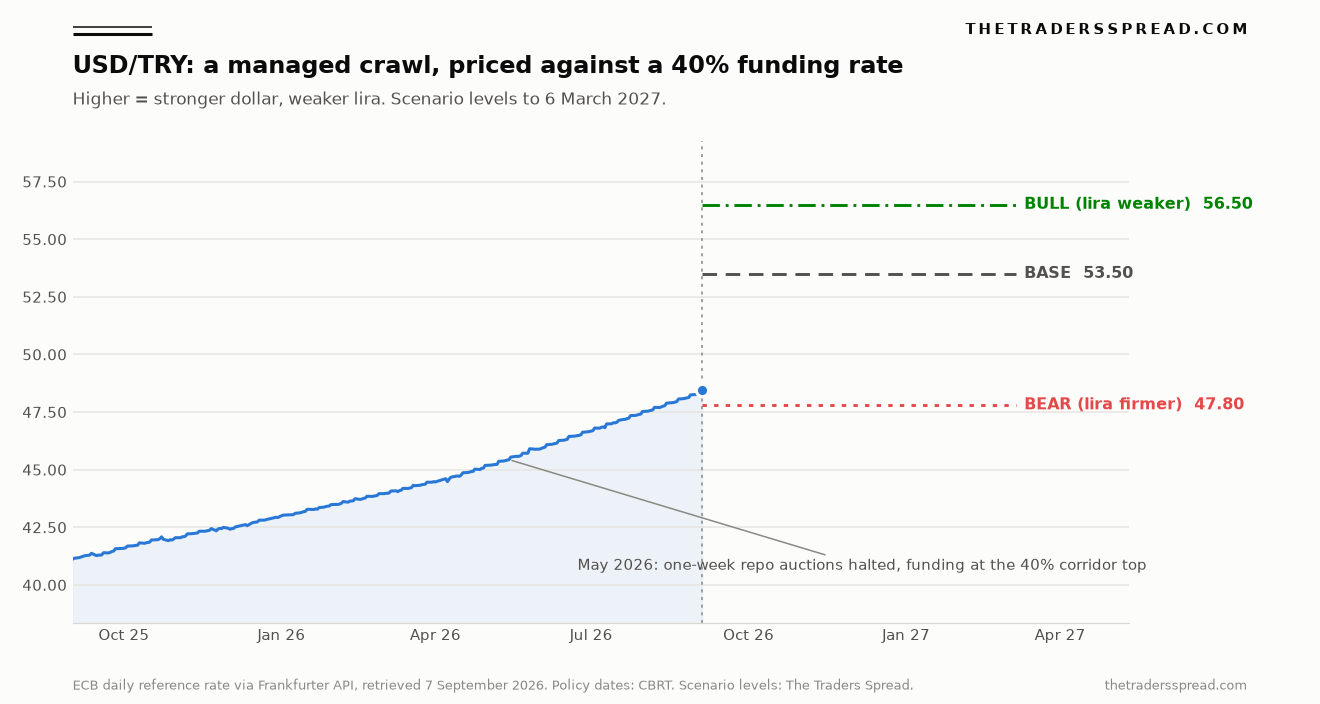
57.84 is the number that settles the USD/TRY question, and it does not appear in a single published forecast. That is the level the pair has to reach by 6 March 2027 before a dollar holder who converted into lira this week, parked the proceeds in Turkish money markets and converted back six months later ends up behind where he started. Spot on the European Central Bank's 4 September reference fixing was 48.443. The breakeven sits 19.4 percent above it. Nothing in the Turkish policy record, in the central bank's own survey panel, or in the shape of the last twelve months of fixings puts the pair anywhere near that level by March. The lira will almost certainly be weaker in six months. The dollar funder positioned against it can still lose.
The second thing nobody writes down is that the rate doing the compensating is not 37 percent. That is the headline one-week repo rate, unchanged since 23 January 2026. The rate that actually accrues is closer to 40, because the Central Bank of the Republic of Türkiye stopped holding one-week repo auctions in May and now funds the banking system at the top of its corridor. Over the trailing twelve months, that arrangement paid a dollar funder 17.3 percent net of a 17.65 percent currency loss, and it did so at an annualised realised volatility of 1.42 percent. There is no other liquid pair in the world where the carry is this large and the variance this small.
The facts this piece is built on
- Policy rate held at 37.00 percent on 23 July 2026, the fourth consecutive hold since January's 100 basis point cut — CBRT Press Release on Interest Rates 2026-28, 23 July 2026.
- Money-market rates are managed at "nearly 40 percent" because one-week repo auctions have been suspended and liquidity is met at the overnight lending rate — Governor Fatih Karahan, Inflation Report 2026-III briefing, 13 August 2026.
- Annual consumer inflation 31.51 percent in August 2026, 1.84 percent on the month — TurkStat data published by the CBRT, released 3 September 2026.
- USD/TRY 48.443 on the ECB reference fixing of 4 September 2026, 17.65 percent higher than a year earlier — ECB reference rates via the Frankfurter API, retrieved 7 September 2026.
- Official reserve assets of $188.198bn, of which gold accounts for $117.089bn and convertible foreign currency for only $63.355bn — CBRT International Reserves and Foreign Currency Liquidity, week to 28 August 2026.
- Short-term foreign exchange liabilities of the Central Bank and central government of $116.5bn against those reserves, and net reserves excluding swaps of $56bn on 12 August 2026 — CBRT weekly template, 28 August 2026, and Karahan, 13 August 2026.
- The CBRT's own panel of 68 forecasters expects USD/TRY at 57.4278 twelve months ahead and the policy rate at 29.59 percent — CBRT Survey of Market Participants, August 2026, conducted 10-12 August 2026.
The carry ledger, window by window
Most USD/TRY pages extrapolate a line. The line is not the trade. What a dollar-based book actually earns is the Turkish money-market rate minus the pace of depreciation, and the honest way to see whether that spread is widening or closing is to run the ledger over several holding windows and annualise the result. Doing that produces a picture the price chart alone conceals: the currency loss is accelerating while the interest paid to absorb it is falling.
| Holding window to 4 Sep 2026 | USD/TRY at start | Dollar gain vs lira | Lira slide, annualised | TRY interest accrued | Net dollar return, annualised |
|---|---|---|---|---|---|
| 1 month | 47.576 | +1.82% | +24.57% | 3.04% | +15.62% |
| 3 months | 46.084 | +5.12% | +22.17% | 9.22% | +16.63% |
| 6 months | 44.074 | +9.91% | +20.87% | 18.45% | +16.19% |
| 12 months | 41.175 | +17.65% | +17.65% | 37.98% | +17.28% |
Spot levels are ECB daily reference rates retrieved on 7 September 2026. Interest is accrued on the CBRT one-week repo path, which ran 43.00 percent to 12 September 2025, then 40.50, 39.50, 38.00 and 37.00 percent from 23 January 2026. Because the realised money-market rate has been near 40 percent since May, every figure in the final column is conservative by roughly 250 basis points on the shorter windows.
Read the last column downward. A twelve-month hold returned 17.28 percent. The most recent month annualises to 15.62 percent. The cushion is thinning, slowly, and it is thinning for a mechanical reason: the depreciation rate has climbed from 17.65 percent annualised over a year to 24.57 percent annualised over the last thirty days, while the policy rate has fallen 600 basis points over the same period. Neither of those trends is a surprise on its own. Together they define how much room is left.
Two things keep the spread positive. The first is that the crawl is administered rather than traded, so the depreciation arrives in daily increments of a few hundredths of a lira instead of in a gap. The second is that the real policy rate is genuinely positive: 37 percent against 31.51 percent August inflation leaves roughly 4.2 percentage points of ex-post real return, and against the 23.69 percent inflation the CBRT's panel expects twelve months out, the ex-ante real rate is nearer 10 points. Türkiye is one of the few emerging markets currently paying a double-digit expected real rate. That is what funds the cushion, and it is why the Turkish trade screens differently from the more familiar Latin American carry positions covered in our USD/MXN forecast and USD/ZAR forecast.
Sixty-two percent of the reserve stack is a gold price
Headlines about Turkish reserves have been uniformly good this year. Governor Karahan told the August briefing that "gross reserves, which stood at 155 billion dollars on March 27, 2026, increased by 30 billion dollars, reaching 185 billion dollars on August 12, 2026," and that net reserves excluding swaps rose by $35bn to $56bn over the same stretch. Both statements are accurate. Both describe something other than a war chest of dollars.
The CBRT's own weekly template for the week to 28 August puts official reserve assets at $188.198bn. Gold is $117.089bn of that, or 62.2 percent, held as 25.443 million fine troy ounces. Convertible foreign currency reserves are $63.355bn. Set that against short-term foreign exchange liabilities of the Central Bank and central government of $116.5bn, and the FX-only coverage ratio is 0.54. The gold position, not the currency position, is what has been rebuilding the headline.
This matters for a specific reason. Reserve adequacy is now levered to a commodity the CBRT does not control.
The 28 August valuation implies a gold price of $4,602 per ounce on those 25.443 million ounces. Gold traded at $4,396.20 on the morning of 7 September, 4.5 percent lower. On unchanged holdings, that is a $5.2bn mark-to-market reduction in the official reserve stack in ten days, arriving with no policy decision and no press release. Anyone reading a Turkish reserve number as a measure of the central bank's ability to defend a level is reading a gold chart with extra steps, which is why our gold price prediction is now, awkwardly, part of the Turkish sovereign risk model.
The July month-end template makes the mechanism plain. Official reserve assets were $164.448bn with gold at $100.637bn on 24.835 million ounces. Between then and 28 August the ounce count rose by 608,000 while the implied gold price rose from $4,052 to $4,602. Purchases explain roughly $2.8bn of the increase. Price explains the rest.
The option market is paying for a break the tape will not deliver
Realised volatility on USD/TRY over the sixty ECB fixings to 4 September was 1.42 percent annualised. Over the full year of fixings it was 1.53 percent. For scale, a G10 pair typically realises somewhere between 6 and 10 percent, and our USD/JPY forecast covers a market that has spent the year realising several multiples of what the lira does.
The option market disagrees violently. The CBRT's July Monetary Policy Committee summary records one-month implied volatility on the lira at 5.7 percent and twelve-month implied at 18.6 percent as of 22 July 2026. Twelve-month implied is therefore running at roughly twelve times what the pair has actually delivered.
That gap is not an anomaly to be arbitraged. It is the correct price of a crawling peg. Under an administered slide, realised variance is near zero right up until the moment the administration stops, at which point it is enormous. Option sellers are being paid for the discontinuity, not for the drift. A trader who reads 1.42 percent realised volatility as evidence of a low-risk position has confused the absence of variance with the absence of risk, which is the specific error that the 2021 episode punished.
December 2021 is the precedent, and it started with negative real rates
The comparison gets made lazily, so it is worth being precise about what actually happened and what it required.
On the ECB fixings, USD/TRY went from 8.2919 on 1 September 2021 to 17.7797 on 20 December 2021. That is 114 percent in under four months, and 61 percent of it arrived in the thirty-two days after 18 November. The precondition was a policy rate cut from 19.00 percent in September 2021 to 14.00 percent on 17 December 2021 while annual inflation ran at 21.31 percent in November and 36.08 percent in December. The real policy rate was deeply negative and getting worse by design.
Then the direction reversed with equal violence. The fixing moved from 17.7797 on 20 December to 13.0263 on 21 December, a 26.7 percent single-day collapse in the dollar, on the announcement of the lira-protected deposit scheme.
Today's configuration inverts the 2021 precondition. The real policy rate is positive on both realised and expected inflation. The share of Turkish lira deposits has risen to 62 percent, per Karahan's August briefing. Total loan growth has been walked down from 34.6 percent at the end of February to around 25 percent. None of that guarantees stability, but it does mean that the 2021 template is not currently loaded. The precedent is instructive mainly for its second half: when the regime changes, USD/TRY can fall 26 percent in a session, and a bear case that looks absurd in a drifting market becomes the only case that matters within one press release.
What the officials themselves have got wrong
In December 2025, Mehmet Şimşek, Minister of Treasury and Finance of Türkiye, told the Future of Finance Summit in Istanbul: "Even with some delay, inflation targets will at least be met at the upper end of the band. Disinflation will continue in 2026." He put the following year's target range at 13 to 19 percent, while noting that "the market expects it to be in the 20s."
The market was right and the band was not. The CBRT's interim inflation target for 2026 now stands at 24 percent, its own end-2026 forecast was revised up to 28 percent in the August Inflation Report, its survey panel expects 29.43 percent, and August printed 31.51 percent. Four numbers, four different answers, all above the target.
The practical inference for a currency position is that the disinflation path keeps being extended rather than abandoned, and an extended path means the crawl runs longer at a rate the central bank is prepared to keep paying for. That is a friendlier configuration for carry than a fast disinflation would be. It is also why the September meeting matters less than it looks: the panel's modal expectation for the 10 September decision is no change at 37.00 percent, with the first cut priced for the 22 October meeting.
The Call
Timeframe is six months, to 6 March 2027. Bull means a higher USD/TRY print, which is a weaker lira; bear means a lower print and a firmer lira. Levels are quoted against the ECB daily reference fixing, which is what the price panel on this page tracks.
Base case, 53.50, 60 percent. The crawl continues at roughly its trailing three-month pace of 22 percent annualised, which lands the pair at 53.54 by early March. The CBRT's survey panel, interpolated between its 51.6567 end-2026 figure and its 57.4278 twelve-month figure, implies 53.75 for the same date. Two methods, 25 kuruş apart. At an effective funding rate near 39 percent, a lira position held to that level returns about 8 percent in dollars over the window.
Bull case, 56.50, 30 percent. The crawl steepens to roughly 36 percent annualised because the easing cycle restarts faster than the panel expects while inflation stalls near 30 percent, compressing the real rate. The carry still covers it, barely, at about 2.4 percent net over six months. This is the scenario in which the level moves a long way and the position makes almost nothing.
Bear case, 47.80, 10 percent. A nominal pullback below spot requires an event, not drift. The candidates are a definitive end to the energy shock that collapses the import bill, a fresh lira-protection or reserve-building scheme that forces a repricing, or an inflation print that undershoots badly enough to let the CBRT slow the crawl deliberately. December 2021 shows that when such an event lands, the move is not gradual.
What would change my mind: a September or October cut larger than 100 basis points, a monthly CPI print above 3 percent, official reserve assets falling below $170bn on the weekly template, or three consecutive weekly fixings showing a daily crawl above 0.1 lira. Any one of those pulls the base case toward the bull level and cuts the carry cushion faster than the table above suggests.
RelatedAUD/CHF Forecast: 0.6120 Bull Case vs 0.5480 Bear Case
Questions traders are asking
Is the bull case here bullish on the lira?
No, the opposite. USD/TRY is quoted as lira per dollar, so the bull case at 56.50 is a stronger dollar and a weaker lira, and the bear case at 47.80 is a firmer lira. Every level in this piece follows the pair, not the currency. The site's other dollar-base pages use the same convention, which is why a rising line on the chart is a falling lira.
Why quote a 40 percent funding rate when the policy rate is 37 percent?
Because the CBRT has not run a one-week repo auction since May 2026 and meets the market's liquidity need at the overnight lending rate instead, which sits at 40.00 percent. Governor Karahan stated in the August briefing that money-market rates are managed at "nearly 40 percent". A funder accrues the money-market rate, not the auction rate that is no longer being auctioned.
What is the carry-adjusted return, in one sentence?
Over the twelve months to 4 September 2026, converting dollars into lira, accruing the CBRT policy rate and converting back returned 17.28 percent in dollar terms, because 37.98 percent of accrued interest more than covered a 17.65 percent currency loss. The most recent month annualises to 15.62 percent on the same method.
How exposed is Türkiye's reserve position to gold?
Very. Gold was $117.089bn of $188.198bn in official reserve assets on 28 August 2026, or 62.2 percent, held as 25.443 million ounces. A 10 percent fall in the gold price removes roughly $11.7bn from the headline reserve stack without any capital leaving the country. Convertible foreign currency reserves cover only 0.54 times short-term public-sector FX liabilities.
What happens at the 10 September Monetary Policy Committee meeting?
The CBRT's own survey panel, polled between 10 and 12 August, expects no change at 37.00 percent at the first meeting and 36.13 percent at the second. A hold would be the fifth in a row since January. The summary of the meeting follows within five working days, on 17 September, and historically carries the reserve and implied volatility figures that matter more to this trade than the headline rate does.
Where do the spot levels in this article come from?
All USD/TRY levels are European Central Bank daily reference rates, retrieved from the Frankfurter API on 7 September 2026. The most recent fixing available was 48.443 on 4 September 2026. Reference fixings are set once daily and will differ from an intraday interbank or broker quote, which matters when reading the carry trade arithmetic to two decimal places.
Disclaimer
This article is analysis and information, not investment advice, and it is not a recommendation to enter any position. Levels, probabilities and scenarios reflect the author's reading of publicly available data as of 7 September 2026 and may be wrong. Trading foreign exchange and contracts for difference carries a high risk of loss, including the loss of capital in excess of the amount deposited. Emerging market currencies under administered exchange rate regimes carry gap risk that is not captured by realised volatility. Readers should conduct their own research and consider their circumstances before acting.