

Having tracked NZD/CAD from the Reserve Bank of New Zealand's cutting cycle through the July lift in the Official Cash Rate to 2.50% and the 2 September lift to 2.75%, I keep the ECB cross on a desk sheet rather than a headline rate gap. NZD/CAD fixed at 0.79569 on the European Central Bank reference of 15 October 2026. Frankfurter does not publish this pair. The figure is 1.4207 Canadian dollars per US dollar divided by 1.7855 New Zealand dollars per US dollar, the two legs for that day, retrieved on 16 October. I have had 0.82746, the 4 August high, on that sheet since the week it printed. The cross is 3.8% under the high, and only about a fifth of the way up from the 19 November 2025 low of 0.78843. For 31 December the bull case above the live cross is 0.8320. The bear case below it is 0.7680. The base, 0.7894, is last year's close.
The year and the last ten weeks are not the same cross. From 31 December 2025, NZD/CAD rose 0.8% to 0.79569 because the loonie cheapened against the US dollar by more than the kiwi: CAD per USD from 1.3692 to 1.4207, NZD per USD from 1.7345 to 1.7855. Since 4 August that has flipped. The kiwi leg is 5.1% weaker against the dollar, the loonie leg 1.0% weaker, and the cross is 3.8% under 0.82746. On 2 September the OCR went to 2.75% and the Bank of Canada held at 2.25%. NZD/CAD that day was 0.81148. The wider 50 basis point gap did not lift it.
- NZD/CAD 0.79569 on the ECB reference of 15 October 2026, from 1.4207 CAD per USD and 1.7855 NZD per USD — ECB via Frankfurter, retrieved 16 October 2026
- 3.8% under the 4 August 2026 high of 0.82746, and 0.9% above the 19 November 2025 low of 0.78843 — ECB via Frankfurter, retrieved 16 October 2026
- OCR 2.75% after a 25 basis point increase on 2 September 2026; next update 2:00pm New Zealand time on 28 October, a Monetary Policy Review — Reserve Bank of New Zealand, 2 September 2026
- Bank of Canada overnight rate held at 2.25%, with the Bank Rate at 2.5% and the deposit rate at 2.20%; next decision 28 October, with the Monetary Policy Report — Bank of Canada, 2 September 2026
- New Zealand CPI 4.1% in the June 2026 quarter, and 2.9% excluding vehicle fuels — RBNZ summary record of the 2 September meeting
- Canada: second-quarter GDP up 3.3%; CPI hovering around 3%, and 2.2% excluding gasoline in July; unemployment 6.4% in July — Bank of Canada, 2 September 2026
- Dubai crude around US$65 a barrel before the Middle East conflict, around US$105 at the May statement, back near US$65 at the July review, and around US$90 when the September forecast was closed — Anna Breman, RBNZ media conference, 2 September 2026
Two committees, one oil shock
Anna Breman, Governor of the Reserve Bank and chair of the Monetary Policy Committee, told the 2 September media conference what the rate can and cannot do. "Monetary policy cannot offset the direct effects of higher fuel costs on headline inflation. What it can and must do is prevent this shock from becoming persistent inflation." Inflation, she said, was still above target, at 4.1% in the June quarter because of higher fuel prices. The committee raised the OCR by 25 basis points to 2.75% by consensus. She called that level accommodative, and said a gradual removal of stimulus was how to get inflation back to target without an unstable path for output and employment.
On the same date, a governor who did not hike drew a similar limit. Tiff Macklem, Governor of the Bank of Canada, said in his opening statement: "Monetary policy cannot offset the effects of tariffs or influence global energy prices. What we can do is ensure global developments don't jeopardize price stability in Canada." With the data "largely in line with our July forecast," the Governing Council maintained the policy rate at 2.25%. The press release put the Bank Rate at 2.5% and the deposit rate at 2.20%, and set the next overnight-rate decision, with the next Monetary Policy Report, for 28 October 2026.
Paul Conway, the Bank's chief economist, was firmer still on the OCR page, which shows 2.75% updated at 2:00pm on 2 September and the next update at 2:00pm on 28 October. Policy cannot change global oil prices, he said, and it "can and will" stop higher fuel prices becoming ongoing inflation. The barrel prices behind that line are hers, from the same conference: near US$65 before the conflict, around US$105 at the May statement, near US$65 again in July, and around US$90 when the September forecast closed. Not a price for 16 October.
The summary record makes the 25 basis points unanimous and the next meeting less so. Hayley Gourley, Karen Silk, Prasanna Gai and Anna Breman saw upside risks from energy prices, from firms lifting domestic prices ahead of import costs, and from administered prices. Paul Conway and Carl Hansen saw inflation risks as balanced, with activity risks on the downside, including weak house prices and cautious households. All six agreed the recovery could stay uneven, and that the OCR may need to rise further on a path that is not pre-committed.
Canada's document is a hold with the inflation risk marked up. Second-quarter GDP was up 3.3% after a very weak first quarter. Macklem said some of that strength was temporary, and that consumption, housing, exports and business investment had all picked up. Unemployment was 6.4% in July, with labour demand still subdued. CPI had been hovering around 3% on gasoline. Excluding gasoline it was 2.2% in July, and core was close to 2%. He put the new US tariffs on about 5% of exports to the United States, and said Strait of Hormuz shipments were still curtailed. Both points are the 2 September statement, not a reading for 16 October.
One line in the New Zealand record is easy to misread against this cross. Higher wholesale rates had passed into mortgage and business lending rates, the committee said, and there had been "a small appreciation in the exchange rate," partly from expectations of further OCR increases. That is their description of conditions into the meeting. It is not an NZD/CAD print. On the ECB legs the kiwi was already softer against the US dollar on 2 September than on 4 August, 1.7160 per dollar against 1.6993. Any appreciation they recorded was a different basket. Against Canada, the cross had already fallen from 0.82746 to 0.81148.
Where the 3.8% went
The decline since the August high is a New Zealand-dollar move. It is not a rally in the loonie.
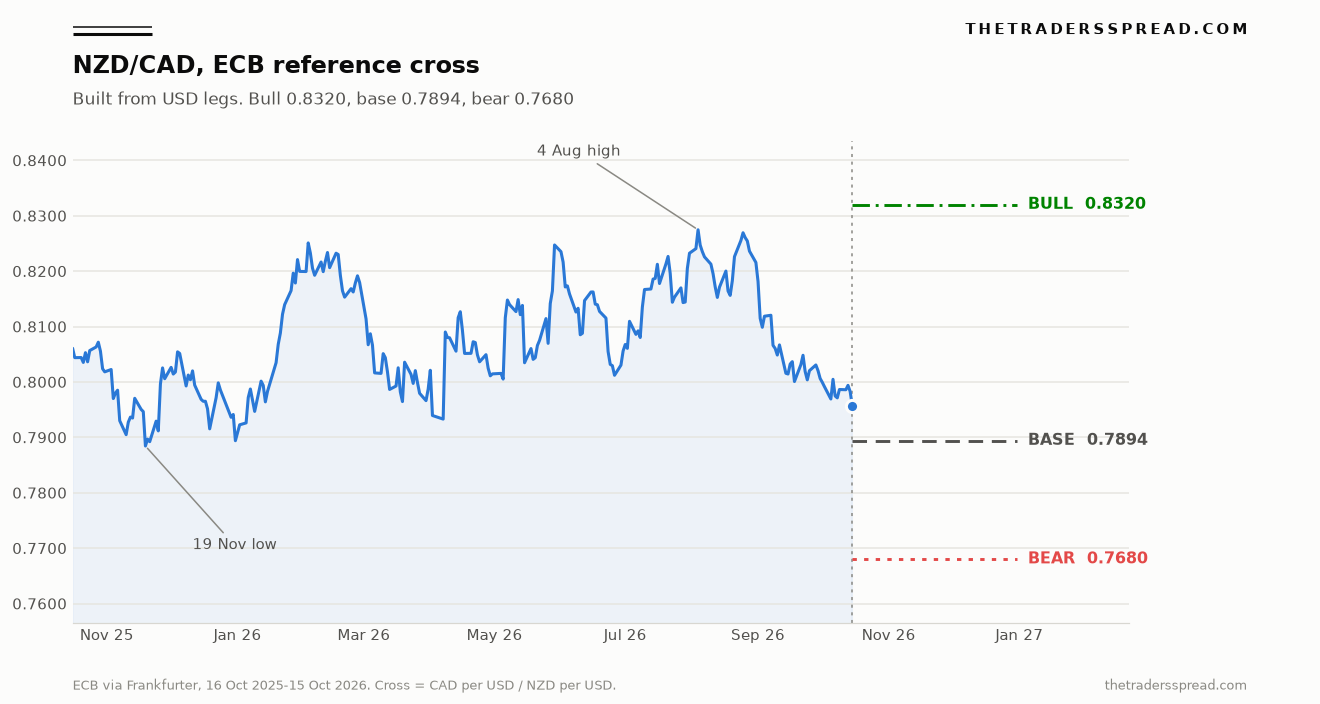
From 4 August to 2 September the cross fell 1.9%, and both legs contributed. NZD per USD rose 1.0%. CAD per USD fell 1.0%, from 1.4061 to 1.3925, a firmer loonie. That second move matches the Bank of Canada's line that the Canadian dollar had appreciated slightly on US-dollar weakness between July and the decision. After 2 September the loonie's firmness reversed. By 15 October, CAD per USD was 1.4207, 2.0% above the 2 September fix, and NZD per USD was 1.7855, 4.1% above it. The cross fell another 1.9%, from 0.81148 to 0.79569. Since the hike, Canada has cheapened against the US dollar. New Zealand has cheapened by about twice as much.
| ECB date | NZD per USD | CAD per USD | NZD/CAD |
|---|---|---|---|
| 19 November 2025 | 1.7772 | 1.4012 | 0.78843 |
| 31 December 2025 | 1.7345 | 1.3692 | 0.78939 |
| 4 August 2026 | 1.6993 | 1.4061 | 0.82746 |
| 2 September 2026 | 1.7160 | 1.3925 | 0.81148 |
| 15 October 2026 | 1.7855 | 1.4207 | 0.79569 |
The December row is the year-to-date story. The cross is up 0.8% from 0.78939 only because the Canadian leg moved further, 1.3692 to 1.4207, than the New Zealand leg, 1.7345 to 1.7855. Give that Canadian move back and the cross sits on last year's close. That is 0.7894: 0.78939 taken to four decimals, not a round number picked for a headline.
0.79569 is 0.9% above the November low. A kiwi cross with no Canadian dollar in it is the NZD/CHF forecast. It does not replace the legs in the table.
A gap that does not survive the CPI
Fifty basis points is the figure that gets quoted, and it has only been 50 since 2 September. At the July review the OCR rose by 25 basis points to 2.50%. The Bank of Canada maintained 2.25% on 2 September, so that was the rate it carried into the meeting. Before Wellington's second hike the nominal gap was 25 basis points. The hike doubled it. The cross then fell from 0.81148 to 0.79569.
Set the OCR against June's CPI and the 50 basis points change character. Headline inflation was 4.1%, so 2.75% sits 1.35 percentage points below the CPI rate. The summary record separates the basket: excluding vehicle fuels, annual inflation was 2.9% in the June quarter, and most core measures were inside the 1% to 3% band. On that ex-fuel figure, 2.75% is still 0.15 percentage points below inflation. The committee expects inflation to stay elevated this year, to re-enter the band by mid-2027, and to reach the 2% midpoint later next year. The September Monetary Policy Statement page says inflation should remain above 3% for the rest of 2026. An OCR the Governor called accommodative on the day of the hike is not a restrictive real rate against those prints.
Canada's ex-energy figure points the other way, with a caveat. The press release said CPI was hovering around 3% and did not give a single headline index to the decimal, so I will not subtract 2.25 from a rounded "around 3" and treat the residual as exact. It did publish 2.2% excluding gasoline in July, with core close to 2%. The overnight rate at 2.25% is 0.05 percentage points above that ex-gasoline reading. Vehicle fuels in a June New Zealand CPI and gasoline in a July Canadian CPI are not the same basket. They are the ex-energy figures the two banks published with the 2 September decisions. On those figures the real policy rate is slightly negative in New Zealand and slightly positive in Canada.
July's neutral-rate remarks keep a further hike possible. Breman called 2.25% somewhat below neutral, with a band near 2.5% to 3.5% and a midpoint around 3%. Conway said the near-term neutral rate was probably higher while inflation expectations were up. At 2.75% the OCR is inside that band and still under the midpoint, and the September record says it may need to rise further. Holding in September, the committee judged, risked a faster rise later.
The home economy in that record does not look like a currency that has to be bid. Growth was lacklustre in the second quarter. The third-quarter recovery was expected to be uneven, stronger for meat and dairy exporters than for households. Unemployment was elevated in Auckland and Wellington, and among the young and the long-term unemployed. Spare capacity remained in the labour market. The terms of trade were projected to rise again, which is a support for national income and still a projection. Pass-through into term deposit rates had been limited, which is not the transmission the committee said it wanted.
If the question is the kiwi against the Australian dollar rather than against Canada, that pair is the AUD/NZD forecast. Australia's September labour print is a fact about the Australian dollar. It is not an input here.
One Wednesday, two documents
28 October 2026 is a Monetary Policy Review on the Reserve Bank's calendar, at 2:00pm New Zealand time. The next document it labels a Monetary Policy Statement is 9 December. The same date at the Bank of Canada is an overnight-rate announcement with a Monetary Policy Report. A review and a quarterly report are not the same object. Ottawa can rewrite the forecast, the oil assumption and the line on the next move in one paper. Wellington's October slot, on the Bank's own label, is the shorter meeting. 31 December is still nine weeks after that Wednesday.
The mapping from those two documents to the three levels is narrower than a rate-gap slogan. Another OCR increase, beside a Canadian report that looks through oil the way the September hold did, is how the cross gets to 0.8320: a reversal of the kiwi leg, not a new range. Two holds, with neither paper promising a hike before year-end, is how it finishes near 0.7894. A Wellington hold beside a Canadian hike, or beside a report that puts the next Canadian move up, is how 0.78843 gives way and 0.7680 comes into view. Conway and Hansen are the New Zealand half of that last path. Macklem's oil risk, as he stated it on 2 September, is the Canadian half.
The Canadian dollar against the Australian dollar is a different policy pair, set out in the AUD/CAD forecast. It is not the decomposition in the table. Since August, NZD/CAD has been the New Zealand leg. Swapping in a third currency does not change 1.7855 or 1.4207.
RelatedUSD/THB Forecast: 34.80 Bull Case vs 32.40 Bear Case
The call
The base case, which I weight at about 50%, is 0.7894 on 31 December 2026. That is the 31 December 2025 ECB cross of 0.78939 taken to four decimals, 0.8% under the 15 October print. It hands back a gain that came from a softer loonie, not a stronger kiwi. It needs the OCR left at 2.75% on 28 October, and the overnight rate left at 2.25% without a promise of a Canadian hike before Christmas. The kiwi's slide against the US dollar slows. The November 2025 low at 0.78843 holds.
The bull case, about 20%, is 0.8320. It is 4.6% above 0.79569 and about 0.5% above the 4 August high. I get there if the review hikes again, the stance is still described as accommodative, and the Canadian report looks through oil the way September did, with core inflation still close to 2%. That is a reversal of the kiwi leg since August, not a level outside the year's range. Export prices are already in the September record. They did not hold 0.81148.
The bear case, about 30%, is 0.7680, 3.5% under the live cross and about 2.6% under the November 2025 low. The review holds, Conway and Hansen's balanced risks become the committee's, and the Monetary Policy Report either lifts the overnight rate or says the next Canadian move is up. The kiwi leg keeps cheapening faster than the loonie, which is what it has done since 4 August.
A hike in Wellington on 28 October, with a Canadian report that does not match it, and I would retire 0.7894 and make 0.8320 the base. A Canadian hike, or a hold that schedules one, and 0.7680 becomes the base. I would drop the bear case if the New Zealand-dollar leg stopped weakening against the US dollar while Canada's did not. These weights are an editorial judgement for 31 December, not a market price and not an instruction. The Wednesday has not happened.
Frequently asked questions
How is this NZD/CAD rate calculated?
Frankfurter does not publish NZD/CAD, so the cross is built from the two US dollar legs. On the ECB reference of 15 October 2026, 1.4207 Canadian dollars per US dollar divided by 1.7855 New Zealand dollars per US dollar equals 0.79569. The pull was made on 16 October 2026. It is a daily reference rate, not a live bank quote, and this page has no NZD/CAD price tile. The cross is not in the site's symbol list.
What do 0.8320 and 0.7680 mean?
They are scenarios for 31 December 2026, not orders. The bull case at 0.8320 sits above the 15 October cross of 0.79569, about 4.6% higher and about 0.5% above the 4 August high of 0.82746. The bear case at 0.7680 sits below it, about 3.5% lower and about 2.6% under the 19 November 2025 low of 0.78843. The base, 0.7894, is the 31 December 2025 cross of 0.78939 rounded to four decimals.
How large is the policy-rate gap?
On 2 September 2026 the Official Cash Rate rose 25 basis points to 2.75%, and the Bank of Canada held the overnight rate at 2.25%. That nominal gap is 50 basis points. It was 25 basis points when the OCR stood at 2.50% after the July review. June-quarter New Zealand CPI was 4.1%, or 2.9% excluding vehicle fuels. Canadian inflation excluding gasoline was 2.2% in July. Those inflation rates offset most of the nominal gap.
When do the two central banks next decide?
The Reserve Bank has set the next OCR update for 2:00pm New Zealand time on 28 October 2026, and its calendar calls that a Monetary Policy Review. The next Monetary Policy Statement is 9 December. The Bank of Canada has scheduled the next overnight-rate announcement for 28 October 2026 and said the Monetary Policy Report comes out the same day. This NZD/CAD forecast runs to 31 December, so that Wednesday is inside the horizon.
Did the September hike lift NZD/CAD?
No. The cross was 0.81148 on the 2 September ECB reference, the day the OCR went to 2.75% and the overnight rate stayed at 2.25%. On 15 October it was 0.79569, about 1.9% lower. Between those fixes the New Zealand dollar weakened about 4.1% against the US dollar and the Canadian dollar about 2.0%, counted as more local currency per US dollar. The wider nominal gap is not in the cross.
Disclaimer
This is analysis of published rates and central-bank documents, not a recommendation to take a position in NZD/CAD or any other instrument. The bull, base and bear figures are scenarios for 31 December 2026. Reference rates move, documents go out of date, and capital is at risk.