

GBP/NZD does not appear on the page the Bank of England published on 17 September. The page, still showing a 12 October update when read for this note, says Bank Rate was held at 3.75%, that the next decision falls on 5 November, and that inflation is 3.1% against a 2% target. None of those lines is a currency. The currency has to be built. Frankfurter's feed of European Central Bank reference rates has no GBP/NZD pair, so the cross is New Zealand dollars per US dollar divided by pounds per US dollar. On the 16 October reference the inputs were 1.7656 and 0.74989. One pound bought 2.3545 New Zealand dollars. That fixing sits half a percent under the 2.3652 high of 5 October, the richest print in a sample back to 2 January 2025, and it lands eleven days before the Reserve Bank of New Zealand next sets the Official Cash Rate.
Read as a sterling rally, 2.3545 is the wrong decomposition. From the 16 July reference to 16 October the cross rose 2.0%. Over the same two ECB dates the pound fell 1.3% against the dollar, from 1.3511 to 1.3335, and the kiwi fell 3.3%, from 0.5855 to 0.5664. GBP/NZD is high because the New Zealand dollar has been the softer of two currencies that both lost ground to the dollar. A weaker kiwi is also how a global fuel shock reaches New Zealand prices. The Reserve Bank has said it will lean against second-round effects from that shock. The move that lifted the cross is the move most likely to invite a response that pulls the cross back down.
Key facts
- GBP/NZD fixed at 2.3545 on 16 October 2026, from ECB rates of 0.74989 pounds and 1.7656 New Zealand dollars per US dollar — Frankfurter, ECB reference, 16 October 2026
- The cross is 0.5% under its sample high of 2.3652 on 5 October, and 4.8% above the 2026 low of 2.2470 on 17 February — Frankfurter, ECB reference, 16 October 2026
- In the three months to 16 October the cross rose 2.0%, sterling fell 1.3% against the dollar and the kiwi fell 3.3% — Frankfurter, ECB reference, 16 July and 16 October 2026
- Bank Rate is 3.75% after a 6–3 vote to hold. Three members wanted 4%. UK CPI was 3.1% in August, with staff seeing around 3.75% in the fourth quarter and slightly above 4% in early 2027 — Bank of England minutes, 17 September 2026
- The Official Cash Rate is 2.75% after a 25 basis point rise on 2 September, the second increase since early July. Consumers price inflation was 4.1% in the June quarter and tradables inflation was 4.9% — Reserve Bank release, republished by Scoop, 2 September 2026; Parliamentary Library, 11 September 2026
- Bank Rate sits 1.00 percentage point above the OCR. September projections put the OCR at a 2.8% average in the December 2026 quarter and 3.2% in the December 2027 quarter — Parliamentary Library, citing the Monetary Policy Statement, 11 September 2026
- Brent crude was $106 a barrel at the 14 September close, up 36% since the run-up to the July Report, and UK wholesale gas was 207 pence a therm, up 78% — Bank of England minutes, 17 September 2026
Two committees, one fuel bill
On 2 September the Reserve Bank's committee reached consensus to lift the Official Cash Rate by 25 basis points, from 2.50% to 2.75%. The release, as Scoop carried it, tied the step to fuel: inflation had risen to 4.1% in the June quarter because of higher prices from the Middle East conflict. Core inflation, expected wage growth and inflation expectations were described as still consistent with a return to the 1–3% band by mid-2027 and the 2% midpoint later next year. The committee called it a gradual removal of stimulus, taken so a larger rise would be less likely later.
The Reserve Bank's own site returned a 403 on a direct fetch and again through a reader proxy. The Parliamentary Library's Monthly Economic Review of 11 September is the public record used here. It says the cash rate had risen 50 basis points since early July and was still stimulatory. Further increases were thought likely. The path was not predetermined. The September statement forecast an OCR average of 2.8% in the December 2026 quarter and 3.2% in the December 2027 quarter.
Stats NZ figures in that review put annual inflation at 4.1% in the year to June, up from 3.1% to March. Petrol accounted for almost a quarter of the 4.1%. The quarterly rise was 1.5%, the largest since the September 2023 quarter, and petrol and diesel made up almost two-thirds of it. Tradables inflation was 4.9%. Non-tradables inflation was 3.4%.
Fifteen days later the Bank of England held. At the meeting ending 16 September, six members kept Bank Rate at 3.75% and three voted for 4%: Megan Greene, Catherine L Mann and Huw Pill, against Andrew Bailey, Sarah Breeden, Swati Dhingra, Clare Lombardelli, Dave Ramsden and Alan Taylor. The minutes put UK CPI at 3.1% in August. About 0.7 points of the 1.1 point overshoot against the 2% target was the direct effect of energy, mostly motor fuel. Services inflation was 3.4%, down from 4.5% in March. Private-sector regular pay grew 2.9% in the three months to July. The Bank's cross-check put underlying wage growth nearer 3.5%.
On the decision page, Governor Andrew Bailey is quoted directly: "Today, we've held Bank Rate at 3.75%. So far, higher global energy costs have had a limited effect on price and wage setting in the UK. But the longer this volatility persists, the bigger the impact it will have on inflation, and the more likely it is we will need to raise Bank Rate to ensure that inflation falls back to our 2% target."
The minutes price the shock the committee was staring at. Brent was $106 a barrel on 14 September and UK wholesale gas was 207 pence a therm. On those prices, staff expected CPI around 3.75% in the fourth quarter, against 3.2% in the July Report, and slightly above 4% in early 2027. Ofgem's cap for October to December was £1,723. The quoted two-year fixed mortgage rate was about 95 basis points above its pre-conflict level. GDP rose 0.4% in the second quarter, and a staff update put the third quarter at 0.4% rather than the 0.1% in the July Report. Unemployment was 4.9% in the three months to July.
The hold is the decision. The condition for giving it up is written beside it.
What actually moved
Sterling's dollar price on 16 October was 1.3335. It was 1.3456 on 16 September, 1.3511 on 16 July, 1.3443 on 2 January and 1.3427 on 16 October 2025. The pound is down against the dollar over a month, a quarter, the year to date and the year. The kiwi is down by more in every window: 0.5664 now, against 0.5762, 0.5855, 0.5769 and 0.5736 on those same dates. The kiwi's loss to the dollar was 1.7%, 3.3%, 1.8% and 1.3%. Sterling's was 0.9%, 1.3%, 0.8% and 0.7%. The cross rose in all four windows, by 0.8%, 2.0%, 1.0% and 0.6%.
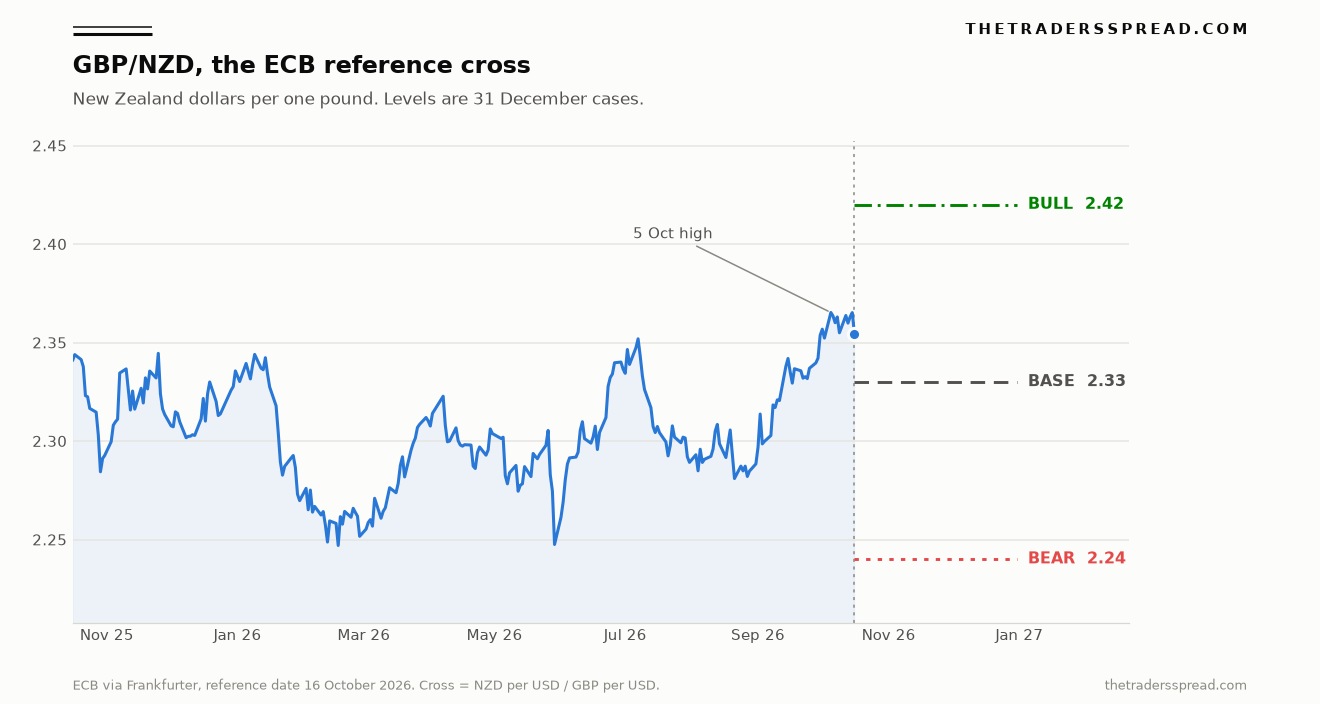 The line is the ECB reference cross, New Zealand dollars per pound, from 16 October 2025. Bull, base and bear are 31 December cases, drawn to the right of the last fixing. They are not a path.
| United Kingdom | New Zealand | |
|---|---|---|
| Policy rate | 3.75% Bank Rate, held 17 September | 2.75% OCR, raised 2 September |
| Latest inflation on the record used here | 3.1% CPI in August | 4.1% CPI in the June quarter |
| Next scheduled decision | 5 November 2026 | 28 October 2026 |
| Change vs the US dollar, 16 July to 16 October | pound −1.3% | kiwi −3.3% |
The same split is in other notes on this desk, and none of them is a price for GBP/NZD. The kiwi leg is the NZD/CAD forecast. Sterling against another dollar-bloc currency is the GBP/AUD forecast. The cross between those blocs is AUD/NZD. The only inputs to 2.3545 are the two ECB dollar rates.
| Case for 31 December | Level | Gap to the 16 October cross |
|---|---|---|
| Bull | 2.42 | +2.8% |
| Base | 2.33 | −1.0% |
| Bear | 2.24 | −4.9% |
Since 2 January 2025 the cross has averaged 2.28. The base, 2.33, sits near the 2 January 2026 fixing of 2.3302. It gives back the October extension. It does not return the pair to that longer average.
17 February is still the low
The 2026 low is 2.2470 on 17 February. On 29 May the cross was back at 2.2475. It had traded through 2.31 in March and near 2.30 in April, and the May retest did not break February. The 30 June reference was 2.3365. The end-July and end-August references were 2.2892 and 2.2884. Then 2.3537 on 30 September, and 2.3652 on 5 October.
That high was not a sterling blow-off. On 5 October the pound bought 1.3225 dollars and the kiwi bought 0.5591. Both were weaker than now. By 16 October sterling had recovered 0.8% against the dollar and the kiwi 1.3%, and the cross was 0.5% off the high. The step back is the kiwi regaining a little, not the pound rolling over alone.
From the 16 October 2025 fixing of 2.3408, the gain is 0.6%. Ten weeks at the top of the sample is not a new regime. February and May are still this year's floor.
The Library's mid-September compilation is a recovery with a fuel tax on top. Real GDP rose 0.8% in the March quarter. The Bank, writing before the June accounts, had expected that quarter to be broadly flat. Unemployment was 5.6% in June, highest since the September 2015 quarter, with 171,000 people unemployed even as employment rose 0.5%. Retail volumes fell 0.5% and fuel volumes fell 13.1%, while spending on fuel rose 12%. Food prices rose 1.9% in the year to July, the smallest rise since December 2024.
Non-tradables at 3.4%, and food at 1.9%, are not the 4.1% headline. Tradables at 4.9% are.
The high makes its own objection
Governor Anna Breman told the Finance and Expenditure Committee on 3 September, as interest.co.nz reported, that the OCR track still contained a probability of another rise, and that after two increases the committee could "probably take some time to assess and see how this has affected the economy and whether we see stronger or less strong second-round effects from the high fuel prices." She called 2.75% still supportive of growth and jobs. At the press conference the day before, she said a further increase was likely and that "the timing is highly uncertain."
Chief economist Paul Conway called the strategy a "gradual and calibrated withdrawal of stimulus." The next morning he called the task a "delicate balance" between supporting growth and stopping a price shock from becoming generalised inflation. He also said that "if New Zealand was less dependent on fossil fuels, then inflation would be lower." That is not a forecast. It names the shock.
The 2.8% December-quarter average can be checked with a day-count. These are not the Bank's weights. A 92-day quarter with the OCR at 2.75% until a rise to 3.00% on 10 December averages about 2.81%. The same rise on 29 October averages about 2.92%. The published 2.8% sits next to December. A modest chance of an October move is already inside an average, and Breman said that week the track is not a promise.
On 11 September the Library said markets were pricing a 28% chance of a further increase at the late-October review. That figure is five weeks old. There is no live overnight-index probability in this note. What was pulled today is the kiwi's dollar rate, down 1.7% since 16 September. A softer currency leans on the tradables inflation the June CPI already put at 4.9%. The cross is rich because the kiwi fell, and the kiwi fell in the way most likely to keep imported prices hot into the September-quarter CPI, due on 22 October.
Interest.co.nz noted that 28 October sits ten days before the election, with the next full statement on 9 December. That proximity is not an input to 2.33. Labour-market figures land on 4 November, and Bank Rate on 5 November, after both the CPI and the cash rate are public.
The bull case is not empty. Three of nine members have already voted for 4%. The September minutes describe a market curve peaking near 4.9% by the end of 2027, and say risk premia were a material part of that slope. The Market Participants Survey, closed on 4 September, had a median that implied Bank Rate staying put. That is a September description, not a 17 October print. The live gap is simpler: Bank Rate is 3.75%, the OCR is 2.75%, and only one committee has tightened.
Base, bull, bear
The base case is 2.33 New Zealand dollars per pound on 31 December, about one percent under 2.3545. It assumes the September track survives the 22 October CPI: no rise on 28 October, or one so fully priced that the kiwi does not squeeze, with December left live. It assumes the Bank of England either holds on 5 November or lifts Bank Rate by a quarter point sterling has already partly priced. The cross gives back the push toward 2.3652 and finishes near the 2 January fixing. Bias is neutral. Conviction is 2 out of 5. The print that can retire the path is five days away.
RelatedEUR/SEK Forecast: 11.55 Bull Case vs 10.70 Bear Case
That weighting is a judgement, not a market probability. The base is the centre. The bear case is the fatter tail, because the cross is already on its highs. The bull case needs sterling to rise against the dollar, which it has not done since July.
The bull case is 2.42. It needs 5 November to deliver the quarter point Greene, Mann and Pill wanted, and 28 October to leave the OCR at 2.75%. Clearing 2.3652 would be the first evidence. Another 2.8% by year-end is reachable if the kiwi's slide resumes after a hold. It is not the centre. The pound's dollar price fell in every window in which this cross rose.
The bear case is 2.24. A hot September-quarter CPI, led by tradables, pushes the Reserve Bank to raise the OCR on 28 October even though a 2.8% average did not require it. The Bank of England holds on 5 November. The cross falls through the February and May floor near 2.247. That is a 4.9% decline in ten weeks. It is the tail.
A CPI still clear of 4% makes 2.33 look hopeful. A soft CPI, an October hold and a November rise in Bank Rate do the reverse. Fixings held above 2.3652 into that November decision would mean the give-back had failed. The invalidation is 2.42: a year-end cross there means the bull case became the outcome.
Questions the cross actually draws
Where does this GBP/NZD forecast put the pair at year-end?
The central case is 2.33 New Zealand dollars per pound on 31 December 2026, about 1% under the 16 October ECB cross of 2.3545. The bull case is 2.42 and the bear case is 2.24. They are the levels at which the year-end centre would have been wrong, not a schedule the cross has to follow.
Why is there no direct GBP/NZD rate to quote?
The ECB feed behind Frankfurter publishes the pound and the New Zealand dollar against the US dollar, not against each other. Dividing New Zealand dollars per dollar by pounds per dollar gives New Zealand dollars per pound. On 16 October that was 1.7656 over 0.74989, which rounds to 2.3545. A figure taken from a search snippet is not this calculation.
What would the bull case need?
Sterling has to do more of the work than it has done since July. The clean version is a Bank Rate rise to 4% on 5 November after the Reserve Bank holds on 28 October. The cross would need to clear the 5 October high of 2.3652 and keep going, toward 2.42. A further slide in the kiwi, without a matching slide in the pound, reaches the same place by a different split.
What would the bear case need?
The kiwi has to stop being the softer currency. A hot September-quarter CPI on 22 October, an OCR rise on 28 October and a Bank of England hold on 5 November is the mix that fits 2.24. That level sits just under the 2026 low of 2.2470, set on 17 February and retested at 2.2475 on 29 May. Covering that ground in ten weeks would be a large move. It is the tail, not the centre.
When do the two central banks next decide?
The Reserve Bank's review is on 28 October. Stats NZ's September-quarter CPI is due on 22 October, and the labour-market figures on 4 November, on the dates in the Parliamentary Library's September review. The Bank of England decides Bank Rate on 5 November. The Reserve Bank's next full statement is on 9 December.
Does a neutral call mean there is no view?
It means the view is a level, 2.33, rather than a direction dressed up as a forecast. The cross can arrive there by drifting a cent lower or by a wider round trip that ends in the same place. The panel's invalidation, 2.42, is the bull case: a year-end fixing there would mean the fade was the wrong centre. Nothing here is a recommendation to transact.
This is analysis, not advice. It is not a solicitation to take a position in GBP/NZD or any other instrument. Exchange rates move for reasons these scenarios miss, and capital is at risk. The levels come from the 16 October ECB reference cross and from the documents named above.