

I have tracked USD/SGD through both slope increases the Monetary Authority of Singapore delivered this year, the April step and the smaller July step, and the October review is the first of the three that did not add another. The rate is Singapore dollars per US dollar. A higher number is a weaker Singapore dollar, which is easy to mishear if you only follow the basket headline. On the European Central Bank reference dated 16 October 2026 the fixing was 1.2792, taken from Frankfurter's republication of that rate and checked again on 18 October. The 14 October fixing, the day of the decision, was 1.2826. The pop faded inside two sessions. I have watched this pair do that when the trade-weighted currency was already sitting where the Authority wanted it, and the dollar's move was being absorbed by the other currencies in the basket rather than by the bilateral rate alone.
The useful split is between those two prices of the Singapore dollar. The Authority said the nominal effective exchange rate had strengthened modestly inside the upper half of an appreciating band since July. Maybank's marks on 14 October, reported by The Business Times the next day, had USD/SGD at 1.2796 before the statement, 1.2804 just after and 1.2810 later, with their model of the basket about 1.55% above the midpoint. Joey Chew at HSBC had it about 1.4% above the midpoint after a fall of nearly 10 basis points. Two reconstructions of a band the Authority does not publish, and the same neighbourhood. The ECB fixing was plainer: 1.2799 on 13 October, 1.2826 on the decision day, 1.2829 on 15 October, 1.2792 on 16 October. A surprise hold left the basket firm and failed to reprice the dollar leg for more than a session.
Key facts
- The ECB reference for USD/SGD was 1.2792 on 16 October 2026, down 1.2% from 1.2948 on 17 October 2025 — European Central Bank via Frankfurter, retrieved 18 October 2026
- On that series the high was 1.3077 on 21 November 2025 and the low was 1.2617 on 28 January 2026 — European Central Bank via Frankfurter, retrieved 18 October 2026
- The fixing moved from 1.2799 on 13 October to 1.2826 on 14 October and 1.2829 on 15 October, then back to 1.2792 on 16 October — European Central Bank via Frankfurter, retrieved 18 October 2026
- MAS left the slope, the width and the centre of the S$NEER band unchanged on 14 October, after a steepening in April and a smaller one in July — Monetary Authority of Singapore, 14 October 2026
- MAS Core Inflation was 2.1% year on year in July–August, up from 1.5% in the second quarter, and the 2026 forecast was narrowed to 1.5–2.0% — Monetary Authority of Singapore, 14 October 2026
- Advance estimates put third-quarter GDP at 5.4% year on year and 1.1% quarter on quarter, seasonally adjusted — Ministry of Energy, Trade and Industry, cited by MAS on 14 October 2026
- Maybank's FX research looks for the pair at 1.2650 by the fourth quarter of 2026 — The Business Times, 15 October 2026, reporting Maybank
A hold, and the basket stayed on its slope
Singapore does not set policy with a policy rate. The Authority manages the trade-weighted Singapore dollar, the S$NEER, inside a band. It can change the slope, the width and the centre. It does not publish the parameters. A steeper slope is a tighter stance. Leaving all three alone, while the slope is still positive, is not an easing.
That is what 14 October was.
The statement says July raised the pace of appreciation "very slightly", with width and centre unchanged, and that the basket has since sat in the upper half. October maintained that pace so the S$NEER can keep strengthening against imported inflation. Chua Han Teng, senior economist for ASEAN at DBS Bank, wrote on 14 October: "The Monetary Authority of Singapore (MAS) did not tighten its SGD policy a third time this year." The note, with Philip Wee and Eugene Leow, calls the pause something other than a U-turn. July was already smaller than April.
Channel NewsAsia reported that all 10 analysts in a Reuters poll had expected another tightening. The poll was wrong. The fixing rose 27 pips on the day, from 1.2799 to 1.2826, and was back at 1.2792 on 16 October.
Core inflation, excluding accommodation and private transport, rose to 2.1% year on year in July–August from 1.5% in the second quarter. Food went from 1.9% to 2.2%. Tariffs for electricity and gas stepped up. Services inflation undershot the Authority's own projection, held down by healthcare subsidies and sharper competition in telecommunications. Channel NewsAsia put August's core print alone at 2.2%, the highest month since September 2024.
For 2026, core inflation was narrowed to 1.5–2.0% from 1.5–2.5%, with all-items inflation around 2.0%. For 2027 both are pencilled at 1.5–2.5%, easing more clearly from the middle of the year. Risks still tilt up, via energy, food, or a broader AI boom. The downside that matters for a higher USD/SGD is the one the statement names: a larger rise in global interest rates, or a sharper pullback in AI investment.
Growth is not what stopped the third steepening. Advance estimates cited in the statement put third-quarter GDP at 5.4% year on year and 1.1% quarter on quarter, seasonally adjusted. Technology led. The output gap is expected to narrow next year, and the ministry's GDP forecasts for 2026 and 2027 are due in November. DBS trimmed 2026 core and headline inflation to 1.8% and 2.0% and lifted its GDP forecasts to 5.7% and 3.5%. A bank's marks, consistent with leaving the slope alone.
Twelve months inside 1.2617 and 1.3077
From 1.2948 on 17 October 2025 to 1.2792 a year later, USD/SGD fell 1.2%. Two tightenings and a hold produced a modest gain for the Singapore dollar against the dollar, not a trend you can see from across the room.
The high on this ECB series was 1.3077 on 21 November 2025. The low was 1.2617 on 28 January 2026. Four hundred and sixty pips. The latest fixing is 285 pips under the high and 175 pips over the low, a little stronger for the Singapore dollar than the mid-range near 1.2847.
End-March was 1.2881. End-June, at 1.2949, is the highest month-end of 2026 here. July finished 1.2849, August 1.2727, September 1.2772. October into the 16th runs 1.2799, 1.2826, 1.2829, 1.2792. The rate has tried to live near 1.29 and has not stayed. It has not revisited the January low either.
The basket can firm while this bilateral rate does not, because USD/SGD also takes the dollar's move against the renminbi, the ringgit, the euro and the other trade weights. MAS does not publish those weights. Inventing them is how a note acquires false precision. When the dollar is firm against Singapore's trading partners, this rate can refuse to fall even with the S$NEER in the upper half. October was that week in miniature.
USD/CNH is the check on whether a push through 1.30 is a Singapore story or a dollar story. China dominates the trade relationship, and a dollar move that never shows up in the offshore renminbi is a different event. USD/THB is the regional pair without this band doing the leaning. Neither number enters the arithmetic below. Both say whether the upper-half cushion is being spent.
From the January low the dollar has taken back 175 pips, about 1.4%. From the June month-end the Singapore dollar has taken back about 1.2%. August's 1.2727 tested the low 1.27s and held. A base case that needs a new low by December is asking the existing slope to sprint. A bull case at 1.32 is asking for a high the fixing has not printed since before last Christmas.
Three levels, and where the fixing sits
The chart runs from 17 October 2025 to 16 October 2026, with three levels drawn to 31 December. Scenarios, not a path. Bull is 1.3200, above the fixing and above the November 2025 high. Base is 1.2680, below the fixing and inside the range. Bear is 1.2500, below the January low.
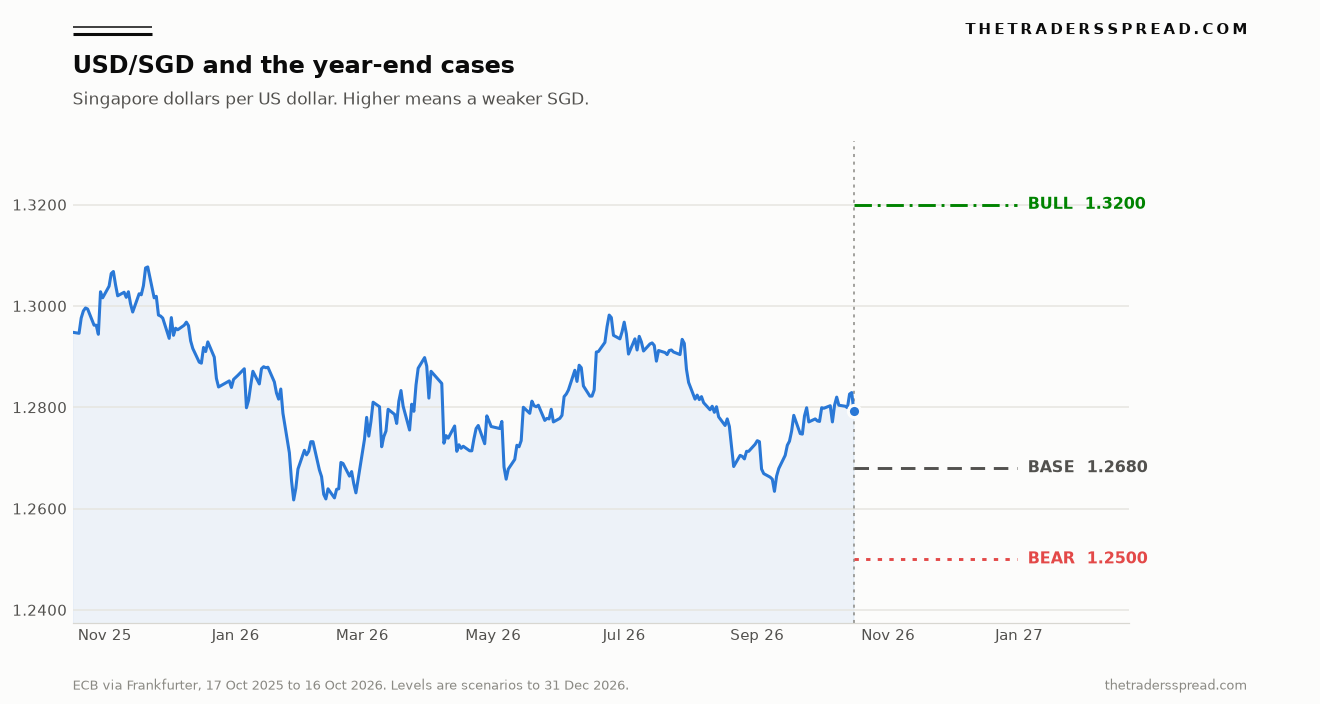
1.2680 is 112 pips under 1.2792, about 0.9%. Maybank's FX team, after the hold, looks for 1.2650 by the fourth quarter, 30 pips lower, and for 1.2450 only by the third quarter of 2027. I sit above their year-end mark because the slope was not steepened and because a pop to 1.2829 already failed. The base is a drift toward the January and August neighbourhood, not a break.
| Scenario | USD/SGD | Against 1.2792 | What has to be true by 31 December |
|---|---|---|---|
| Base | 1.2680 | 112 pips lower, about 0.9% | The slope keeps working, the dollar does not extend, and the fixing drifts lower without a new low |
| Bull | 1.3200 | 408 pips higher, about 3.2% | The dollar outruns the basket, the upper-half cushion compresses, and 1.30 stops capping the rate |
| Bear | 1.2500 | 292 pips lower, about 2.3% | The slope plus a softer dollar takes the reference through the 28 January low of 1.2617 |
1.3200 is outside the data. The high in the window is 1.3077, so the bull case is a new high, about 3.2% above the latest reference. It needs the dollar, not a slip by MAS. Chew's cushion and Maybank's were 1.4% and 1.55% above their own midpoints, 15 basis points apart, on a figure the Authority does not release. Both mean the upper half. Averaging them into an official print would be theatre.
1.2500 is 117 pips under the 28 January low. Maybank's 1.2450 belongs to the third quarter of 2027, not to this December. Pulling it forward ignores the statement's point that energy prices have risen again since September. A stronger Singapore dollar would help that inflation problem, so the Authority would not fight the tail. It also just refused to speed the slope up. The bear case is the existing pace in a softer dollar.
The line that actually retires the base is 1.3000, not 1.3200. DBS, as The Business Times recounted on 15 October, has described the pair as stable from roughly 1.26 to 1.30 through two tightenings, the Federal Reserve's September increase, and a dollar index that on that account hit an 18-month high. A fixing that holds above 1.30 means the range, not the bull-case extreme, has stopped mattering.
Funding currency, or a scarce institution
Joey Chew, head of Asia FX research at HSBC, wrote what The Business Times reported on 15 October: "Given that the next MAS meeting is only in late January, we suspect the market will go back to seeing the SGD as a potential funding currency in the region." Borrowing a low-yielding Singapore dollar to hold something else is a bid for USD/SGD. Enough of it also leans on the basket.
On the figures the Business Times attributed to her, the basket's implied yield was about minus 1.6%, and the S$NEER fell only about 10 basis points on the day because it had not risen much into the meeting. She still reads the Authority as wanting the basket to appreciate with the slope. The constraint is operational. Reserves have fallen once redemptions and maturing long forwards are allowed for. Dollars have been sold against the Singapore dollar while MAS bills have been redeemed on net. Until intervention is less sterilised and US rates stop rising, forward points struggle. FX deposits have grown. Singapore-dollar deposits have not.
Bank of America analysts Ang Kai Wei and Abhay Gupta kept an interest in positioning against the basket. Low volatility near the top of the band can do that even when the rate gap is only about 40 basis points a year. They look for the Singapore Overnight Rate Average around 1.2–1.4%, and for what the paper called a "calibrated tightening" in January 2027, not this January. Chew's conditions for another move are also early 2027: oil staying high, El Niño lifting food import costs, or the AI boom outlasting the Authority's forecast. This call assumes ten weeks of the slope already in place.
Maybank's FX research, led by Saktiandi Supaat, is on the other side: "We remain bullish on the SGD as the credibility of its institutions is an increasingly scarce commodity in an uncertain world and this should continue to build SGD resilience." Their marks are 1.2650 by the fourth quarter of 2026 and 1.2450 by the third quarter of 2027. The Business Times said the team prefers to sell dollars on rallies. The 14 October afternoon is the exhibit they would cite. The steepening did not come. Their marks edged from 1.2796 to 1.2810. The ECB reference gave the pop back.
Rates abroad are the hinge between those two notes. The Authority said higher interest rates in the advanced economies would weigh on final demand into 2027. Transmission from a high Treasury yield into prices is a separate question, set out in the note on what a 5.31% US 10-year yield does to prices. A stronger dollar helps Chew's funding bid and puts 1.30 in play. Yields that stop rising remove one of her conditions. USD/KRW is where a broad Asian dollar leg shows up when the move is not Singapore's alone. The fixing will not be decided only on Shenton Way.
RelatedAUD/CHF Forecast: 0.6120 Bull Case vs 0.5480 Bear Case
The dull outcome is also available. Basket in the upper half, slope unchanged, SORA near 1.2–1.4%, USD/SGD chopping between 1.27 and 1.29. That sits next to the base. It is not 1.2500 and it is not 1.3200. It is most of the chart since spring.
Where I put the weight
Base case: 1.2680 by 31 December 2026, with about half the weight. Under the 1.2792 fixing, above the 1.2617 low. The slope does a little more work, the dollar does not drag the basket down from the upper half, and the funding bid stays noise. Entry is the fixing. Target is 1.2680. Conviction is 3 out of 5, because the basket and the bilateral rate are related without being the same price.
Bull case: 1.3200, about one weight in five. The dollar has to do to this cross what it last did on 21 November 2025, against an appreciating band. I would need the bank models' cushion to compress, the fixing to stop respecting 1.30, and the won, the baht and the offshore renminbi to weaken with it. The base is already wrong if the reference holds above 1.3000. Waiting for 1.3200 to admit that would be late.
Bear case: 1.2500, about three weights in ten on a path that threatens it, and less on finishing there by New Year. Through 1.2617, toward Maybank's 1.2450, which they date to the third quarter of 2027. Energy prices firm since September keep that mark in next year. The Authority would not fight a stronger Singapore dollar. It also refused to hurry, so the tail stays a tail.
A steepening before 31 December, scheduled or not, would pull the base toward 1.26 and make 1.2500 ordinary. A core print that breaks the narrowed 1.5–2.0% band and revives a recentring, rather than another small slope change, would be stronger than 1.2500. I am not pricing a recentring. A reference above 1.3000, with the basket models back near the midpoint, retires 1.2680.
None of these levels is an instruction. The pair can sit on 1.2792 for weeks. On 18 October the slope is still appreciating, the bilateral rate is mid-range, the fixing has faded the surprise, and the next decision is late January, after this horizon.
Reader questions
What is the USD/SGD forecast into the end of 2026?
The base case is 1.2680 on the ECB reference by 31 December 2026, against 1.2792 on 16 October. The bull case, a higher rate and a weaker Singapore dollar, is 1.3200. The bear case is 1.2500. About half the weight sits on the base, less on the bear path, and least on the bull path. The horizon ends before the late-January MAS review.
Does a higher USD/SGD mean a stronger Singapore dollar?
No. USD/SGD is the number of Singapore dollars per US dollar. At 1.2792, one dollar costs 1.2792 Singapore dollars. A rise toward 1.3200 means the Singapore dollar buys fewer US dollars. A fall toward 1.2500 means it buys more. The S$NEER can firm even when this bilateral rate does not, which is what the October fixings showed.
Why did MAS not steepen the band in October?
The Authority kept the slope, width and centre where July had left them. Core inflation is a bit above 2% and is forecast to ease more clearly from mid-2027. The 2026 core range was narrowed to 1.5–2.0%. Growth is firm, at 5.4% year on year in the third quarter, but the output gap is expected to narrow. The earlier steepenings are still in the band. A third was the street's forecast, not the decision.
How is the S$NEER different from this pair?
The S$NEER is a trade-weighted basket inside a policy band. USD/SGD is one bilateral rate. MAS does not publish the weights, the slope or the centre. Bank estimates that put the basket 1.4% or 1.55% above the midpoint on 14 October are models, and they differed. The ECB fixing is the number that can be checked. Treating the two prices as one is how a week like this one becomes a surprise.
What level retires the base case?
A reference that holds above 1.3000. That is inside the bull case of 1.3200 and above the 1.26–1.30 area DBS has described as the pair's stable range. The drift toward 1.2680 would be the wrong call even if the rate never reached 1.32. A steepening of the band before year-end would pull the base down rather than cancel the direction.
This is analysis, not advice. Foreign exchange can move through any of these levels, and capital is at risk. The figures are scenarios built from the ECB reference, the 14 October policy statement and named bank research. They are not a recommendation to transact in USD/SGD or in any other instrument.