

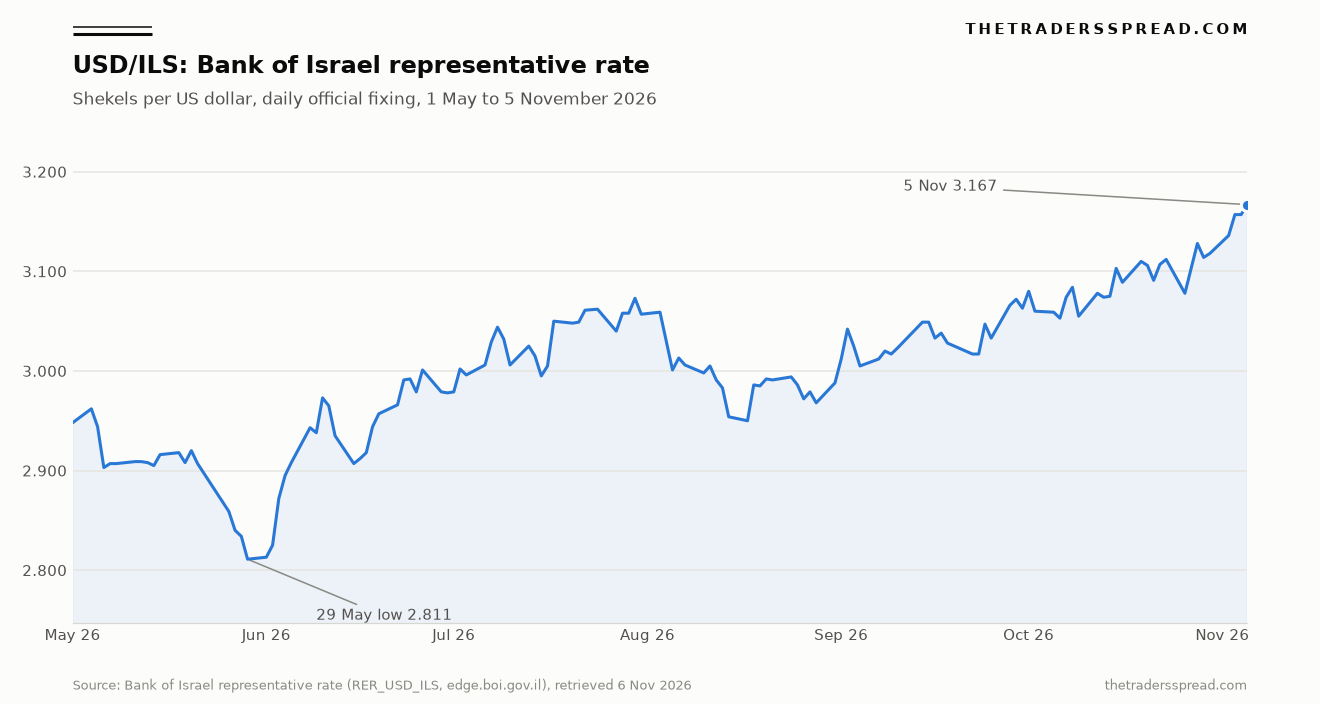
USD/ILS has climbed 12.7% from its 29 May low, and the Bank of Israel's representative rate of 3.167 shekels per dollar on 5 November is the weakest shekel fixing since 30 March, according to the central bank's own representative rate series. Over the five fixings from 30 October to 5 November the pair rose 1.6%, from 3.118 to 3.167, and the interbank market has kept going: Yahoo Finance's ILS=X feed showed 3.2093 at 06:06 UTC on 6 November.
Two independent fixes tell the same story. The ECB-derived cross published by Frankfurter moved from 3.1284 on 30 October to 3.1716 on 5 November, a 1.4% gain for the dollar. That ECB figure is a once-a-day reference calculated from euro rates, so it lags live trading, yet it lines up with the Bank of Israel number within half a percent. The more telling link runs through inflation. A weaker shekel raises the cost of imports, and imported inflation is the channel that could stall the Bank of Israel's easing path, which in turn would remove one of the forces pushing the shekel lower.
How the slide unfolded
The timeline below uses Bank of Israel representative rates unless marked otherwise.
| Date | USD/ILS | What happened |
|---|---|---|
| 26 Oct | 3.078 | Last fixing before the 27 October Israeli election |
| 28 Oct | 3.128 | First fixing after the vote, up 1.6% in one print |
| 30 Oct | 3.118 | Start of the five-fixing window |
| 3 Nov | 3.157 | Globes reports the shekel at a seven-month low |
| 5 Nov | 3.167 | Weakest fixing since 30 March (3.170) |
| 6 Nov | 3.2093 | Yahoo ILS=X interbank quote, 06:06 UTC |
From the last pre-election fixing to 5 November the dollar gained 2.9% against the shekel.
Why the shekel is weakening
Globes reporter Tzachi Greenvald wrote on 3 November that the shekel traded at NIS 3.154 per dollar in afternoon interbank dealing, its weakest level since late March. Yossi Menashe, founder and co-CEO of Altshuler Shaham Financial Services, told the paper that the dollar had been "consistently strengthening since hitting a low of NIS 2.80/$ around June." He named interest rate differentials first, with Israeli rates falling while US cuts are delayed, and political uncertainty in both countries second.
Modi Shafrir, chief financial markets strategist at Bank Hapoalim, tied the 3 November move to a Nasdaq decline the previous day and to open questions over government formation and Iran. Eytan Kleinman, a managing partner at Long Road, made a similar case in the same report.
Policy has stayed put. The Bank of Israel's Monetary Committee kept its rate unchanged at 3.25% on 21 October and published the minutes of that discussion on 4 November.
The reserves cushion
Israel's foreign exchange reserves stood at $237.773 billion at the end of October, up $775 million in the month, Globes reported on 5 November citing the Bank of Israel. Most of the increase came from a revaluation of about $1.755 billion, partly offset by roughly $965 million of government foreign exchange activity. Reserves equal 34.3% of GDP, which gives the central bank room to act if it judges the move disorderly.
Other emerging-market dollar pairs have shown how rate gaps and political risk interact; see our USD/TRY forecast and the USD/ZAR scenario map for two other cases.
Key facts
- Bank of Israel USD/ILS representative rate: 3.167 on 5 November, up from 3.118 on 30 October (Bank of Israel, 5 Nov 2026).
- Low of the year so far: 2.811 on 29 May, making the rise to 5 November 12.7% (Bank of Israel, 5 Nov 2026).
- Live quote: 3.2093 on Yahoo Finance ILS=X at 06:06 UTC (Yahoo Finance, 6 Nov 2026).
- Policy rate held at 3.25% on 21 October (Bank of Israel, 21 Oct 2026).
- FX reserves at $237.773 billion at end-October, up $775 million (Globes citing Bank of Israel, 5 Nov 2026).
What to watch
15 November: Israel's Central Bureau of Statistics lists the October consumer price index for that date on its release calendar. A hot reading would test Menashe's warning that a weaker shekel feeds imported inflation.
RelatedUSD/HKD Peg: What the Convertibility Band Actually Does
23 November: the Bank of Israel's next interest rate announcement, due at 16:00 Israel time according to its 2026 schedule. A hold at 3.25% after a 12.7% dollar rally since May would signal how much currency weakness the committee is prepared to absorb.
8–9 December: the Federal Reserve's final FOMC meeting of the year, the other half of the rate gap that Menashe identified.
This article is for information only and is not investment advice. Currency trading carries a high risk of loss.