

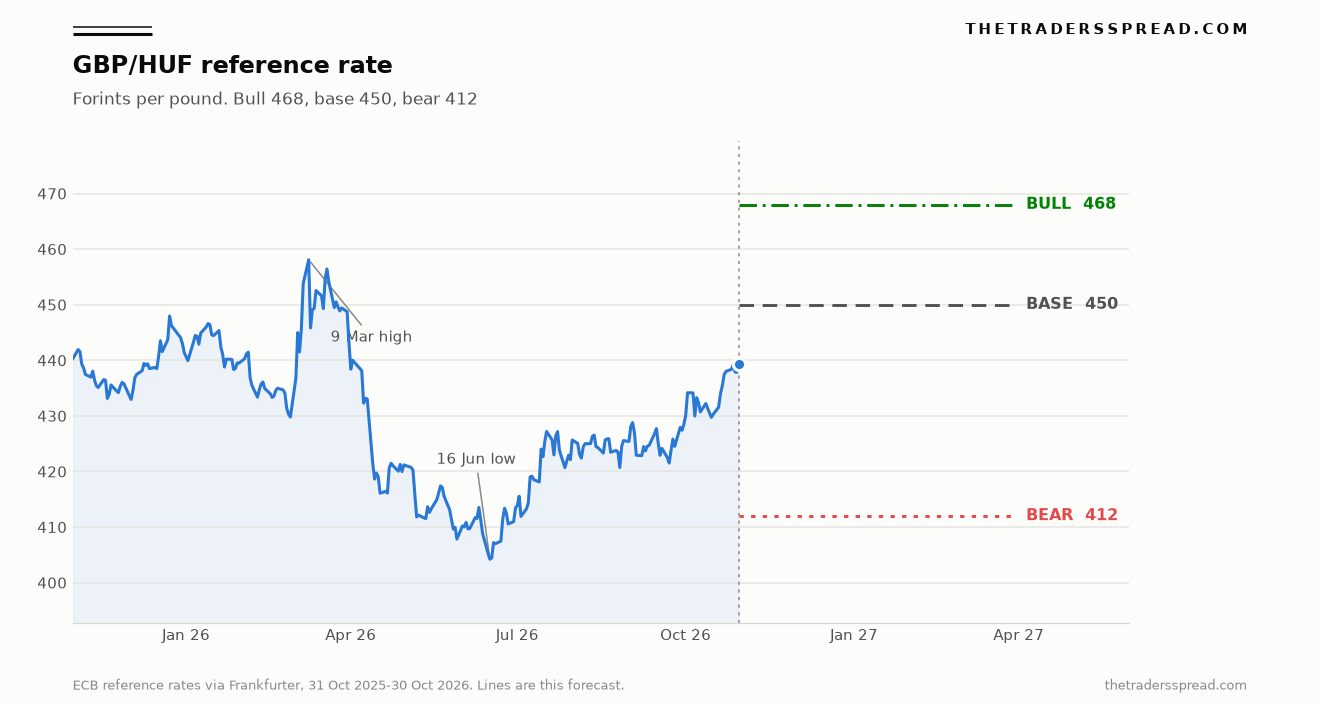
GBP/HUF closed the European Central Bank reference day of 30 October 2026 at 439.35, only 0.87 forint below the 440.22 print of 31 October 2025, after a round trip of 53.86 forints.
The two currencies inside that flat ratio moved hard, and they moved against the euro in the same direction. EUR/HUF fell from 388.10 to 366.33, a 5.6 percent gain for the forint. EUR/GBP fell from 0.8816 to 0.8338, which lifted sterling from 1.1343 to 1.1993 pounds per euro, a 5.7 percent gain. GBP/HUF is the forint-per-euro rate divided by the pound-per-euro rate. On 30 October that division is 366.33 / 0.8338, equal to 439.35, the same number Frankfurter publishes as the direct fix. A year that looks quiet in the cross is two large euro moves cancelling each other.
Between those endpoints the cross peaked at 458.08 on 9 March 2026 and troughed at 404.22 on 16 June 2026. EUR/GBP was 0.8653 on the high and 0.8647 on the low, so the 11.8 percent drop was the forint: EUR/HUF went from 396.38 to 349.53. The 8.7 percent rebound to 439.35 splits into a 4.8 percent forint giveback against the euro and about 3.7 percent from sterling’s further rise.
| ECB date | GBP/HUF | EUR/HUF | EUR/GBP | Reading |
|---|---|---|---|---|
| 31 Oct 2025 | 440.22 | 388.10 | 0.8816 | Start of the window |
| 9 Mar 2026 | 458.08 | 396.38 | 0.8653 | High of the window |
| 16 Jun 2026 | 404.22 | 349.53 | 0.8647 | Low of the window |
| 30 Oct 2026 | 439.35 | 366.33 | 0.8338 | Latest reference fix |
Frankfurter, called on 2 November 2026, returned base GBP, date 2026-10-30, rate 439.35. The one-year history covers 255 ECB days from 31 October 2025, and the euro-leg rebuild matches the direct series. Sterling’s euro rate has its own levels in the EUR/GBP forecast. The chart draws the 255 fixes and three lines to 31 March 2027: bull 468, base 450, bear 412.
Key facts
- GBP/HUF was 439.35 on the ECB reference day of 30 October 2026, against 440.22 on 31 October 2025, a change of 0.87 forint. Source: Frankfurter API, ECB reference rates, retrieved 2 November 2026.
- The high in that window was 458.08 on 9 March 2026 and the low was 404.22 on 16 June 2026, a range of 53.86 forints. Source: Frankfurter API, ECB reference rates, retrieved 2 November 2026.
- Bank of England Bank Rate is 3.75 percent, last changed on 18 December 2025 from 4.00 percent, with the next decision due on 5 November 2026. Source: Bank of England Bank Rate database and monetary policy page, last updated 21 October 2026.
- The Magyar Nemzeti Bank base rate is 5.50 percent, the overnight deposit 4.50 percent and the overnight collateralised loan 6.50 percent, effective 21 October 2026. Source: MNB Monetary Council press release, 20 October 2026.
- UK CPI rose 3.5 percent in the twelve months to September 2026, up from 3.1 percent in August, with motor fuels the largest upward contribution. Source: Office for National Statistics, released 21 October 2026.
- Hungarian inflation was 1.6 percent in September 2026 and core inflation was 1.9 percent. Source: MNB Monetary Council press release, 20 October 2026.
- The nominal policy gap is 175 basis points, against 250 basis points on 31 October 2025, when Bank Rate was 4.00 percent and the MNB base rate was 6.50 percent. Source: Bank of England database and MNB base-rate history, read 2 November 2026.
Two currencies cancelled each other out
A higher GBP/HUF can arrive from a weaker forint against the euro, a stronger sterling rate against the euro, or both in a smaller size. The March-to-June drop was a forint story: the pound-per-euro rate differed by 0.0006 between 9 March and 16 June, and the cross still fell 53.86 forints. October was the sterling share of the rebound. EUR/GBP went from 0.8537 on 1 October to 0.8338 on 30 October, while EUR/HUF went from 367.18 to 366.33, and the Hungarian base rate was unchanged.
The GBP/SEK rate-path piece asks whether a sterling cross is really a dollar cross. On GBP/HUF the euro legs already reproduce the fix to the hundredth of a forint.
Nominal gap, June low
Bank Rate is the UK legal rate. The Bank of England database, read on 2 November 2026, shows 3.75 percent, after the cut from 4.00 percent on 18 December 2025, so 4.00 percent was the rate on 31 October 2025. The monetary policy page, updated 21 October 2026, sets the next announcement for 5 November 2026. On 16 September the committee voted 6–3 to hold, with Greene, Mann and Pill for 4 percent. Minutes of that vote appeared on 17 September.
The Hungarian legal rate is the central bank base rate. The history page shows 6.50 percent from 25 September 2024, then the cuts in the table, down to 5.50 percent on 26 August. The 20 October release left 5.50 percent in place from 21 October, overnight deposit 4.50 percent and overnight collateralised loan 6.50 percent: 100 basis points of cuts, then a hold. The gap in the table is the base rate minus Bank Rate.
| ECB date | Bank Rate | MNB base rate | Gap | GBP/HUF |
|---|---|---|---|---|
| 31 Oct 2025 | 4.00% | 6.50% | 250 bp | 440.22 |
| 18 Dec 2025 | 3.75% | 6.50% | 275 bp | 443.52 |
| 25 Feb 2026 | 3.75% | 6.25% | 250 bp | 431.35 |
| 9 Mar 2026 | 3.75% | 6.25% | 250 bp | 458.08 |
| 16 Jun 2026 | 3.75% | 6.25% | 250 bp | 404.22 |
| 24 Jun 2026 | 3.75% | 6.00% | 225 bp | 413.37 |
| 22 Jul 2026 | 3.75% | 5.75% | 200 bp | 426.41 |
| 26 Aug 2026 | 3.75% | 5.50% | 175 bp | 420.71 |
| 30 Oct 2026 | 3.75% | 5.50% | 175 bp | 439.35 |
The widest gap, 275 basis points on 18 December 2025, sat beside 443.52. The June low of 404.22 arrived at a 250 point gap, with the base rate still 6.25 percent; the cut to 6.00 percent is dated 24 June, when the cross was already 413.37. The March high of 458.08 happened at that same 250 point gap. From June to August the differential narrowed from 250 basis points to 175 and the cross rose to 420.71. October’s rise to 439.35 came on the sterling leg, with Hungary on hold.
Andrew Bailey, Governor of the Bank of England, set the UK side on the decision page of 17 September 2026: “Today, we’ve held Bank Rate at 3.75%. So far, higher global energy costs have had a limited effect on price and wage setting in the UK. But the longer this volatility persists, the bigger the impact it will have on inflation, and the more likely it is we will need to raise Bank Rate to ensure that inflation falls back to our 2% target.” The minutes price that energy move at the 14 September close: Brent at $106 a barrel, up 36 percent versus the run-up to the July Report, and UK gas at 207 pence a therm, up 78 percent. The Market Participants Survey, closed on 4 September, had a median of a long hold, while the short-rate curve peaked near 4.9 percent by the end of 2027.
The Bank of England posted the 6–3 hold on the day the September decision was published. That vote is the last Bank Rate decision absorbed by the cross ahead of the 5 November meeting.
The Monetary Policy Committee voted 6-3 to keep the interest rate at 3.75%.
— Bank of England (@bankofengland) September 17, 2026
Find out more:https://t.co/GHHt7QdrbF pic.twitter.com/9tlJ8aqmM9
Why the real rate still leans to the forint
The nominal gap and the real gap point different ways, which is the main objection to a bullish reading of GBP/HUF. UK CPI rose 3.5 percent in the twelve months to September 2026, the Office for National Statistics said on 21 October, up from 3.1 percent in August. Bank Rate of 3.75 percent minus 3.5 percent is an ex-post real rate of about 0.25 point, and staff in the September minutes looked for CPI slightly above 4 percent early in 2027. Hungary’s September inflation was 1.6 percent and core 1.9 percent, with Council averages of 1.8 percent for 2026 and 3.1 percent for 2027, and a 2.5 percent target from 1 January 2028. A 5.50 percent base rate minus 1.6 percent is a 3.9 point real rate, about 3.65 points above the UK figure and more than twice the 1.75 point nominal gap. The Council said the current rate is necessary. Abridged minutes, due at 2 p.m. on 4 November, sit outside these levels.
Mihály Varga, Governor of the Magyar Nemzeti Bank, said on 10 October: “Adopting the euro may benefit Hungary, but more important than the date is that the Hungarian economy is adequately prepared to introduce the common currency.” The Bank’s account adds that euro adoption would mean giving up an independent interest-rate policy, that the 2.5 percent target is a milestone, and that 1.6 percent inflation still leaves external risks. A 3.9 point real rate plus a preparation story, rather than a calendar date, gives the forint buyers who can wait.
Bull case arithmetic at 468
The lean is toward the bull side, and it is a modest lean. The bull case is 468 by 31 March 2027. From 439.35 that is 28.65 forints, or 6.5 percent, and it sits above the March 2026 high of 458.08, so it asks for a new high in the cross.
One mix that produces 468 is EUR/HUF near 380 and EUR/GBP near 0.812, since 380 / 0.812 equals 467.98. That is a 3.7 percent softening of the forint from 366.33, still short of the March reading of 396.38, and a further 2.7 percent sterling gain, from 1.1993 pounds per euro to 1.2315. Each leg is smaller than the move it has already made since June.
Peter Virovacz, ING’s chief economist for Hungary, writing on 15 October with Frantisek Taborsky, EMEA FX & FI Strategist, and Zoltán Homolya, economic research trainee, expected the hold the Council then delivered. Past that meeting they wrote: “Looking ahead, we still expect monetary easing before year-end. Our assumption is that domestic developments will open the door to a 25bp rate cut in December, leaving the base rate at 5.25% at end-2026.” They forecast a terminal rate of 4.25 percent next year. A December cut to 5.25 percent, with Bank Rate still at 3.75 percent, would take the gap from 175 basis points to 150. A Hungarian rate of 4.25 percent against a UK rate of 3.75 to 4.00 percent would leave 25 to 50 basis points, against the 250 point gap of the first half of this window.
Catherine Mann, a member of the Monetary Policy Committee, wrote in the September minutes: “Since my vote to increase Bank Rate in July, upside risks to inflation have increased as the ‘sporadic continuance’ of conflict has ratcheted up energy prices well above the baseline from the July Report.” She added: “Raising Bank Rate is a better risk-management strategy when faced with uncertainty about inflation dynamics and second-round effects.” Greene and Pill voted with her. Bailey’s line is conditional on how long the energy volatility lasts. These levels use the 3.75 percent rate still on the database, ahead of 5 November.
Static carry is too small to reach 468 on its own. A 175 basis point differential on 439.35 is about 7.7 forints a year, and the 152 days to 31 March 2027 are about 3.2 forints if nothing else moves. The bull case is 29 forints above the spot. The gap’s job is to change who holds forints against sterling.
A base path near 450
The base path is 450, 10.65 forints or 2.4 percent above the 30 October fix, the middle line on the chart. EUR/GBP stays near 0.8338 and the forint eases to about 375 per euro: 375 / 0.8338 equals 449.7, a smaller move than the 4.8 percent already given back since June. The policy reading is ING’s December cut to 5.25 percent, only partly in the currency. Against the Council’s 3.1 percent average for 2027 that rate is still a real yield above 2 points, so the bid Varga described can survive the trim. After a 53.86-forint year, 450 is the smaller request and 468 needs both legs.
Bear case arithmetic at 412
The bear case is 412, 27.35 forints or 6.2 percent under the latest fix, and it sits above the June low of 404.22. Replay June’s EUR/HUF of 349.53 at today’s EUR/GBP of 0.8338 and the cross prints 419.2, because sterling is stronger against the euro than it was on the day of that low.
One mix that produces 412 is EUR/HUF near 352 and EUR/GBP near 0.8544, since 352 / 0.8544 equals 412.0. That is a 3.9 percent forint gain from 366.33, still short of 349.53, and a sterling giveback from 1.199 pounds per euro to about 1.170, roughly 2.4 percent of the euro rally. The forint reclaims most of the post-June loss, and sterling hands back part of the move from 1.134.
The dollar price of the forint is a separate forecast, set out in the USD/HUF forecast. GBP/HUF still collapses to the two euro rates, so a dollar path reaches this cross only after it has moved EUR/HUF or EUR/GBP.
RelatedEUR/RON vs USD/RON when the leu sets the cross rate
The same ING note is still with the forint. Virovacz, Taborsky and Homolya wrote that a more hawkish market stance, combined with steps toward euro adoption, should be positive for the forint, and that “These factors make gains for the forint challenging to achieve, yet our FX outlook remains bullish.” That view pulls GBP/HUF down unless sterling’s euro gain outruns it, which is why 412 stays beside 468 and the lean carries low conviction. A 3.9 point real rate and a paused Council can hold buyers while the base rate edges lower.
The level that retires the bull case, before 412 is reached, is 420. From 439.35 that is a 4.4 percent decline, within a forint of the 419.2 that June’s EUR/HUF would print at today’s sterling-euro rate. Under 420 the working description is the bear map. Above 420 the bull case, including the base at 450, remains the working description.
What would flip either reading
The bull case flips if the gap stops narrowing and the cross trades through 420. That is a base rate held at 5.50 percent, the stance the 20 October release calls necessary, with the Bank of England leaving the hike dissent unanswered. A cut in Bank Rate would widen the gap from the UK side. A forint near 350 per euro does the same job even if neither committee moves: at today’s EUR/GBP that rate is already a GBP/HUF print near 419.
The bear case flips if ING’s cuts show up in the currency and sterling holds its euro gain. A base rate moving from 5.50 percent toward 5.25 percent this year and 4.25 percent next year, with EUR/HUF toward 380 and EUR/GBP near 0.83 or lower, is the 468 mix. Varga has tied euro adoption to preparation, low inflation and fiscal balance. A hurried date, or a fiscal path the Council has already listed with euro-adoption expectations and the external market as the three influences on its assessment, would strain the idea that those steps support the forint.
A longer energy shock, on the September minutes, makes a Bank Rate rise more likely and supports the bull case. The same shock supports the bear case if the Council keeps the base rate at 5.50 percent. The 152 days to 31 March 2027 cover a plausible MNB cut, the Bank of England decision on 5 November, and about 3 forints of static carry. The lean is bull of 439.35 because the gap has narrowed, and the cross has risen with it, since June. At 412 the real rate is what the forint is trading.
Frequently asked questions
What is the policy-rate gap between Britain and Hungary?
Bank Rate is 3.75 percent and the MNB base rate is 5.50 percent, a nominal gap of 175 basis points. The overnight deposit is 4.50 percent and the overnight collateralised loan is 6.50 percent from 21 October 2026. A year earlier the gap was 250 basis points. September inflation was 1.6 percent in Hungary and 3.5 percent in the UK, so the real gap is wider.
What has to happen for the bull case at 468?
The gap has to keep narrowing, and some of that has to reach the cross. One mix near 468 is EUR/HUF around 380 and EUR/GBP around 0.812. ING looks for a Hungarian base rate of 5.25 percent by the end of 2026 and 4.25 percent next year. A Bank Rate hold, or a rise toward 4 percent, would narrow the gap from the UK side too.
What would make 412 the better map?
A 5.50 percent base rate minus 1.6 percent September inflation is about 3.9 points, against about 0.25 point in the UK. If buyers stay with the forint and sterling gives back part of its euro gain, EUR/HUF near 352 and EUR/GBP near 0.8544 lands on 412. A fall through 420 retires the bull case first. June’s EUR/HUF, at today’s euro-sterling rate, would put GBP/HUF near 419.
Does the euro-adoption debate set GBP/HUF by itself?
Mihály Varga said on 10 October 2026 that adopting the euro may benefit Hungary, while preparation matters more than the date, and that Hungary would give up an independent rate policy. ING still calls its foreign-exchange outlook bullish the forint, alongside further cuts. The debate moves GBP/HUF only through EUR/HUF against sterling’s euro rate.
These levels are a forecast of an ECB reference rate for GBP/HUF, not a recommendation to buy or sell sterling, the forint, or any contract linked to the cross. Policy decisions after publication, including the Bank of England announcement scheduled for 5 November 2026, can retire them.