

USD/KRW opened at 1,374 in Seoul on Tuesday morning and then fell almost without a pause. Exporters were converting dollar receipts before the Chuseok holiday, foreign institutions were selling dollars in size, and one commercial-bank dealer told the Seoul Economic Daily there were "hardly any bids." By the close the pair sat at 1,358.2, down 22.8 won on the session, its steepest one-day drop since 8 July. The paper noted the move came even as the dollar gained ground globally, six days after the Federal Reserve raised rates and left the Korean policy rate a full percentage point below the top of the US range. Our live read this morning is 1,364.90 (CNBC quote feed, 07:35 UTC, 23 September). The latest ECB reference fix, from 22 September, is 1,356.15. From the 1 July fix of 1,558.09, that is a 13.0% fall in less than three months.
Here is what most won coverage misses. Between 28 August and 9 September, Brent crude rose 22% to $109.51 a barrel, and the won still printed a 23-month high against the dollar on 9 September. Korea relies heavily on imported energy, and the usual expectation is that a jump in oil prices pushes USD/KRW higher. This time chip revenue outran the fuel bill. In the first 20 days of September, semiconductor exports came to $34.12 billion, up 259% on the year according to Korea Customs Service data, and the trade surplus for those 20 days was $23 billion. So the question for the fourth quarter is flows. Neither oil nor the rate gap will decide it.
Key facts
- USD/KRW ECB reference fix 1,356.15 on 22 Sep 2026, down 8.83% from 1,487.52 on 23 Mar and 12.96% below the 1,558.09 peak on 1 Jul (api.frankfurter.dev, retrieved 23 Sep 2026)
- Bank of Korea Base Rate raised 25bp to 3.00% on 27 Aug 2026 in a 6-1 vote, its second consecutive hike (Bank of Korea statement, 27 Aug 2026)
- The Fed raised its target range by 25bp to 3.75%–4.00% on 16 Sep 2026, so the top of the US range now sits 1.00 point above the BoK rate (Federal Reserve, 16 Sep 2026)
- Korea's current account surplus was $49.73bn in June and $42.08bn in July 2026 (Bank of Korea ECOS table 301Y013, retrieved 23 Sep 2026)
- Exports for 1–20 Sep reached $71.4bn, up 78%, with chips making up about 48% of the total (Korea Customs Service, reported by The Korea Times, 21 Sep 2026)
- Net foreign outflows from Korean securities narrowed to $4.50bn in August from $30.72bn in June (Bank of Korea Q3 market report, reported by Aju Press, 17 Sep 2026)
- Brent rose from $89.75 on 28 Aug to $130.80 on 15 Sep, a 45.7% increase (FRED DCOILBRENTEU, retrieved 23 Sep 2026)
How does an oil importer's currency rally into $130 Brent?
Start with the size of the flows. The Bank of Korea's ECOS database shows current-account surpluses of $28.29 billion in April, $38.61 billion in May, $49.73 billion in June and $42.08 billion in July. That adds up to $158.7 billion in four months. The Korea Times, reporting the July release, noted that goods exports alone were $100.4 billion in July, up 65.3% on the year, and that Korea has posted a surplus for 39 months running.
Oil does show up in these numbers. It just no longer dominates them. Brent's jump from $89.75 on 28 August to $130.80 on 15 September is the kind of shock that would normally push the won weaker, because refiners and utilities have to buy dollars for every cargo. Customs data for 1–20 September put imports up 26.7% on the year at $48.4 billion. That is a real increase in the import bill, and it was still covered almost one and a half times by exports of $71.4 billion. Chips alone brought in $34.12 billion.
The surplus was huge through June as well, and yet the USD/KRW ECB fix peaked at 1,558.09 on 1 July. That points to where the dollars went. In the first half they left the country through portfolio outflows. According to the Bank of Korea's third-quarter market report, as reported by Aju Press, net foreign outflows from Korean securities were $30.72 billion in June and $21.65 billion in July, then fell to $4.50 billion in August. Foreign equity flows turned to a small $40 million inflow in August after a $20.70 billion outflow in July. The trade surplus did not change much between June and August. The outflows that used to absorb it did.
The Bank of Korea said the same in its 27 August decision. In his opening remarks, Governor Shin Hyun Song said that "the Korean won to US dollar exchange rate fell significantly to the upper 1,300 won range as foreign exchange market supply-demand conditions improved due to a moderation in foreign investors' stock investment outflows and a weakened US dollar." The central bank named the outflows first and the dollar second.
That order matters. The Fed's broad trade-weighted dollar index (FRED DTWEXBGS) fell only 1.35% between 1 July and 18 September. Over the same dates USD/KRW fell 10.9% on the ECB fixes. The won accounts for almost all of that move. Aju's summary of the BoK report puts numbers on it: from end-July to 15 September the won gained 4.8% against the dollar, compared with 1.9% for the yen, 1.4% for the Taiwan dollar and 1.8% for the rupiah.
The rate gap went against the won, and the won kept rising
Most USD/KRW models start from the policy-rate spread, and on that measure the won should have been weakening all month. The Bank of Korea raised by 25 basis points in July and again in August, taking the Base Rate to 3.00%. The Fed's 16 September statement then lifted the US target range "by 1/4 percentage point to 3-3/4 to 4 percent." The gap to the upper end of the US range widened from 0.75 point to 1.00 point.
The pair did respond for a while. The ECB fix climbed from 1,336.20 on 9 September to 1,388.10 on 18 September, and the Seoul close rose for seven straight sessions through 18 September. The Korea Times wrote that the 1,400 level was back in view and quoted Lee Yoo-jung, a researcher at Hana Bank: "The Fed's rate hike has fueled dollar strength, so the possibility of the exchange rate reaching 1,400 won needs to be taken into account." Lee also said: "The recent rise in the exchange rate can largely be viewed as a move driven by broad dollar strength."
Four days after the Fed hike, exporters and foreign institutions took back nearly half of that rise in a single session.
So the spread tells you which way the pressure points, while exporter supply decides how far the pair actually travels. With the trade surplus near $23 billion in 20 days, a one-point rate gap costs a Korean exporter little when it decides to convert dollars into won. It does matter for Korean life insurers and pension funds that hold dollar assets and hedge them, and that is why the rate gap shows up gradually through hedge ratios rather than in one day's price.
The Bank of Korea's guidance leans toward more hikes. The statement says the Board "will decide the timing and pace of further increases in the Base Rate while assessing the trends in inflation and the domestic economy, as well as financial stability." It raised its 2026 growth forecast to 3.3% from 2.6% and its core inflation forecast to 2.5%, and it warned about Seoul housing prices and household credit. One member, Hwang Kunil, voted to hold. The next rate decision is on Thursday 22 October, according to the Board's published 2026 calendar. A third hike would cut the gap back to 0.75 point without any help from Washington.
Tokyo is tightening too. The Bank of Japan's 18 September statement set the overnight call rate at around 1.25% in a 7-2 vote, effective 24 September, so the Fed is not the only central bank in the region's funding markets that is tightening. Our earlier USD/JPY forecast sets out the yen levels.
Twelve months of fixes, and where the levels sit
The chart uses ECB reference fixes rather than Seoul closes, so it can be checked against a free public series. The two differ by a few won on most days. The 9 September low, for example, was 1,336.20 on the ECB fix and 1,336.1 at the Seoul close reported by The Korea Times.
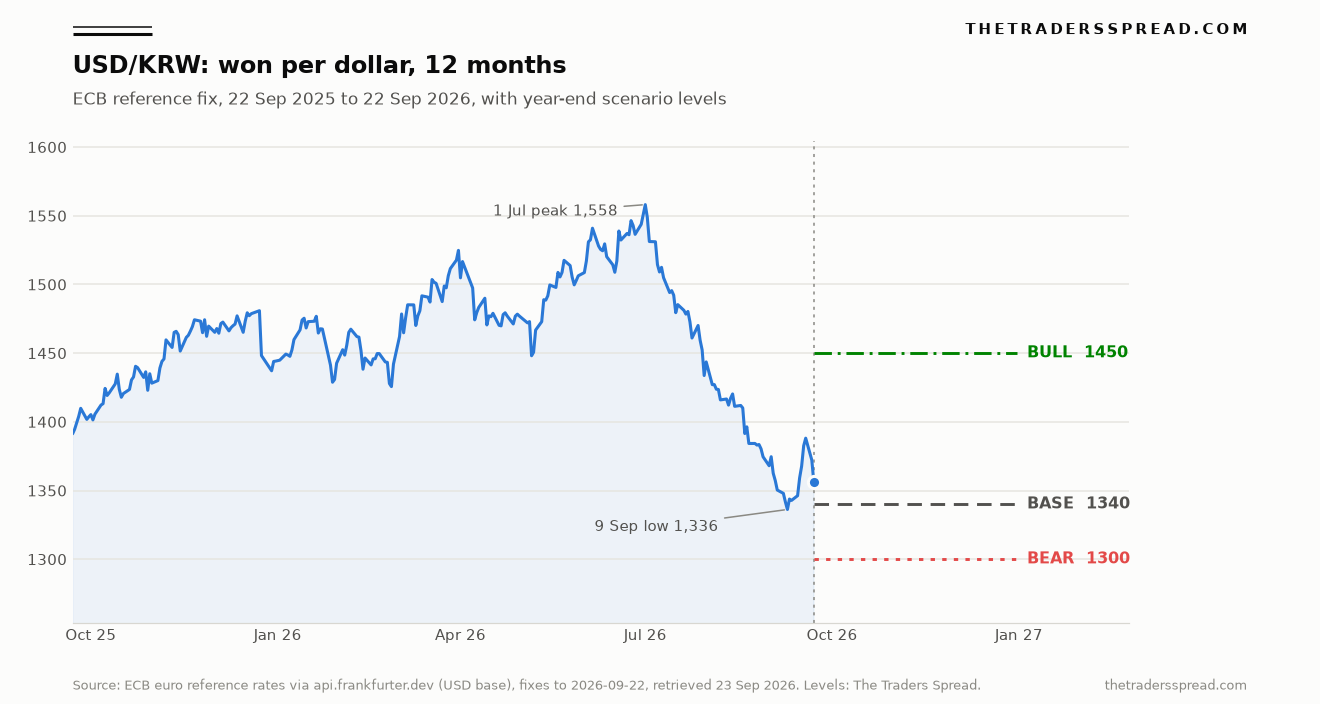
The chart shows a slow climb from 1,391 in September 2025 to the 1,558 July peak, a steep fall through August, and a short bounce in mid-September that has already faded. Monthly averages of the fixes give the same picture: 1,530.14 in June, 1,490.85 in July, 1,402.99 in August and 1,358.09 so far in September.
| Measure | June 2026 | July 2026 | August 2026 | September 2026 (to date) |
|---|---|---|---|---|
| USD/KRW average ECB fix | 1,530.14 | 1,490.85 | 1,402.99 | 1,358.09 |
| Current account surplus | $49.73bn | $42.08bn | not yet released | not yet released |
| Net foreign securities flow | -$30.72bn | -$21.65bn | -$4.50bn | not yet released |
| Average daily USD/KRW move | 0.50% | 0.53% | 0.31% | not yet released |
| BoK Base Rate at month-end | 2.50% | 2.75% | 3.00% | 3.00% |
Sources: ECB fixes via api.frankfurter.dev; current account from Bank of Korea ECOS; flows and volatility from the BoK Q3 market report as reported by Aju Press; policy rate from BoK statements. The June Base Rate is the 2.50% starting point named in the BoK's 16 July decision.
The volatility row is the one we would watch. After a 13% move, average daily swings in August were the smallest in the table. That usually means the move had come from steady, repeated selling by exporters and reduced outflows, rather than a short squeeze. Moves built that way tend to last longer than squeezes.
What would break the flow story?
There are three ways this goes wrong, and they get more likely in the order listed.
The first is a return of equity outflows. The Aju summary contains a warning: on a trading-date basis, as opposed to settlement, foreign stock outflows actually widened to $8.66 billion in August from $5.46 billion in July. The settlement numbers look better than the trading-date numbers, and the gap between the two bases is worth watching. If foreign investors keep taking profits on Korean chipmakers after the sector's run, the $30 billion-a-month outflows of June could return within one quarter. Korean 10-year yields rose 34 basis points to 4.60% between end-July and 15 September, and bond outflows widened to $4.53 billion in August. The BoK linked that to worse arbitrage incentives.
The second is oil staying at current prices. September's 20-day surplus included only part of the Brent spike, because crude is paid for with a lag. A full quarter at $120-plus would add billions of dollars to the import bill. Our Brent crude price prediction sets out the supply range. In that scenario refiners' dollar buying would offset part of the chip receipts, and the October trade data would show it first.
The third is the seasonal effect. Exporters convert dollars before Chuseok, as they did on 22 September, and some of that supply is simply brought forward from October. The Bank of Korea spoke to this on the same day. Kim Shin-young, head of the central bank's foreign exchange analysis department, told the Seoul Economic Daily: "It is true that the pace of the recent decline in the exchange rate has been fast. But the recent won strength has an element of reversal, and we do not judge that there has been an excessive one-way tilt." The paper notes that this quote was translated from Korean. The comment suggests the central bank is not trying to lean against the rally. It also says that part of the rally was a reversal of earlier weakness, and a reversal can finish on its own.
On the other side, the BoK said dollar supply in the foreign-currency funding market remains ample because companies have kept making net forward purchases through the third quarter. Ample onshore dollars usually limit how far USD/KRW can bounce.
Who is on the other side of the trade
The won's first-half weakness came from Koreans buying foreign assets and foreigners selling Korean ones. The second half has seen less of both. Anyone looking for USD/KRW to return to 1,450 is really betting that foreign equity selling resumes at June's pace. The BoK's own data shows that selling fell to almost nothing on a settlement basis in August.
Japan is an obvious comparison, and it shows why the won has done better. Aju Press's figures have the yen up 1.9% against the dollar from end-July to mid-September, less than half the won's gain. The difference is that Korea's surplus is being driven by one sector at record volumes. Readers following our Nikkei 225 forecast will find the Japanese equity side of the regional picture there.
The market also has to deal with a hawkish Fed. The Fed's September hike was the event on our Fed September decision board. The 12-0 statement said the move "will support a timelier return to the Committee's 2 percent goal" and ended with "The Committee will deliver price stability." Each additional US hike widens the gap unless Seoul matches it, and each one tends to lift the broad dollar for a few sessions. The Fed can slow the won's appreciation. What it has not done this quarter is stop exporter supply.
RelatedAUD/CAD Forecast: 1.0250 Bull Case vs 0.9480 Bear Case
The call
Base case, 50%: USD/KRW ends 2026 near 1,340, trading mostly between 1,320 and 1,400. Monthly current-account surpluses around $40 billion, a Bank of Korea that stays hawkish on 22 October, and foreign equity outflows well below first-half levels keep the pair heavy. Chuseok-related selling unwinds in early October and the pair tests 1,380–1,390 again, but it does not hold there. At 1,340 the pair would be 1.8% below this morning's 1,364.90.
Bear case for the pair, 30%: 1,300. The BoK hikes again in October, Brent drops back below $100, and foreign investors return to Korean equities. The ECB fix would then fall below 1,300 for the first time since December 2023. That is 4.8% below spot.
Bull case for the pair, 20%: 1,450. Outflows on a trading-date basis accelerate toward June's pace, Brent holds above $120 through October, the Fed hikes again and the BoK pauses. The pair would then retrace to where it traded at the end of July (1,443.61 on 31 July). That is 6.2% above spot.
The invalidation level for the base case is a daily close above 1,415. That would clear 1,411.8, the level The Korea Times cites for 18 August before the slide to the 23-month low. Conviction is modest: 2 out of 5.
What would change my mind: an August or September balance-of-payments release showing foreign equity outflows back above $10 billion on a settlement basis, or a hold on 22 October together with guidance that drops the phrase about "further increases in the Base Rate." Either of those means the flows behind this call are weakening.
FAQ
What is the USD/KRW forecast for the end of 2026?
Our base case is 1,340 by 31 December 2026, with a 50% probability. The bull case for the pair, meaning a weaker won, is 1,450 at 20%. The bear case for the pair, meaning a stronger won, is 1,300 at 30%. Spot was 1,364.90 at 07:35 UTC on 23 September on the CNBC quote feed. The latest ECB fix was 1,356.15 on 22 September.
Why did the Korean won strengthen so much after July?
The main reason is flows, not rates. Net foreign outflows from Korean securities fell from $30.72 billion in June to $4.50 billion in August, according to the Bank of Korea. Meanwhile current-account surpluses stayed above $40 billion a month on semiconductor exports. The broad dollar fell only 1.35% over the same period, so most of the won's move came from Korea itself.
Does the Fed's September hike mean USD/KRW goes back to 1,400?
It raises the chance. The top of the US range is now 1.00 point above the Bank of Korea's 3.00% rate, and the Seoul close rose for seven straight sessions after 9 September. The rise reversed on 22 September when exporters sold dollars before Chuseok. In our view, 1,400 is possible after the holiday but hard to hold while chip exports stay near record levels.
When is the next Bank of Korea rate decision?
Thursday 22 October 2026, according to the Monetary Policy Board's published 2026 calendar. The 27 August statement said the Board will decide "the timing and pace of further increases in the Base Rate," which is guidance toward more hikes. After October there is one more meeting this year, on Thursday 26 November.
Why use the ECB reference rate instead of the Seoul closing rate?
The ECB fix is a free, consistent daily series that anyone can check, which makes the chart and the percentage changes reproducible. Seoul onshore closes differ by a few won. For example, the 9 September low was 1,336.20 on the ECB fix and 1,336.1 at the Seoul close. Live spot in this article comes from a timestamped CNBC quote.
Disclaimer
This article is analysis and not investment advice. Levels, probabilities and scenarios describe our view of how USD/KRW could trade and are not a recommendation to trade. Foreign exchange and CFD trading carries a high risk of loss, and losses can exceed deposits on margined products. Capital is at risk.