

A stated misconception treats the USD/HKD peg as a single official rate the market is obliged to print each day. The Hong Kong Monetary Authority describes a convertibility zone. It sells Hong Kong dollars to banks at HK$7.75 per US dollar and buys Hong Kong dollars from banks at HK$7.85, and the dealing happens when a bank asks.
The overview page, last revised on 27 June 2024, dates the Linked Exchange Rate System to 17 October 1983 and says the currency board keeps the rate stable within HK$7.75-7.85 to one US dollar. The how-it-works page, last revised on 22 October 2025, adds the interest-rate recoil that follows a change in the Aggregate Balance. The monetary base is fully backed by US dollar assets in the Exchange Fund, and changes in the base are matched at a fixed rate.
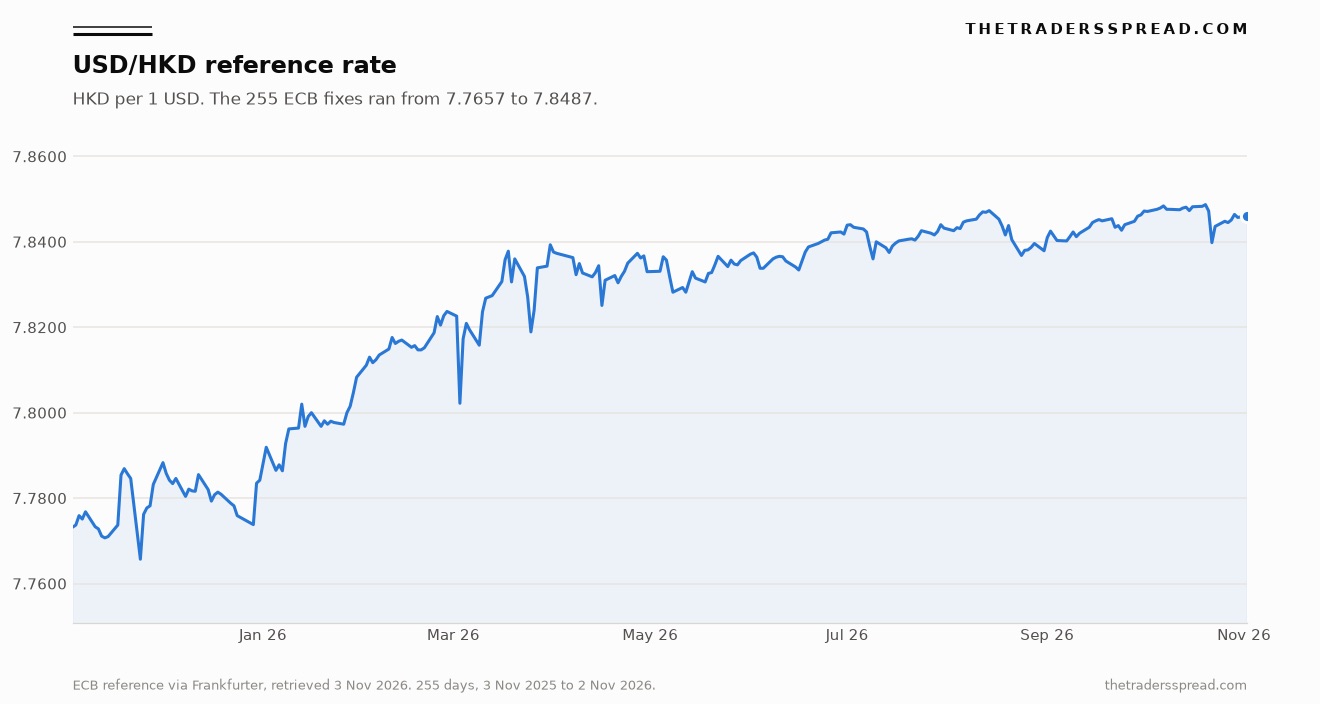
Set the latest reference beside that rule and the awkward fact appears at once. Frankfurter, retrieved on 3 November 2026, returned an ECB reference of 7.8461 Hong Kong dollars per US dollar for 2 November 2026. That print sits 0.0039 short of 7.85 and 0.0961 above 7.75, which is 96.1 percent of the way across the zone. On the HKMA daily sheet timestamped 18:30 on 29 October 2026, the forex column printed zero for 30 October, 2 November, 3 November and the days after, while overnight HIBOR was 2.36 percent against a 4.25 percent base rate. A fix near the weak edge and cheap Hong Kong dollar funding are the pair of conditions Eddie Yue, Chief Executive of the Hong Kong Monetary Authority, described on 26 June 2025. A daily reference near the edge is a different event from a bank exercising the undertaking.
Updated 3 November 2026.
Key facts
- The Linked Exchange Rate System has operated since 17 October 1983, and the HKMA states that the currency board keeps the rate within HK$7.75-7.85 to one US dollar. Source: Hong Kong Monetary Authority, Linked Exchange Rate System page, last revision 27 June 2024.
- At HK$7.75 per US dollar the HKMA sells Hong Kong dollars to banks, and at HK$7.85 it buys Hong Kong dollars from banks. Source: HKMA, How Does the LERS Work, last revision 22 October 2025.
- The ECB reference was 7.8461 Hong Kong dollars per US dollar on 2 November 2026, 0.0039 short of 7.85. Source: Frankfurter API, retrieved 3 November 2026.
- Across 255 ECB days from 3 November 2025 to 2 November 2026, the low was 7.7657 on 24 November 2025 and the high was 7.8487 on 20 October 2026. Source: Frankfurter API, retrieved 3 November 2026.
- At 18:30 on 29 October 2026 the closing Aggregate Balance was HK$53,999 million, the monetary base was HK$2,089,425 million, overnight HIBOR was 2.36 percent and the base rate was 4.25 percent. Source: HKMA daily monetary statistics, 29 October 2026.
- Foreign-currency reserve assets were US$432.9 billion at end-September 2026, against US$442.8 billion in the previous observation. Source: HKMA Economic and Financial Data for Hong Kong, page last updated 2 November 2026.
- In September 2026 Hong Kong dollar deposits fell 1.1 percent, foreign-currency deposits rose 1.6 percent, and the Hong Kong dollar loan-to-deposit ratio rose to 70.3 percent from 69.3 percent. Source: HKMA, Monetary Statistics for September 2026, 30 October 2026.
1 The rate gap does the daily work
When demand pushes the market rate to 7.75, the HKMA sells Hong Kong dollars to banks for US dollars, the Aggregate Balance expands, and Hong Kong dollar interest rates are pushed down. When supply pushes the rate to 7.85, the authority buys Hong Kong dollars, the balance contracts, and Hong Kong dollar rates are driven up.
On 29 October the local gap was wide and easy to misread. Overnight HIBOR was 2.36 percent, the one-month HIBOR fixing was 2.71494 percent, and the discount-window base rate was 4.25 percent, so the base rate sat 1.89 percentage points above overnight HIBOR and 1.53506 points above the one-month fixing. The Economic and Financial Data page, updated 2 November 2026, shows the same 4.25 percent base rate for October and a 91-day Exchange Fund bill yield of 2.77 percent, against 2.72 percent previously, a gap of 1.48 points.
An administered rate beside a market yield is the subject of the US 10-year yield explainer. The 1.89 point gap on this sheet is a Hong Kong dollar fact, and it becomes a carry story only once a dollar rate is set beside it, the comparison Yue made in 2025.
His words that day still give the order of events. "The strong-side CU was triggered several times in early May, resulting in total inflows of HK$129.4 billion. The subsequent abundance of liquidity in the HKD market led to a decline in HKD interbank rates, and the widened HKD-USD interest rate differential incentivised carry trade activities that sold HKD for USD, causing the HKD exchange rate to weaken."
2 Banks ask at 7.75 and at 7.85
The undertaking is a bank facility. The page says the HKMA deals upon request by banks, at 7.75 on the strong side and at 7.85 on the weak side. Certificates of indebtedness, listed on the monetary-base page, back notes issued by note-issuing banks, which is a separate pipe from the spot deal a bank can request at the edge.
On 26 June 2025 the weak-side undertaking was triggered in New York hours. The HKMA sold US dollars for HK$9.42 billion of Hong Kong dollars on request by banks, the Aggregate Balance was to fall to HK$164.1 billion on 27 June, and the weak-side undertaking had last been triggered in May 2023. The same remarks named dividend season, non-local issuers converting IPO and bond proceeds, and the end of half-year funding as the drains that arrived with the carry.
The 29 October 2026 sheet is the check on reading every print near 7.85 as a triggering. It showed an offer of 7.85, a bid of 7.75 and a zero in the forex column on the dates listed through and after 3 November, while the 2 November reference was still 0.0039 inside the weak side. A triggering outside Hong Kong hours is posted the next business morning, and Reuters and Bloomberg carry it the same day, so that zero is firm about the 29 October sheet and thinner about every hour of 2 November.
| Reading | Figure | Where it was published |
|---|---|---|
| Strong-side undertaking | HK$7.75 per US$1 | HKMA how-it-works page, revised 22 October 2025 |
| Weak-side undertaking | HK$7.85 per US$1 | Same page |
| ECB reference | 7.8461 | Frankfurter, 2 November 2026, retrieved 3 November 2026 |
| Window low and high | 7.7657 and 7.8487 | Same history, 24 November 2025 and 20 October 2026 |
| Closing Aggregate Balance | HK$53,999 million | HKMA daily statistics, 18:30 on 29 October 2026 |
| Monetary base | HK$2,089,425 million | Same timestamp |
| Reserve assets | US$432.9 billion | HKMA SDDS page, end-September 2026 |
3 Dividends, issues and the corporate deposit switch
Dividend season, repatriation of issuance proceeds and the end of half-year funding are ordinary treasury decisions, and on 26 June 2025 they were enough, stacked on carry, to bring banks to the weak-side undertaking for HK$9.42 billion. Each flow sells Hong Kong dollars or stops a bid for them.
September 2026 is the latest monthly print of the same family, released on 30 October. Total deposits rose 0.4 percent, Hong Kong dollar deposits fell 1.1 percent, and foreign-currency deposits rose 1.6 percent, "mainly reflecting fund flows of corporates." Over the year to end-September, total deposits rose 7.7 percent and Hong Kong dollar deposits rose 7.3 percent. Renminbi deposits rose 2.6 percent to RMB1,129.9 billion. The Hong Kong dollar loan-to-deposit ratio rose to 70.3 percent from 69.3 percent because Hong Kong dollar loans rose while Hong Kong dollar deposits fell.
The release warns that a single month is a poor place to generalise, because interest rates, fund-raising and seasonal funding all move the figures. The 1.1 percent drop is real, and the 7.3 percent rise over the year blocks any reading of September as a run. The mix is the point: more foreign currency, fewer Hong Kong dollars, in the same month the reference high of 7.8487 printed on 20 October.
On 9 October 2026 the HKMA account on X pointed readers to the half-yearly monetary and financial stability report and tagged the note with HIBOR and interbank liquidity, which is the channel the zone actually uses.
🎥Tune in for the HKMA Podcast on the Half-Yearly Monetary & Financial Stability Report: https://t.co/dHhjw9lntk
— HKMA 香港金融管理局 (@hkmagovhk) October 9, 2026
📖Read the full report: https://t.co/U1fOY5Wz7e#FINI #IPO #HIBOR #InterbankLiquidity
4 A small balance inside a large monetary base
On 29 October the closing Aggregate Balance was HK$53,999 million, certificates of indebtedness were HK$659,435 million, government notes and coins were HK$13,241 million, and Exchange Fund Bills and Notes were HK$1,362,750 million, of which banks held HK$1,182,482 million. Those four lines sum to the published monetary base of HK$2,089,425 million, and the discount window that day was zero.
The balance was 2.58 percent of that total, certificates 31.56 percent, Exchange Fund paper 65.22 percent, and notes and coins 0.63 percent, so paper and certificates together were 96.78 percent. Tracking only the clearing balance, which the footnote says includes CHATS and Faster Payment System accounts, misses the stock that actually dominates the base.
After the June 2025 triggering the HKMA said the balance would fall to HK$164.1 billion on 27 June, or HK$164,100 million. The October 2026 close of HK$53,999 million is 32.9 percent of that figure. The base beside it stayed large, at HK$2,090,180 million at end-September on the SDDS page. Foreign-currency reserve assets were US$432.9 billion, US$9.9 billion below the previous US$442.8 billion. Dividing reserves by the Hong Kong dollar base would invent a backing ratio the page does not publish. The published rule is the matching of base changes with US dollar assets at a fixed rate.
5 Exchange Fund paper absorbs what interest adds
Interest on Exchange Fund paper would swell the Aggregate Balance, and the daily sheet's footnote says the HKMA issues new paper at the earliest opportunity to absorb that increase. The job is the clearing balance. Where USD/HKD sits inside the zone is a different column.
On the 29 October sheet, forex, other market activities and the discount window were zero for 30 October, 2 November and 3 November, with the forecast balance held at HK$53,999 million. After 3 November the paper column showed minus HK$688 million, and the forecast balance was HK$53,311 million. That HK$688 million is 1.27 percent of the closing balance and 0.033 percent of the monetary base, small on the day and kept out of the foreign-exchange column.
RelatedNOK/SEK Cross Starts From Two Separate Dollar Rates
6 A trade-weighted index answers a different question
The same sheet prints a trade-weighted index of 100.1, down 0.1, on a January 2020 base of 100. The undertakings are a US dollar contract, so a quiet basket can coexist with a fix 0.0039 from 7.85 whenever the US dollar's other crosses are doing the work in the index.
From 7.7732 on 3 November 2025 to 7.8461 on 2 November 2026 the reference rose 0.0729, or 0.938 percent. The low was 7.7657 on 24 November 2025 and the high was 7.8487 on 20 October 2026, 0.0013 short of 7.85. The largest move between consecutive dates was a drop of 0.0204, from 7.8226 on 2 March to 7.8022 on 3 March, with 7.8173 on 4 March handing most of it back. Of 255 days, 199 printed at or above 7.80 and 82 at or above 7.84. The range of 0.0830 used 83 percent of the zone's 0.10 width, and every fix sat between the two published rates.
A cross inherited from two dollar rates is the mirror case, set out in NOK/SEK and its dollar legs. USD/HKD is the pair the board deals directly. GBP/SEK is the other kind, a sterling cross with a path of its own. Reading the basket as a vote on the peg imports that second story into a US dollar contract.
Frequently asked questions
Who can ask the HKMA to deal at 7.75 or 7.85?
The how-it-works page says the HKMA sells Hong Kong dollars on request by banks at HK$7.75 per US dollar and buys Hong Kong dollars on request by banks at HK$7.85. The undertaking named there is a banking-system pipe. Certificates of indebtedness, a separate component of the monetary base, back the notes issued by note-issuing banks. A retail holder of notes is outside the sentence the convertibility page actually writes.
Why can the reference rate sit near 7.85 while the zone still stands?
The ECB reference on 2 November 2026 was 7.8461, and the high of the 255-day window was 7.8487 on 20 October 2026. Both lie inside the 7.75 to 7.85 zone on the HKMA page. The page treats the interest-rate recoil, after the Aggregate Balance changes at a triggered undertaking, as the force that moves the rate back from the edge. A daily reference near 7.85 is still inside the rule that page writes down.
Does a smaller Aggregate Balance mean the arrangement is failing?
On 29 October 2026 the closing Aggregate Balance was HK$53,999 million, beside a monetary base of HK$2,089,425 million that evening. In June 2025 the HKMA said the balance would fall to HK$164.1 billion on 27 June after a weak-side triggering. The how-it-works page says a smaller balance pushes Hong Kong dollar interest rates up and moves the spot back from 7.85. That adjustment is the design the authority describes.
Verdict
What the pages support is a currency board with two bank dealing rates and an interest-rate recoil. Banks ask, the Aggregate Balance moves, and Hong Kong dollar rates move with it. A reference 0.0039 short of 7.85, on a day whose prior sheet showed a zero in the forex column, is a state the rule allows. The ECB path from 7.7657 to 7.8487 used most of the zone and stayed between the published rates.
Carry after a flood of liquidity, dividend season, repatriation of issuance proceeds and the end of half-year funding are the flows Yue named, and September's deposit mix repeated the corporate half at a monthly scale while Hong Kong dollar deposits were still up 7.3 percent on the year. The clearing balance is 2.58 percent of the base, Exchange Fund paper at 65.22 percent absorbs coupons, and the trade-weighted index at 100.1 answers a basket question the undertaking leaves aside. Higher Hong Kong dollar rates, as that balance shrinks, are the recoil already written into the design.
This page records the Hong Kong Monetary Authority's published convertibility rules and reference figures retrieved on 3 November 2026. It is not a recommendation to buy or sell the Hong Kong dollar, the US dollar, or any contract linked to USD/HKD.