

A 55.1% rise in Brent futures left NOK/JPY only 11.2% higher on the European Central Bank reference cross between 6 November 2025 and 6 November 2026. The contract Yahoo Finance lists as BZ=F closed at 63.38 dollars a barrel on the first date and at 98.32 on the second. The reference cross moved from 15.1068 yen per krone to 16.7937. A screen labelled nok jpy is offering yen for one krone, and across that year the oil contract and the cross refused to scale together.
Splitting the reference cross shows where the 11.2% came from. Yen per euro went from 177.15 to 176.77, a dip of 0.2%. Kroner per euro went from 11.7265 to 10.5260, so the krone strengthened 10.2% against the euro. The official cross rose because the krone strengthened. The yen's euro reference finished almost where it began. Inside the year the yen was busier than that endpoint: the ECB print hit 187.72 yen per euro on 17 April 2026 and 175.51 on 23 October 2026, a 7.0% gap between those two fixings.
A traded indication sat somewhere else on the same Friday. Yahoo Finance showed NOKJPY=X at 16.6868 at 21:59 UTC on 6 November 2026, inside a day range of 16.6505 to 16.9667. The ECB figure of 16.7937 lies inside that range. The late indication was 0.1069 yen under the fix, while the high and the low stood 0.3162 yen apart. One label already covers a euro-numeraire fix, a vendor quote, and a full-day travel that dwarfs the gap between them.
Updated 7 November 2026
Seven readings anchor the rest of the account.
- The ECB reference cross was 16.7937 yen per krone on 6 November 2026, equal to 176.77 yen per euro divided by 10.5260 kroner per euro. Source: European Central Bank reference rates, 6 November 2026.
- The same cross stood at 15.1068 on 6 November 2025, and the rise from that print to 16.7937 is 11.2%. Source: ECB reference rates via Frankfurter, 6 November 2025 and 6 November 2026.
- Yahoo Finance showed NOKJPY=X at 16.6868 at 21:59 UTC on 6 November 2026, with a day range of 16.6505 to 16.9667. Source: Yahoo Finance, retrieved 7 November 2026.
- Brent last-day financial futures, symbol BZ=F, closed at 98.32 dollars on 6 November 2026 against 63.38 on 6 November 2025, a rise of 55.1%. Source: Yahoo Finance, retrieved 7 November 2026.
- Norges Bank held the policy rate at 4.5% after its meeting on 4 November 2026, having raised it from 4.25% to 4.50% in September. Source: Norges Bank press releases, 24 September 2026 and 5 November 2026.
- The Bank of Japan guided the uncollateralized overnight call rate to remain at around 1.25% in its 30 October 2026 statement. Source: Bank of Japan, 30 October 2026.
- Norges Bank's net foreign-exchange purchases for November 2026 are NOK 176 million per day. Source: Norges Bank, 30 October 2026.
What does a NOK/JPY quote actually name?
NOK/JPY is the number of yen that exchange for one Norwegian krone. Both the ECB-derived reference and the Yahoo indication are quoted that way, krone as the base and yen as the price. A higher print means the krone buys more yen. A lower print means the yen buys more krone. The unit itself is silent on barrels, policy rates and hours of the day, which shove the number around from outside the unit.
Four institutions touch the quote, and they are doing different jobs. The ECB publishes euro reference rates, and a NOK/JPY figure can be divided out of them after the fact. Yahoo Finance distributes an indicative currency quote under the symbol NOKJPY=X, exchange code CCY, which is a market indication rather than a central-bank snapshot. Norges Bank runs the krone's policy rate and the government's foreign-exchange transactions. The Bank of Japan sets the yen's overnight guideline.
| Reading | Role | Figure | Clock |
|---|---|---|---|
| ECB NOK/JPY reference | Euro concertation ratio, for information | 16.7937 yen per krone | Concertation about 14:10 CET on 6 November 2026, published about 16:00 CET |
| Yahoo NOKJPY=X | Indicative market quote | 16.6868, day range 16.6505 to 16.9667 | 21:59 UTC on 6 November 2026 |
| Brent BZ=F | Traded futures, last-day financial | 98.32 dollars a barrel | Daily close 6 November 2026, last indication 21:59 UTC |
| Norges Bank policy rate | Krone-leg administered rate | 4.50% | Held in the release published 5 November 2026 |
| BoJ call-rate guideline | Yen-leg administered rate | around 1.25% | Statement of 30 October 2026 |
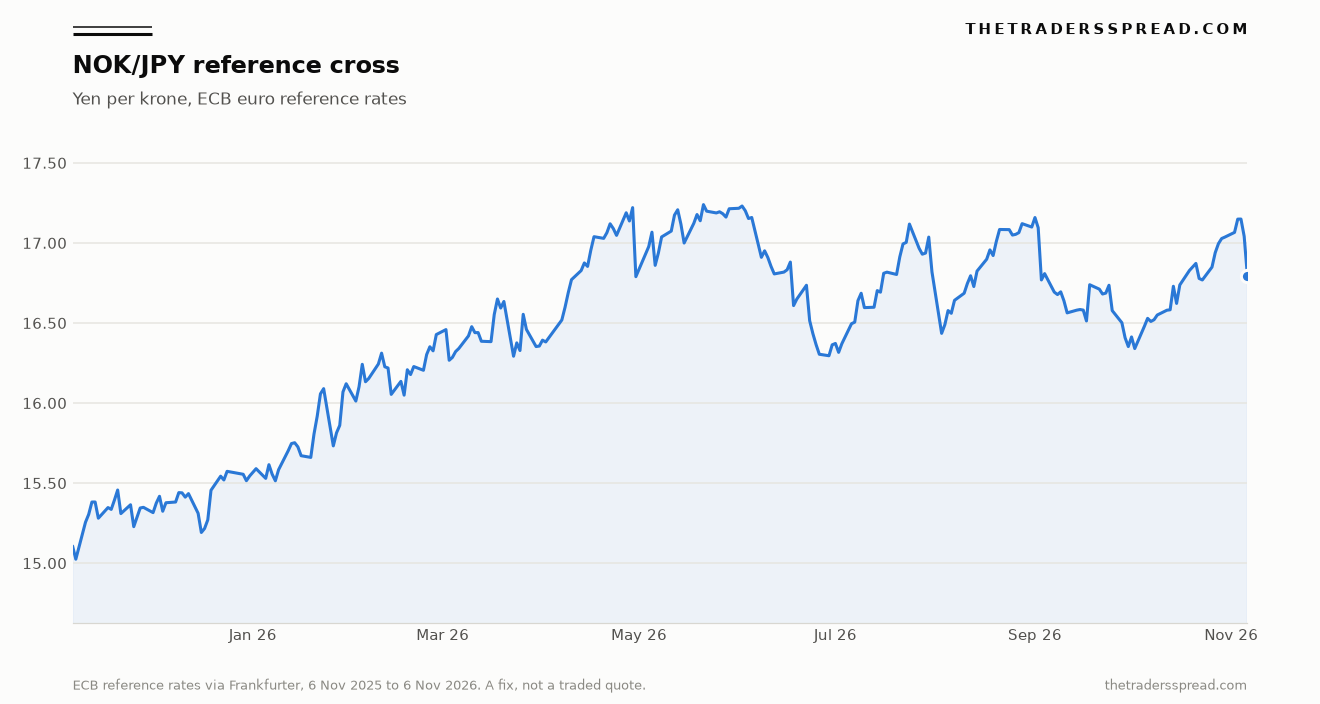
The line is the ECB reference cross over that year. Its low in the window was 15.0246 on 7 November 2025, and its high was 17.2393 on 21 May 2026. From that low to that high the cross spanned 14.7% of the low. Over a matching stretch the Brent futures contract ran from 58.92 dollars on 16 December 2025 to 118.35 on 31 March 2026, a span of 100.9% of its own low. The cross spent the year inside a range the futures contract exceeded several times over.
How does the ECB arrive at 16.7937?
The ECB updates its euro foreign exchange reference rates around 16:00 CET on working days, other than TARGET closing days. The rates come from a concertation among European central banks that normally takes place around 14:10 CET. On the ECB's own page the rates are for information, and the bank strongly discourages using them for transactions. A fix kept off a dealing ticket is a reference object, and a poor stand-in for a price someone could have dealt a minute later.
On 6 November 2026 the page showed 176.77 yen per euro and 10.5260 kroner per euro. Divide the first by the second. 176.77 / 10.5260 = 16.79365, which rounds to 16.7937 at four decimals. Frankfurter's ECB provider returned that same 16.7937 for the pair dated 6 November 2026, and the retrieval for this page was on 7 November. A year earlier the inputs were 177.15 yen per euro and 11.7265 kroner per euro. 177.15 / 11.7265 rounds to the 15.1068 cross. The arithmetic is checkable, which is what lets the oil comparison mean something.
Some crosses are pinned by a local rule rather than by this ratio. GBP/DKK and the euro peg that sets the cross is that sort of machine: a band elsewhere in the European system does the work, and the sterling cross inherits it. A peg of that kind is absent from NOK/JPY. Norway's mandate is inflation close to 2% over time, with an eye on employment and stability. Japan guides an overnight yen rate. The 16.7937 print is two euro reference rates divided after a 14:10 CET snapshot, and it changes on the next working day only if one of those euro rates changes.
What does the oil price change in the krone leg?
Oil reaches the krone as government revenue and as a line in Norges Bank's account of inflation, and the 2026 decisions leave the size of either channel unstated.
The September decision is the clearer rhyme with oil. Norges Bank published, on 24 September 2026, a rise in the policy rate from 4.25% to 4.50% after its meeting on 23 September. The committee said that since June, prices for oil and gas and various other commodities had risen. In the same stretch it said a stronger krone would dampen imported-goods inflation. Oil higher and the krone stronger share a decision, while any coefficient linking them stays unstated.
Governor Ida Wolden Bache, governor of Norges Bank, said "Inflation is too high" in the 5 November 2026 press release, and the committee kept the policy rate at 4.5% after meeting on 4 November. The same text put twelve-month CPI inflation at 3.4% in September and CPI-ATE, the measure adjusted for tax changes and excluding energy products, at 3.0%, against a target of 2%. The same paragraphs recorded softer oil spot prices, somewhat higher futures prices, and a krone that had appreciated beyond what the bank had assumed, with inflation still above target and the policy rate left at the tighter September level. A stable oil beta would have wanted the krone to soften with the spot barrel. The committee wrote the opposite pairing down and moved the policy rate by nothing in November.
The revenue channel is slower and more concrete. The Norwegian government receives petroleum income in kroner and in foreign currency. Part of that income finances the planned non-oil budget deficit. The rest is saved in foreign currency in the Government Pension Fund Global. Norges Bank, for the Ministry of Finance, carries out the foreign-exchange transactions that line the spending up with the saving. A barrel touches the krone market, when it touches it, by changing how large that saving is over a budget, and then by showing up as a daily transaction size the bank announces before the month begins.
A second oil door sits on the yen side and, in the usual telling, points the same way. The Bank of Japan's 18 September 2026 statement linked a still-high producer-price index to AI-related demand and to high crude oil prices. Japan imports crude while Norway exports it, so a richer Norwegian terms of trade and a softer yen would both raise yen per krone. Both doors at full strength would have amplified a 55.1% futures rise, yet the reference cross rose 11.2%, which is thin evidence that officials noticing the barrel means the barrel sets the cross.
Where does the oil price drop out of the daily machinery?
The 6 November barrel arrived after November's dealing plan was already public. The plan is a sum of kroner. The barrel is a price in dollars. They meet, if they meet, inside a budget and on a delay.
Norges Bank's release of 30 October 2026, published at 10:00, set daily net purchases of foreign exchange for November at NOK 176 million. The gross pieces point opposite ways. The bank purchases foreign currency equivalent to NOK 300 million a day for the government, a sale of kroner, and sells foreign currency equivalent to NOK 124 million a day to fund dividends and interest, a purchase of kroner. Net, kroner are sold in a fixed daily size, whatever Brent's close that morning.
The dividend leg is older than the oil year in the opening sentence. The Executive Board decided in December 2025 to purchase kroner for the transfer of 2025 dividends and interest. The total is NOK 29.4 billion, spread evenly from March 2026 through February 2027, and Norges Bank said the amount stays fixed. Brent futures rose 55.1% inside the life of that decision, and the NOK 124 million daily sale of foreign currency stayed the figure already chosen.
Anyone who wants oil inside the official NOK/JPY number has to move EUR/NOK or EUR/JPY first, and that route slips. Take every date from 6 November 2025 through 6 November 2026 that exists both in the ECB cross and in the BZ=F daily close, then step from one shared session to the next: 248 steps, with a correlation of percent changes equal to 0.19. On 103 of the 247 steps where the cross and the futures price each actually moved, they moved in opposite directions. That correlation punishes anyone who treats Friday's barrel as Friday's cross. The cross high, 17.2393 on 21 May 2026, also arrived weeks after the futures high of 118.35 dollars on 31 March.
How can the yen reprice the cross on a quiet oil day?
The quote is yen per krone. A move in the yen changes the price on a day when the krone's oil news is unchanged, because that is what the unit means, before any safe-haven story is bolted on. When the yen strengthens against the krone, fewer yen buy one krone and the print falls. When the yen weakens, the print rises. Brent can print the same close twice and NOK/JPY can still travel, if the yen leg travels.
RelatedAUD/SGD Price Prediction: 0.92 Bull Case vs 0.86 Bear Case
The yen leg has its own committee. On 18 September 2026 the Bank of Japan set the uncollateralized overnight call rate guideline at around 1.25%, effective 24 September, on a 7-2 vote, with the complementary deposit rate at 1.25% and the basic loan rate at 1.5%. On 30 October the Policy Board kept that call-rate guideline, by 8 votes to 1. Takata Hajime, a Policy Board member, proposed around 1.5% and lost. The October vote was about the call rate. Crude had been a price-index remark in September, which is a different decision.
Set the two administered rates side by side and the temptation is to invent a fair cross from the gap. Norges Bank's 4.50% policy rate sits about 3.25 percentage points above a call rate taken at 1.25, and the Bank of Japan figure is "around" 1.25 rather than a traded fixing. The gap is silent on a fair level for NOK/JPY. GBP/SEK and its own rate path is the neighbouring case: a cross can follow two domestic monetary paths and still keep an identity of its own. A 0.2% dip in euro-yen over the full year is easy to over-read: the path from 187.72 yen per euro in April to 175.51 in October was large enough to move the cross on sessions when Brent barely did.
Why do Tokyo hours and London hours change the spread?
The only official daily reference that contains both the krone and the yen is taken at about 14:10 CET and published around 16:00 CET. In November, Central European Time is one hour ahead of UTC, and Japan Standard Time is nine hours ahead of UTC. Concertation at 14:10 CET is 22:10 in Tokyo. Publication around 16:00 CET lands at midnight, as the next calendar day begins in Japan. The 6 November reference is a late-evening Tokyo event. A Tokyo business morning, 09:00 to 15:00 Japan time, falls at 01:00 to 07:00 CET and ends before the snapshot.
A desk that shows a NOK/JPY indication during that morning is bridging yesterday's European ratio and whatever yen flow is live locally. The krone leg has a stale concertation. Norges Bank's government transactions are a European business-day amount, announced from Oslo as a monthly plan, and they are absent from a Tokyo auction timetable. Yen liquidity is the leg that is awake. The krone is the leg that is waiting. A deep yen order book plus a stale krone indication is still an uncertain cross, and the market-maker who warehouses both risks charges for the stale leg. That charge is the spread, wider while the krone information is older, and a different number once the 14:10 CET snapshot exists. In November that snapshot is 13:10 in London, with publication around 15:00 London time, which is when Norges Bank's monthly dealing plan is a same-day European operation rather than a leftover from the previous fix. Yen depth in Tokyo substitutes poorly for a krone price.
The width actually in hand is the vendor's full-day travel, and it is labelled as such. On 6 November the Yahoo indication travelled from 16.6505 to 16.9667, a span of 0.3162 yen. The file records the high and the low and withholds the hour of each, so the span stays a full-day travel. Handing the low to Tokyo and the high to London would be a guess. The last indication, 16.6868 at 21:59 UTC, is 22:59 in Oslo and 06:59 on Saturday morning in Tokyo, Friday evening in London, near the day's low, and 0.1069 yen under the 14:10 CET fix. None of those stamps is a bid-ask from a named dealing desk.
The hour that matters is the hour of the quieter leg. Why GBP/ZAR spreads change at the Johannesburg open has the same shape: the local open of the less liquid currency, rather than the depth of the currency that was already trading. On NOK/JPY during the Tokyo morning, the less liquid currency is the krone. A busy yen market at 10:00 in Tokyo can still show a hesitant NOK/JPY quote, because the hesitation sits in the krone leg. Once the ECB has concerted, that particular reason for a wide quote has expired.
What new fact would make this mechanics page stale?
A fresh Brent close would leave the account standing. The 55.1% and the 11.2% only show that the scales differ. The page goes stale when an institution changes the plumbing.
Four institutional changes would retire the account. Norges Bank could begin setting the daily government foreign-exchange amount from the same day's oil price, in place of a krone sum published the previous month. The dividend-and-interest total of NOK 29.4 billion, spread from March 2026 to February 2027, could be revised because the barrel moved, after the bank said that amount stays fixed. The ECB could begin publishing a NOK/JPY rate intended for dealing, in place of a euro concertation ratio it tells users to keep off transaction tickets. Or a Tokyo-hours market in the krone could grow deep enough that the 14:10 CET snapshot stopped being the only official daily reference the pair has.
A nearer document is already on the calendar. The 5 November decision skipped new forecasts and pointed to Monetary Policy Report 4/26, due with the rate decision on 17 December 2026. If that report takes oil out of the way the committee explains the krone, or if it starts printing a numerical oil link for the policy rate, the krone-leg account needs rewriting. A new barrel price, standing alone, leaves the plumbing intact: a euro ratio for the official daily value, a pre-announced krone sum for the fiscal flow, and a stale krone leg inside the Tokyo morning.
Figures on this page are reference readings for the dates cited, gathered to show how the quote is assembled. They are not a recommendation to buy or sell NOK/JPY, the krone, the yen, or crude oil.