

The popular reading of 5 November, that Banxico's rate cut pushed EUR/MXN higher, gets the order of events backwards: on the hourly tape the cross had already jumped from 20.85 to 21.02 by 16:00 UTC, three hours before the Bank of Mexico published its decision at 19:00 UTC. When the statement landed, the 19:00 hour printed a spike to 21.285 and then closed at 21.0243, almost exactly where it opened. Yahoo Finance had EUR/MXN at 21.0136 at 06:06 UTC on 6 November, 0.71% above the ECB reference fix of 20.8655 struck on 5 November.
The ECB "fix" is a once-a-day reference rate that European central banks agree around 14:10 CET, which in November is 13:10 UTC, so the 5 November print of 20.8655 was set roughly six hours before Banxico spoke and captures none of the afternoon repricing.
The more useful lesson comes from splitting the cross in two. Between 4 September and 5 November, EUR/MXN rose 6.24% on the ECB fixes, from 19.6401 to 20.8655. Over the same stretch the euro lost 3.42% against the dollar while the dollar gained 10.0% against the peso: the euro was falling and the peso was falling faster. The cut adds to a slide that began two months earlier, after an ECB that spent 2026 raising its deposit rate, so both central banks are squeezing the same carry spread from opposite ends.
Key facts
- Banxico target rate 6.25%, cut by 25 basis points with effect from 6 November 2026, on a 3–2 majority vote. Banco de México policy statement, 5 November 2026, opened 6 November 2026.
- ECB deposit facility 2.50% since 16 September 2026, up from 2.25% on 17 June 2026 and 2.00% on 11 June 2025. ECB key interest rates page, opened 6 November 2026.
- Rate gap 3.75 percentage points, down from 5.25 points a year earlier, on the policy rates above. Arithmetic from the Banxico and ECB pages, 6 November 2026.
- EUR/MXN 20.8655 on the 5 November ECB reference fix and 21.0136 live at 06:06 UTC on 6 November. ECB reference rates via the Frankfurter API and Yahoo Finance EURMXN=X, retrieved 6 November 2026.
- 12-month range 19.6401 to 21.459, the low on 4 September 2026 and the high on 7 November 2025. ECB fixes via Frankfurter, 31 October 2025 to 5 November 2026.
- Mexican headline inflation 3.62% in the first half of October, up from 3.42% in the first half of September, with core at 3.78%. Banxico statement, 5 November 2026.
1. What Banxico decided, line by line
The Board of Governors of the Banco de México lowered its target for the overnight interbank interest rate by 25 basis points to 6.25%, effective 6 November 2026, according to the Spanish-language statement published on banxico.org.mx. Governor Victoria Rodríguez Ceja and deputy governors José Gabriel Cuadra García and Omar Mejía Castelazo voted for the cut. Deputy governors Galia Borja Gómez and Jonathan Heath voted to hold at 6.50%.
A three-to-two split is the first thing a newer trader should notice, because a cut with two dissenters was a close call and close calls are harder to repeat. The statement leans the same way: the Board called the move a one-off adjustment ("un ajuste puntual") and said that keeping the rate at the level reached for a prolonged period would support inflation's return to target.
The Board's reasoning rested on slack: disinflation has continued, demand pressures are absent, and with spare capacity the pass-through from a weaker exchange rate to consumer prices would be limited. Pass-through is the share of a currency move that ends up in shop prices.
Headline inflation rose from 3.42% in the first half of September to 3.62% in the first half of October, driven by the non-core basket. Core inflation, which strips out volatile items such as energy and fresh food, slipped from 3.79% to 3.78%. Banxico raised its fourth-quarter 2026 headline forecast to 3.7% from 3.5%, still sees convergence to its 3% target in the fourth quarter of 2027, and kept an upward bias on the balance of risks. Among the upside risks it listed was "a greater depreciation of the Mexican peso".
Banxico's announcements table shows this was the first cut since 7 May, after three holds at 6.50% on 25 June, 6 August and 24 September.
2. The tape on 5 November, hour by hour
Banxico publishes policy decisions on Thursdays at 13:00 Mexico City time, according to its 2026 calendar, and Mexico City sits at UTC-6 all year. Banco de México's official X account posted the headline line of the statement at 19:02 UTC, and that timestamp anchors the sequence below.
Con la presencia de todos sus miembros, la Junta de Gobierno del #BancodeMéxico decidió por mayoría disminuir la Tasa de Interés Interbancaria a 1 día a un nivel de 6.25% con efectos a partir del 6 de noviembre del 2026.
— Banco de México (@Banxico) November 5, 2026
Consulta el comunicado en: https://t.co/v3aqzLKKrQ pic.twitter.com/SQNagxQNsp
Yahoo Finance hourly bars for EURMXN=X, pulled at 06:06 UTC on 6 November, give this sequence. The 13:00 UTC hour closed at 20.8485, close to the ECB fix struck in that same window. The 15:00 UTC hour opened at 20.8792 and closed at 21.0205, a gain of 0.68% inside one hour, and the 18:00 UTC hour closed at 21.0032. The decision hour, 19:00 UTC, printed a high of 21.285 and closed at 21.0243. The 23:00 UTC hour closed at 21.0845, and the 05:00 UTC hour on 6 November closed at 21.0013.
Hourly spot data from a free feed is a composite of dealer quotes, and an isolated spike such as 21.285 can be a thin-liquidity print that few traders could actually deal on. The tape shows when the peso moved, and the 15:00 UTC jump came well before the statement, so a reader who credits the whole move to Banxico is reading the wrong hour.
3. Carry, and why the ECB–Banxico gap is the number to watch
Carry is the interest you earn for holding one currency while funding it with another. Hold Mexican pesos funded with borrowed euros and you collect roughly the Mexican short rate while paying roughly the euro short rate, and the difference between the two is the carry. The simplest proxy for EUR/MXN is the gap between Banxico's target rate and the ECB's deposit facility rate, the rate the ECB pays banks on overnight deposits and the one it uses to steer policy.
That gap is now 3.75 percentage points: 6.25% minus 2.50%. A year ago it was 5.25 points, after Banxico's 6 November 2025 cut took its rate to 7.25% while the ECB deposit rate stood at 2.00%. The table rebuilds the path from the two central banks' own decision records.
| Date | Change | Banxico target | ECB deposit rate | Gap (pp) |
|---|---|---|---|---|
| 6 Nov 2025 | Banxico −25 bp | 7.25% | 2.00% | 5.25 |
| 18 Dec 2025 | Banxico −25 bp | 7.00% | 2.00% | 5.00 |
| 26 Mar 2026 | Banxico −25 bp | 6.75% | 2.00% | 4.75 |
| 7 May 2026 | Banxico −25 bp | 6.50% | 2.00% | 4.50 |
| 17 Jun 2026 | ECB +25 bp | 6.50% | 2.25% | 4.25 |
| 16 Sep 2026 | ECB +25 bp | 6.50% | 2.50% | 4.00 |
| 6 Nov 2026 | Banxico −25 bp | 6.25% | 2.50% | 3.75 |
Sources: Banco de México announcements of monetary policy decisions and the ECB key interest rates table, both opened 6 November 2026. Dates are effective dates as each bank lists them.
Over twelve months the gap shrank by 150 basis points, and two of those six steps came from Frankfurt, so the cushion that pays a peso holder for bearing exchange-rate risk thinned from both sides. A 3.75-point carry still gives the peso a real income advantage, but a smaller cushion absorbs less bad news.
4. Two legs: EUR/USD times USD/MXN
Every EUR/MXN quote is the product of two dollar rates. EUR/MXN equals EUR/USD multiplied by USD/MXN, because the interbank market quotes both currencies mainly against the dollar. That is why the peso can weaken against the euro on a day when the euro itself is falling.
| ECB fix date | EUR/MXN | EUR/USD | Implied USD/MXN |
|---|---|---|---|
| 31 Oct 2025 | 21.4286 | 1.1554 | 18.5465 |
| 4 Sep 2026 (12-month low) | 19.6401 | 1.1622 | 16.8991 |
| 5 Nov 2026 | 20.8655 | 1.1224 | 18.5901 |
| Change, 4 Sep to 5 Nov | +6.24% | −3.42% | +10.01% |
Source: ECB euro reference rates for MXN and USD via the Frankfurter API, retrieved 6 November 2026. USD/MXN is EUR/MXN divided by EUR/USD on the same fix.
The bottom row carries the lesson. The euro fell against the dollar, which on its own would pull EUR/MXN down, yet the cross rose because the peso lost ten percent against the dollar. Yahoo Finance quoted USD/MXN at 18.76 at 06:06 UTC on 6 November, above the implied 18.59 on the fix, so the peso's dollar leg is still doing the work. For the dollar side of the story, the desk's USD/MXN forecast sets out its own cases, and the EUR/USD forecast covers the euro leg.
Over the full year the picture flips. On 31 October 2025 the implied USD/MXN rate was 18.5465, almost identical to the 18.5901 of 5 November 2026. The peso round-tripped against the dollar, and EUR/MXN ended 2.63% lower mostly because EUR/USD dropped from 1.1554 to 1.1224, which is why every percentage needs its time window.
The same split works on other emerging-market euro crosses; the desk's EUR/ZAR price prediction traced most of the rand's move to EUR/USD, the reverse of the peso case.
5. Volatility and the carry breakeven
Realised volatility measures how much a price has actually moved, scaled to a yearly figure. On daily ECB fixes, EUR/MXN's realised volatility was 6.3% over the past year, 8.4% over the last 60 trading days and 11.3% over the last 20. The 20-day reading is nearly double the one-year figure. Rising volatility is the classic enemy of carry, because the income from the rate gap accrues slowly while a currency loss can arrive in an afternoon.
A forward rate shows the trade-off in one number. Using policy rates as a stand-in for market rates, the forward is spot times one plus the Mexican rate for the period, divided by one plus the euro rate. With spot at 21.0136 and 145 days to 31 March 2027, that gives about 21.32. The forward sits above spot because the peso pays more interest, and it marks the breakeven: a euro-funded peso holder comes out ahead if EUR/MXN stays below about 21.32 at the end of March, and behind if it ends above.
Volatility sets the scale around that breakeven. At the one-year realised volatility of 6.3%, a one-standard-deviation move over 145 days is about 4.0%, or roughly 0.84 of a peso per euro. At the 20-day reading of 11.3% the same move is about 7.1%, or 1.50 pesos. The scenario levels below sit about 3.8% either side of spot, inside one standard deviation on either reading.
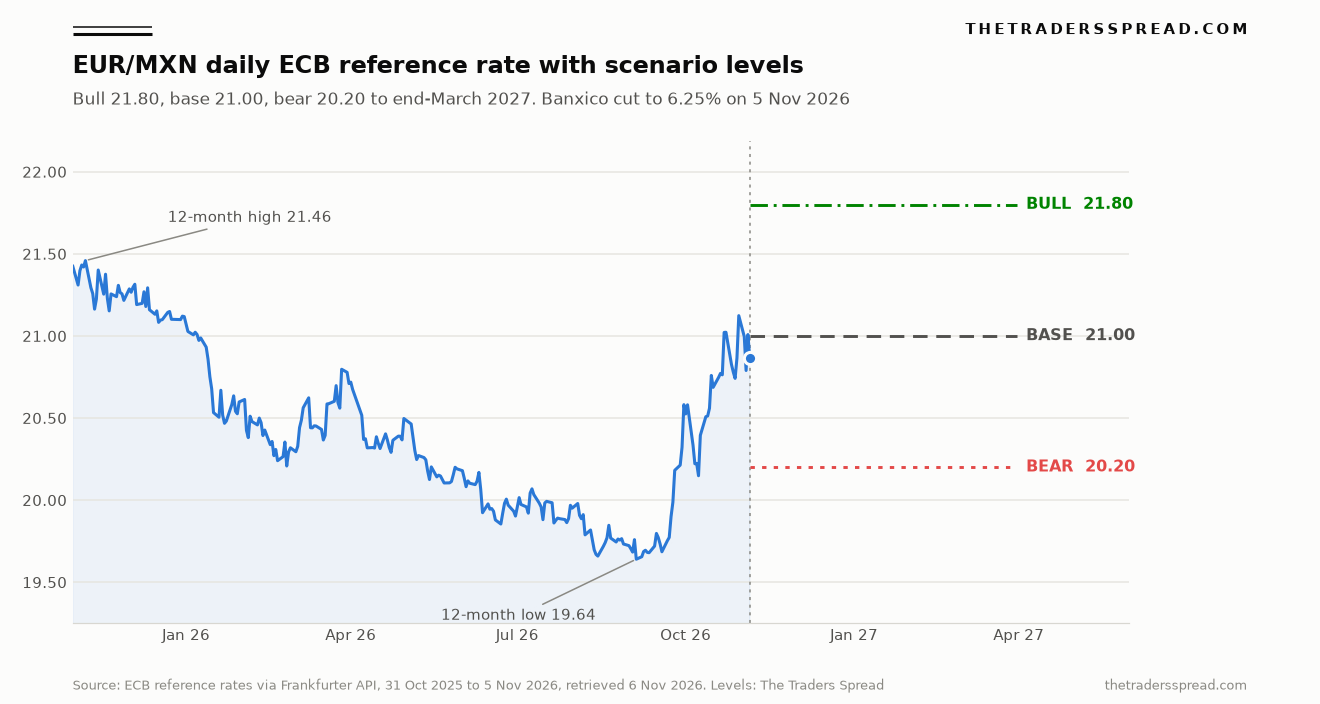
On trend measures, the 5 November fix of 20.8655 sits above the 20-day average of 20.7874, the 50-day average of 20.2769 and the 200-day average of 20.2127. The cross has risen 3.56% in 20 trading days, from 20.1486 on 8 October, and 6.08% in 60 trading days, from 19.6694 on 13 August.
6. Mexican peso forecast: what the inflation numbers imply
A Mexican peso forecast built on this statement starts with the forward guidance. Banxico said holding the rate for a prolonged period would be appropriate, which reads as a pause after this cut. A paused Banxico keeps the 3.75-point gap intact unless the ECB moves.
Banxico repeated that guidance in a separate X post eleven minutes after the headline, and it is the line markets will hold every data release against.
Hacia delante, la Junta de Gobierno considera que mantener la tasa por un tiempo prolongado en el nivel alcanzado apoyará la convergencia de la inflación a su meta y será adecuado para enfrentar los retos macroeconómicos externos. https://t.co/v3aqzLKcCi
RelatedGBP/SGD Is the Product of Two Dollar Rates and Hours
— Banco de México (@Banxico) November 5, 2026
Inflation is where the pause could break. If the peso keeps sliding and headline prints climb toward 4%, the two dissenters gain arguments, and the market would start pricing a longer hold or a reversal, a path that supports the peso. If activity weakens instead, a downside risk Banxico also flagged, markets may price further cuts despite the guidance.
For how prediction-market traders priced the Banxico path, see the desk's Banxico rate decision analysis.
7. Dates between now and the end of March
- 19 November 2026: minutes of the 5 November Board meeting, per Banxico's 2026 calendar.
- 26 November 2026: Banxico quarterly inflation report for the third quarter.
- 17 December 2026: both Banxico's final 2026 decision and day two of the ECB's monetary policy meeting in Frankfurt, according to each bank's calendar. One day can move the gap by up to 50 basis points either way.
- 4 February and 18 March 2027: ECB monetary policy meetings with press conferences, from the ECB meeting calendar.
8. The call
| Case | EUR/MXN by 31 Mar 2027 | Move from 21.0136 | Weight | What it assumes |
|---|---|---|---|---|
| Bull | 21.80 | +3.7% | 25% | Volatility stays near 11%, peso keeps weakening against the dollar, Banxico cuts again or the ECB hikes |
| Base | 21.20 | +0.9% | 50% | Banxico holds at 6.25%, ECB holds at 2.50%, the cross drifts toward the carry-implied forward near 21.32 |
| Bear | 20.20 | −3.9% | 25% | Volatility fades, carry buyers return, USD/MXN retraces toward its September levels |
Base case at 21.20 by 31 March 2027: Banxico holds at 6.25% as it signalled, the ECB stays at 2.50%, and with the gap frozen at 3.75 points EUR/MXN drifts modestly toward the forward. The level sits below the 21.32 breakeven, so the carry still pays, and above the current quote because the peso's recent weakness has shifted the centre of the range higher. The weights are judgement calls scaled to the volatility in section 5.
Bull case at 21.80: this level would be a new 12-month high above the 21.459 fix of 7 November 2025. It needs the peso's dollar leg to keep weakening, plus a further narrowing of the rate gap, either through another Banxico cut or another ECB hike on 17 December or in early 2027. Rising realised volatility makes this case more likely, since carry positions get cut when daily swings widen.
Bear case at 20.20: this level sits just above the 8 October fix of 20.1486 and near the 200-day average of 20.2127. It needs volatility to calm, a sustained hold from Banxico, and USD/MXN to give back a large part of its September-to-November rise.
The lean: the skew sits toward the upside, at low conviction, because the gap is narrower than at any point in the past year, realised volatility has risen fast, and the dollar leg has momentum. A daily ECB fix below 20.55 would undercut that lean, since it would put the cross back under its October congestion and below the 20-day average.
What would change the call: hawkish December minutes from the Board, or a December hold paired with an ECB cut, would widen the gap and favour the bear case. A second consecutive Banxico cut, or headline inflation above 4% with the peso still weakening, would favour the bull case. A move of USD/MXN back below 17.50 on the Yahoo quote would also argue for shifting the base case lower.
Frequently asked questions
Does a Banxico rate cut always weaken the peso?
Usually a little, because a cut reduces the interest a peso holder earns, but on 5 November most of the move came before the decision. EUR/MXN rose from 20.8792 to 21.0205 in the 15:00 UTC hour, and the decision hour closed nearly flat after a brief spike to 21.285. Expectations and global dollar moves often matter more than the announcement itself.
What is the eur mxn rate today, and which number should I use?
Two numbers circulate, and the ECB reference fix for 5 November was 20.8655, set around 13:10 UTC before Banxico's statement. The live Yahoo Finance quote was 21.0136 at 06:06 UTC on 6 November. Use the fix for official comparisons and accounting, and a live dealing quote for anything time-sensitive. They will rarely match, since the fix is a single daily snapshot.
How big is the ECB–Banxico rate gap now?
It is 3.75 percentage points, with Banxico's target at 6.25% from 6 November 2026 and the ECB deposit facility at 2.50% since 16 September 2026. A year earlier the gap was 5.25 points. Banxico cut four times over that period and the ECB raised its deposit rate twice, so both sides narrowed the spread that rewards holding pesos against euros.
What is a reasonable Mexican peso forecast against the euro?
The base case here is 21.20 by 31 March 2027, with a bull case at 21.80 and a bear case at 20.20, weighted 50%, 25% and 25%. The base assumes both central banks hold. The carry-implied forward near 21.32 marks where a euro-funded peso holder would break even, which is a useful yardstick for judging any forecast you read.
Why did two Banxico board members vote against the cut?
The statement records that Galia Borja Gómez and Jonathan Heath preferred to hold at 6.50%, and the minutes due on 19 November should set out their reasons. The statement itself flags rising headline inflation, an upward revision to the near-term forecast and an upside bias in the balance of risks, all of which give a hold argument weight.
Figures are reference rates, live quotes and published policy settings as of 06:06 UTC on 6 November 2026. The cases above are analysis of possible outcomes for the cross and are not investment advice or an instruction to trade.