

The popular story that Beijing is dragging USD/CNH lower to keep Washington happy gets the People's Bank of China's role almost exactly backwards. On Tuesday 29 September the central bank set its USD/CNY central parity at 6.7411 at 09:15 Beijing time, according to the China Foreign Exchange Trade System. A few hours later onshore spot was changing hands at 6.7030 and the offshore rate, USD/CNH, at 6.7045 (CNBC, 05:55 New York). Both markets were trading about 0.55% on the strong-yuan side of the official midpoint. A central bank that wanted a faster rally would fix at or below spot. This one has fixed above it, meaning weaker for the yuan, on 199 of the 202 sessions since 1 December 2025 by our count, and Reuters has reported the midpoint landing on the weak side of its own survey of estimates since November. The yuan has still climbed 5.95% against the dollar in the offshore market over twelve months. That rally belongs to the market. The fix has been the brake.
Here is the part that most coverage skips. We lined up 262 CFETS fixings against same-day onshore closes and found that the gap between spot and fix is now closing from the fix side, not the spot side. On 14 September onshore spot sat 0.91% stronger than the midpoint. By 28 September the gap was 0.44%, yet spot had barely moved (6.7082 to 6.7103). The PBoC did the walking: it cut its fix from 6.7698 to 6.7399 in two weeks, the strongest parity in the whole series. Meanwhile the offshore premium that normally betrays a speculative push has vanished. USD/CNH averaged just one pip away from onshore USD/CNY in September, against a 56-pip stronger-offshore discount in January. Put together, the two readings describe a managed glide rather than a squeeze, and that is the frame for every number that follows.
Key facts
- USD/CNH live at 6.7045, session range 6.7043 to 6.7126 — CNBC quote feed, 29 Sep 2026, 09:55 UTC.
- USD/CNY central parity 6.7411, 12 pips weaker than Monday's 6.7399 — CFETS, 29 Sep 2026, 09:15 Beijing.
- Offshore yuan up 5.95% against the dollar in a year (USD/CNH 7.1290 on 29 Sep 2025) and 3.89% year to date (6.9756 on 31 Dec 2025) — our calculation from CNBC daily closes.
- Fed funds target range raised 25bp to 3.75% to 4.00% on a 12-0 vote — Federal Reserve statement, 16 Sep 2026.
- US 10-year Treasury yield 5.243% against China's 10-year at 1.665%, a 358bp gap — CNBC, 29 Sep 2026.
- US-China tariff truce extended to 10 January 2027 — Treasury Secretary Scott Bessent via CNBC, 24 Sep 2026.
Onshore, offshore and the fix: three prices, one currency
Every figure in this piece names its market, because the yuan has three.
The central parity (the "fix") is a single number the PBoC publishes through CFETS each trading morning at 09:15 Beijing. Onshore spot, quoted as USD/CNY, trades in the mainland interbank market and may move no more than 2% either side of that morning's parity. For Tuesday that band runs from 6.6063 to 6.8759. USD/CNH is the same currency traded offshore, chiefly in Hong Kong, London and Singapore, and it has no band at all. It answers to deposit liquidity in Hong Kong, to hedging flows and to anyone who wants to express a view on China without an onshore account. The ECB's daily reference rate, pulled through the Frankfurter API, gives a fourth reading: an onshore USD/CNY cross of 6.7105 on 28 September, derived at 14:15 CET from the euro rates, which makes it useful for trend work and useless for intraday comparison.
Most of the time the three sit within a few dozen pips of each other. When they split, the split is the information. A USD/CNH print well above onshore spot says offshore money is paying up to be short the yuan; one well below says it is racing ahead of Beijing. Neither is happening now.
| Reading (29 Sep 2026 unless stated) | Rate | Versus the fix | Source |
|---|---|---|---|
| USD/CNY central parity | 6.7411 | n/a | CFETS, 09:15 Beijing |
| Onshore USD/CNY spot | 6.7030 | 0.57% stronger yuan | CNBC, 09:53 UTC |
| Offshore USD/CNH spot | 6.7045 | 0.54% stronger yuan | CNBC, 09:55 UTC |
| Onshore band floor / ceiling | 6.6063 / 6.8759 | ±2.00% | Our calculation |
| ECB-derived USD/CNY (28 Sep) | 6.7105 | n/a (reference rate) | ECB via Frankfurter |
| CNH minus CNY basis | +15 pips | Offshore marginally weaker | Our calculation |
Is the counter-cyclical factor in use? The PBoC does not publish its model inputs, so nobody outside the building can prove it. What can be measured is the residual. On 21 September the parity of 6.7487 came in 536 pips weaker than the Reuters survey estimate, and on 25 August the 6.7852 print was 633 pips weaker, the widest weak-side miss in six months, according to Reuters. Gaps of that size do not come from yesterday's close plus a basket adjustment. Something discretionary is in the formula, and it has been pointing the same way for most of a year.
The chart: a trend with a governor fitted
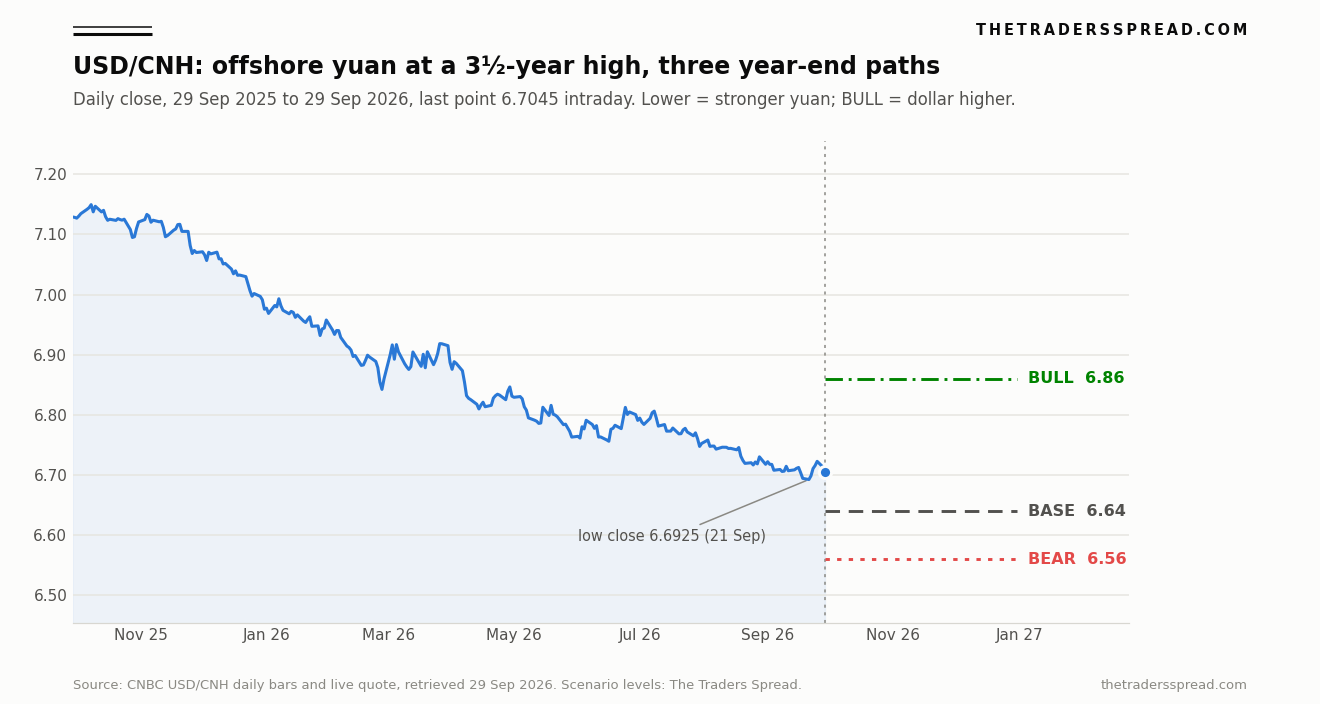
The shape is unusually clean for an emerging-market pair. USD/CNH peaked at a 7.1495 close on 8 October 2025, first closed below 7.00 on 25 December (6.9973), spent February and March swinging between 6.8423 and 6.9412, and has ground lower since. The last stretch is the tell. From late August to now the pair has moved inside a 377-pip range, 6.6925 to 6.7302, with the lowest close in the series on 21 September, the Monday Xi Jinping's delegation was preparing to fly to Washington.
| Window (anchor date) | USD/CNH anchor | Change to 6.7045 | CFETS fix anchor | Change to 6.7411 |
|---|---|---|---|---|
| 1 week (22 Sep) | 6.6986 | +0.09% | 6.7459 | -0.07% |
| 1 month (28 Aug) | 6.7302 | -0.38% | 6.7811 | -0.59% |
| 3 months (29 Jun) | 6.8004 | -1.41% | 6.8175 | -1.12% |
| Year to date (31 Dec 2025) | 6.9756 | -3.89% | 7.0288 | -4.09% |
| 1 year (29 Sep 2025) | 7.1290 | -5.95% | 7.1089 | -5.17% |
Every percentage above was recomputed from raw daily closes (CNBC bars for USD/CNH, the CFETS history file for the fix), with the anchor printed beside it. A negative number means a stronger yuan. Notice the one-month column: the fix has strengthened faster than the offshore market over the past four weeks, which is the arithmetic form of the gap-closing described at the top.
Volatility is the other reason this pair behaves unlike its Asian neighbours. Set against the won, covered in our USD/KRW forecast, the yuan's daily moves are small by design rather than by luck. Marc Chandler's September monthly put one-month implied volatility on onshore CNY at 2.4%, a number more typical of a pegged currency than a floating one.
What the 358bp yield gap should have done, and did not
Textbook carry says USD/CNH ought to be going up. The US 10-year yield printed 5.243% on Tuesday morning, close to its 52-week high of 5.26%, while China's 10-year sat at 1.665%, a whisker above its 52-week low. Short rates tell the same story: Reuters listed three-month SHIBOR at 1.4% and three-month CNH HIBOR at 1.6% on 21 September, against a fed funds range that the Federal Open Market Committee lifted to 3.75% to 4.00% on 16 September, its first hike since July 2023. "Inflation remains elevated," the statement said, and "Today's policy action will support a timelier return to the Committee's 2 percent goal."
A holder of offshore yuan therefore gives up well over two percentage points a year against a dollar deposit. That cost is visible in the forward curve, where Chandler's late-August snapshot had one-month CNY forwards at 6.7650 against spot of 6.7290.
So why has the yuan rallied through it? Three forces, and none of them is exotic. The likeliest driver, in our reading, is exporters converting dollar receipts they hoarded while the yuan was weak, a flow that feeds on itself once the trend looks durable. The dollar has had a choppy year: the index was 100.23 on 21 September, Reuters reported, after gaining more than 1% in the week of the Fed hike. And politics has offered cover: OCBC noted in the same Reuters report that a stronger, stable yuan reduces the scope for renewed accusations of competitive depreciation during trade talks. Chandler, chief market strategist at Bannockburn Global Forex, wrote in his September 2026 monthly that "Beijing has facilitated the continued gradual appreciation of the yuan" despite the US 10-year premium over China widening "to more than 300 bp in August, which is nearly a record."
The honest conclusion is that the yield gap is a speed limit, not a reverse gear. It makes rapid appreciation expensive to hold offshore and gives the PBoC a ready argument for leaning against it. It has not been enough to turn the trend.
Summit week, a two-month truce and who sits on the other side
The Washington summit ran 23 to 25 September. Its only market-relevant deliverable arrived before it started: Treasury Secretary Scott Bessent told Fox News that the tariff truce agreed in South Korea last October, which was due to expire in November, would run to 10 January 2027, CNBC reported. Many had expected six months or more. The two-month extension "suggests to me the U.S. is unsatisfied with China's offers and wants to keep the heat on, with a bonus being it is more likely that Xi goes to the G20 in Miami," said Scott Kennedy, senior adviser at the Center for Strategic and International Studies.
Short leash, then. That matters for USD/CNH because the calendar now has three political checkpoints before the truce lapses: the APEC meeting in Shenzhen in November, the G20 in Miami in December, and the 10 January deadline itself.
Who is on the other side of the yuan-bull trade? Mostly Chinese policymakers. A strong currency tightens conditions for an economy that MUFG analysts Lin Li and Khang Sek Lee described on 18 August as showing "a slowdown in aggregate economic momentum" with overall demand weak enough to need further stimulus, per FXStreet. Their year-end call was unchanged all the same: "We maintain the view of USD/CNY to reach 6.65 by the end of 2026." OCBC, quoted by Reuters on 21 September, put the risk plainly. Given the wide yield differential and soft fundamentals, the bank wrote, "part of the recent appreciation may reflect policy-managed stability around the summit rather than a fundamental re-rating of the RMB." Goldman Sachs took the opposite side in the same report, arguing policymakers "should continue to feel comfortable allowing sustained but gradual currency appreciation."
Both can be right. The fix tells you the PBoC accepts appreciation; the size of its misses tells you it does not accept acceleration.
Golden Week and the offshore-only window
From 1 October the mainland shuts for the National Day holiday. Onshore USD/CNY stops trading and the PBoC stops fixing, while USD/CNH keeps going in Hong Kong and London. For a week, the only live yuan price has no parity to lean on.
Historically that is when the CNH-CNY basis can widen, because offshore liquidity thins and any US data surprise lands on a market without its anchor. The calendar is not quiet. China's official September PMIs are due on 30 September, the last onshore day before the break, and the US September jobs report is due in the first days of October. The Fed's September projections showed 16 of 18 participants expecting another rate increase, CNBC reported, and a strong payrolls print feeding that case would test USD/CNH while Beijing is on holiday. We would treat any move above 6.75 during that window with suspicion until the first post-holiday fix confirms or rejects it. Managed Asian currencies share this vulnerability to thin sessions, a theme that also runs through our USD/INR forecast.
USD/CNH forecast: base, bull and bear to 31 December
Base case, 6.64 (probability 50%). The glide continues at roughly the pace of the past three months, about 1.4% a quarter, which from 6.7045 lands near 6.64 by year-end. That sits between MUFG's 6.65 onshore target and Chandler's view that the Bloomberg survey median of 6.70 "may be too modest." The mechanism is the one already visible: the PBoC keeps nudging the parity down, keeps its misses against the survey large enough to stop runs, and the CNH-CNY basis stays near zero. Offshore yuan would then have risen about 7% over 2026, a strong year by the standards of a managed currency and still well short of the undervaluation critics claim.
RelatedUSD/SGD Forecast: 1.3200 Bull Case vs 1.2500 Bear Case
Bull case for USD/CNH, 6.86 (probability 25%). A higher dollar needs two things to go wrong at once. The first is US rates: a hot payrolls-and-CPI sequence that makes a second Fed hike a done deal pushes the dollar index back above its September high. The second is politics, with the January deadline turning into tariff threats after a thin APEC round. A move to 6.86 would take the pair back to its spring 2026 territory (the 6.8871 end-March close) and would still sit inside today's onshore band, which is a useful reminder that even a 2.3% dollar rally would not break Beijing's rules. It would, however, reverse the fix trend, and the first parity printed above 6.77 would be the signal.
Bear case for USD/CNH, 6.56 (probability 25%). A faster yuan rally needs the PBoC to stop leaning. If the gap between fix and spot, now 0.54% on the offshore rate, closes to zero and stays there, the brake is off. Add a softer US labour market and a dollar that gives back its post-hike gains, and exporter conversion could carry USD/CNH through 6.60 into the mid-6.50s. That would take the offshore yuan to levels last seen in the first half of 2022, and it is the scenario that Chandler's "too modest" line hints at.
What would change our mind. We hold a mild bearish tilt on USD/CNH, meaning a firmer yuan, from 6.7045 with 6.64 as the base target. A daily close above 6.80, the level the pair traded at the end of June, would mean the gradual-appreciation regime has broken and would invalidate the base case. Two softer tells would come first: a run of five or more consecutive weaker fixings, or USD/CNH trading more than 100 pips above onshore USD/CNY for several sessions. Either would show offshore money betting against Beijing's glide path. Our conviction is 3 out of 5, capped mainly by the 358bp yield gap and a truce that expires in fifteen weeks. For how the same dollar-rate story is playing through other pairs, compare our USD/JPY forecast and the China-linked AUD/USD forecast.
FAQ
What is the difference between USD/CNH and USD/CNY?
USD/CNY is the onshore rate, traded in mainland China's interbank market and limited to 2% either side of the PBoC's daily central parity. USD/CNH is the same currency traded offshore, mainly in Hong Kong, with no band. On 29 September 2026 the two sat 15 pips apart, 6.7045 offshore against 6.7030 onshore, per CNBC quotes, which is unusually tight for a pair that has diverged by more than 50 pips at times this year.
Why is the PBoC fix weaker than the market?
Because the central bank is slowing the yuan's rise rather than reversing it. The 29 September parity of 6.7411 sat about 0.55% on the weak-yuan side of both spot rates. Reuters has reported fixes weaker than its survey estimates since November 2025, with misses of 633 pips on 25 August and 536 pips on 21 September. The parity has still strengthened 4.09% this year, so the direction is set and only the speed is being managed.
Does the counter-cyclical factor still exist?
The PBoC does not publish whether it applies the factor on a given day, so it cannot be confirmed directly. What is measurable is the residual: parity prints hundreds of pips from the level the published model would suggest. Gaps of 500 pips or more against the Reuters survey, as on 21 September, are consistent with a discretionary input remaining in the formula through 2026.
How does Golden Week affect USD/CNH?
The onshore market and the daily fix pause for the National Day holiday from 1 October, while USD/CNH keeps trading. With no parity published and thinner liquidity, offshore moves can overshoot, particularly around US data such as the 2 October payrolls report. The first fix after the break usually shows whether Beijing accepts or leans against whatever the offshore market did while it was away.
What would push USD/CNH back above 7.00?
It would take a sharp reversal on both sides: a US rate path well above the Fed's current dot plot and a breakdown of the tariff truce that runs to 10 January 2027, followed by the PBoC choosing to let its parity weaken. The pair last closed above 7.00 on 26 December 2025, at 7.0017. Our bull case stops at 6.86 because the policy trend in the fix would have to turn first, and there is no sign of that yet.
Disclaimer: This article is market analysis for information only and is not investment advice or a recommendation to buy or sell any currency or derivative. Scenario levels and probabilities are the author's estimates and may prove wrong. Trading foreign exchange and CFDs on margin carries a high level of risk, and you can lose more than your initial capital. Data is as of 29 September 2026, 09:55 UTC, unless stated otherwise.