

Calling GBP/ZAR a liquid 24-hour sterling cross with a stable spread collapses against London's own dealer survey, which put direct pound-rand spot at $50 million a day in October 2025. On that same survey the dollar-rand spot book was $18,054 million and cable spot was $99,689 million, so the dedicated cross was about one dollar of spot for every $361 of dollar-rand spot and every $1,994 of cable spot. A screen can still show a pound-rand price at any hour. The price is usually the product of those two larger quotes, and the product gap widens when the legs are priced by different desks.
The Foreign Exchange Joint Standing Committee, in results the Bank of England published on 4 February 2026, measured average daily UK foreign-exchange turnover at $3,850 billion in October 2025, 5% below the April 2025 survey and 20% above October 2024. Reporting follows the location of the price-setting dealer. The pair lines inside that total decide whether pound-rand has a book of its own.
Updated 1 November 2026
Two quotes, one product
A dealer who builds GBP/ZAR from the liquid legs multiplies. The cross bid is the cable bid times the dollar-rand bid, and the cross ask is the cable ask times the dollar-rand ask, so the spread on the ticket is the gap between those two products. If either leg's own bid-ask opens, the product gap opens with it. A second source of width is a stale mid: cable can print a new price while dollar-rand is still showing the previous one, and the multiplied quote then blends two different moments.
The $50 million direct spot line is the dedicated bid for that blend, while cable's $99,689 million spot line can reprice sterling long before the direct book has absorbed the same move. Pound-rand inherits both legs: Johannesburg's morning for the rand, London's hour for cable, and the smaller North American pool once London's day is over.
European Central Bank reference rates, pulled through frankfurter.dev at 08:01 GMT on 1 November 2026, fix one point a day. For 30 October 2026 the cable reference was 1.3399 dollars per pound and the dollar-rand reference was 16.6895 rand per dollar, so the product is 22.36 rand per pound. That daily product has a width of zero by construction, and the spread a ticket met in any of the three windows sits outside it.
The London book, line by line
The October 2025 data tables, in millions of US dollars of average daily volume, split the direct cross into a few instruments: spot at $50 million, outright forwards at $28 million, foreign-exchange swaps at $42 million, options at $5 million, and currency swaps at zero. Adding the lines gives $125 million a day. Dollar-rand across spot, forwards, swaps, currency swaps and options, plus its non-deliverable forwards, summed to $56,784 million on the same sheets.
The non-deliverable forward table names dollar-rand at $1,305 million and cable at $4,452 million. The pound-rand cell is absent from that sheet in the October workbook and in the April workbook, so the instrument stays out of the $125 million sum rather than being entered as a guessed zero.
| Instrument, October 2025 | GBP/ZAR | USD/ZAR | USD/GBP |
|---|---|---|---|
| Spot | 50 | 18,054 | 99,689 |
| Outright forwards | 28 | 5,495 | 63,736 |
| FX swaps | 42 | 27,479 | 290,357 |
| Currency swaps | 0 | 660 | 9,415 |
| Options | 5 | 3,791 | 9,606 |
Figures are average daily volume in millions of US dollars, from the Bank of England FXJSC data tables for the October 2025 reporting period, price-setting dealer basis. The top three UK pairs that month were still dollar-euro, dollar-yen and cable, and dollar-euro alone was $901 billion a day, 23% of UK turnover. Pound-rand, at $125 million, sits outside that ranking on a $3,850 billion market.
A thinner direct book beside a larger rand leg
The April 2025 tables, on the same average-daily basis, had pound-rand spot at $90 million, outright forwards at $42 million, FX swaps at $62 million and options at $16 million, with currency swaps at zero. The comparable sum was $210 million a day. By October the direct book had fallen to $125 million. Over the same two surveys, dollar-rand spot rose from $16,635 million to $18,054 million, and cable spot eased from $101,646 million to $99,689 million.
A comfortable reading says a sterling cross should fatten when sterling is busy. The pair lines refuse it: the rand leg's spot book grew while the dedicated pound-rand book shrank, inside a UK spot market that itself fell from $1,293 billion to $1,059 billion. Cable FX swaps were $290,357 million a day and dollar-rand swaps $27,479 million, against $42 million of pound-rand swaps, so the overnight funding market for the cross is another small cell.
The Johannesburg morning arrives first
The spread widens at the Johannesburg open because the rand leg is the live one and cable is still waiting on London. UK clocks go back one hour at 2am on the last Sunday in October and forward one hour at 1am on the last Sunday in March, and the months after the clocks go back are Greenwich Mean Time. The 2026 row on the government page, last updated 24 November 2025, puts that change on 25 October. The IANA time zone database records Africa/Johannesburg at a standard offset of two hours, with daylight-saving rules in that file only for 1942 to 1944, and it treats SAST as the name for UTC+2 in South Africa.
In the GMT season, Johannesburg therefore runs two hours ahead of London, so a local morning hour is already underway while London is still two hours earlier on the clock. When the UK is on British Summer Time the gap shrinks to one hour, because London has moved and Johannesburg has stayed. The window shifts with the British clocks. The reason it exists is the same in either season: rand users keep South African civil time, and the sterling book that can reprice the product keeps London's.
What those users meet is dollar-rand plus whatever direct pound-rand a dealer will show out of a $50 million spot line. A rand move in that morning, with cable still on an earlier print, opens the product gap, and the direct book is too small to pull the two mids back together. The Johannesburg Stock Exchange equity timetable returned HTTP 403 on retrieval, so the clock argument uses civil time and the dealer survey.
The South African Reserve Bank, on 6 October 2026, posted that its October Monetary Policy Review had come out with inflation still above the target, and it pointed to fuel, food and a possible rand depreciation if policy tightens in the advanced economies. Its stated priority was to keep a temporary inflation rise from becoming entrenched and to bring inflation back to the 3% target. A policy note of that kind lands on the rand leg, and it reaches GBP/ZAR only after someone multiplies it by cable.
The South African Reserve Bank (SARB) has released the October 2026 Monetary Policy Review (MPR), which gives a more detailed look into the local and international economic developments shaping domestic monetary policy.
— SA Reserve Bank (@SAReserveBank) October 6, 2026
The MPR’s release comes as inflation remains above target,… pic.twitter.com/BEpLSEtysh
Cable sets the London hour
Once London's morning is the active sterling session, the dominant book is cable. The October spot cell of $99,689 million is the sterling price the rest of the UK market is hedging, crossing and swapping against, which is why the published record of GBP/USD is a different page from the rand leg. A move in cable changes the pound-rand product even when dollar-rand has printed nothing in the same minute, because the cross ask is cable's ask times the rand leg's ask. USD/ZAR spot, at $18,054 million, is about 18% of the cable spot line and about 361 times the direct pound-rand spot line.
Dealers already warehousing cable risk recycle it through the legs rather than through a $50 million direct market, so the London hour can show a tight cable spread and a wide pound-rand spread at the same moment. Another sterling cross in the same market, GBP/JPY, has its own row and its own customers.
North America is the leftover book
After London, the published pool that is still a survey is the North American one. The Foreign Exchange Committee, sponsored by the Federal Reserve Bank of New York and speaking for itself, released its October 2025 volume survey on 10 February 2026. Average daily turnover in North American OTC foreign exchange was $1,303.2 billion, 5.4% below April 2025 and 8.9% above the prior year. The reporting basis is again the location of the price-setting dealer, the same basis as the UK survey, so the two totals can be read as centre books.
On that comparison the UK book is 2.95 times the North American book, $3,850 billion against $1,303.2 billion. Survey over survey, the written findings say GBP/USD and USD/BRL rose the most, by $34.1 billion and $8.4 billion, while EUR/USD and USD/JPY fell the most. The findings name those pairs and stay silent on GBP/ZAR and on USD/ZAR, which is silence rather than a printed zero. Cable, already the sterling leg, was among the pairs North America was busy in.
The leftover hour is wide for a synthetic cross when the legs are in different states, for instance once London has finished making fresh cable prices while New York is still dealing dollar pairs, or once the rand leg has gone quiet with Johannesburg's evening while cable is still a New York pair. The direct $125 million book was measured in London, and the North American findings discuss other pairs.
RelatedEUR/ZAR Price Prediction: 19.45 Bull Case vs 17.90 Bear Case
| Window | Whose book is live | Survey print behind it |
|---|---|---|
| Johannesburg morning | Local rand flow, ahead of London in the GMT season by two hours | GBP/ZAR spot $50 million a day; USD/ZAR spot $18,054 million. FXJSC, October 2025 |
| London hour | Cable, with dollar-rand on the same London desks | USD/GBP spot $99,689 million; USD/ZAR spot $18,054 million. FXJSC, October 2025 |
| After London | The North American OTC book | North America $1,303.2 billion a day, against UK FX turnover of $3,850 billion. Both October 2025 |
A daily fix omits the spread
The reference history is still worth plotting, because it shows what the product did when both legs were taken from the same daily fix. Across 256 overlapping business days from 30 October 2025 to 30 October 2026, the ECB cross moved from 22.77 rand per pound to 22.36. The first point is 1.3124 times 17.3524. The last point is 1.3399 times 16.6895. Cable's reference rose about 2.1% over that year, and dollar-rand's reference fell about 3.8%, meaning fewer rand per dollar. The product of a firmer pound and a firmer rand was a cross about 1.8% lower.
The year's low on this series was 21.45 rand on 25 February 2026, from 1.3523 times 15.8603, and the high was 22.87 rand on 24 March 2026, from 1.3372 times 17.1019. A range of roughly 1.4 rand on a daily fix looks orderly because a single daily product is built to be orderly. Sterling rose in dollar terms, the rand strengthened against the dollar, and the cross changed only modestly. The path has already dropped the intraday spread.
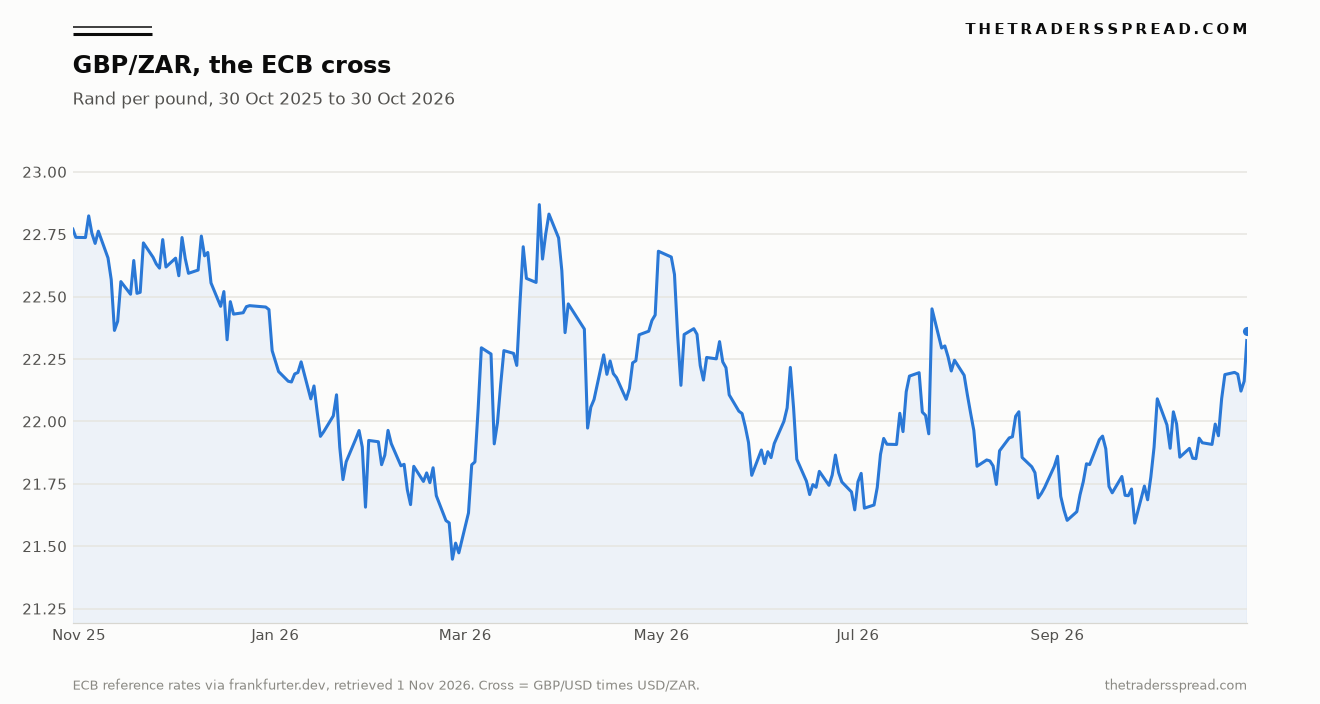
Frankfurter's latest endpoint dated both legs 30 October 2026, the history endpoints cover the same window, and the dollar-rand history answered at 08:02 GMT on 1 November 2026. Weekend dates are absent because the ECB reference is a business-day series. A broker spread that is wide on a Sunday evening leaves a trace on a ticket and leaves none on this chart.
Questions the survey can answer
Is GBP/ZAR liquid around the clock?
A platform can display a pound-rand price through the night, which is the liquid-sterling claim in practical form. London price-setting dealers reported $50 million of direct spot a day in October 2025, against $18,054 million of dollar-rand spot and $99,689 million of cable spot, in the FXJSC tables published on 4 February 2026. The display can run all day. The dedicated book is the small cell, and the product gap opens when the two legs sit on different clocks.
Why does the spread change at the Johannesburg open?
In the months when the UK is on Greenwich Mean Time, Johannesburg runs two hours ahead of London, on the IANA record of South African Standard Time at UTC+2. The local morning is already pricing the rand while London's cable book is still on an earlier hour. A pound-rand quote built by multiplying the legs then mixes a fresh rand price with an older sterling price, and the $50 million direct spot line is a small bid beside either leg.
How is a pound-rand quote built from the two legs?
The cross bid is the cable bid multiplied by the dollar-rand bid, and the cross ask is the cable ask multiplied by the dollar-rand ask, so the spread is the gap between those products. It widens when either leg widens, and again when the mids come from different moments, because a cable move changes the product before dollar-rand prints a matching tick. The ECB series is one point a day, so that gap is already gone from the chart.
What did London report for the direct cross?
In October 2025, average daily pound-rand volume was $50 million in spot, $28 million in outright forwards, $42 million in FX swaps and $5 million in options, with currency swaps at zero, which sums to $125 million. The April 2025 tables, on the same basis, had summed to $210 million, while dollar-rand spot rose from $16,635 million to $18,054 million. The non-deliverable forward sheet names the legs, and the pound-rand cell is absent there in both workbooks.
What remains for the cross after London?
The UK survey put average daily UK foreign-exchange turnover at $3,850 billion in October 2025. The New York Foreign Exchange Committee put North American OTC turnover at $1,303.2 billion for the same month, in a release dated 10 February 2026, on the same price-setting dealer basis. Its written findings name cable among the pairs that rose and stay silent on pound-rand and on dollar-rand. After London, that smaller surveyed pool is the published book still on the table.
If a live GBP/ZAR quote is borrowing the rand's book in the Johannesburg morning, cable's book in the London hour, and a North American pool about a third the size of London's after that, which of those three clocks is the spread on the ticket actually using?
General information only, drawn from published surveys and reference rates, and not a recommendation to buy or sell any currency or a forecast of the next print.