

"Today the Board decided to increase the cash rate to 4.85 per cent," Michele Bullock, Governor of the Reserve Bank of Australia, said in Sydney on 3 November 2026, and that cash-rate step still leaves AUD/SGD answering to a second policy regime in Singapore.
Frankfurter's ECB reference for 4 November 2026, retrieved on 5 November 2026, prints the cross at 0.89646 Singapore dollars per Australian dollar. The figure is a daily reference rate from the European Central Bank's fixing, delivered through Frankfurter. A dealing screen shows a bid and an offer around a reference of that kind, and the distance between them is the spread at that hour.
| Reading | Figure | Where it comes from |
|---|---|---|
| AUD/SGD ECB reference | 0.89646 on 4 November 2026 | Frankfurter, retrieved 5 November 2026 |
| One-year high | 0.92239 on 13 May 2026 | Frankfurter daily series, 5 November 2025 to 4 November 2026 |
| One-year low | 0.84047 on 24 November 2025 | Same 255-print series |
| Change across the window | +5.8 per cent, from 0.84733 | Same series, first print to last |
| RBA cash rate target | 4.85 per cent, effective 4 November 2026 | RBA cash-rate overview, read 5 November 2026 |
| Vote on 3 November 2026 | Six members for 4.85 per cent, three for 4.60 per cent | RBA media release 2026-30 |
| MAS setting on 14 October 2026 | Appreciation slope maintained; width and centre unchanged | MAS monetary policy statement |
Read the rows as two instruments, then as a price. Australia's tool is the overnight cash rate banks pay one another, and it is 4.85 per cent from 4 November 2026 after a 25 basis point rise that six members backed and three opposed, preferring 4.60 per cent. Singapore's tool, restated on 14 October 2026, is the slope of a trade-weighted band, kept on its appreciating setting with the July width and centre. A hike in Sydney is a thin reason, on its own, for a higher AUD/SGD, because the currency on the other side of the cross is the policy instrument.
The references refuse the tidy version. Across 255 daily prints from 5 November 2025 to 4 November 2026 the cross rose from 0.84733 to 0.89646, a gain of 5.8 per cent, with a high of 0.92239 on 13 May 2026 and a low of 0.84047 on 24 November 2025. The latest print sits 2.8 per cent under that high and 6.7 per cent above that low. The median of the sample is 0.89783, so 0.89646 is 0.00137 under the middle of its own year, near the 44th percentile, and the mean is 0.89210. Spot is ordinary on both centres, so a breakout story and a collapse story each ask for a move away from a print the sample already treats as normal.
Key facts from the fixing and the two boards
- The AUD/SGD ECB reference is 0.89646 for 4 November 2026, retrieved from Frankfurter on 5 November 2026.
- The one-year range on that daily series runs from 0.84047 on 24 November 2025 to 0.92239 on 13 May 2026, across 255 prints, per Frankfurter on 5 November 2026.
- The RBA cash rate target is 4.85 per cent, effective 4 November 2026, and the next update is listed for 2.30 pm Sydney time on 8 December 2026, per the cash-rate overview read on 5 November 2026.
- The 3 November decision carried six votes to raise the target by 25 basis points and three votes to leave it at 4.60 per cent, per RBA media release 2026-30.
- MAS maintained the rate of appreciation of the S$NEER policy band on 14 October 2026, with the width and the centre left as they were, per the monetary policy statement of that date.
- MAS Core Inflation was 2.1 per cent year on year in July and August 2026, up from 1.5 per cent in the second quarter, per the same MAS statement of 14 October 2026.
- Singapore's GDP grew 5.4 per cent year on year in the third quarter of 2026, and 1.1 per cent quarter on quarter seasonally adjusted, on advance estimates cited by MAS on 14 October 2026.
A year of references, already spent
The path is a climb, a two-day spike, and a giveback. From a November 2025 month-end of 0.84690 the cross reached 0.90553 on 10 March 2026, its first print at or above 0.90, then 0.92239 on 13 May and 0.92198 on 14 May, the only two days in 255 at or above 0.92. June closed at 0.89180, 28 August reached 0.91466, the highest reference since 5 June, 15 October made the post-May low at 0.88661, and 4 November settled at 0.89646.
Of the 125 prints after 13 May, 97 sat above today's reference, so the second half of the sample still looks rich beside the latest fixing even while the full-year median says the price is ordinary. Since 5 June the highest print is 0.91466 on 28 August, while 55 references sit at or below 0.878 and 33 sit at or below 0.86, the latter clustered before March. The base level below is a place the cross has occupied, and the bear level is a return toward 0.85917, the 31 December 2025 print, which the cross now exceeds by 4.3 per cent.
An AUD/SGD forecast built only from the latest cash-rate gap starts in the wrong place, because the year's 5.8 per cent rise is already in the fixing and the session after the hike still looks like a median outcome. AUD/NZD is a different pair, and a hike in Australia reaches that cross through another quote currency.
Six votes, and the next step left open
The decision Bullock was explaining is media release 2026-30. The Board raised the cash rate target by 25 basis points to 4.85 per cent. The statement says inflation remains elevated and broadly based, stays above 3 per cent for the coming year, and reaches the top of the 2 to 3 per cent target range only in late 2027, around three quarters later than the previous forecast. Staff forecasts were revised higher on fuel and other commodity prices tied to the Middle East conflict, and on domestic capacity pressure judged a little tighter than thought. The same release says financial conditions are already tighter, housing prices have fallen significantly, and the unemployment rate has risen, with business investment, including data centres, the firmer offset.
The vote is the line a rate-gap story skips. Six members chose 4.85 per cent and three chose to leave the target at 4.60 per cent, so the fifth increase of the year, after four earlier rises Bullock dates from February, arrived with a large minority for a hold. She said the tightening addresses domestic capacity pressure, and that the cash rate has little purchase on the direct effect of global oil prices. The hold camp put more weight on housing that had already reacted, unemployment that was drifting up, and wages growth that had stayed steady. She left the next move unnamed, declined forward guidance, and called this a moment to take stock, while saying transmission can take 12 months or longer and that the exchange rate moves along the way.
The Reserve Bank of Australia posted the decision in its own words on the RBAInfo account, the handle listed on the Bank's site, and the post matters because it carries the Board's sentence on the move to 4.85 per cent.
At its meeting today, the Board decided to increase the cash rate target by 25 basis points to 4.85 per cent.
— Reserve Bank of Australia (@RBAInfo) November 3, 2026
Read the full statement here: https://t.co/DsN05taWth pic.twitter.com/ubLk8g99nV
The cash-rate overview, read on 5 November 2026, confirms the target at 4.85 per cent, the effective date of 4 November 2026, and the next update at 2.30 pm Sydney time on 8 December 2026, alongside the two objectives of inflation between 2 and 3 per cent and sustained full employment. Until December, the Australian side of the cross is a 4.85 per cent cash rate with a recorded dissent and an unnamed following step.
What MAS steers is a slope
The 14 October 2026 monetary policy statement says that in July MAS increased the rate of appreciation of the S$NEER policy band very slightly, leaving width and centre where they were, and that the currency has since strengthened modestly inside the upper half of that band, which October then maintained. Core inflation rose to 2.1 per cent year on year in July and August, from 1.5 per cent in the second quarter, and food inflation rose to 2.2 per cent from 1.9 per cent. Forecasts for 2026 are core inflation of 1.5 to 2.0 per cent and CPI-All Items around 2.0 per cent, with both at 1.5 to 2.5 per cent in 2027. Third-quarter GDP, on the advance estimates MAS cites, grew 5.4 per cent year on year and 1.1 per cent quarter on quarter, seasonally adjusted.
The statement gives the direction of the band and leaves the slope, the width and the centre off the page as numbers, so the path can be called appreciating and then the arithmetic has to stop. The S$NEER is a trade-weighted basket, Australia is one partner in it, and a steeper slope is a headwind for AUD/SGD only to the extent the Australian dollar lags that basket, which is a different object from a cash rate set beside 4.85 per cent. USD/SGD meets the same band from the US dollar, and GBP/SGD is a different pair, sterling against the Singapore dollar. From 0.89907 on 14 October the reference fell to 0.88661 the next day and was back at 0.90171 by 28 October, a round trip that is a weak basis for calling 0.88661 a new regime.
Where that comfortable rate-gap story breaks
The comfortable story says a 4.85 per cent cash rate, beside a Singapore band, means the Australian dollar grinds higher. The hike happened, and the October page publishes a slope while a Singapore cash rate stays off it, yet the references reject that conclusion: 0.89628 on 2 November, 0.89473 on 3 November, and 0.89646 on 4 November, a move of 0.00018 from the eve of the hike. The climb to the May high happened during the tightening that began in February, so this step, with three members preferring to wait, is smaller news than the first hike, and a slope that is simply kept is still a slope. The cash rate leans one way and the band leans the other, while 0.89646 sits near the middle of the lived year.
Three levels drawn out from the fixing
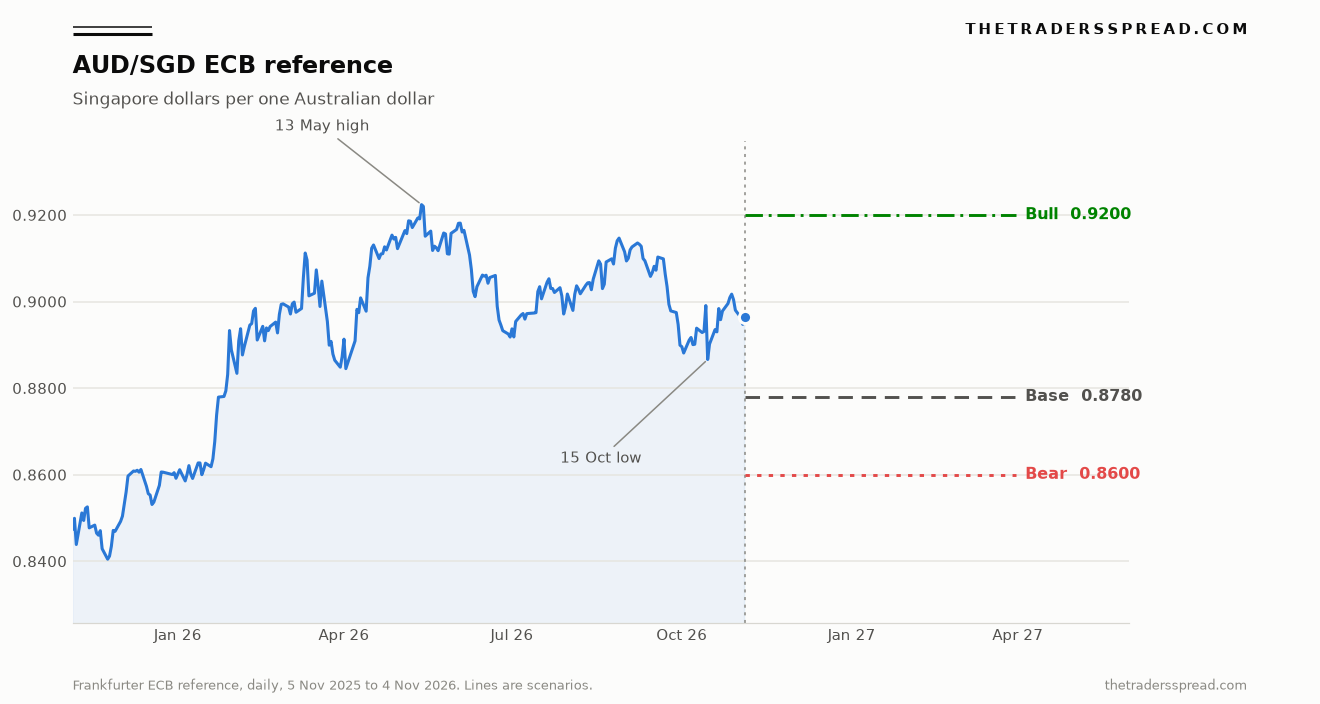
The chart plots the 255 daily ECB references and carries three scenario lines out to 31 March 2027. The vertical scale is the cross, Singapore dollars per one Australian dollar, and bull, base and bear use separate dash patterns. The lines are scenarios from the range and the two policy documents. A dealing bid can sit away from each of them.
| Path | Level | Versus 0.89646 | What has to hold |
|---|---|---|---|
| Bull | 0.92 | +2.6 per cent | Cash-rate support outweighs the SGD slope, and the cross revisits the two-day May spike near 0.92239 |
| Base | 0.878 | minus 2.1 per cent | The slope stays as MAS left it, December is used to watch the data, and the cross slips through the 15 October low of 0.88661 |
| Bear | 0.86 | minus 4.1 per cent | The band does more of the work, and the climb gives back toward the 31 December 2025 print of 0.85917 |
Questions the fixing still leaves open
Where does the 0.89646 AUD/SGD figure come from?
The 0.89646 print is the ECB reference rate for 4 November 2026, pulled from Frankfurter on 5 November 2026 with the Australian dollar as the base and the Singapore dollar as the quote. Dealing screens show a bid and an offer through the session, so a broker quote can sit away from 0.89646 by the spread at that hour, and the history above uses the same source across 255 prints.
Did the November cash-rate hike lift the cross on the fixing?
The references around the vote were 0.89628 on 2 November, 0.89473 on 3 November and 0.89646 on 4 November, a gap of 0.00018 from the eve of the decision to the next reference. On this series the hike arrived and the fixing finished the next session where it had started.
RelatedGBP/HUF bull case at 468 versus a bear case at 412
What is the cash rate now, and how did the Board split?
The cash rate target is 4.85 per cent, effective 4 November 2026, on the RBA cash-rate page. Media release 2026-30 records six members voting to raise the target by 25 basis points and three voting to leave it at 4.60 per cent, after four earlier increases this year. The Governor said the hold camp weighted downside risks more heavily. The next update listed on the cash-rate page is 2.30 pm Sydney time on 8 December 2026.
What did MAS decide in October about the band?
On 14 October 2026 MAS maintained the rate of appreciation of the S$NEER policy band. The width and the centre stayed where the July review had set them, after a step MAS described as a very slight increase in the slope. The statement says the currency had strengthened modestly inside the upper half of the band since July. Core inflation for 2026 is forecast at 1.5 to 2.0 per cent, with a clearer easing from the middle of 2027.
How wide was the AUD/SGD range over the past year of fixings?
From 5 November 2025 to 4 November 2026 the ECB reference ranged from 0.84047 on 24 November 2025 to 0.92239 on 13 May 2026, across 255 daily prints. The latest reading, 0.89646, is 5.8 per cent above the first print and 2.8 per cent below the high. Only 13 May and 14 May printed at or above 0.92. The median of the full sample is 0.89783, a hair above the latest fixing.
What would make 0.878 the wrong working level?
A reference at or above 0.915 would be the first print at that height since 5 June 2026, clearing 0.91466 from 28 August, and that print would retire the drift toward 0.878. A further cash-rate rise on 8 December, or an MAS decision to flatten the appreciation slope, would shift weight toward 0.92. A fresh steepening of the band, with Australian growth slowing as the November statement describes, would shift weight toward 0.86.
The call that follows from 0.89646
The working call is the base, at 0.878, about 2.1 per cent under the 4 November reference, a little through the 15 October low of 0.88661 and well above the year's low. It needs the fewest new decisions: MAS keeps the appreciating slope restated in October, and the RBA uses 8 December to watch the data, the stance Bullock described as a point to take stock. Fifty-five of the 255 references were at or below 0.878, so the level is inside the lived sample and still a step down from a fixing near the median. The lean is lower, with low conviction, because a 4.85 per cent cash rate can still pull the other way and because the statement gives the slope as a direction and leaves the percentage off the page.
The bull case is 0.92, about 2.6 per cent above the reference and just shy of the 13 May high, a level seen on only two days in the year, so a return wants another hike or a flatter MAS band. The bear case is 0.86, about 4.1 per cent under the reference and close to the 31 December 2025 print of 0.85917, a neighbourhood the fixing left behind on 10 March 2026 when it climbed through 0.90. That path wants the band to do more than October's round trip showed, and it asks for a giveback of most of the year's rise while the Board still calls inflation too high for the coming year.
What changes the call is on the same two sources. A reference at or above 0.915 retires the lower lean, because the cross would have cleared 0.91466, the highest print since 5 June. A hold on 8 December, read as a pause to take in the data, would leave 0.878 in place. A further hike, or a flatter MAS slope, would move weight toward 0.92, and a fresh steepening of the band would move weight toward 0.86. Between those events the fixing is 0.89646, the cash rate is 4.85 per cent on a 6 to 3 vote, and the Singapore dollar's setting is still an appreciating band.
The figures above are an analysis of central-bank documents and an ECB reference rate, and they are information in place of an instruction to deal.