

Having tracked this pair since the morning of 15 January 2015, when the Swiss National Bank walked away from its euro floor and USD/CHF fell through parity inside a single session, I have learned to distrust every clean story told about the Swiss franc. The pair spent the following decade teaching the same lesson repeatedly: the franc does what Swiss savings and geopolitics tell it to do, and the interest rate differential arrives late to the argument. On 2 September 2026 the European Central Bank reference rate put USD/CHF at 0.81396. A dollar buys 81 and a bit Swiss centimes, which is roughly where it has sat, give or take five per cent, for two years.
Here is the part almost nobody prices correctly. The SNB policy rate is 0.00%, and has been since the bank stopped cutting in June 2025. But the policy rate is not what a franc actually earns. SNB data show SARON, the Swiss overnight reference rate, averaged −0.060456% in August 2026, and three-month money market debt register claims of the Swiss Confederation averaged −0.083%. Every month of 2026 has printed a negative SARON. Switzerland is running negative money market rates with a zero policy rate, because sight deposits above each bank's threshold at the SNB carry a discount of 0.25 percentage points. The marginal franc parked at the central bank earns minus a quarter point. Against a US effective fed funds rate of 3.63% on 1 September, the carry gap on this pair is not 363 basis points. At the margin it is 388.
What the tape actually did
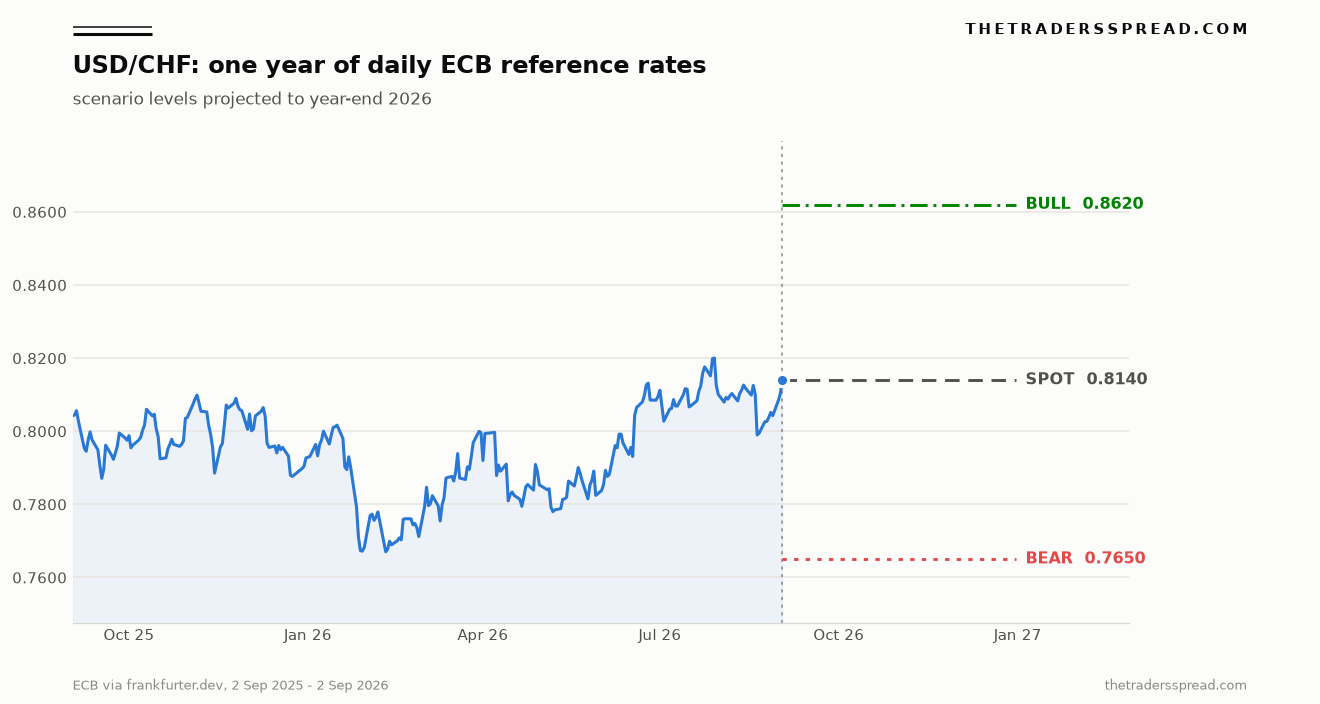
The twelve months to 2 September 2026 contain one real trend and one violent interruption. USD/CHF opened the window at 0.80422 on 2 September 2025. It ground lower into winter, then broke down hard in late January, bottoming at 0.76703 on 10 February 2026, the low of the period and the strongest the franc has been against the dollar in this cycle. From there it recovered for five months, peaking at 0.82004 on 29 July 2026, before a sharp two-day drop to 0.79899 on 20 August and a fast recovery into the 0.814 area where it now sits.
That shape matters more than the level. The February low coincided with the escalation in the Middle East that dominates every SNB document published since. The recovery from it coincided with something the SNB itself flagged: interest rates in the major currency areas rising while Swiss rates stayed pinned at zero. All series here come from the ECB reference rate feed, 256 daily observations, pulled on 2 September 2026.
The SNB has told the market exactly what it is doing
Central banks are usually read like tea leaves. Not this one. At the monetary policy assessment of 18 June 2026 the SNB left the policy rate at 0% and published a paragraph that comes close to an explicit exchange rate reaction function.
"Upward pressure on the Swiss franc initially increased with the escalation of the conflict in the Middle East, as the franc was sought after as a safe haven. We therefore increased our willingness to intervene in the foreign exchange market at the beginning of March. Interest rates in the major currency areas have since risen, in part because markets expect monetary policy tightening there due to the higher inflation. As the interest rate differentials with other countries have widened, the Swiss franc has depreciated somewhat."
That is Martin Schlegel, Chairman of the Governing Board at the Swiss National Bank, in the introductory remarks to the June news conference in Berne. Read it as a timeline. In March, the SNB raised its intervention willingness. Then the differential did the work instead, and the franc gave back ground without the bank having to spend much.
The same document sets the inflation frame. "At 0.6%, inflation is relatively low by international standards and lies within the range consistent with price stability, which we equate with an inflation rate of between 0% and 2%," Schlegel said. The bank's conditional forecast, built on the assumption of a 0% policy rate across the whole horizon, puts average annual inflation at 0.6% for 2026, 0.6% for 2027 and 0.7% for 2028.
Ten weeks later the message had not moved. Presenting at the EPFL Innovation Park in Ecublens on 31 August 2026, Petra Tschudin, Member of the Governing Board at the Swiss National Bank, summarised the stance on a single slide: "Medium-term inflationary pressure virtually unchanged – SNB has left policy rate at 0% in June and, if necessary, has an increased willingness to intervene in FX markets." The same presentation carries a slide titled "Effective US tariffs at the highest level in eighty years," and another attributing the Swiss inflation pickup mainly to oil products.
The balance sheet says something the speeches do not
Pull the SNB's monthly balance sheet items from its data portal and compare July 2026 with July 2025. The composition has shifted in a way that is easy to miss.
| SNB balance sheet item | July 2025 | July 2026 | Change |
|---|---|---|---|
| Foreign currency investments | CHF 746.0bn | CHF 802.5bn | +CHF 56.5bn |
| Gold holdings and gold claims | CHF 89.9bn | CHF 109.4bn | +CHF 19.5bn |
| Sight deposits of domestic banks | CHF 434.6bn | CHF 420.9bn | −CHF 13.8bn |
| SNB debt certificates outstanding | CHF 51.7bn | CHF 81.9bn | +CHF 30.2bn |
| Total balance sheet | CHF 855.5bn | CHF 930.0bn | +CHF 74.5bn |
Foreign currency investments grew by CHF 56.5bn over the year. Some of that is valuation, and the balance sheet alone cannot separate purchases from mark-to-market. What valuation cannot explain is the liability side. SNB debt certificates outstanding rose 58.6% while domestic bank sight deposits fell by CHF 13.8bn. The SNB has been draining francs out of the sight deposit system and into bills, which is what a central bank does when it wants reserves absorbed rather than sitting where the tiering discount bites.
Scale it. Swiss nominal GDP was CHF 867.5bn in 2025 on World Bank figures. The SNB balance sheet at CHF 930.0bn is 107% of national output, and the foreign currency book alone is 92.5% of it. No other G10 central bank runs an FX position of that relative size, and that fact sits underneath every argument about how much room the bank has to lean against its own currency.
Washington is watching, and that is a real constraint
The US Treasury published its semiannual currency report in July 2026. Switzerland stays on the Monitoring List alongside China, Japan, Korea, Taiwan, Thailand, Singapore, Vietnam, Germany and Ireland. The detail that matters for this pair is that in this report Switzerland met only one of the three criteria in the 2015 Act, the material current account surplus test, and Treasury states it "will be removed from the Monitoring List if [it meets] fewer than two criteria in the next reporting period."
Treasury's estimate of Swiss intervention is modest. Cumulative net foreign exchange purchases by the SNB over the four quarters through December 2025 came to $6bn, or 0.6% of GDP, with roughly $9.7bn of that concentrated in April during a burst of safe haven demand. Switzerland is also one of seven trading partners that signed a joint statement with Treasury reaffirming a commitment not to target the exchange rate for competitive advantage.
Two more numbers from that report frame the franc's fundamental pull. Switzerland ran a current account surplus of 7.0% of GDP over the four quarters through December 2025, down from a 9.0% peak in 2022. And the IMF's 2024 assessment, the most recent available, judged the franc overvalued by 11.5% on a real effective basis. A currency that expensive, attached to a surplus that large, does not cheapen on carry alone.
The bull case: 0.8620
The dollar-positive path does not need a new story. It needs the current one to persist.
Start with the differential, because it is the only variable currently moving in the dollar's favour and it is enormous. The Federal Reserve's target range sits at 3.50–3.75% with effective fed funds at 3.63% as of 1 September, per the New York Fed. Swiss overnight money pays less than nothing. Holding francs against dollars costs a shade under 4% a year before any spot move, and that cost compounds against anyone warehousing a safe haven position they no longer urgently need.
Second, the euro area is tightening and Switzerland is not. The SNB's own account of the June meeting notes that "key interest rates have been raised in the euro area, while they have remained unchanged in the US." SNB data show three-month EURIBOR climbing from 2.324% in June 2026 to 2.484% in July and 2.593% in August. Every basis point of euro tightening widens the gap against a Swiss rate the SNB has forecast at zero through 2028.
Third, the SNB is a declared asymmetric seller of its own currency. The bank has said, in three consecutive communications, that it has an increased willingness to intervene against rapid franc appreciation. There is no matching statement about franc weakness. A central bank that will lean against 0.77 but not against 0.85 skews the distribution of outcomes upward for this pair.
Fourth, the safe haven bid has an expiry. The February low at 0.76703 was a geopolitical print. The subsequent 6.9% recovery to 0.82004 by late July happened without any Swiss policy change at all, which suggests the flow, not the rate, was doing the work. If the Middle East situation stabilises, that flow reverses rather than merely stopping.
The 0.8620 level is a 5.9% move from spot. It sits above the 29 July 2026 high of 0.82004 and inside the range this pair traded in during early 2025, before the franc's 14.3% appreciation against the dollar over that year. It is a return to recently occupied territory, not a new regime.
The bear case: 0.7650
The franc-positive path is shorter to describe and harder to dismiss.
Switzerland's current account surplus is the whole argument. A country running 7.0% of GDP in external surplus generates continuous structural demand for its own currency, and Treasury's own analysis lists the reasons it will not fade quickly: a large share of prime-aged savers, an ageing population, a high household savings rate, limited domestic investment opportunities and a large positive net international investment position. Carry is a flow argument. Surplus is a stock argument, and stock wins over multi-year horizons.
RelatedGBP/AUD Forecast: 1.9600 Bull Case vs 1.8400 Bear Case
The rate gap can close from the other end. The Fed's range at 3.50–3.75% is already off its highs, and the SNB has committed to nothing beyond a conditional forecast. If US growth softens while the SNB stays parked at zero, the differential compresses without a single Swiss decision.
Geopolitics has not resolved. Schlegel was explicit that "the geopolitical situation remains uncertain. The risk of strong upward pressure thus persists." Tschudin's Berne remarks listed the same risk and added US trade policy, with tariffs on most Swiss exports set at 15% under the framework agreement reached with Washington. A second escalation would reproduce the February move, and February took the pair 5.8% below where it trades now in about three weeks.
Intervention capacity is not unlimited in practice. Sitting on the Monitoring List means every large purchase is counted and published, and Switzerland is one criterion away from leaving that list. The bank has an incentive to spend sparingly, which caps how hard it will lean before 0.77 breaks.
The 0.7650 level is a 6.0% move from spot and sits just below the 10 February 2026 low of 0.76703. It is a cycle low extension, not an invention.
What settles the argument
The calendar is unusually clean. The SNB publishes its next monetary policy assessment on 24 September 2026, with the news conference at 10:00, and the following one on 10 December 2026. The summary of the monetary policy discussion lands on 22 October, and interim results as at 30 September arrive on 30 October. Four dated events, all inside the horizon these levels describe.
The tell at each will not be the policy rate, which the SNB has already forecast at zero throughout. It will be the intervention language. If "increased willingness to intervene" is dropped, the asymmetry that supports the bull case goes with it. If the phrase hardens, or if the September interim results show the foreign currency book jumping again, the market will read it as a floor being defended somewhere near 0.79.
Swiss inflation is the second gauge. SNB data put the July 2026 national consumer price index at +0.354% year on year, down from 0.616% in May. If that keeps decelerating toward zero while energy base effects fade, the case for a franc the SNB tolerates strengthening gets easier to make, because a weaker franc stops being an inflation problem the moment inflation is not one.
How this desk is framing it
The measured position is a mild dollar lean with low conviction and a tight structural stop. Reference level 0.8140, upside scenario 0.8620, downside scenario 0.7650. The level that invalidates the constructive read is 0.7950. A sustained close below it breaks the recovery sequence that has been intact since 10 February and puts the February low back in play well before any of the four scheduled SNB events.
The honest summary is that the carry argument and the surplus argument point in opposite directions and have done so for a decade. Carry has been winning by inches since February. It has lost by miles before, and always suddenly.
Traders comparing execution costs on this pair may find our review of Swissquote, the Swiss bank-licensed broker, relevant, since franc pricing differs sharply between Swiss-domiciled and offshore venues. The same carry mechanics driving USD/CHF are visible in our USD/JPY forecast, where the differential is wider still, and in our EUR/HUF analysis of a high-carry European cross. The Fed leg of this trade is examined in our breakdown of September Fed pricing, and the gold position on the SNB's balance sheet connects to our gold price analysis.
Sources and dates
- Spot and history: ECB reference rates via frankfurter.dev, 2 September 2026. USD/CHF 0.81396.
- SNB policy rate, inflation forecast and intervention stance: Monetary policy assessment of 18 June 2026 and the introductory remarks of the same date.
- SARON, EURIBOR, Confederation money market claims, balance sheet items and the consumer price index: SNB data portal, series retrieved 2 September 2026.
- US rates: Federal Reserve Bank of New York reference rates, 1 September 2026.
- Monitoring List, intervention estimates, current account and IMF valuation: US Treasury, Macroeconomic and Foreign Exchange Policies of Major Trading Partners, July 2026.
- Publication calendar: SNB time schedule.
Disclaimer: this article is analysis and information only. It is not investment advice, a recommendation, or an offer to buy or sell any currency, contract for difference or other instrument. Levels discussed are scenario markers used to frame risk, not targets to act on. Foreign exchange and CFD trading carries a high risk of loss. Figures are accurate as at 2 September 2026 and will move. Readers should conduct their own research and consider seeking independent professional advice.