

The European Central Bank's accounts page lists the next monetary-policy account for 8 October 2026, the euro-side document EUR/CAD still has to price before any new fixing. That account covers the Governing Council meeting held in Berlin on 9-10 September. The latest rate on the ECB's daily sheet, pulled on the morning of 5 October 2026, is still dated 2 October, at 1.5984 Canadian dollars per euro. Nothing in the series has printed for Monday. The Berlin account is due at 13:30 CET on Thursday. Statistics Canada has scheduled the September Labour Force Survey for Friday 9 October, covering the week of 13 to 19 September. Between those two documents the cross has a year of reference rates, a drop of 0.0111 on the last print, and no newer official fixing. The scenarios below are built on 1.5984, not on a live dealer quote.
The awkward fact in that last print is the company it keeps. On 2 October, Eurostat's flash estimate put euro-area inflation at 3.8% for September, up from 3.2% in August, with energy at 18.8%. The same morning the US Bureau of Labor Statistics said nonfarm payroll employment, up 29,000, and the unemployment rate, at 4.2%, changed little in September. A hotter euro-area inflation flash is the sort of number that, on its own, would be read as support for the euro. The ECB reference for EUR/CAD fell anyway, from 1.6095 on 1 October to 1.5984. It fell while the ECB deposit facility rate, at 2.50% since 16 September, sat 30 basis points above the Bank of Canada's 2.20% deposit rate. The cheapening is not a story about which central bank has the higher policy deposit rate. That gap was already public. The open question is whether Thursday's account and Friday's jobs survey treat the gap as something to extend or something to fade.
Key facts
- EUR/CAD on the ECB reference was 1.5984 on 2 October 2026, down 0.69% from 1.6095 on 1 October. Source: ECB reference rates via frankfurter.dev, retrieved 5 October 2026.
- In the 254 ECB references from 6 October 2025 to 2 October 2026, the high was 1.6393 on 17 October 2025 and the low was 1.568 on 9 March 2026. Source: same series, retrieved 5 October 2026.
- The ECB raised its three key rates by 25 basis points on 10 September 2026. The deposit facility is 2.50%, main refinancing 2.65% and marginal lending 2.90%, from 16 September. Source: ECB monetary policy decision, 10 September 2026.
- The Bank of Canada held its overnight target at 2.25% on 2 September 2026, with the deposit rate at 2.20%. The next announcement is 28 October 2026. Source: Bank of Canada, 2 September 2026.
- Euro-area flash inflation was 3.8% in September 2026, and energy was 18.8%. Source: Eurostat, 2 October 2026. Canada's consumer price index rose 3.0% year on year in August, and gasoline rose 22.8%. Source: Statistics Canada, 14 September 2026.
- Canadian employment fell by 42,000, or 0.2%, in August, and the unemployment rate was unchanged at 6.4%. The next Labour Force Survey is 9 October 2026. Source: Statistics Canada, 4 September 2026.
A Friday reference, not a Monday tick
Frankfurter.dev republishes the ECB's euro foreign-exchange reference rates. It is not a broker screen. Queried on the morning of 5 October 2026, the latest endpoint returned the date 2026-10-02 and the rate 1.5984. The same response priced the euro at 1.1225 US dollars. This piece does not turn that second rate into its own forecast.
The one-day move into that print was 0.0111, from 1.6095 to 1.5984, or 0.69%. Across the 253 day-to-day changes in the sample that starts on 6 October 2025, that decline ranks third. The larger two were 2 March 2026, from 1.6139 to 1.5991, and 8 December 2025, from 1.623 to 1.609. Friday was a large reference-day move. It was not a unique one inside this year of fixes.
It was the lowest print since 21 May 2026, when the reference was 1.5972. Every ECB fixing after that May print and before 2 October sat above 1.5984. The 22 September references averaged 1.6073, with a low of 1.6019 on 3 September and a high of 1.6127 on 25 September. On 30 September the rate was 1.6105. On 1 October it was 1.6095. One fixing then left the band the cross had occupied for most of the month.
Of the 254 references, 155, or 61%, were at or above 1.61. The latest reference is 1.96% below the 6 October 2025 print of 1.6304.
A return to 1.61 retraces one fixing. A print at 1.64 or 1.56 leaves the year's range.
Thursday's account, then Friday's survey
The ECB accounts index states the next release as 8 October 2026. The bank's weekly calendar is more specific: Thursday 8 October, 13:30 CET, publication of the account of the monetary policy meeting held on 9-10 September 2026 in Berlin. An account records a discussion that has already happened. It is not a new rate decision.
The decision of 10 September was a 25 basis point rise in all three key rates, with no pre-commitment to a path. The deposit facility went to 2.50%, main refinancing to 2.65% and marginal lending to 2.90%, from 16 September. The staff baseline sees headline inflation averaging 3.0% in 2026, 2.5% in 2027 and 2.1% in 2028. Excluding energy and food, the baseline is 2.5%, 2.6% and 2.3%. Growth is 0.9%, 1.4% and 1.5%.
The September flash, at 3.8%, sits above that 3.0% average for 2026. A year average and a single month are different objects. There is a dating trap as well. The account describes 9-10 September. Eurostat did not publish 3.8% until 2 October, so the account cannot react to a number that did not yet exist. On 28 September, before that flash, Lagarde said headline inflation had risen to 3.2% in August from 2.9% in July.
Christine Lagarde, President of the ECB, told the European Parliament's economic committee in Brussels on 28 September, after the meeting and before the flash: "Looking at these three criteria today, we see higher inflation ahead but no signs yet that it is becoming embedded." She added that the shock was too large to look through, and that "we view a measured response as appropriate to keep inflation in check." Compensation per employee, she said, stood at 3.3% in the second quarter, down from 3.6% in the first, and she did not see energy prices feeding into higher wages at that stage. The speech is later colour. The account will not contain it, because the Council had already met.
Unemployment in the euro area, she said at the same hearing, stood at 6.4% in July. That is a July rate. It is not a September labour-force print for Canada.
Statistics Canada's 4 September release is the latest Labour Force Survey a reader can open. Employment fell by 42,000, or 0.2%, to 21,173,000. The employment rate fell 0.1 percentage points to 60.8%. Unemployment was unchanged at 6.4%. August covers the reference week of 9 to 15 August. September, due on 9 October, covers 13 to 19 September. The sample is about 65,000 households. Friday is a survey, not a census, and a single month has reversed before.
On 2 September the Bank of Canada left the overnight target at 2.25%, the Bank Rate at 2.5% and the deposit rate at 2.20%. The next announcement is 28 October 2026, with the Monetary Policy Report, at 09:45 Eastern time on the Bank's 2026 schedule.
One year of fixes, and three lines past the dot
The chart plots all 254 ECB references for EUR/CAD from 6 October 2025 to 2 October 2026, then draws three scenario lines from the last dot to 31 December 2026. The lines are cases, not a path the fixing has already walked.
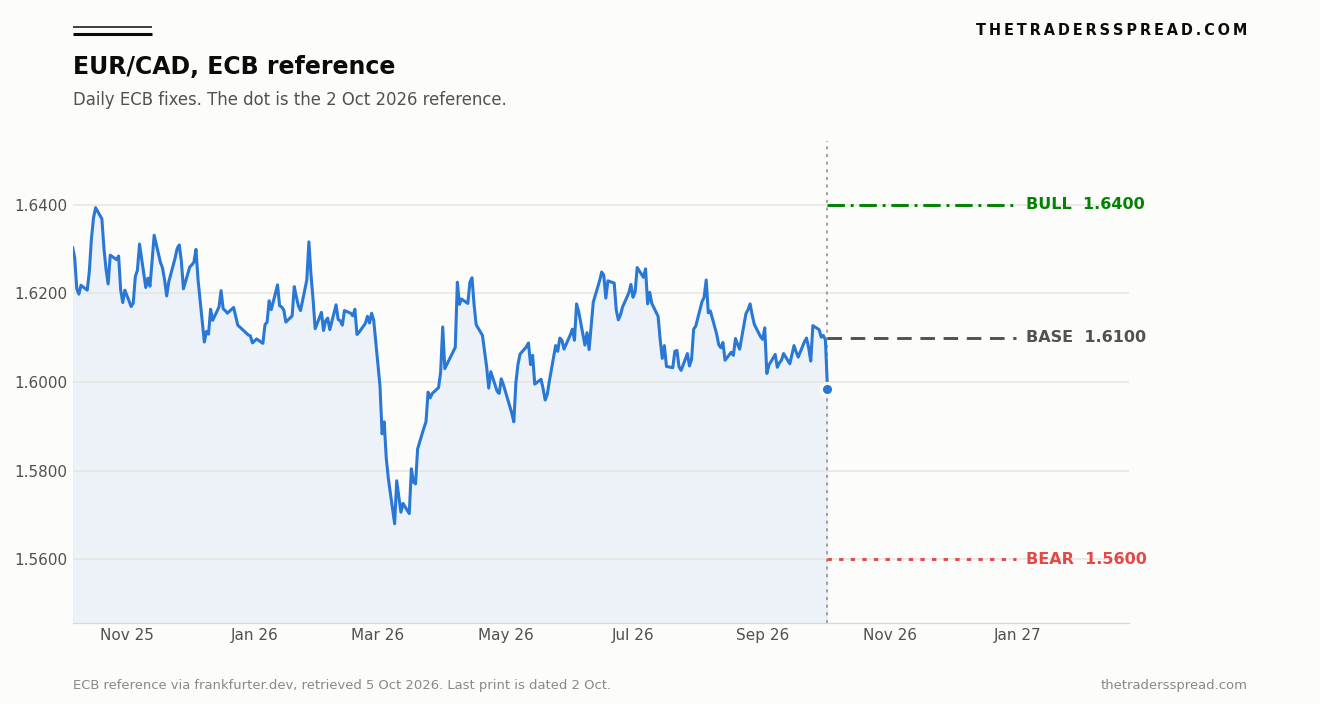
Bull is 1.6400, 0.0007 above the sample high and 2.60% above the latest reference. Base is 1.6100, 0.73% above 1.5984. Bear is 1.5600, 2.40% below it and 0.008 under the March low. The dot sits below the base line. For most of the year, 1.61 was ordinary and 1.64 was rare.
| Mark | EUR/CAD | What it is |
|---|---|---|
| 17 Oct 2025 | 1.6393 | High of the ECB sample |
| 9 Mar 2026 | 1.568 | Low of the ECB sample |
| 21 May 2026 | 1.5972 | Last print at or below 1.5984 before 2 October |
| 30 Sep 2026 | 1.6105 | Last September reference |
| 1 Oct 2026 | 1.6095 | Reference the day before the drop |
| 2 Oct 2026 | 1.5984 | Latest ECB reference in this piece |
| Bull scenario | 1.6400 | 31 December 2026, just through the sample high |
| Base scenario | 1.6100 | 31 December 2026, back in the September cluster |
| Bear scenario | 1.5600 | 31 December 2026, through the March low |
Historical rows are ECB reference rates via frankfurter.dev, retrieved 5 October 2026. The three scenarios are this article's year-end cases, not past prints.
The March low did not last. The reference was 1.6022 by 31 March. Getting to 1.64 means printing a high this sample does not contain. Getting to 1.56 means undercutting a low that bounced within three weeks.
The same energy shock, two different baskets
Statistics Canada, on 14 September, said the consumer price index rose 3.0% year on year in August, matching July. Excluding gasoline it rose 2.4%, after 2.2% in July. Gasoline rose 22.8% year on year, slower than July's 25.7%. The all-items index fell 0.1% on the month and rose 0.2% seasonally adjusted. The agency tied elevated gasoline prices to the conflict in the Middle East. September Canadian consumer prices are not in this piece. They had not been published by the morning of 5 October.
The euro-area flash is a different basket and a different month. Energy at 18.8% is the outlier: services were 3.2%, food, alcohol and tobacco 1.4%, and non-energy industrial goods 1.1%. Both headline rates sit above a 2% target. Treating 3.0% and 3.8% as one gap compares August in Canada with September in the euro area.
Tiff Macklem, Governor of the Bank of Canada, said at the 2 September press conference in Ottawa: "Monetary policy cannot offset the effects of tariffs or influence global energy prices." In the same opening statement he said the Middle East conflict was keeping energy prices higher for longer, which had increased the upside risks to inflation. With data "largely in line with our July forecast," the Council held the policy rate at 2.25%. He also said second-quarter GDP was up by 3.3% after a very weak first quarter, and that unemployment had edged down to 6.4% in July. Two days later the August survey left unemployment there and took 42,000 off employment. The growth line and the jobs line are not the same signal.
European gas is a separate market from this cross. The year-end range on Dutch TTF gas has its own bull and bear cases. It sits in the background only because both central banks have tied their inflation risk to energy.
Two labour markets at 6.4%, and two meetings still ahead
Canada's unemployment rate was 6.4% in August, unchanged, in a survey released on 4 September. Lagarde, on 28 September, cited a 6.4% euro-area unemployment rate for July. Same headline, different month, different survey. The policy response was not the same either. Frankfurt raised the deposit facility to 2.50% on 10 September. Ottawa held the overnight target at 2.25% on 2 September, and the deposit rate at 2.20%. On a deposit-to-deposit comparison the euro's policy rate is 30 basis points higher. The ECB reference is still the lowest since May.
A weaker employment print on Friday would, on the usual reading, lean toward the bull case, because it would soften the argument for a tighter Bank of Canada on 28 October. A firmer print, with unemployment down from 6.4%, would lean toward the bear case. That is a scenario link, not an instruction. The US payroll release and the inflation flash share 2 October with the fixing. This piece does not assign the 0.0111 drop to any one of the three.
The second central bank is the reason other euro crosses are not this one. Sterling has its own year-end cases. So does the Swiss franc. A Canadian jobs print does not answer either. EUR/CAD here is the euro against the Canadian dollar only.
RelatedGBP/NOK Price Prediction: 13.20 Bull Case vs 12.10 Bear
After Friday the window still holds two decisions. The Bank of Canada announces on 28 October, with a new Monetary Policy Report. The ECB calendar has the Governing Council in Frankfurt on 28-29 October, with the decision on the second day. If either bank breaks the September pattern, a hike in Frankfurt and a hold in Ottawa, the 30 basis point deposit gap changes with it.
The call into 31 December
The base case is 1.61 on the ECB reference by 31 December 2026. That is the target attached to this view: back near the 30 September print of 1.6105 and September's 1.6073 average. From 1.5984 the distance is 0.73%. The lean is mildly upward because one fixing left a band the cross had held for months, and neither the 30 basis point deposit gap nor Lagarde's measured framing makes that fixing a new regime. Conviction is 2 out of 5. Thursday's account and Friday's survey can each reverse the lean before the late-October meetings.
The bull case is 1.64, the figure in the title and the top line on the chart, not the central path. It sits 0.0007 above the 17 October 2025 high, which this sample has not cleared. It becomes the central path only if the account is more willing to extend the September hike than the 28 September wording, and if Friday's survey pushes the 28 October Bank of Canada decision away from a hike. A later reference back above 1.61 would shorten that step. The October meetings would still sit in the window.
The bear case is 1.56, and that is where the bull lean fails. It sits 0.008 under the 9 March low of 1.568. It becomes the central path if the account is read as the last step of this phase and Friday's survey pulls unemployment down from 6.4%, leaving a tighter Bank of Canada live for 28 October. A reference under 1.568 would damage the range. One that settles under 1.56 would put the cross in the bear scenario.
A reference dated after 2 October that is already through 1.61, or through 1.568, would make this map stale. None existed on the morning of 5 October. An account that drops the measured line would move the base case before Friday. A jobs print far from August's small job loss and unchanged 6.4% unemployment rate would reweight 28 October. A late-October decision that changes the 2.50% versus 2.20% deposit comparison would force a new gap. The levels are scenarios, not a position.
Questions readers actually ask
What EUR/CAD rate is this forecast using?
It uses 1.5984 Canadian dollars per euro, the ECB reference for 2 October 2026, retrieved from frankfurter.dev on the morning of 5 October. The feed's latest date was still 2 October. No Monday fixing is in the series this piece uses. A dealer quote during the Ottawa day can differ, and no such quote is in the scenarios. Both 1.64 and 1.56 are measured from that Friday reference.
Why is the bull case only 1.64, so close to an old high?
Because 1.64 is a year-end scenario, and the horizon includes the 28 October Bank of Canada decision and the 29 October ECB decision. The line is 0.0007 above the 17 October 2025 high of 1.6393. Reaching it means retracing the drop to 1.5984 and then printing a high the sample does not contain. That is already a full move across about twelve weeks. A higher bull case would be a different claim.
What would make 1.56 the central path?
An ECB reference that breaks the 9 March 2026 low of 1.568 and stays there, after an account read as a pause and a jobs report that firms the case for the Bank of Canada on 28 October. The bear line is 0.008 under that March low. A single soft fixing that remains above 1.568 would hurt the bull lean without making 1.56 the base. The failure level used here is 1.56 itself.
When do the account and the jobs survey come out?
The ECB weekly calendar lists the account of the 9-10 September meeting for Thursday 8 October 2026 at 13:30 CET. Statistics Canada has scheduled the September Labour Force Survey for Friday 9 October 2026. September covers the week of 13 to 19 September. August, released on 4 September, showed employment down 42,000 and unemployment unchanged at 6.4%. The account is a record of the meeting, not a new decision.
Does a higher ECB deposit rate mean EUR/CAD rises?
Not by itself. The ECB deposit facility is 2.50% and the Bank of Canada deposit rate is 2.20%, a gap of 30 basis points, and the cross still printed its lowest reference since 21 May on 2 October. Canada's overnight target, at 2.25%, is a different instrument. The inflation flash, Friday's survey and the two late-October decisions can matter more than that gap before 31 December.
Is 1.61 something to act on?
It is the base-case scenario for the ECB reference on 31 December 2026, and the target attached to a mild upward lean. It is not an order. The 1.64 bull case and the 1.56 bear case are the tails around it. A single release can travel through all three, and the next ECB business day can travel back. This is analysis, not a recommendation. Capital is at risk.
Disclaimer
This article is analysis, not a recommendation. The bull, base and bear levels are scenarios for the ECB reference rate into 31 December 2026, not instructions. Past reference rates do not determine the next fixing. A survey and a meeting account can both move the rate by more than the gap between these scenarios. Capital is at risk.