
Swissquote is not a forex broker that happens to be Swiss. It is a Swiss bank that happens to run a forex desk, and almost every review of it gets that backwards. The distinction is not marketing. It decides what happens to your money if the firm fails, who supervises the entity you actually sign with, and why you are quoted 1.7 pips on EUR/USD when a Melbourne broker sells the same liquidity all-in for about half a pip. Swissquote Group Holding Ltd has traded on the SIX Swiss Exchange under the ticker SQN since 29 May 2000, publishes audited half-year accounts, and held CHF 96.3 billion of client assets at 30 June 2026. No raw-spread competitor publishes anything comparable. This review answers one arithmetical question: what does that structure cost you per lot, and at what account size does the trade stop making sense?
Here is the number that reframes the account. At 30 June 2026 Swissquote held 39,881 eForex accounts containing CHF 459.2 million of client equity, against total group client assets of CHF 96,274.3 million. The leveraged FX and CFD book is therefore 0.48% of the assets on the platform, and eForex accounts fell 7.2% over twelve months while ordinary trading accounts grew 12.3%. Swissquote is not pricing EUR/USD to win a spread war it is not fighting. It is pricing a small, shrinking side business inside a CHF 16.9 billion balance sheet. Every conclusion below follows from that ratio, and it is why a scalper and a buy-and-hold investor should reach opposite verdicts here.
Key facts
- EUR/USD minimum spread 1.7 pips on the entry tier, 1.4 Premium, 1.1 Prime, no commission — Swissquote forex product page, 30 August 2026.
- Tiers are gated by deposit: Standard from USD 1,000, Premium USD 10,000, Prime USD 50,000 — Swissquote trading conditions, 30 August 2026.
- Client assets CHF 96.3 billion (+19.8% year on year) across 1,220,818 accounts; pre-tax profit CHF 182.9 million on net revenues of CHF 364.2 million; capital ratio 25.2% — H1 2026 release, 13 August 2026.
- Deposit protection differs by entity: CHF 100,000 (esisuisse), EUR 100,000 (FGDL Luxembourg), GBP 85,000 (FSCS investments) — scheme documentation, 30 August 2026.
- Interest paid on client cash: 0% in every currency and balance band since 1 October 2024 — Swissquote account fees page, 30 August 2026.
- 68.22% of retail investors lost money trading CFDs with the Swiss entity over the past 12 months; the UK entity discloses 78.23% — Swissquote site disclosures, 30 August 2026.
A banking licence is a different product, not a better adjective
Most brokers described as "regulated" hold an investment-firm authorisation. They may keep client money segregated at a third-party bank, but they are not banks and cannot take deposits. Swissquote Bank Ltd is one. Its group disclosure states that it "holds a banking licence issued by its supervisory authority the Swiss Federal Financial Market Supervisory Authority (FINMA) and is a member of the Swiss Bankers Association", and the half-year release confirms licences in two jurisdictions: Switzerland and Luxembourg.
The practical consequence surfaces in FINMA's supervisory categories. In its 13 August 2026 results release Swissquote disclosed that its balance sheet had reached CHF 16.9 billion and that it "should be reclassified from a category 4 to a category 3 bank by FINMA in the next 6 months (the threshold being CHF 17.0 billion in total balance sheet assets)", lifting its minimum capital ratio requirement from 11.2% to 12.0%. It already runs 25.2% on CHF 1,391.0 million of equity. A broker disclosing that its regulator is moving it into a heavier supervisory bracket is not a normal sentence in a broker review, and nothing equivalent is verifiable offshore — compare the entity ladder in our Tickmill review, where retail leverage runs from 30:1 under the FCA to 1000:1 offshore.
The listing does the rest. Because the holding company trades on SIX under ISIN CH1548235246, those numbers are audited, filed and market-sensitive rather than volunteered; the share last closed at CHF 42.40, up 1.34%, on the SIX delayed feed pulled on 30 August 2026. "Swissquote combines a unique multi-asset class trading platform with the innovative power of a fintech company based on a solid Swiss bank," says Marc Bürki, Co-founder and Chief Executive Officer of Swissquote Group — a marketing line, but for once one a shareholder can audit.
Which Swissquote entity you actually face — and what it protects
"Swissquote is a Swiss bank" is true of the group and frequently untrue of the contract you sign. Swissquote Bank Ltd in Gland holds the FINMA banking licence. Swissquote Ltd, the London entity, is authorised and regulated by the Financial Conduct Authority under reference number 562170, registered in England and Wales as company 07710095. Swissquote Bank Europe Ltd in Luxembourg holds a full banking licence, is supervised by the CSSF under ECB oversight, and calls itself a "Member of FGDL Deposit Guarantee Scheme". Swissquote Capital Markets Ltd in Limassol is the CySEC-regulated forex and CFD entity; Swissquote MEA Ltd holds a DFSA category 3A licence in the DIFC and offers no CFDs to retail clients at all; Swissquote Asia Ltd a Hong Kong SFC Type 3 licence under CE number AZV127; Swissquote Pte Ltd a MAS Capital Markets Services licence under UEN 201906194G; Swissquote South Africa (Pty) Ltd an FSCA Category 1 licence, FSP 43908. The Malta company is MFSA-licensed for institutional custody, not retail trading.
| Entity | Supervisor | Scheme | Ceiling | What it covers |
|---|---|---|---|---|
| Swissquote Bank Ltd (Switzerland) | FINMA | esisuisse | CHF 100,000 | Cash balances; securities returned separately as client property |
| Swissquote Bank Europe Ltd (Luxembourg) | CSSF / ECB | FGDL | EUR 100,000 | Eligible deposits, any currency, any residence |
| Swissquote Ltd (United Kingdom) | FCA, FRN 562170 | FSCS | GBP 85,000 | Investment business, failures after 1 April 2019 |
| Swissquote Capital Markets Ltd (Cyprus) | CySEC | Investor Compensation Fund | Statutory ICF ceiling | Investment business, not deposits |
| A typical offshore CFD entity | Seychelles / Vanuatu | None | Nil | Nothing |
Two details matter more than the ceilings. esisuisse requires banks to hold Swiss-domiciled collateral equal to 125% of protected and preferential deposits, with the industry standing behind a maximum of CHF 7.9 billion. And — almost no broker review says this — esisuisse lists "claims or compensation claims from derivatives" among items that are not protected deposits. Idle cash is covered to CHF 100,000; the marked-to-market value of an open CFD is not. Securities in custody sit outside the estate entirely: they "are held in safekeeping by the bank, but they are the property of the client".
These schemes are not theoretical. FINMA opened bankruptcy proceedings against Swiss broker-bank FlowBank SA on 13 June 2024, and the FGDL began reimbursing covered deposits of Banque Havilland S.A. on 9 August 2024. Both fired. Nothing fires at an offshore entity, the underlying point of our broker comparison hub.
Costing the premium: 1.7 pips against the field
Swissquote quotes all-in spreads with no separate FX commission: 1.7 pips minimum on Standard, 1.4 on Premium, 1.1 on Prime, with 1% margin on majors, so 1:100 leverage on the Swiss entity. At USD 10 per pip on a 100,000-unit lot that is USD 17.00, USD 14.00 and USD 11.00 per round turn.
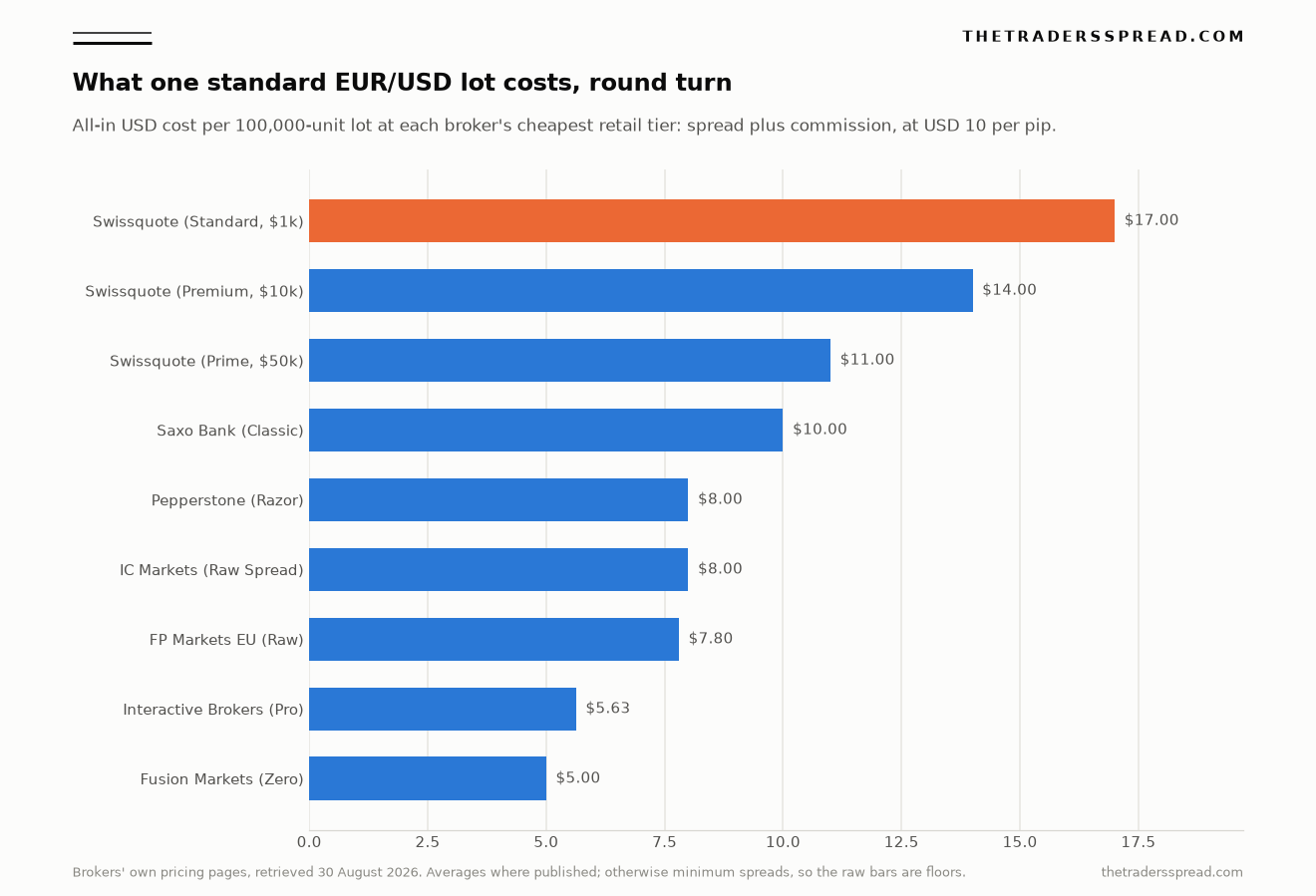
| Broker, cheapest retail tier | EUR/USD spread | Commission, round turn | All-in per lot |
|---|---|---|---|
| Fusion Markets — Zero | 0.0 min; broker states ~0.5 pips all-in | USD 4.50 | ~USD 5.00 |
| FP Markets (EU) — Raw | 0.18 pips, Aug-2026 average | USD 6.00 | USD 7.80 |
| IC Markets — Raw Spread, MT4/MT5 | 0.1 pips, stated avg | USD 7.00 | USD 8.00 |
| Pepperstone — Razor, MT4/MT5 | 0.1 pips, May-2026 average | USD 7.00 | USD 8.00 |
| Saxo Bank — Classic | 1.0 pip min | None on spot FX | USD 10.00 |
| Swissquote — Prime (USD 50,000) | 1.1 pips min | None | USD 11.00 |
| Swissquote — Premium (USD 10,000) | 1.4 pips min | None | USD 14.00 |
| Swissquote — Standard (USD 1,000) | 1.7 pips min | None | USD 17.00 |
A word on method, because most cost tables quietly cheat. Every figure is the broker's cheapest published retail tier, spread plus commission, at USD 10 per pip, from that broker's own pricing pages on 30 August 2026 — the basis used in our FP Markets review. Where an average spread is published we use it and name the month; otherwise we use the "from" minimum, which makes the raw rows floors.
Now the row that dismantles the usual defence. The standard excuse for wide bank spreads is that a banking licence is expensive: capital, compliance, audit and deposit protection all have to be paid for. Saxo Bank prices that same excuse at 1.0 pip — a Danish licensed bank, spread-only on spot FX with no commission at its default Classic tier. Swissquote's entry tier is 70% more expensive than another bank's, and its best tier, which demands USD 50,000 on deposit, is still 10% above Saxo's entry. So the licence costs roughly a pip; the other 0.7 is the price of a desk with no reason to compete. Against Fusion Markets' Zero account, documented in our Fusion Markets review, the entry-tier premium is about USD 12 a lot, or 240% — roughly USD 3,000 a year at one lot a day.
Two sources combined give a figure neither publishes alone. The H1 2026 accounts report net eForex income of CHF 45.58 million on eForex turnover of USD 684.2 billion — 6.84 million standard-lot equivalents, or about CHF 6.66 of net revenue per USD 100,000 traded, well under the USD 17 sticker because that figure is net of hedging cost and spans a mix weighted toward discounted tiers, metals and index CFDs. The gap cuts both ways: the desk is not gouging, and it is not scaled to compete. Client equity of CHF 459.2 million across 39,881 eForex accounts averages about CHF 11,500 — putting the typical client on Standard or barely into Premium, paying 1.7 or 1.4 pips, not the 1.1 the marketing leads with.
The fees that never appear in a spread comparison
Swissquote charges an inactivity fee of up to 10 units of the account base currency a month — CHF 10, or EUR 10 on the EU entity — once an account has held no open positions and done no trading for six months or more, deducted monthly until trading resumes or the balance hits zero. Retail clients only; introducing brokers, money managers, institutional and corporate accounts are exempt.
The securities account carries a quarterly custody fee — CHF 20 per quarter up to CHF 50,000 of assets, rising in bands to a maximum of CHF 50 above CHF 150,000, plus 8.1% VAT and 0.0075% per quarter above CHF 1 million for external safekeeping. Crypto counts toward it; cash does not, so a cash-only forex account escapes it. Stock CFD commission is the sharper edge: USD 0.03 per share with a USD 20 minimum per side on Swiss Standard, falling to USD 0.01 and a USD 10 minimum on Prime, against USD 0.01 and a USD 9 minimum on the Luxembourg schedule. Small equity tickets on Swiss Standard therefore cost at least USD 40 round turn.
Then there is the cash. Swissquote's fee schedule shows interest on cash deposits of 0% in CHF, EUR, GBP, USD and AED at every balance band, unchanged since 1 October 2024. Roughly 15% of client assets sat in cash at 30 June 2026 — on CHF 96.3 billion, some CHF 14 billion — and the group booked CHF 115.9 million of net interest income in the half. Debit balances run the other way: the Lombard rate is 3.000% in CHF, 5.186% in EUR and 6.621% in USD. You finance the bank at zero and borrow from it at market, and no spread table shows it.
Regulatory and structural tension
The uncomfortable disclosure is Swissquote's own. Over the past 12 months, 68.22% of retail investors trading CFDs with the Swiss entity lost money, lost their margin at position close, or ended with a negative balance; the UK entity's mandated figure is worse at 78.23%. Both are published under regulatory obligation, and they are the correct context for any leverage claim on the page above them.
The entity ladder creates the second tension. A retail client outside Switzerland is unlikely to face Swissquote Bank Ltd at all: EU residents contract with Swissquote Bank Europe or Swissquote Capital Markets, UK residents with Swissquote Ltd, Hong Kong clients with Swissquote Asia, while Singapore and Malta serve accredited and institutional business only. The CHF 100,000 esisuisse protection that anchors the brand's safety story therefore reaches a specific subset of clients; the rest inherit a different scheme, a different ceiling and, for CFDs, one covering investment business rather than deposits. Leverage differs too — 1:100 on majors under the Swiss schedule against the 30:1 ESMA and FCA caps, and Luxembourg stock CFD margin starting at 20% where the Swiss table starts at 5%.
Third, note what the group is optimising. Pre-tax profit of CHF 182.9 million was flat year on year at a 50.2% margin, and on 13 August 2026 full-year guidance was cut to about CHF 730 million of net revenues and CHF 365 million of pre-tax profit, from CHF 760 million and CHF 385 million, on a weak crypto market that cut net crypto assets income 66.2% to CHF 14.6 million. The 2028 target of CHF 500 million was reaffirmed. Nothing in that plan depends on winning retail forex volume, which is precisely why the spread has not moved.
The verdict, and where it inverts
Rated as a broker, Swissquote scores 4.3 out of 5, carried almost entirely by structure. On protection and disclosure it is the strongest firm on our comparison shelf: two banking licences, a SIX listing, audited half-year accounts, a 25.2% capital ratio and deposit schemes with a demonstrated payout record. On price it is the weakest, at 1.7 pips all-in for an entry-tier client where raw accounts clear at roughly USD 5.00 to USD 8.00 a lot and a rival bank quotes 1.0 pip.
RelatedAlpari Review 2026: EUR/USD Ticket Is $25 at Close
The break-even is arithmetic, not opinion. The entry-tier premium is about USD 12 per standard lot against the cheapest raw account on our shelf, and about USD 7 against Saxo. Ten lots a month costs roughly USD 1,440 a year; a hundred lots a month costs USD 14,400. Set that against what the licence buys — a CHF 100,000 ceiling on cash, plus securities held as client property — and the trade clears only for an account that turns over little and holds a lot. Below roughly two lots a month, on a balance sitting mostly in cash and custody, the licence is cheap. Above ten, you are buying insurance you could not claim on anyway, because open derivative positions are not protected deposits.
What would change this assessment: a repricing of Standard to Saxo's 1.0 pip or below, removing the bank-to-bank premium entirely; interest paid on client cash; or evidence that eForex attrition has stopped, suggesting the desk is being funded rather than harvested. What would worsen it: a wider gap between the Swiss and non-Swiss schedules, or a higher stock CFD minimum ticket. On present numbers, Swissquote is a bank you can trade at, not a broker you should trade through.
Frequently asked questions
Is Swissquote a real bank?
Yes. Swissquote Bank Ltd holds a banking licence issued by FINMA and is a member of the Swiss Bankers Association, and the group holds a second banking licence in Luxembourg through Swissquote Bank Europe Ltd, supervised by the CSSF under ECB oversight; the 13 August 2026 results release confirms both. That is a different authorisation from the investment-firm licences most CFD brokers hold.
How much of my money is protected at Swissquote?
It depends on the entity. Cash at the Swiss bank is protected to CHF 100,000 under esisuisse; deposits at the Luxembourg bank to EUR 100,000 under the FGDL; UK investment business to GBP 85,000 under the FSCS for failures after 1 April 2019. Securities in custody are client property and returned outside any ceiling, but derivative claims are not protected deposits under the Swiss scheme.
What does Swissquote charge on EUR/USD?
Minimum spreads of 1.7 pips on Standard, 1.4 on Premium and 1.1 on Prime, with no separate FX commission. The tiers require USD 1,000, USD 10,000 and USD 50,000. At USD 10 per pip that is USD 17.00, USD 14.00 and USD 11.00 per standard lot round turn.
Is Swissquote expensive compared with other brokers?
On forex, yes. The entry tier costs about USD 17.00 a standard lot round turn where raw accounts at Fusion Markets, IC Markets and Pepperstone clear at roughly USD 5.00 to USD 8.00. More tellingly, Saxo Bank — also a licensed bank, also commission-free on spot FX — quotes EUR/USD from 1.0 pip, making Swissquote's entry tier 70% dearer than a peer with the same kind of licence.
Did this review sample customer ratings?
No. Trustpilot blocks automated clients and we did not obtain a verified rating, so rather than repeat a figure we could not check we left customer-review scores out entirely. Every number above comes from Swissquote's own pricing and legal pages, its half-year release, a protection scheme's own documentation, or a live exchange feed.
Sources
Swissquote: forex products, trading conditions, account fees, group structure, financial reports (half-year 2026 release, 13 August 2026). Protection schemes: esisuisse, FGDL, FSCS. Registers: FCA, MAS. Peers: Saxo, Fusion, IC Markets, Pepperstone. All 30 August 2026.
Analysis and information only. This review is not financial advice, not a recommendation and not an offer. CFDs and leveraged forex are high-risk: Swissquote's own disclosure states 68.22% of its retail clients lost money over the past 12 months, and 78.23% at its UK entity. Capital at risk. Figures verified 30 August 2026; pricing changes without notice — check the broker's current schedule first.