

Has the slide since the Magyar Nemzeti Bank held its base rate changed the year-end path for USD/HUF, or is the 2 October fixing mostly a dollar story?
Both, depending on which clock you start. From 4 September to 2 October the ECB reference moved from 312.58 forints per dollar to 328.89, a rise of 16.31 forints, or 5.2 percent. About 11.05 of those forints came from the euro falling from 1.1622 to 1.1225 against the dollar. About 5.08 came from the forint slipping from 363.28 to 369.18 against the euro. Start the clock instead on 22 September, the day of the hold, and the split is almost even: from 315.43 to 328.89, roughly 6.7 forints from the dollar and 6.6 from the forint.
The dollar did the month. The forint did the days after the hold.
Into 31 December the base is 325, the bull case is 350 and the bear case is 307. The 350 is a forint level, not a second dollar move.
The fix, and what it is not
USD/HUF is not a line the ECB publishes. It quotes currencies against the euro. On the reference-rate page for 2 October 2026 the dollar stands at 1.1225 and the forint at 369.18. Divide the second by the first and you get 328.89, the same figure frankfurter.dev returns for a dollar base. The history below was pulled from that feed on 4 October 2026 and checked against the ECB page for the latest date.
The reference is a statistical print, not a dealing price. The ECB says the rates are usually updated around 16:00 CET on working days, from a concertation between central banks that normally takes place around 14:10 CET. They are published for information. Using them for transactions is strongly discouraged. A bank's USD/HUF quote that afternoon will not have been 328.89, and nothing below treats the fixing as a ticket.
- USD/HUF 328.89 on 2 October 2026, from 312.58 on 4 September. ECB reference via frankfurter.dev, retrieved 4 October 2026.
- EUR/USD 1.1225 and EUR/HUF 369.18 on 2 October 2026. Over the prior year of reference dates, 1 October 2025 to 2 October 2026, 1.1225 is the low and 1.1974 on 28 January 2026 is the high.
- USD/HUF over that year: low 301.47 on 16 June 2026, high 343.20 on 19 March 2026. The 1 October 2025 print was 331.54, so 328.89 is about 0.8 percent under a year ago.
- MNB base rate 5.50 percent, left unchanged on 22 September 2026, after a 25 basis point cut from 5.75 percent on 25 August. Overnight deposit 4.50 percent, overnight collateralised loan 6.50 percent.
- August inflation 1.3 percent and core inflation 2 percent, as the Council stated on 22 September. The September projection puts inflation at 1.8 percent in 2026 and 3.1 percent in 2027.
- A 2.5 percent inflation target, with a symmetric band of 1 percentage point, takes effect on 1 January 2028. It does not bind a forecast that ends this December.
Two windows, not one slide
Read only the dollar crosses and Hungary looks like the region. From 4 September to 2 October, USD/HUF rose 5.2 percent, USD/PLN 5.0 percent, USD/RON 5.4 percent and USD/CZK 4.7 percent. Warsaw, Bucharest and Prague wore a very similar dollar.
| Dollar cross | 4 Sep 2026 | 2 Oct 2026 | Change |
|---|---|---|---|
| USD/HUF | 312.58 | 328.89 | +5.2% |
| USD/PLN | 3.7126 | 3.8998 | +5.0% |
| USD/CZK | 20.813 | 21.80 | +4.7% |
| USD/RON | 4.5199 | 4.7651 | +5.4% |
All four are ECB references, dollar base, retrieved 4 October 2026. A higher number is a weaker local currency.
The zloty is the control, not the subject. The USD/PLN forecast published on 3 October sets a bull case at 4.15 and a bear case at 3.65, around a 2 October reference of 3.8998. If the forint's dollar cross had blown out while the zloty had not, the residue would be Hungarian. Over the full month, it did not.
Against the euro the month still looks ordinary. EUR/HUF rose 1.62 percent, from 363.28 to 369.18. EUR/PLN rose 1.45 percent, EUR/CZK 1.16 percent, EUR/RON 1.82 percent. Hungary sat in the pack.
Now cut the sample at the hold.
| Euro cross | 22 Sep 2026 | 2 Oct 2026 | Change |
|---|---|---|---|
| EUR/HUF | 361.58 | 369.18 | +2.10% |
| EUR/PLN | 4.348 | 4.3775 | +0.68% |
| EUR/CZK | 24.344 | 24.47 | +0.52% |
| EUR/RON | 5.266 | 5.3488 | +1.57% |
| EUR/USD | 1.1463 | 1.1225 | -2.08% |
After 22 September the forint weakened against the euro by more than the zloty, the koruna or the leu. The gap versus Poland is about 1.4 percentage points. That is not a run. It is also no longer just the dollar. The Hungarian residue in USD/HUF lives in this second window.
On the dollar side of that window the euro's drop, from 1.1463 to 1.1225, contributed about 6.69 forints. The forint's own move, from 361.58 to 369.18 per euro, contributed about 6.63. A cross-term of about 0.14 takes the reference to 328.89. Half and half, after a month that had been two-thirds dollar.
A hold taken at 315.43
On 22 September the Monetary Council left the base rate at 5.50 percent, with effect from 23 September. The overnight deposit stayed at 4.50 percent and the overnight collateralised loan at 6.50 percent. The decision note is the source for the rates and the forecasts that follow. The reference that day was 315.43. The move to 328.89 came after the votes.
The Council had cut on 25 August, from 5.75 percent to 5.50, and called that cut the third in a series announced in June. The abridged minutes, published at 2 p.m. on 9 September, record a unanimous vote. Mihály Varga, governor since 4 March 2025, voted for the cut, as did Zoltán Kurali, deputy governor for monetary policy since 22 April 2025. The September minutes are due at 2 p.m. on 7 October 2026. They are not out. This piece does not guess the vote.
The September statement puts August inflation at 1.3 percent, with core at 2 percent. It leaves 2026 inflation at 1.8 percent and lifts 2027 to 3.1 percent, citing energy prices and tobacco excise. Second-quarter GDP growth was 1.7 percent. The September projection is 1.8 percent for 2026, 2.9 percent for 2027 and 2.8 percent for 2028.
Set 5.50 percent against August inflation of 1.3 percent and the gap is 4.2 percentage points on that backward look. It is not the Council's own real-rate definition. The August minutes used the room anyway: members described a still-positive real rate, high against the region, as what had made the cut feasible if the foreign-exchange market stayed orderly.
Those minutes also say the exchange rate had stayed in the stronger range and was still disinflationary, while forint volatility above the region's warranted attention. On 25 August the reference was 310.65. On 2 October it was 328.89. The stronger-range sentence was already in print on 9 September, before the run from 315.43 to 328.89. It describes the summer, not the first days of October.
The same meeting reset the inflation target. From 1 January 2028 it will be a 2.5 percent rise in the consumer price index published by the Hungarian Central Statistical Office, inside a symmetric band of 1 percentage point. The target note, dated Budapest, 22 September 2026, puts the new level 0.5 percentage point above the ECB's target. From 2027 the Council will hold eight policy meetings a year. None of that changes the target inside the next twelve weeks. The Council's risk list for Hungary is the fiscal path, euro adoption, and the external market.
On that external market the Council was explicit. In September, it said, the European Central Bank, the Federal Reserve and the Bank of Japan each raised policy rates by 25 basis points. Czech and Polish rates were left unchanged. Hungary had cut in August and then held. From 25 August that is 25 basis points of easing in Budapest against 25 basis points of tightening at the Fed and the ECB. EUR/USD then printed the low of its past year of reference rates on 2 October, at 1.1225.
Where 350 and 307 come from
USD/HUF is a ratio. Any December level has to name an EUR/HUF and an EUR/USD, because those are the series the ECB publishes. The three paths are products, rounded to the forint.
| Path to 31 Dec 2026 | EUR/HUF | EUR/USD | USD/HUF |
|---|---|---|---|
| Bull | 392.88 | 1.1225, unchanged | 350 |
| Base | 368.00 | 1.1323 | 325 |
| Bear | 356.12 | 1.1600 | 307 |
| Fix, 2 Oct 2026 | 369.18 | 1.1225 | 328.89 |
The bull holds the dollar at the 2 October fix and sends the forint back to 392.88 per euro. That is still under the 9 March high of 396.38, and under the 394.30 print on 19 March, the day USD/HUF itself topped at 343.20. So 350 clears the year's high in the dollar cross without a new high against the euro. The EUR/HUF forecast published on 31 August set a bull case at 380 and a bear case at 350. At 369.18 the euro cross is still inside that range. A dollar-cross bull of 350, with the dollar held here, would mean the euro cross had gone through that page's bull case.
The base gives only a sliver of the post-hold slip back, to 368 per euro, near the 1 October print of 367.18 rather than 369.18. It lets the euro retrace about a quarter of the ground lost from 1.1622 on 4 September to 1.1225, which is 1.1323. Divide 368 by 1.1323 and the reference is 325.
The bear puts EUR/HUF at 356.12, a shade under the 30 June fixing of 356.30 and above the 16 June low of 349.53, and puts EUR/USD back at 1.1600, between 1.1594 on 16 June and 1.1622 on 4 September. The product is 307. Both legs already traded this summer.
Repeat September's percentage drop in EUR/USD, starting from 1.1225, and the euro would stand near 1.0842. Leave EUR/HUF at 369.18 and USD/HUF is about 340.5, still under the March high. To reach 350 on the dollar alone, EUR/USD would have to fall to about 1.0548. The year's low is 1.1225. That path is a break of the range, not a revisit.
The dollar leg has its own page. The EUR/USD forecast of 3 September put the bear case at 1.1250. The 2 October reference is 1.1225, a little through it. The base path here does not assume a further low. It assumes a partial retrace of a move that has already tagged the bottom of a year of fixes.
RelatedGBP/NOK Price Prediction: 13.20 Bull Case vs 12.10 Bear
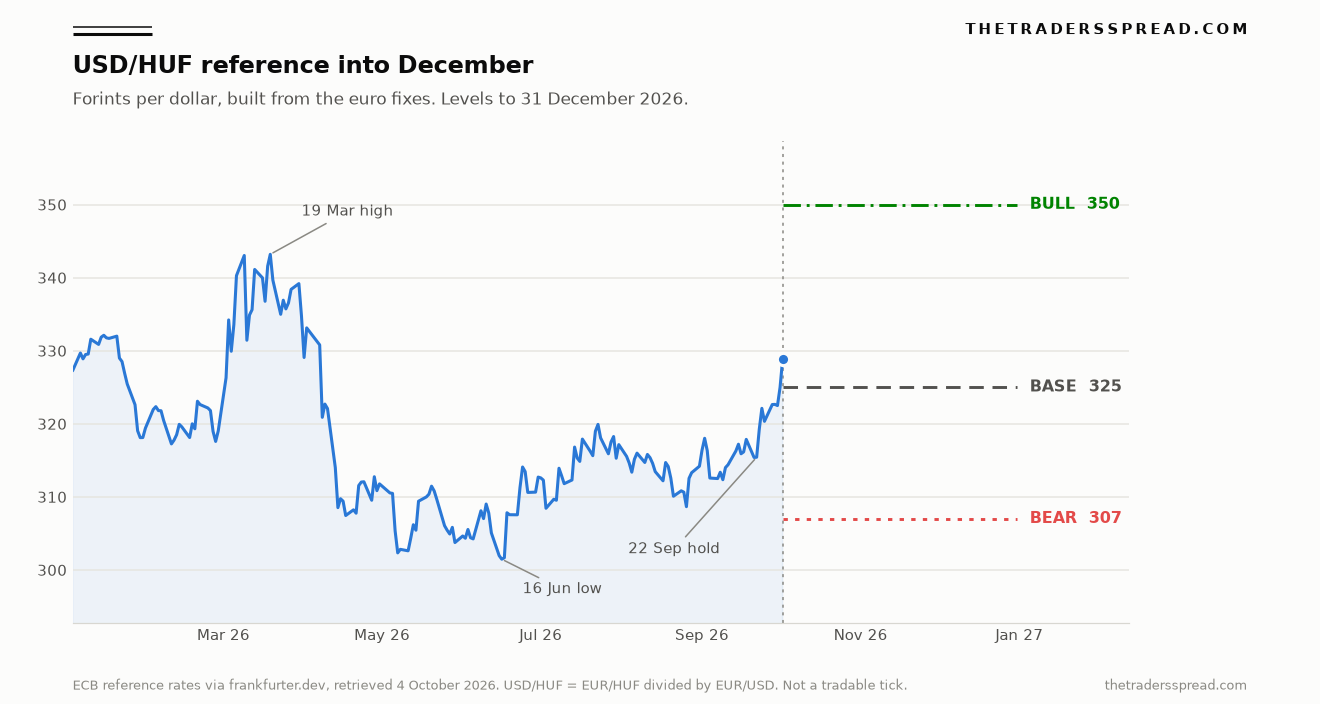
The line runs from 327.26 on 2 January to 328.89 on 2 October. The March high is 343.20, so the bull line at 350 sits just above a level already traded. The June low is 301.47, and 307 is the near side of it. The dotted divider is the last fixing. Nothing to the right of it is history.
Weights, and what knocks 325 over
The weights are scenario weights for this piece, not option prices and not a vote. Base 325 gets 50 percent. Bear 307 gets 28 percent. Bull 350 gets 22 percent. The weighted figure is 0.50 times 325, plus 0.28 times 307, plus 0.22 times 350, which comes to 325.5. That sits a little under 328.89, which is why the lean is bearish on the pair and why conviction is only 2 out of 5.
The key-data panel carries 325, the base, not 307. Entry is 328.89. Invalidation is 343.20, the 19 March high. A fix through that high before 31 December means the stall has failed, whether or not 350 has printed. Four forints either side of the latest fixing is noise against a year that already ran from 301.47 to 343.20.
A forint move against the euro that starts to look like March, rather than the 1.6 percent of the past month, would push weight onto the bull. EUR/HUF through 396.38, the 9 March high, would mean 350 was no longer a revisit. The bear needs both summer legs at once: EUR/HUF back near 356 and EUR/USD back near 1.16. One without the other does not get to 307.
The Council has tied the next base-rate decision to the inflation outlook, global developments and Hungary's risk premium, and it has said that an orderly foreign-exchange market helps anchor expectations. The hold was taken at 315.43. If the 7 October minutes treat the move since then as a reason to pause the August cuts, that supports 325 rather than 350. A hike would help the bear case. No such decision is published today.
Nor is 328.89 a broken forint. It sits inside the year's dollar range, about 14 forints under the March high and about 27 over the June low. Against the euro it is firmer than on 1 October 2025, when EUR/HUF was 388.7, and weaker than it was in June. The open question is whether the post-hold gap versus Poland and Czechia compounds by 31 December. The 50 percent weight says it does not, and that about a quarter of the dollar move gives way.
Questions the arithmetic actually answers
Is 328.89 a price a broker will deal?
No. It is 369.18 forints per euro divided by 1.1225 dollars per euro, the ECB reference rates for 2 October 2026. Those rates are updated around 16:00 CET from a concertation around 14:10 CET, published for information, and strongly discouraged for transactions. A dealing quote in USD/HUF will differ. The gap is the reason for saying so.
Why did USD/HUF rise if the base rate was held?
Because the cross has two legs, and a hold is not a cut. From 4 September the larger leg was the euro's drop against the dollar, from 1.1622 to 1.1225. The Council's 22 September note said the ECB, the Fed and the Bank of Japan had each raised policy rates by 25 basis points that month. The forint's move against the euro over the full window was 1.6 percent. The sharper forint-specific slip came after the hold.
Does 350 mean the forint has to break?
Not against the euro, if the dollar stays at the 2 October fix. EUR/HUF at 392.88 is still under the 9 March high of 396.38. What would be new is the dollar cross: 350 is about 2 percent above the 19 March USD/HUF high of 343.20. A new euro-cross high and a fresh dollar low together would print above 350. That is not the bull case written here.
How is this different from the EUR/HUF page?
That forecast, dated 31 August, is forints per euro, with 380 as the bull and 350 as the bear. This one is forints per dollar. At 369.18 the euro cross is still inside that older range. Getting the dollar cross to 350 while EUR/USD stays at 1.1225 would take EUR/HUF to about 392.88, through the older bull case. Same currency, different ratio.
What would make 325 the wrong base?
A reference fix above 343.20, the 19 March high, before 31 December. That is the invalidation. Another September-sized drop in the euro, to about 1.0842 dollars, with EUR/HUF unchanged at 369.18, would put USD/HUF near 340.5, still under that line. The base fails when the forint leg joins the dollar, not when the dollar merely repeats the month just passed.
A last distinction
This is analysis, not a recommendation. The levels are scenarios built from ECB reference rates, which are not tradable ticks, and from the Magyar Nemzeti Bank's published decisions. Capital is at risk. The September minutes are unpublished until 7 October 2026, and a reference rate is a poor substitute for the price on a ticket.