

A central bank cutting interest rates is supposed to sink its own currency, and yet EUR/HUF has spent 2026 doing the opposite. The Magyar Nemzeti Bank has taken 100 basis points off the Hungarian base rate since January, most recently to 5.50% effective 26 August 2026, and the forint is stronger now than when the easing began. EUR/HUF fixed at 364.79 on 28 August 2026, against 383.58 on 2 January. That is a 4.9% fall in the pair and a 5.15% gain for the forint, in a year the consensus spent waiting for the cuts to break it.
The reflex reading is that each cut is one step closer to the end of the carry trade. That reading is arithmetically wrong, and the size of the error is the whole story.
Here is the calculation almost nobody runs. In January the base rate was 6.50% and Hungarian headline inflation was 2.1%, a real policy rate of +4.40 percentage points. Today the base rate is 5.50% and July inflation printed at 1.2%, a real policy rate of +4.30 points. One hundred basis points of easing has cost the forint's real carry cushion exactly ten basis points, because disinflation paid for roughly ninety per cent of the cuts as they happened. The forint has not been strong in spite of the MNB. It has been strong because the Council has been cutting more slowly than prices have been falling. That reframes the trade entirely: the question for EUR/HUF is not whether the MNB cuts, but whether inflation keeps funding the cuts.
Key facts
- MNB base rate cut 25bp to 5.50%, effective 26 August 2026; overnight deposit 4.50%, overnight collateralised loan 6.50% — Magyar Nemzeti Bank press release, 25 August 2026
- EUR/HUF spot 364.79, ECB reference rate for 28 August 2026 — frankfurter.dev, pulled 31 August 2026
- Hungarian headline CPI +1.2% y/y in July 2026, core +1.9% — Hungarian Central Statistical Office (KSH), tables 1.2.1.1 and 1.2.1.9, updated 7 August 2026
- Hungary's real policy rate is +4.30pp, against +2.05pp in Czechia and +0.75pp in Poland — policy rates via BIS, CPI via KSH, CZSO and GUS, all July 2026
- Forint up 5.15% against the euro year to date; the zloty is down 2.86% and the koruna is flat at +0.12% — ECB reference rates, 2 January to 28 August 2026
- EUR/HUF 52-week range 349.53 to 396.90, the low set 16 June 2026 — ECB reference rates via frankfurter.dev
- MNB forecasts average annual inflation of 1.8% in 2026 and 2.3% in 2027 — Governor Mihály Varga, MNB, 26 June 2026
What the MNB actually did, and why the carry survived it
The mechanics of the 25 August decision are unglamorous. The Monetary Council reduced the central bank base rate from 5.75% to 5.50%, with the overnight deposit rate moving to 4.50% and the overnight collateralised lending rate to 6.50%, preserving the symmetric ±100bp corridor. All three took effect on 26 August 2026. That is the fourth 25bp step of the year, from 6.50% at the start of January.
A carry position in the forint against the euro earns the nominal differential. With the ECB deposit facility at 2.25%, that differential is 325 basis points annualised. Four cuts have narrowed it, but the ECB has not moved in the other direction, and 325bp remains the widest nominal spread on offer inside the European Union's floating-rate bloc.
What matters more for a currency is the real rate, because that is what compensates a foreign holder for the erosion of the asset they are holding. Hungarian inflation has collapsed through 2026: 2.1% in January, 1.4% in February, 1.8% in March, 2.1% in April, 1.8% in May, 1.7% in June and 1.2% in July, all measured year on year by the KSH. Core inflation has tracked the same path down to 1.9%. Every one of those prints has arrived faster than the Council's quarter-point response, which is why the real cushion has barely moved.
This is the same structural feature that has kept other high-yielding currencies bid long after their central banks started easing, and traders who followed the peso through its own cutting cycle will recognise the shape of it. The pattern we traced in our USD/MXN forecast holds here: the carry dies when real rates compress, not when nominal rates fall.
The MNB has been unusually explicit that it sees the room it is operating in. Speaking in Basel on 26 June 2026, Governor Mihály Varga said that "as the geopolitical conflicts shaping the global economy also impact the financial outlook, central banks must insist on maintaining stability", and told the Bank for International Settlements meeting that an improving domestic inflation outlook and diminished global risk had widened Hungary's monetary policy leeway.
Who is responding, and how the region is positioned
Rate decisions in Hungary sit with the Monetary Council, the MNB's supreme decision-making body, which convenes at least monthly with one rate-setting meeting per month on a pre-announced schedule. Rates are set by simple majority of members present, with the Governor holding a casting vote in the event of a tie. Varga has held the governorship since 4 March 2025; Zoltán Kurali has been the deputy governor responsible for monetary policy, financial stability and reserve management since 22 April 2025.
Around them, the regional picture has diverged sharply. The National Bank of Poland's reference rate stood at 3.75% in late August 2026 and the Czech National Bank's two-week repo rate at the same 3.75%, according to Bank for International Settlements policy-rate data. The European Central Bank's deposit facility has been at 2.25% throughout. Hungary is therefore paying 175 basis points more than either CEE neighbour and 325 more than the euro area.
The inflation backdrop is what turns that nominal gap into a real one. Poland printed 3.0% headline inflation for July 2026, published by Statistics Poland on 13 August. Czechia printed 1.7% for the same month, published by the Czech Statistical Office on 11 August. Hungary printed 1.2%. The country paying the highest nominal rate in the region also has the lowest inflation in it, which is an unusual combination and the reason the forint has outperformed both its peers by a wide margin this year.
Carry is always a relative trade, and the funding side matters as much as the receiving side. The dynamics we set out in our USD/JPY forecast apply to any position financed out of a low-yield currency: the position works until the differential compresses or volatility makes the drawdown intolerable.
The Czech print carried its own warning about how quickly the disinflation story can turn. "July's year-on-year consumer price development was, as in previous months, significantly influenced by fuel and food prices," said Vladimír Cába, Director of the Price Statistics Department at the Czech Statistical Office, on 11 August 2026, noting that fuel prices had returned to growth after a two-month decline and were up almost 17% against July 2025.
The market data, and where the levels sit
EUR/HUF fixed at 364.79 on 28 August 2026. The 52-week high is 396.90, set on 29 August 2025, and the 52-week low is 349.53, set on 16 June 2026. The pair is 8.09% below where it stood a year ago, but it is also 4.37% above the June low, which means the forint has already given back a meaningful slice of its 2026 gain over the past ten weeks.
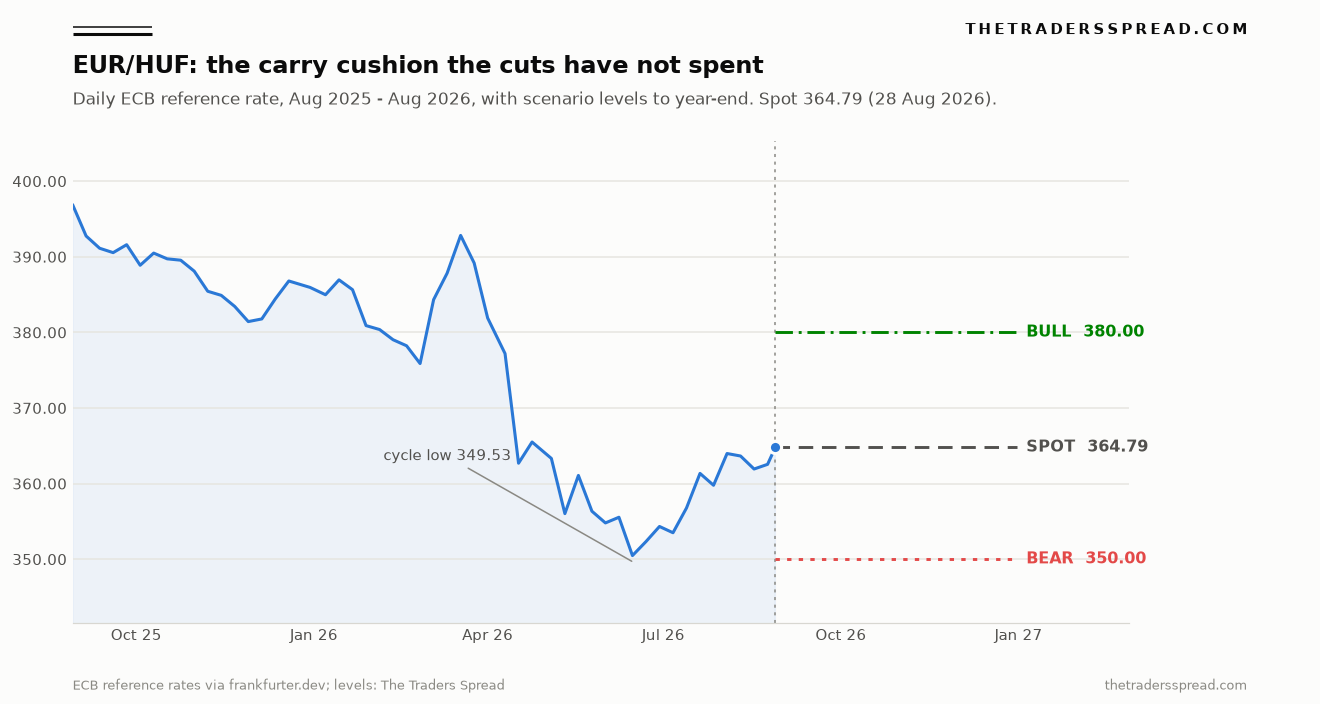
The two scenario levels are not arbitrary. EUR/HUF began 2026 at 383.58, so 380 is close to a full round trip back to the January starting point. The June low at 349.53 sits just under 350, making the bear level a retest rather than a breakout. Both are roughly 4% from spot, which is a symmetric distribution around an asymmetric carry.
Set against the region, the position is stark:
| Currency | Policy rate | July 2026 CPI y/y | Real policy rate | YTD vs EUR |
|---|---|---|---|---|
| Hungarian forint (HUF) | 5.50% | 1.2% | +4.30pp | +5.15% |
| Czech koruna (CZK) | 3.75% | 1.7% | +2.05pp | +0.12% |
| Polish zloty (PLN) | 3.75% | 3.0% | +0.75pp | -2.86% |
| Euro (reference) | 2.25% | n/a | n/a | n/a |
Policy rates are from BIS central bank policy rate data for late August 2026 and the MNB press release of 25 August 2026; inflation from KSH, CZSO and GUS July 2026 releases; currency performance from ECB reference rates between 2 January and 28 August 2026. The forint's real cushion is more than twice the koruna's and almost six times the zloty's, and the year-to-date performance column lines up with that ranking almost exactly. That correlation is the single best evidence that this has been a real-rate story rather than a growth or sentiment story, and traders comparing it with the developed-market majors can see the contrast in our GBP/USD forecast, where the differential is a fraction of this size.
The structural tension the MNB has to manage
There is an uncomfortable fact underneath the forint's strength. The MNB's medium-term inflation target is 3%, with a ±1 percentage point tolerance band adopted in March 2015, giving a band of 2% to 4%. July's 1.2% headline print is not merely inside that band, it is a full 80 basis points below its floor. Core at 1.9% is also below it. An inflation-targeting central bank undershooting its own tolerance band has a mandate-driven reason to keep easing, quite separate from any view on the exchange rate.
That is the tension. The rate that is undershooting the target is the same rate that is holding the currency up, and the currency that is holding up is itself part of why inflation is undershooting. Varga acknowledged the loop directly in June, noting that the appreciation of the forint exchange rate in recent months would affect the evolution of consumer prices both in 2026 and in 2027. A stronger forint lowers imported goods prices, which lowers CPI, which raises the real policy rate if the Council does not cut, which supports the forint. The mechanism is self-reinforcing in both directions, and it unwinds as fast as it builds.
Varga's June guidance was that inflation would run around the lower boundary of the tolerance band for the rest of the year, with average annual inflation forecast at 1.8% in 2026 and 2.3% in 2027. Read carefully, that 2027 number is the warning. It implies the MNB expects roughly a full percentage point of reflation over the next eighteen months. If that forecast is right and the Council continues cutting at 25bp a meeting, the real cushion compresses from both ends simultaneously.
The MNB has also stated that its medium-term target will be reviewed at the time of Hungary's entry into the European exchange rate mechanism, ERM II. No such entry is scheduled, and nothing in the August decision touched the framework, but it is the structural question sitting behind every Hungarian rate cycle and it constrains how far the Council can let the currency run in either direction.
Bull case 380 and bear case 350
The trade is pause versus continue, not cut versus hold.
RelatedGBP/AUD Forecast: 1.9600 Bull Case vs 1.8400 Bear Case
The bull case for EUR/HUF at 380 requires the funding mechanism to reverse. It needs Hungarian inflation to turn up towards the MNB's own 2027 forecast of 2.3% while the Council keeps cutting on schedule at each monthly rate-setting meeting. Two more 25bp steps to 5.00% against a 2.5% CPI would cut the real cushion to +2.50pp, roughly halving it and putting Hungary close to where Czechia already sits while paying a materially higher currency risk. At that point the region's cleanest real-carry story stops being clean. Base effects are the specific mechanism to watch: the July 2025 comparison base was low, and the fuel-price reversal Cába flagged in Czechia is a regional input, not a Czech one. A move through the April high near 393 would confirm the full round trip.
The bear case for EUR/HUF at 350 requires only that the Council blinks. A pause at 5.50%, or a slower cadence than one cut per meeting, holds the real rate above +4pp while every peer sits below +2.10pp. The June low at 349.53 is the obvious magnet, and a sustained break below it would take the pair to levels not seen in the data series examined here.
The carry itself sets the neutral line. At a 325bp nominal differential, holding forint against euro accrues roughly 1.08 percentage points over the four months to 31 December 2026. That puts the carry-adjusted breakeven for the pair at about 368.7, some 1.1% above spot. EUR/HUF has to rise past 368.7 by year-end before a forint holder is behind, which is the quiet advantage a wide differential buys and the reason the 380 scenario needs a genuine catalyst rather than drift. Positioning discipline matters more than direction here, a point that also runs through our AUD/USD forecast.
The level that invalidates the whole framework is 380. Above it, the market is no longer pricing Hungarian real rates and is pricing something else, most likely a fiscal or external-balance concern that this analysis does not capture.
Frequently asked questions
What is the current EUR/HUF rate?
EUR/HUF fixed at 364.79 on 28 August 2026, based on European Central Bank reference rates retrieved from frankfurter.dev on 31 August 2026. The pair traded between 349.53 and 396.90 over the preceding 52 weeks, with the low set on 16 June 2026 and the high on 29 August 2025.
Why did the forint strengthen while the MNB was cutting rates?
Because Hungarian inflation fell faster than the base rate did. The MNB cut 100 basis points between January and August 2026, from 6.50% to 5.50%, while headline CPI fell from 2.1% to 1.2%. The real policy rate therefore only declined from +4.40 percentage points to +4.30, leaving the forint's carry advantage substantially intact throughout the easing cycle.
What is Hungary's real interest rate compared with Poland and Czechia?
Using July 2026 inflation, Hungary's real policy rate is +4.30 percentage points (5.50% less 1.2%), Czechia's is +2.05 points (3.75% less 1.7%) and Poland's is +0.75 points (3.75% less 3.0%). Hungary offers more than double the Czech real rate and close to six times the Polish one, which broadly matches this year's ranking of currency performance against the euro.
When does the MNB next set rates?
The Monetary Council convenes at least once a month, with one rate-setting meeting per month held according to a schedule the MNB announces in advance. The Council publishes a statement explaining its reasoning on the day of each interest rate decision, and abridged minutes before the following rate-setting meeting. Confirm the specific date on the MNB's own published calendar rather than relying on the pattern of previous meetings.
What would invalidate the bearish case for EUR/HUF?
A sustained move above 380 would. That level is roughly where the pair started 2026, at 383.58 on 2 January, and reclaiming it would signal that the market has stopped pricing Hungary's real-rate advantage. The likely mechanism would be inflation reflating towards the MNB's 2.3% forecast for 2027 while the Council continues cutting at every meeting, compressing the real cushion from both directions at once.
How much does the carry earn between now and year-end?
The nominal differential between the MNB base rate at 5.50% and the ECB deposit facility at 2.25% is 325 basis points annualised. Over the four months to 31 December 2026 that accrues roughly 1.08 percentage points before any exchange rate movement, putting the carry-adjusted breakeven at approximately 368.7 against a spot of 364.79.
Analysis, not advice. This article is information about market conditions and does not recommend any position or transaction. Foreign exchange trading carries significant risk and your capital is at risk. Prices and central bank rates cited were accurate at the dates given and change without notice. Conduct your own research and consider independent professional guidance before making financial decisions.