

The question priced into USD/BRL this month is not who wins Brazil's presidential election on 4 October. It is whether the Banco Central do Brasil can sit perfectly still at 13.75% for four consecutive meetings while a government changes hands. The pair fixed at 5.1261 on the European Central Bank's daily reference rate for 7 September 2026, a published fix rather than a tradable quote, and the central bank's own Focus survey of 143 institutions, taken on 28 August, has Copom cutting once on 16 September and then doing nothing until March 2027. Four holds in a row. One first round, one probable runoff, one inauguration, one budget vote. Ten and a bit points of carry, accruing daily, on the assumption that nothing forces the committee's hand.
Test the election story against the tape and it comes apart. Luiz Inácio Lula da Silva's probability on Polymarket's Brazil presidential market has fallen eight points since 1 August, from 64.5¢ to 56.5¢, while Senator Flávio Bolsonaro has gained 17.6 points over the same stretch. Across exactly that window the real moved 1.05%, from a PTAX selling rate of 5.0723 on 3 August to 5.1253 on 4 September. We ran the daily changes against each other on the Brazilian business-day calendar: the correlation between the change in Lula's implied probability and the change in USD/BRL is −0.155 since 1 June, across 67 trading days, and −0.257 since 1 August, across 24. Negative, and small enough to be noise. On the days the incumbent's odds rose, the real did not sell off. It firmed, fractionally.
Key facts
- USD/BRL fixed at 5.1261 on the ECB daily reference rate for 7 September 2026; the BCB's own PTAX selling rate was 5.1253 on 4 September, with no fix on 7 September because of Brazil's Independence Day holiday — European Central Bank via the Frankfurter API and BCB time series 1, both retrieved 8 September 2026.
- The dollar has lost 5.74% against the real so far in 2026, from 5.4384 on 2 January, and sits 8.3% below the 5.5872 fix of 23 December 2025 — ECB daily fixes, 8 September 2026.
- The Selic target is 14.00%, effective 6 August 2026 after a unanimous quarter-point cut at the 280th Copom meeting — BCB time series 432 and the Copom minutes of 4–5 August 2026.
- The Fed's effective funds rate was 3.63% on 3 September 2026 inside a 3.50–3.75% target range, leaving a nominal carry of 10.37 percentage points — Federal Reserve Bank of New York, retrieved 8 September 2026.
- Brazil's gross general government debt reached 82.51% of GDP in July 2026, up from 79.12% in February and the highest reading since April 2021 — BCB time series 13762, released 31 August 2026.
- July produced a primary surplus of R$1.361bn against R$98.963bn of nominal interest, a monthly nominal deficit of R$97.602bn — Banco Central do Brasil fiscal statistics, 31 August 2026.
- The Focus survey median puts USD/BRL at 5.20 at end-2026 and 5.30 at end-2027, from 115 respondents — BCB Focus survey of 28 August 2026.
The exchange rate is an input to Copom's model, not only an output of it
Buried in a footnote on page four of the August minutes is the single most useful number in Brazilian macro, and almost nobody quotes it. Paragraph 10 states that in the reference scenario "the exchange rate starts at USD/BRL 5.10 and evolves according to the purchasing power parity (PPP)". Footnote 2 explains how that 5.10 is built: it "corresponds to the rounded value of the average exchange rate observed over the ten working days ending on the last day of the week prior to the Copom meeting, according to the procedure adopted since the 258th meeting."
That is a formula, and formulas can be run forward. We pulled the BCB's own PTAX selling series for the ten working days ending Friday 31 July 2026, the last day of the week before the 4–5 August meeting, and averaged them: 5.0870, which rounds to 5.10. The reconstruction matches the published assumption exactly.
Now run it on today's data. The ten working days ending 4 September average 5.1513, which rounds to 5.15. The window that will actually be used for the 281st meeting closes on Friday 11 September, so the final figure can still move, but as things stand the committee will walk into its 15–16 September decision with an FX assumption five centavos weaker than the one that produced its August projections of 5.1% IPCA for 2026, 3.8% for 2027 and 3.2% for the first quarter of 2028.
Five centavos is not a crisis. The mechanism matters more than the magnitude. Copom's paragraph 12 lists among its upside risks "a conjunction of internal and external economic policies with a stronger-than-expected inflationary impact, for example, through a persistently more depreciated currency". A weaker real feeds the projection, the projection sets how restrictive policy must be, and tighter policy widens the carry that pulls the real back. Brazil's currency is not floating freely into an election. It is orbiting a reaction function that is written down, published, and reconstructable by anyone with an API key.
What ten points of carry actually buys, and what it costs
The nominal gap is 10.37 points: Selic at 14.00% against a 3.63% effective funds rate. The real gap is nearly as wide. Brazilian inflation ran 4.44% over the twelve months to July 2026, which puts the ex-post real policy rate at roughly 9.15%. US consumer prices rose 3.36% over the twelve months to July on the Bureau of Labor Statistics' all-items index, which leaves the American real policy rate at about 0.26%. Close to nine points of real yield differential is not a normal state of affairs, and it is the entire reason the real has appreciated through a year in which its fiscal accounts deteriorated.
Carry cuts both ways as a valuation tool. Hold the differential flat and a long-real position breaks even only if USD/BRL rises about 5.2% over six months, to roughly 5.39, or 10.4% over a year, to roughly 5.66. Those are policy-rate approximations rather than a forward struck off the DI curve and the cupom cambial, so the onshore number will differ. Anyone quoting a twelve-month USD/BRL forecast below 5.66 is, whether they say so or not, forecasting that the carry keeps paying.
Compare that with the other high-carry pairs we have covered this fortnight. The Turkish lira in our USD/TRY forecast offers a headline yield that inflation swallows whole; the rand in our USD/ZAR forecast pays a fraction of Brazil's real differential. The closest analogue is Mexico, where our USD/MXN forecast tracks a currency held up by the same force. Brazil's version is larger and, sitting on a debt stock of R$10.9tn, far more expensive to maintain.
The election is not in the price, and the tape has been saying so for five weeks
Polymarket's Brazil presidential market carries $144.9m of lifetime volume. Read live on 8 September, Lula's yes leg trades at 56.5¢ and Flávio Bolsonaro's at 41.95¢. The nineteen priced legs sum to 102.30%, so those raw prices carry an overround; de-vigged, the market implies 55.2% for Lula and 41.0% for Bolsonaro. Depth is thinner than the headline volume suggests, with $265,424 of liquidity on the Lula leg and $221,641 on the Bolsonaro leg. Links to Polymarket are affiliate links, from which The Traders Spread may earn a commission at no cost to you; the market itself is here.
When we looked at this market on 28 August, Lula was at 61.5% against Bolsonaro's 35.1% and we put fair value near 53%, arguing that Brazilian pollsters had missed the 2022 first round by 8.8 points in exactly one direction. Eleven days later the market has moved six points toward that estimate. We are not re-running the horse race here. The point is what the currency did while all of that happened, which is: very little, and not in the direction the standard script predicts.
The script says a market-friendly challenger gaining ground should lift Brazilian assets and strengthen the real. The measured relationship says otherwise. A correlation of −0.155 over 67 sessions explains 2.4% of the variance in the daily exchange rate. There is no election trade in USD/BRL right now, only a rates trade with an election-shaped tail sitting on top of it.
That tail has dates. The first round falls on 4 October, a runoff on 25 October if nobody clears 50%, and the inauguration on 5 January 2027. Our six-month horizon deliberately runs past all three and into the first quarter under a new administration, because the currency risk in Brazil has never been the vote. It has been the first budget the winner has to defend.
The carry is funded by the line item that erodes the credit
Here is the loop that makes Brazil different from every other carry story on the board. In July the consolidated public sector ran a primary surplus of R$1.361bn. It also paid R$98.963bn in nominal interest, producing a monthly nominal deficit of R$97.602bn. The primary balance was in the black and gross debt still climbed to 82.51% of GDP, its highest since April 2021, from 79.12% in February. Seventy-three reais of interest for every one real of primary surplus.
The rate paying foreign investors 10.37 points of carry is the same rate compounding that interest bill. Copom said as much in paragraph 7 of the August minutes, warning that "the slowdown in structural reform efforts and fiscal discipline, the increase in earmarked credit, and uncertainties over the public debt stabilization have the potential to raise the economy's neutral interest rate, with deleterious impacts on the power of monetary policy".
The 2027 budget bill reached Congress on 31 August, the constitutional deadline. It projects a headline primary surplus of R$73.2bn, matching the framework target of 0.5% of GDP with a tolerance band of 0.25 points either side. Strip out the carve-outs the rules permit, chiefly court-ordered precatório payments and extraordinary credits, and the effective surplus falls to about R$18.6bn. Bruno Moretti, the planning and budget minister, told Brazilian outlets on 28 and 29 August: "Regardless of spending freezes or not, my accounts deliver a full surplus. We have a balanced budget again." The bond market's response to a 0.5% target that becomes 0.13% once the exclusions are counted will be a better guide to Q1 2027 than any poll.
Where the consensus has been wrong all year
The most useful test we ran was not on the election. It was on the forecasters. At every 2026 Copom decision, the Focus survey's median forecast for USD/BRL at the end of this year has sat above the prevailing spot rate, and the implied depreciation has never once been delivered.
| Copom decision | Selic after | USD/BRL, ECB fix that day | Focus median for end-2026 | Implied depreciation |
|---|---|---|---|---|
| 2 January 2026 (no meeting) | 15.00% | 5.4384 | 5.50 | +1.1% |
| 18 March 2026 | 14.75% | 5.2243 | 5.40 | +3.4% |
| 29 April 2026 | 14.50% | 4.9854 | 5.25 | +5.3% |
| 17 June 2026 | 14.25% | 5.0840 | 5.20 | +2.3% |
| 5 August 2026 | 14.00% | 5.1153 | 5.20 | +1.7% |
| 7 September 2026 (latest fix) | 14.00% | 5.1261 | 5.20 | +1.4% |
Sources: BCB time series 432; ECB daily reference rates via the Frankfurter API; BCB Focus survey annual expectations, median. Retrieved 8 September 2026.
The survey has been structurally long the dollar all year and has been marked down 30 centavos for the privilege. Its 1.4% premium today is the thinnest it has been in 2026, which is itself information: the consensus has finally capitulated to the carry, right at the point where the political calendar gets crowded.
Two supports for the real have nothing to do with rates. Direct investment ran $88.4bn over the twelve months to July 2026 against a current-account deficit of $62.9bn, covering the external gap 1.4 times without a dollar of portfolio money, and reserves stood at $373.4bn on 3 September. Pulling the other way, the BCB's commodity index for Brazil printed 440.36 in July against 452.88 in May, a 2.8% terms-of-trade deterioration visible in the softs: our coffee coverage tracked a 13.5% fall as StoneX lifted its Brazilian crop estimate to 77.2 million bags.
The call
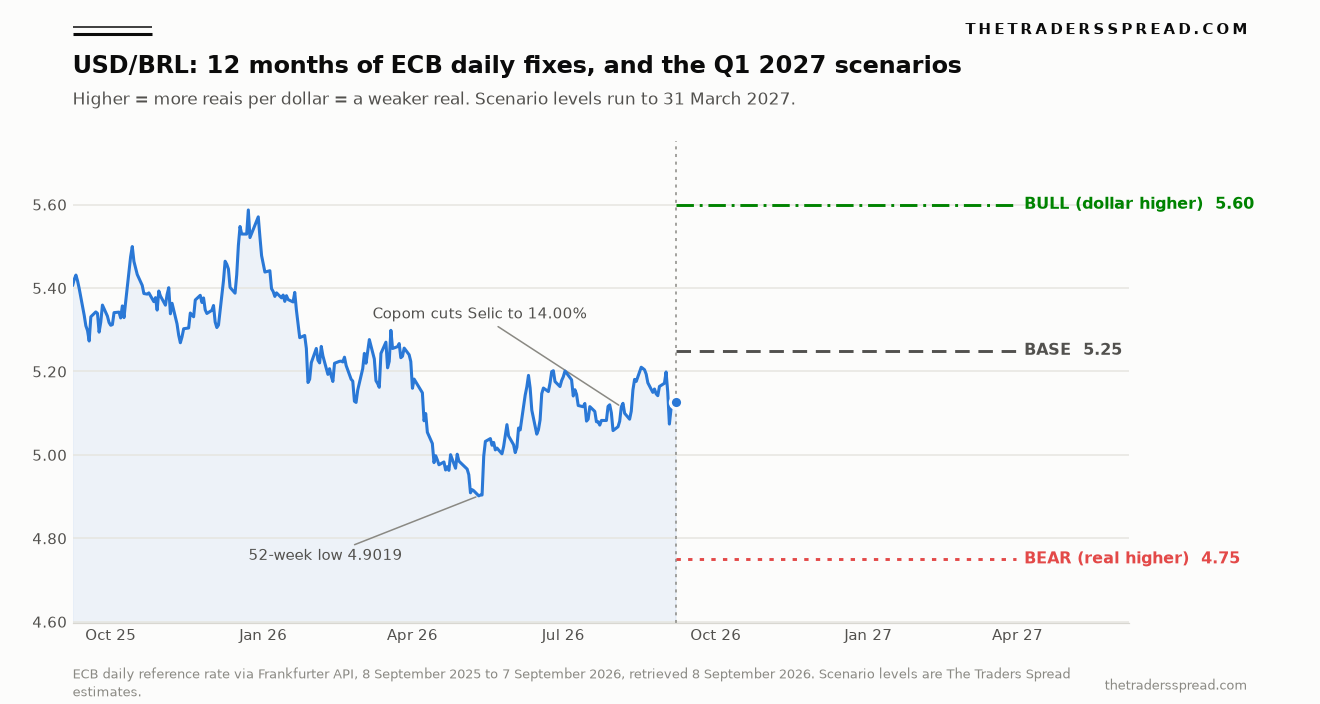
Direction, stated plainly. A bull case in USD/BRL means the dollar goes up and the real goes down: more reais per dollar, a higher number on the screen. A bear case means the opposite, a stronger real and a lower number. Our horizon is six months, to 31 March 2027, which covers the first round, the runoff, the inauguration and the new government's first quarter.
Base case, 5.25, roughly 45%. Copom cuts to 13.75% on 16 September and then holds through November, December and January, exactly as Focus expects. The carry keeps paying but stops widening. USD/BRL drifts up with the differential without reaching the 5.39 that flat carry implies, so a long-real position still earns something. Range of 5.05 to 5.40 for most of the period.
RelatedNZD/CAD Forecast: 0.8320 Bull Case vs 0.7680 Bear Case
Bull case, 5.60, roughly 30%. The dollar higher. A contested second round, or a winner whose first fiscal signal disappoints, pushes the BCB's ten-working-day FX assumption toward 5.40 and forces the committee to abandon the cut it has all but promised. Debt above 84% of GDP does the rest. The level is a shade under the 5.5872 fix of 23 December 2025, so this is a return to last year's high rather than a break of it.
Bear case, 4.75, roughly 25%. The real higher. A clean first-round or early-runoff result, a 2027 budget that passes without its primary target being gutted, and IPCA holding under the 4.5% ceiling as it did in July. The near-nine-point real differential then does what it did in April, when the pair reached 4.9854 on the day of a Copom decision and later printed a 4.9019 low on 11 May.
What would change our mind. A Copom hold on 16 September rather than the priced cut, signalling that the committee sees its currency assumption drifting and will trade growth to stop it. A downgrade or negative outlook change from any major agency on the effective-surplus arithmetic. Or the −0.155 correlation flipping positive with real magnitude, which would say the election has finally entered the exchange rate and everything above needs rebuilding around a different driver. The thesis is invalidated on a sustained close through 4.90, the 11 May low; 4.75 is where the bear case lands after that break, not before it.
Frequently asked questions
Which USD/BRL rate is quoted in this article?
The headline 5.1261 is the European Central Bank's daily reference fix for 7 September 2026, retrieved on 8 September through the Frankfurter API. It is a once-a-day published reference rate, not a dealable price. Where a Brazilian onshore rate is needed we use the BCB's PTAX selling rate, 5.1253 on 4 September 2026; there was no PTAX on 7 September because of Brazil's Independence Day.
Does a USD/BRL bull case mean good news for Brazil?
No, and the wording trips people up constantly. USD/BRL is quoted as reais per dollar. A rising number means the dollar is buying more reais, which is a weaker Brazilian currency. Our 5.60 bull case is a call on dollar strength and real weakness. The 4.75 bear case is a stronger real, which is generally the friendlier outcome for Brazilian importers and for the country's inflation path.
Why is the carry differential so large?
The Selic target sits at 14.00% after a 100 basis point easing cycle that began in March 2026 from a 15.00% plateau held since June 2025. The Fed's effective rate was 3.63% on 3 September 2026. The 10.37-point gap reflects a Brazilian inflation problem that has only recently come back inside the target band and a central bank that has told the market, in paragraph 9 of its August minutes, that deanchored expectations require "greater monetary restriction for a longer period than would be otherwise appropriate".
What happens to the real if the October election goes to a runoff?
On the evidence of the past three months, less than most commentary assumes. The measured correlation between daily moves in Polymarket's Lula probability and daily moves in USD/BRL is −0.155 since 1 June, which explains 2.4% of the variance. A runoff on 25 October would extend the uncertainty by three weeks without changing the rates arithmetic. The larger currency risk sits in the first budget the winner defends, not in the count.
When is the next Copom decision, and what is priced?
The 281st meeting runs 15–16 September 2026, with minutes due on 22 September. The Focus survey of 28 August put the median expectation for that meeting at 13.75%, from 143 respondents, implying one more quarter-point cut. The same survey has 13.75% at the November and December meetings and at the January 2027 meeting, with 13.50% not arriving until March 2027. Four holds across the entire political transition.
How was the correlation figure calculated?
We took the daily midpoint history for the Lula leg from Polymarket's CLOB price API, matched it to Brazilian business days on the BCB's PTAX selling series, and ran the Pearson correlation between the daily change in implied probability and the daily log change in USD/BRL: −0.155 over 67 observations from 1 June and −0.257 over 24 from 1 August, both computed on 8 September 2026.
Disclaimer
This article is analysis and information, not investment advice, and it is not a recommendation to buy or sell any currency, contract for difference or other instrument. Scenario levels are estimates published for discussion and carry no guarantee. Currency and CFD trading involves significant risk and capital is at risk. Figures are accurate as of 8 September 2026 and market conditions change. Readers should conduct their own research and consider their own circumstances before making any financial decision.