

Coffee samples were pulled this winter from four places in Brazil: southern Minas Gerais, Matas de Minas, Cerrado Mineiro and northern Espírito Santo. A StoneX field team processed them, ran a yield study against them, and used the result to validate a number it had been carrying since March. The revised number landed on 2 September 2026: 77.2 million bags, the largest Brazilian coffee crop ever recorded, 23.9% above the 62.3 million bags of 2025/26 and 14.2% above the previous all-time high of 67.6 million set in 2020/21. New York took it badly. The December Arabica contract on ICE fell 3.7% that session to 298.10 US cents a pound, its first close under three dollars since late June, and by Friday's settlement it was at 295.60 cents. Measured from the 24 August high of 341.65, coffee has given up 13.5%.
Here is the part that has not been priced, and arguably cannot be. In the same week that the biggest crop in Brazilian history was confirmed, ICE certified Arabica stocks printed 223,911 bags on 1 September, their lowest in more than a quarter of a century. Those two facts do not offset each other. One describes how much coffee exists; the other describes how much coffee is sitting in an exchange-licensed warehouse, graded, tendered and available to settle a futures contract tomorrow. A record harvest fixes the first problem over months. It does nothing for the second this week, and the reference price the physical trade actually writes contracts against has gone strangely quiet while the risk underneath it has not: the ICO composite averaged 287.29 US cents in August against 287.26 in July, a month-on-month change of three hundredths of a cent, inside a month that ran from 301.97 down to 279.38 in three sessions.
Key facts
- ICE Coffee "C" December 2026 settled at 295.60 US cents/lb, down 13.5% from the 24 August high of 341.65 — ICE Futures U.S. settlement data, 4 September 2026; August range per Comunicaffè, 2 September 2026
- StoneX put Brazil's 2026/27 crop at a record 77.2 million bags, 23.9% above 2025/26's 62.3 million and 2.6% above its own March estimate — StoneX, reported 2 and 4 September 2026
- Brazilian Arabica alone is 51.8 million bags, up 41.9% year on year and an all-time high; Robusta slipped to 25.4 million from 25.8 million — StoneX, 4 September 2026
- ICE certified Arabica stocks fell to 224,011 bags on 28 August, their lowest since May 2000, and 223,911 by 1 September — Reuters citing ICE data, 28 August 2026; Comunicaffè, 2 September 2026
- The ICO composite indicator averaged 287.29 US cents/lb in August against 287.26 in July, while trading between 301.97 on 25 August and 279.38 on 27 August — ICO daily indicator prices, retrieved 5 September 2026
- ICE Futures U.S. lifted the Coffee C September-contract outright margin from US$5,685 before July to US$21,116 on 9 July, then cut it to US$14,606 on 24 July — ICO Coffee Market Report, July 2026
- Vietnam shipped 1.33 million tonnes, or 21.17 million bags, in the first eight months of 2026, up 13.7% by volume but down 8.6% by value — Comunicaffè, 4 September 2026; Vietnamese agriculture ministry data
The number, and how it was built
StoneX did not simply mark its March forecast to the weather. The revision was the output of a field survey run through the whole harvest window, plus a separate yield study in which samples from the four regions above were processed and analysed to check whether the trees were actually delivering what the earlier count implied. They were, and by more than expected. The March projection went up 2.6%, with Arabica taking 1.6 million bags of the increase and Robusta roughly 300,000.
The composition matters more than the headline. Arabica at 51.8 million bags is not merely a big year in a two-year cycle; it exceeds the 2020/21 record by 4.2 million bags and represents a 41.9% jump on the previous crop. Robusta, at 25.4 million, is fractionally below the 25.8 million record set in 2025/26. So the whole of the increase, and then some, sits in the coffee group that New York prices.
Bean filling ran under favourable conditions, which is where the yield came from. The out-of-season rains that fell across the harvest are a separate matter, and StoneX has not netted them off, saying the effect on cup quality remains to be assessed. That caveat is doing quiet work.
The warehouse that did not fill
A record crop that cannot be graded is not, for futures purposes, a record crop.
The International Coffee Organization flagged the divergence in its July 2026 Coffee Market Report: US certified Arabica stocks fell 30.0% over the month to 0.29 million bags, the lowest since January 2024, while London certified Robusta rose 2.5% to 0.69 million. Since then the New York pile has kept draining. ICE data had it at 224,011 bags on 28 August, the lowest since May 2000, and Comunicaffè put it at 223,911 by 1 September. The useful comparison is not last year. Exchange stocks generally ran between one million and five million bags from the mid-2000s until early 2022.
Three things bridge the gap between a Brazilian record and an empty grading floor. The first is quality. ICE certification is not a weight test; coffee has to pass a cup and defect standard, and a crop harvested through unusual wet, with uneven maturation from multiple flowering cycles, throws off a higher share of beans that will not certify. The second is logistics; a bag in a truck queue at Santos is not a bag in an Antwerp warehouse. The third is economics. When the front of the curve is bid relative to deferred months, nobody pays to carry coffee into a certified warehouse; they sell it into the spot market instead.
CEPEA, the agricultural economics centre at the University of São Paulo’s ESALQ campus, put it bluntly. Its late-August survey found the arabica harvest at roughly 90% of area in southern Minas Gerais, 85 to 90% in the Cerrado Mineiro and about 97% in the Zona da Mata, all behind the same point in 2025. The delay came from above-average winter rainfall which, in CEPEA’s reading, also impaired cup quality: the 2026/27 crop is expected to be one of the poorest-quality crops of recent years, with a high incidence of coffees grading below standard. Shipments opened the season strongly: Cecafé, the Brazilian exporters’ council, recorded 3.03 million bags exported in July 2026, up 9.9% on July 2025, draining the same physical pool that certification competes for.
Reuters, reporting the 28 August print, tied both ends together. El Niño-linked heavy rains in Brazil in June and July delayed the harvest and hurt quality, limiting in the near term the volume of high-grade beans eligible for certification as exchange-tradeable stock. The same report found Brazilian growers under no pressure to move what they hold: they are well capitalised, the logistics backlog is real, and Brazil is one of the cheapest places on earth to store coffee. “The nearby market has delivered a clear message: coffee available somewhere is not necessarily coffee available here, now, in deliverable form,” wrote the broker and consultant Michael J Nugent in a note quoted by Reuters.
What set palladium's price in late August was not mine output but a single Montana strike pulling deliverable metal off the board. The binding constraint in coffee is no longer what Brazil grew; it is what will pass a grader.
Safras & Mercado had the 2026/27 Brazilian harvest 97% complete as of 26 August, and puts national production at 75.65 million bags, of which 49.95 million Arabica and 25.7 million Robusta. That is a second independent count in the same neighbourhood as StoneX's, which is worth something: the two consultancies disagree by about 2%, not by a crop.
What the monthly average is hiding
Look at the ICO composite indicator price on a monthly chart and August 2026 barely happened.
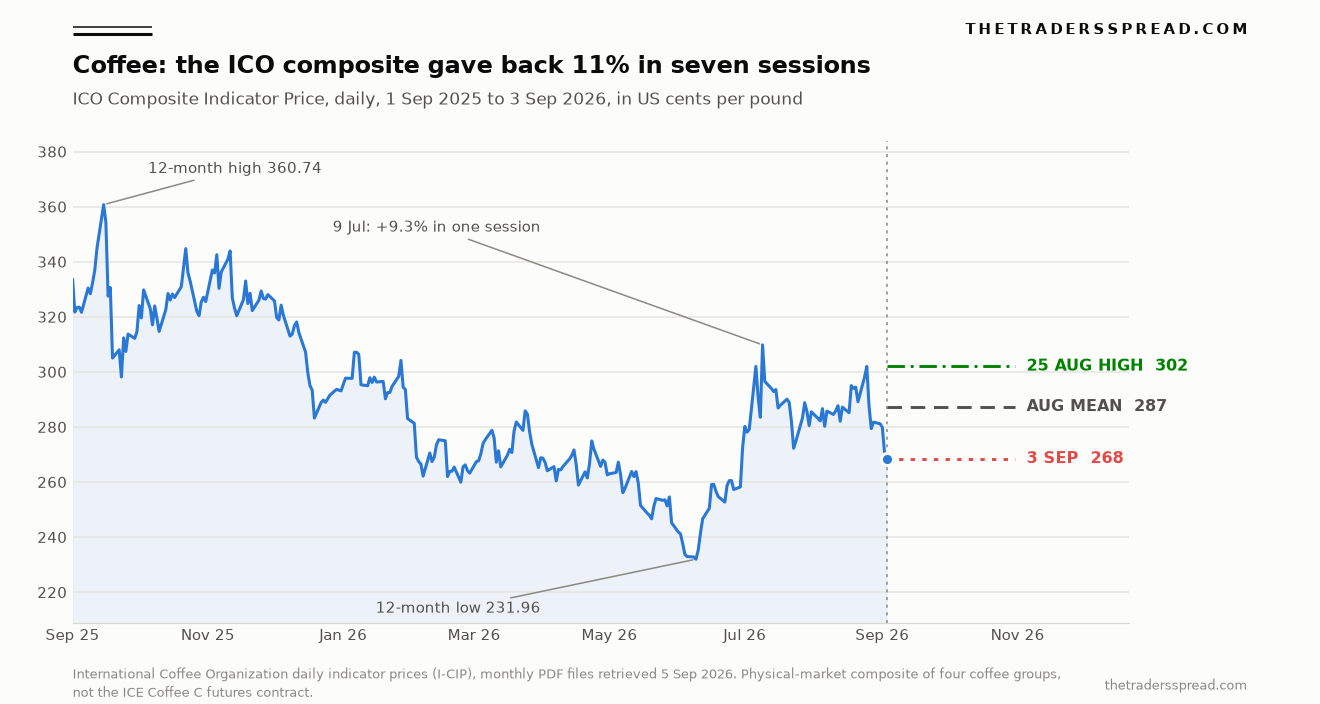
The August mean was 287.29 US cents a pound. The July mean, as published by the ICO, was 287.26. A trade that settles differentials against a monthly average would read those two numbers and conclude that nothing moved. Inside the month, the composite hit 301.97 on 25 August and 279.38 two sessions later on 27 August: a 22.59-cent range, or 7.5% of the mean, compressed into three trading days. By 3 September it was at 268.38, down 11.1% from the August high in seven sessions.
| Month | ICO composite average (US cents/lb) | Change on prior month |
|---|---|---|
| April 2026 | 266.24 | -2.7% |
| May 2026 | 256.05 | -3.8% |
| June 2026 | 248.90 | -2.8% |
| July 2026 | 287.26 | +15.4% |
| August 2026 | 287.29 | +0.0% |
| 1–3 September 2026 | 272.90 | -5.0% |
Source: International Coffee Organization daily indicator price files, retrieved 5 September 2026. September figure covers three sessions only.
The wider frame is stranger still. Coffee is 15.7% above its 9 June low of 231.96 and 25.6% below its 15 September 2025 high of 360.74, both true on the same day. A market simultaneously in violent recovery and deep annual drawdown is one where two groups work from different reference points, which is exactly when liquidity thins and gaps open.
Margin, liquidity and the July precedent
July gave a preview of what happens when position risk meets a thin book. On 6 July the ICO composite rose 8.2% in a session to 301.98, its largest daily gain since 22 July 2021. Three sessions later, on 9 July, it added 9.3% to 309.80. That was the biggest one-day increase since 15 November 2004. Two of the largest daily moves in 21 years, four sessions apart, in a physical composite that by construction moves less than any individual futures contract.
Positioning explains the abruptness. ICE Futures U.S. responded to the risk by raising outright initial margin on the Coffee C September contract from US$5,685 before July to US$14,715 on 6 July and US$21,116 on 9 July, a 3.7-fold increase inside a week, before easing it to US$14,606 on 24 July. Higher margin protects the clearing house. It also forces leveraged participants to post collateral or cut, and a wave of margin calls into an already-thin order book amplifies whatever direction the tape was already going. Intraday volatility on the ICO composite averaged 15.0% in July, up 6.4 percentage points on June; on the New York futures market it hit 22.9%, up 13.3 points.
That machinery has not been dismantled. Margin sits well above its pre-July level, certified stocks are lower than they were when the July squeeze fired, and the December contract has just lost 13.5% from its August high. The same conditions that produced two of the biggest up-days in two decades are in place for the reverse.
Robusta is telling a different story
The break has not been symmetric, and the asymmetry is the tell.
Between 25 August and 3 September the ICO's Brazilian Naturals indicator fell 12.7% and Other Milds 12.1%, while Robustas fell 7.4%. London's November Robusta contract came off a $3,884 high on 5 August to $3,374 on 3 September, a 13.1% decline, but from a base that had never joined the July melt-up in the first place. The Colombian Milds–Robustas differential, which the ICO measured at 198.61 cents in July after a 28.0% one-month expansion, reached 232.27 cents at the 25 August peak and was back at 199.85 by 3 September. That entire spread is Arabica-specific risk premium, and it is deflating.
Supply explains most of it. Vietnam shipped 1.33 million tonnes in the first eight months of 2026, equivalent to 21.17 million bags and up 13.7% on the same period of 2025, for around $6bn, a value down 8.6% year on year. More coffee, less money. Global Robusta green-bean exports in the coffee year to June ran at 36.51 million bags against 33.78 million. Meanwhile the Arabica share of green-bean exports over the first nine months of coffee year 2025/26 fell to 60.4% from 63.7%. Roasters who reformulated blends during the 2025 Arabica spike have no obvious reason to reformulate back at 295 cents.
Anyone who followed the gold–silver ratio through August knows the shape: a spread widens on a scare in one leg, then mean-reverts faster than either outright leg moves.
What this changes
The flat-price anchor has moved. A 77.2 million bag Brazilian crop with 51.8 million bags of Arabica in it resets what "normal" means for the 2026/27 marketing year, and the market spent Wednesday through Friday last week repricing to it. That part is done, or mostly done.
RelatedRubber TSR 20 Rises 8.3% in a Month to 264.8 Cents
What has not been resolved is the mismatch between abundance and deliverability, and this is where the second-order effects sit. The curve is already showing it. Reuters had front-month September Arabica at a premium of about 32 cents a pound over December on 28 August, a backwardation that says the market will pay up for coffee now and expects the shortage to ease later. A record crop does not flatten that shape; certification does. Roasters running hand-to-mouth coverage into a record harvest may find that the coffee they can actually buy at a differential they like is scarcer than the headline suggests, particularly for the higher cup grades that the wet harvest is most likely to have thinned out.
A Reuters poll puts the 2026/27 global coffee surplus at 8.2 million bags against 1.7 million the season before, so the balance sheet itself is not in dispute. Where that surplus physically sits is. “The pace of stock replenishment in destination markets (is key),” Hedgepoint analyst Laleska Moda told Reuters on 28 August. “If the (expected) surplus remains concentrated in origin countries, price volatility could persist as producers retain greater bargaining power.” A surplus parked in Brazilian warehouses is not the same asset as a surplus in Antwerp.
Three things to watch. First, the certified-stock series itself: a rebuild off the 223,911 low would confirm that the Brazilian crop is passing grading and would take the last structural leg out from under Arabica; continued drawdown says the quality damage is real. Second, the post-harvest quality assessments StoneX flagged as pending — those numbers will arrive within weeks and will tell the trade how much of the record crop is certifiable. Third, Brazilian flowering for 2027/28, which El Niño has already pulled forward into August with above-normal rainfall; StoneX expects conditions to support a good main flowering, with January to March temperatures the swing factor, and an off-cycle Arabica year partly offset by area expansion and replanting with higher-yielding varieties.
Freight is the variable nobody puts in a crop model. The ICO attributed part of April's price action to the closure of the Strait of Hormuz, which it said pushed crude 55.8% and shipping freight costs 43.6% higher. Renewed US strikes on Iran took WTI to $91 in the first days of September, putting the same channel back in play. A record crop in Brazil is only a bearish fact once it has arrived somewhere else.
There is a currency leg too, and it is the one most often ignored. Brazilian growers sell in dollars and bank in reais, so the real's path against the dollar changes farmgate economics and therefore the pace at which a record crop actually gets sold, independently of anything the ICE screen does. With Brazil's presidential race now a live macro input, that channel is unlikely to stay quiet.
FAQ
Why did coffee fall if certified stocks are at a 26-year low?
Because certified stocks and total supply are different quantities. Certified stocks measure coffee already graded and sitting in an exchange warehouse, ready to settle a futures contract. Total supply measures what exists. StoneX's 77.2 million bag Brazilian estimate raised the second number sharply while doing nothing immediate for the first. Futures price the balance of both, and in the first week of September the crop number won.
Is the ICO composite the same as the ICE Coffee C price?
No. The ICO Composite Indicator Price is a physical-market index blending four coffee groups — Colombian Milds, Other Milds, Brazilian Naturals and Robustas — so it includes Robusta and moves less violently than any single futures contract. The chart above plots the composite, not the futures. On 3 September the composite was at 268.38 US cents while December Arabica futures settled near 295 cents.
How unusual was the July 2026 move?
Very. The composite rose 8.2% on 6 July, its biggest daily gain since July 2021, then 9.3% on 9 July, the biggest since November 2004. Those were the two largest daily increases in 21 years and they happened four sessions apart. ICE raised Coffee C margin requirements 3.7-fold in the same week, which the ICO identified as a contributor to the thin liquidity behind the swings.
Does a record Brazilian crop mean cheaper retail coffee?
Not directly, and not quickly. Green coffee is a minority of the cost of a packaged retail bag or a café cup, roasters hedge and buy forward on multi-month cycles, and the grades that go into speciality blends are the ones most exposed to the quality damage from Brazil's wet harvest. Green-price falls tend to reach shelves with a lag measured in quarters, and incompletely.
What would signal the Arabica risk premium is rebuilding?
Two things together: certified stocks continuing to fall through the 223,911 bags reported on 1 September while the December–March spread tightens, and the Colombian Milds–Robustas differential turning back up from the roughly 200-cent level it reached on 3 September. Either alone can be noise. Both at once would say the market has decided the record crop is not deliverable coffee.
Disclaimer
This article is analysis and information, not investment advice, and nothing in it is a recommendation to take any position in coffee futures, options, ETNs or any other instrument. Commodity markets carry a high risk of loss, leverage magnifies that risk, and capital is at risk. Figures are as published by the sources named and dated above and may be revised.